War · United Kingdom · US Air Force
Suspected RAF Lakenheath drone activity on Friday evening sent US personnel at the Suffolk base to shelter, in the second security incident in a week at the American bases in the east of England — and by the time the all-clear came, officials had confirmed only that nobody and nothing was harmed, and almost nothing else.
Track it live: https://signalpostnews.com/tracker/wars
LAKENHEATH, Suffolk, November 13, 2026 — US personnel at RAF Lakenheath were ordered to shelter in place on Friday evening after suspected unauthorised drones were reported over the base, the largest US Air Force–operated station in Britain. The RAF Lakenheath drone activity drew a response from the base’s own security forces and ended, according to the only official account published so far, without harm to anyone or anything on the ground. “This evening, USAF Security Forces personnel responded to suspected unauthorised drone activity over RAF Lakenheath,” a US Air Force spokesperson told Reuters. “No personnel, aircraft or infrastructure were affected.” The incident began at about 5:30 p.m. local time on Friday, November 13, as darkness fell over the Suffolk countryside around the base. Sky News reported that it had seen a shelter-in-place alert issued to base personnel and headed, in capital letters, “REAL WORLD” — the marking used to distinguish a genuine incident from an exercise. The Air Force statement, notably, covers RAF Lakenheath only. It names no drone, counts no drone, identifies no operator, and attributes nothing to anyone. Everything in this article beyond that short statement is labelled for what it is: local reporting, an MP’s account of what the base told him, or context from a week in which these bases were already on edge.
That discipline matters, because Friday’s facts are thin and the temptation to thicken them is strong. No drone has been confirmed identified. None has been reported recovered. No official has said how many objects, if any, were seen, how long the activity lasted, or whether what was reported over the base was hostile, careless or mistaken. The Air Force statement is careful to say “suspected” — and suspected is where the public record, for now, stops. What can be reported is what the response looked like from inside and outside the fence, what the area’s member of Parliament says he was told, and why a report of small, unidentified objects over a Suffolk runway was enough, four days after an emergency security raise at the same bases, to send thousands of people indoors.
What residents reported: sirens over Lakenheath and Feltwell
Outside the perimeter, the incident was heard before it was understood. Residents near RAF Lakenheath and in the nearby village of Feltwell reported hearing sirens and loudspeaker announcements on Friday evening, in local reporting carried through the Daily Mail’s reporting chain and echoed in social-media posts from the area. Feltwell sits close to the base’s southern edge and is home to many American service families; its residents are used to the sounds of a working fighter base, and a base-wide announcement system is not one of the ordinary ones. The reports described the kind of public-address warnings that accompany a shelter order — instructions, audible beyond the fence, to stay inside.
Those accounts need their attribution kept firmly attached. The siren and loudspeaker reports are local and social reporting only. They have not been confirmed by the US Air Force, and they are not covered by the Air Force statement, which addresses RAF Lakenheath alone. Some local accounts also mentioned activity around RAF Mildenhall, the sister base a few miles away that hosts US tanker and special-operations aircraft. No official statement on Friday said anything about Mildenhall, and this article treats the Mildenhall and Feltwell reports as what they are: unconfirmed accounts from people who live beside these bases, published because residents hearing sirens is itself part of the event — and labelled as unconfirmed because, on the record available, that is what they are.
The all-clear: the MP, and the questions nobody answered
The first public reassurance came not from the military but from the constituency’s member of Parliament. Nick Timothy, the MP for West Suffolk, said base authorities had told him there was no threat to the public and that the incident was resolved. That account — a local MP relaying what the base told him — was the closest thing to an all-clear issued on Friday night: the shelter order lifted, the response stood down, the surrounding villages in no danger. It also marks the boundary of what officials were willing to say. The UK Ministry of Defence was not immediately available to Reuters for comment, and no British authority published a statement of its own on Friday evening.
The list of what officials have not said is longer than the list of what they have. They have not said what was actually seen, or by whom, or on what sensor. They have not said whether any object was tracked leaving the area, intercepted, jammed or brought down. They have not said whether the activity resembled the sightings reported over American bases in England two years ago, or something new. And they have not said whether Friday’s response is connected in any way to the security measures imposed at the same bases four days earlier. Readers should hold that last point precisely: no official has linked Friday’s suspected drone activity to any country, group or earlier threat report, and nothing in the public record establishes such a link. What happened on November 9 is context for the posture the bases were in on Friday — it is not, on any evidence published so far, an explanation for Friday.
Why this matters
The second security incident at these bases in a week
Friday’s alert did not arrive at a base at rest. On Monday, November 9, the United States raised security at RAF Lakenheath and RAF Mildenhall and moved aircraft out of Mildenhall — more than a dozen of them, on the reporting of Sky News and the Wall Street Journal — amid a reported Iran-linked threat to the bases. US bombers were moved to RAF Fairford in Gloucestershire as part of the same dispersal, a precaution this newsroom covered in its reporting on the RAF Fairford Iran plot case. The Wall Street Journal and The War Zone reported that the force protection condition at the bases was raised to FPCON Charlie, the third of the US military’s five alert levels, applied when an incident occurs or intelligence indicates some form of hostile action is likely. Those measures were a response to a specific reported threat, assessed at the time. They are the background against which Friday’s far smaller report — suspected drones, origin unknown — landed on a base already braced, and they explain the speed and scale of the response without explaining the incident itself.
Alongside the posture change came law. Emergency regulations that took effect at 5:40 p.m. on November 9 ban unauthorised unmanned aircraft flights below 1,200 feet within five nautical miles of RAF Lakenheath, RAF Mildenhall and RAF Feltwell. The zone is wide — it covers villages, farmland and roads well beyond the fences — and it converted what would ordinarily be a rules breach by a hobbyist into a prohibited act inside a protected area around three sensitive sites. If the objects reported on Friday were drones, they were flying where drones have been explicitly banned for four days. If they were not drones, the ban is still the frame through which any report is now handled: at a base under an elevated alert, inside airspace closed by emergency order, an unidentified object overhead is treated as a security incident until it is proved ordinary, not the other way round.
The base at the centre of it
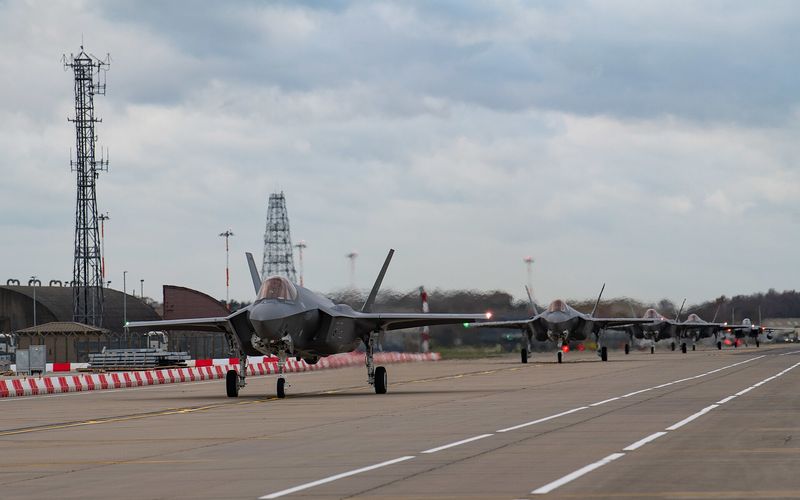
RAF Lakenheath is not a quiet station. It hosts the US Air Force’s 48th Fighter Wing — the Liberty Wing — with roughly 7,000 personnel, and it is the largest USAF-operated base in the United Kingdom. Its squadrons fly the F-15E Strike Eagle and the F-35A Lightning II, making it the principal home of American land-based tactical airpower in Europe and one of the most consequential allied airfields on the continent. That is why things are moved there, why other things are moved away from the region’s bases when threats are reported, and why a shelter order there is news: the base exists to generate combat sorties at short notice, and anything that stops its people moving freely around it — even for an evening, even as a precaution — touches the readiness the whole posture is built on. The aircraft on its ramps are among the most capable, and most expensive, machines the alliance owns; the statement’s insistence that no aircraft were affected is the sentence the Pentagon will have cared about most.
The 2024 precedent, and the attribution problem that will not go away
None of this is without precedent. In November 2024, unexplained drones were reported over US bases in England in a series of sightings that drew British military support to the American investigation and were never publicly resolved: no operator was named, no aircraft was produced, and no conclusion was published. Friday’s incident follows the same shape — a report, a response, a short statement, and then a silence in which every theory fits because no evidence excludes any of them. That shape is now familiar across Europe’s airfields: this newsroom’s coverage of the drone alert that closed Vilnius airport’s runway and scrambled NATO jets described the same sequence on the alliance’s eastern flank, and the same unresolved ending.
The reason these incidents resist resolution is structural, and it is worth stating plainly. A small drone is cheap, quiet, slow, low and made of materials radar was not designed to see. Detecting one is hard; identifying one — model, owner, intent — is harder; and proving who sent it, to the standard a government needs before it accuses another state, is hardest of all. The same object can be a lost hobby aircraft, a journalist’s or spotter’s quadcopter flown in ignorance or defiance of a four-day-old ban, a deliberate probe flown to watch the base’s response and time it, or a genuinely hostile reconnaissance. Each possibility demands a different answer, and on Friday night officials could not publicly distinguish between any of them. The defensive problem is just as asymmetric as the evidential one: the tools for stopping a small drone over a crowded allied base — jamming, nets, guns, interceptor drones — each carry their own risks to the aircraft, people and villages around the fence, which is why the first and often only tool actually used is the one used on Friday: get everyone under cover, secure the aircraft, and wait.
Shelter-in-place is therefore best understood not as panic but as doctrine working as designed — and that is precisely the uncomfortable conclusion. If an unidentified object that may not even be a drone can halt a flagship fighter base for an evening, at trivial cost to whoever sent it if anyone sent it at all, then the tactic works whether or not it was a tactic. Friday’s incident, arriving four days after an emergency security raise and inside freshly banned airspace, will be read in Washington and London as a test of exactly that proposition — even though, on the evidence officials have released, it cannot yet be read as anything more than a report, a response and an all-clear.
What happens next
The immediate sequel is an investigation shared, in some proportion neither side has described, between the US Air Force’s security and investigative arms and British authorities — the base is American-operated but sits in Suffolk, under British law and British airspace rules, and the emergency flight restrictions are a UK instrument. Investigators will work the sensor record first: what was detected, on which systems, for how long, and on what track. Whether any of that is ever published is another matter; after the 2024 sightings, it largely was not.
Three decisions will show how seriously the incident is being taken behind the fence. The first is whether the emergency UAV restrictions around Lakenheath, Mildenhall and Feltwell — imposed on November 9 alongside the wider security raise — are extended, widened or allowed to lapse, and whether enforcement follows: a prosecution of a careless hobbyist, if Friday’s objects prove to have been one, would tell residents more about the night than any statement has. The second is whether the elevated force protection posture at the bases holds, deepens or quietly steps down, and whether the aircraft dispersed from Mildenhall on November 9 complete their return. The third is whether either government chooses to say, eventually, what it believes the objects were. After 2024, the pattern was to say nothing and let the story die; the difference this time is that the story began at bases already on alert, in a week when the threat reporting around them was specific and public.
For now, the established record of Friday, November 13, is short enough to state in full. In the early evening, USAF Security Forces at RAF Lakenheath responded to suspected unauthorised drone activity over the base. A shelter-in-place alert headed “REAL WORLD” was issued to personnel, Sky News reported. Residents near Lakenheath and Feltwell reported sirens and loudspeaker announcements, in unconfirmed local reporting. The area’s MP said the base told him there was no threat to the public and the incident was resolved. No personnel, aircraft or infrastructure were affected. The Ministry of Defence had no immediate comment. No drone has been confirmed, counted, recovered or attributed — and until officials say more, suspected is the word that carries the whole story.
Related coverage: RAF Fairford Iran Plot: British-Iranian Arrested as Burnham Points at Tehran · Vilnius Airport Drone Alert Closes Runway, Scrambles NATO Jets
Sources
- Reuters, November 13, 2026 — the US Air Force spokesperson’s statement: “This evening, USAF Security Forces personnel responded to suspected unauthorised drone activity over RAF Lakenheath. No personnel, aircraft or infrastructure were affected”; and the report that the UK Ministry of Defence was not immediately available for comment.
- Sky News, November 13, 2026 — the shelter-in-place alert headed “REAL WORLD” issued to base personnel, which Sky News reported it had seen; and, with the Wall Street Journal, the November 9 reporting that the US raised security at RAF Lakenheath and RAF Mildenhall and moved more than a dozen aircraft out of Mildenhall amid a reported Iran-linked threat, with US bombers moved to RAF Fairford. The Wall Street Journal and The War Zone reported the force protection condition raised to FPCON Charlie.
- Local reporting via the Daily Mail reporting chain, November 13, 2026 — residents near RAF Lakenheath and Feltwell reporting sirens and loudspeaker announcements on Friday evening. These accounts are unconfirmed local and social reporting; they are not covered by the US Air Force statement, which addresses RAF Lakenheath only.
- Nick Timothy MP, November 13, 2026 — the West Suffolk MP’s account that base authorities told him there was no threat to the public and the incident was resolved.
- Emergency airspace regulations, effective November 9, 2026 (17:40) — the ban on unauthorised unmanned aircraft flights below 1,200 feet within five nautical miles of RAF Lakenheath, RAF Mildenhall and RAF Feltwell.
- US Air Force and 48th Fighter Wing background — RAF Lakenheath hosts the 48th Fighter Wing with about 7,000 personnel and is the largest USAF-operated base in the United Kingdom; and the November 2024 precedent of unexplained drone sightings over US bases in England, which was never publicly attributed.