Vilnius airport drone alert

VILNIUS — The Vilnius airport drone alert shut Lithuania's main international airport for less than an hour Saturday and sent NATO Baltic Air Policing fighters into the air after authorities received a report of an object approaching from the direction of Belarus. The National Crisis Management Centre issued a yellow air-danger warning at 09:48 local time and cancelled it at 10:34.
The object was never conclusively identified. Lithuanian crisis-management chief Vilmantas Vitkauskas told public broadcaster LRT that the observed parameters resembled a drone, but officials had not ruled out a flock of birds. Reports of a possible object moving beyond Vilnius toward Jonava were not confirmed. Authorities said checks were continuing.
That uncertainty is the central fact of the incident, not a footnote. A reported direction of travel is not proof of launch point, ownership or intent. No public evidence available Saturday established that the object was Russian, Belarusian, military or even an aircraft. The fighter scramble shows the track was treated as a potential danger; it does not settle what produced the track.
What happened during the Lithuania air danger alert
The National Crisis Management Centre's yellow warning covered Vilnius and nearby areas, with residents advised to be ready to take shelter. Civil aviation authorities temporarily closed Vilnius Airport while military and civilian sensors tried to clarify the contact. NATO fighters assigned to protect Baltic airspace took off to verify the report.
The public alert lasted 46 minutes. The airport interruption was similarly brief—Reuters reported that Vilnius was closed for less than an hour—before operations resumed. No strike, crash, debris field or damage was announced. Officials did not disclose a firm radar track, recovered wreckage, imagery or a confirmed flight path.
Those absences matter. A low, slow object can be difficult to classify from one sensor return. Ground clutter, weather, birds and small unmanned aircraft can produce ambiguous signatures, especially when a track appears intermittently. Optical confirmation can be harder still when visibility is poor or the object is distant. The operational system is therefore designed to move from detection to verification, not to wait for courtroom-level certainty before protecting a capital's airspace.
Why NATO jets scrambled over Lithuania
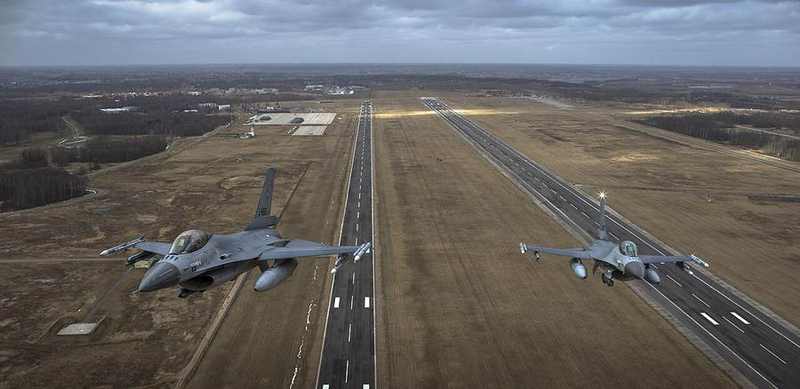
Baltic Air Policing exists because Lithuania, Latvia and Estonia do not maintain the fighter fleets required for round-the-clock interception. Since the three states joined NATO in 2004, allies have rotated aircraft and crews through bases including Šiauliai in Lithuania. Their quick-reaction aircraft can be ordered airborne when an unidentified track approaches or enters allied airspace.
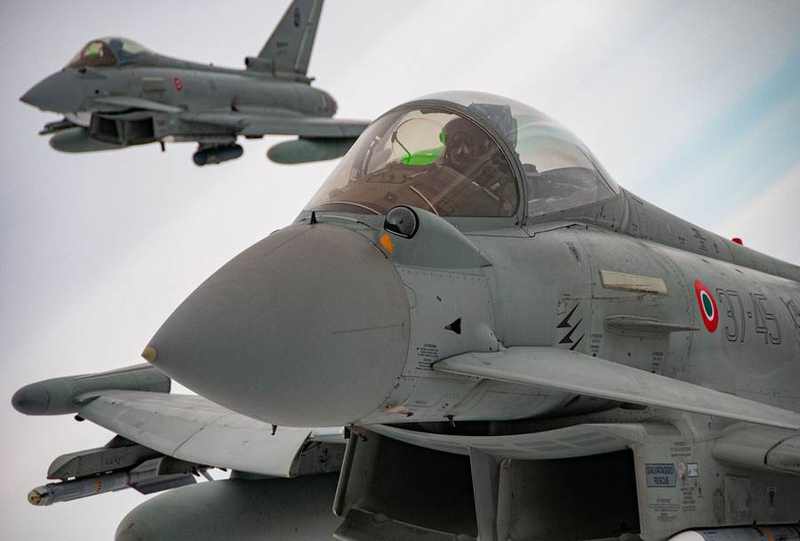
Italy took over the lead detachment at Šiauliai on July 31, 2026, with four Eurofighter Typhoons and more than 100 personnel, succeeding French and Romanian units. NATO has not publicly identified which aircraft flew Saturday's mission. The presence of Italian jets at the base makes them central to the current posture, but it would be premature to state that a particular aircraft or crew made this scramble without an official release.
The difference between air policing and air defence has narrowed as drones have changed the threat picture. On July 8, NATO agreed to upgrade the Baltic mission's role from identification and escort toward a broader air-defence mandate that can include destroying objects judged to threaten allied territory. That does not mean every unknown track is shot down. It means commanders have more options once sensors, rules of engagement and the risk to people on the ground point in the same direction.
A suspected drone from Belarus is a route, not an attribution
Lithuania shares a long eastern border with Belarus, a close Russian ally, and Vilnius lies roughly 30 kilometres from that frontier at its nearest point. That geography compresses decision time. An object moving west from the border can reach the capital region quickly, leaving authorities to choose between disrupting flights too often and reacting too slowly.
But “from the direction of Belarus” describes geometry. It does not establish where the object was launched, who controlled it or whether any state ordered the flight. Long-range drones can deviate because of malfunction, programming error or electronic warfare. Smuggling devices and balloons have also disrupted Lithuanian airspace. If Saturday's track proves to have been birds, the episode would be a false alarm rather than an incursion.
That distinction protects both accuracy and crisis stability. Calling an unidentified return a Russian or Belarusian attack before physical or electronic evidence exists could harden public expectations for retaliation. Understating a genuine incursion could invite repetition. The disciplined middle position is to describe what sensors and officials reported, preserve alternative explanations and update attribution only when investigators publish evidence.
The pattern: Gerbera drone Lithuania incident and false alarms
The alert came less than three weeks after a more serious case. On September 15, an Italian NATO fighter shot down a drone near Pratkūnai in Kaunas County. Lithuanian President Gitanas Nausėda said the wreckage appeared to be a Russian-designed Gerbera and was likely intended for a target in Ukraine before Ukrainian electronic warfare diverted it. The wreckage gave investigators physical evidence that Saturday's episode did not.
That engagement was the first suspected Russian-made drone destroyed by NATO's Baltic mission since air policing began in 2004. The wider picture is not limited to Russian systems: stray Ukrainian drones were shot down over Estonia in May and Latvia in June and August. Origin, operator and intent are different questions, and a drone can cross a border without its controller deliberately targeting the country it enters.
Lithuania also has recent experience with the opposite error. On September 13, Vilnius Airport closed and at least one NATO fighter launched after a suspected drone alert. Visual identification determined that the radar return was a flock of birds, and the airport reopened after 38 minutes. Saturday's officials explicitly kept that explanation open.
Taken together, the cases reveal why the phrase “drone over Lithuania” can cover very different events: a confirmed unmanned aircraft destroyed after crossing allied airspace, a civilian disruption caused by a false identification, or an unresolved track that disappears before visual confirmation. Treating all three as the same threat would distort the evidence; pretending the repeated alerts have no cost would ignore operational reality.
Who benefits, who loses and what critics will question
Residents and passengers pay the immediate cost
Passengers, airlines and airport workers lose time whenever a precautionary closure interrupts departures and arrivals. Residents receive shelter messages before officials can explain what triggered them. Even a short, justified alert can erode confidence if the public sees repeated warnings end without a clear answer. Authorities therefore have to publish enough detail to explain the decision while protecting sensor capabilities and an active investigation.
NATO gains readiness data—but reveals its reactions
Every scramble rehearses the chain linking civilian controllers, national crisis managers, radar operators and allied pilots. Crews gain experience identifying slow and low targets, while commanders can measure how quickly information moves. A hostile actor could also benefit by observing response times, patrol patterns and public communications. That is one reason officials may withhold precise sensor data even after the immediate danger has passed.
Critics will test proportionality and identification standards
One criticism is that closures and fighter launches impose large costs when the target might be wildlife. The counterargument is that waiting for perfect identification could leave too little time to intercept a weapon near a densely populated capital. The policy question is not whether false alarms can be eliminated; it is whether layered sensors, alert thresholds and communication protocols keep both missed threats and unnecessary disruptions acceptably low.
A second concern is cost asymmetry. A small drone can be far cheaper than the fuel, maintenance and interceptor weapons associated with a fighter response. That does not make fighters irrelevant—they carry sensors, speed and command authority—but it strengthens the case for lower-cost counter-drone systems around airports and critical infrastructure.
NATO Baltic air defence options before winter
The first option is better classification at the edge: connect military radars with airport surveillance, mobile counter-drone sensors, electronic-support systems and cameras so more tracks can be identified before they approach Vilnius. No single sensor is decisive. The value comes from fusing speed, altitude, radio-frequency emissions and optical evidence into one operating picture.
The second is a tiered response. Fighters remain necessary for fast, distant or high-consequence threats, but helicopters, ground-based jammers and short-range air-defence units may be better suited to small, slow drones when conditions allow. Lithuania's ongoing investments in mobile short-range systems are aimed at exactly that low-altitude layer, though deployment, training and rules of engagement determine whether hardware can protect civilian airspace safely.
The third is procedural: pre-agreed airspace restrictions, faster notification to airlines and clear shelter guidance can reduce disruption while preserving caution. Saturday's 46-minute warning suggests the system can stand down quickly when the evidence no longer supports an active danger. The harder test is whether authorities can explain an unresolved ending without turning uncertainty into either complacency or panic.
Winter will make the identification problem less forgiving. Short daylight, low clouds and poor visibility can impede visual confirmation, while seasonal bird movements and weather increase ambiguous returns. NATO and Lithuanian authorities may respond with more ground sensors around likely approaches, additional quick-reaction training and tighter coordination between Vilnius Airport and military command centres.
What happens next in the Vilnius airport closure investigation
Investigators will look for radar recordings, electronic emissions, photographs, witness reports and any debris along the suspected route. A sustained track with coherent speed and altitude would support the drone hypothesis. Multiple shifting returns, no radio signature and visual evidence of birds would point the other way. An absence of debris does not resolve the issue if the object left Lithuanian airspace or the original return was never physical.
Three scenarios remain credible. In the first, evidence identifies a real drone and allows authorities to reconstruct its route and probable origin. In the second, improved sensor analysis produces a benign explanation such as birds. In the third, the track remains unresolved—operationally important but unsuitable for confident attribution.
The most consequential development would be a pattern linking repeated approaches, common electronics or recoverable navigation data. That could justify changes in NATO patrols or diplomatic action. By contrast, a confirmed bird flock would support adjusting classification thresholds rather than escalating military posture.
For now, the narrow conclusion is also the most accurate: Lithuania reacted to a suspected airborne object, closed Vilnius Airport briefly and launched NATO fighters; the alert ended without a confirmed drone. The system acted on uncertainty. The investigation's job is to determine whether that uncertainty concealed a real incursion or reflected the unavoidable noise of watching a crowded, contested sky.
Sources and reporting notes
- Reuters: Lithuania closes Vilnius Airport and scrambles NATO jets over suspected drone (October 3, 2026)
- Informat.ro: crisis-centre account, shelter guidance and bird-flock possibility
- Travel and Tour World: 09:48 alert and 10:34 cancellation times
- Demócrata: Lithuanian alert details and September 13 bird-flock precedent
- Reuters: September Gerbera drone shot down over Lithuania
- Reuters: NATO upgrades Baltic air policing to air defence
- GlobalSecurity.org: Italy takes over the NATO air-policing rotation in Lithuania
Reporting note: Signal Post News distinguishes the reported direction of approach from origin and responsibility. Officials had not confirmed the object was a drone or attributed it to Russia or Belarus. Explanations of sensor limits, beneficiaries, costs and future NATO options are analysis.