The Russian president dismissed a proposed exchange of restraint between Ukrainian strikes on refineries and Russian strikes at sea and across Ukraine, closing one of the few narrow diplomatic openings in the expanding deep-strike war.
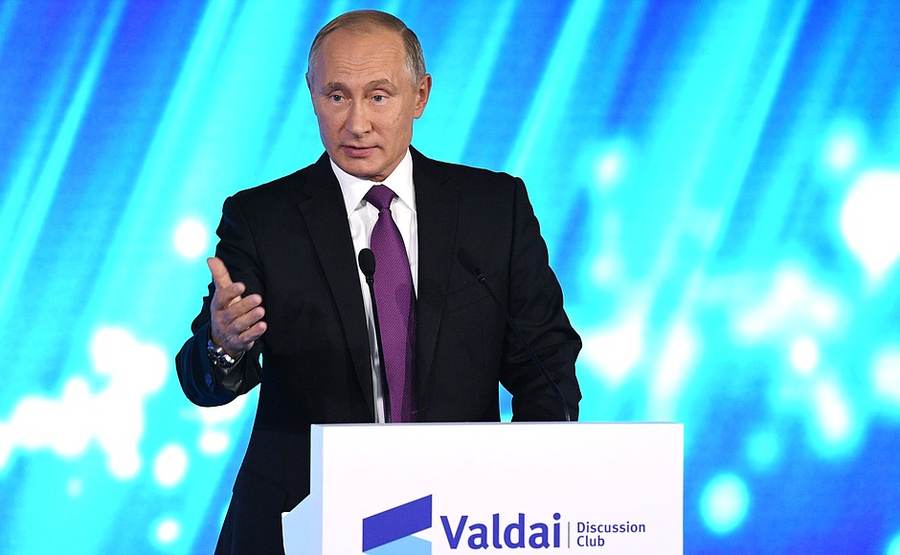
Putin rejects long-range strikes ceasefire proposals from Kyiv and Washington, leaving both Russia's energy network and Ukraine's industrial and transport systems inside an intensifying contest of attrition. At the Valdai Forum on Thursday, October 1, Russian President Vladimir Putin ruled out a mutual halt to long-range attacks and answered “No” when asked how Moscow would respond to the idea.
“We are told: 'Let them stop striking your refineries, and you will stop striking their ships.' It is simply ridiculous.”
The proposal followed the September 22 meeting between U.S. President Donald Trump and Ukrainian President Volodymyr Zelenskyy in New York. Zelenskyy said Ukraine was prepared to stop attacks on Russian refineries and other energy facilities if Moscow stopped attacks on Ukrainian energy infrastructure. Putin's formulation at Valdai narrowed that exchange to “refineries” for “ships,” emphasizing what he portrayed as an unequal trade rather than endorsing Kyiv's broader infrastructure framing.
The rejection does not mean every limited arrangement is impossible, but it removes this one from the immediate diplomatic track. Putin said Russia would prefer to end the war through talks and continued to demand a neutral Ukraine after hostilities. Those stated preferences sit alongside a decision to preserve long-range military pressure while Moscow argues that its campaign answers Ukrainian attacks.
Why Putin's refusal matters
A narrow strike pause could have reduced pressure on two politically sensitive systems before winter: fuel supply in Russia and electricity, transport and export capacity in Ukraine. It also could have tested whether the two sides can verify and sustain a limited bargain without resolving territory, security guarantees or Ukraine's political alignment. Putin's refusal means those risks remain connected to military leverage rather than separated for negotiation.
That has immediate civilian consequences. Russia has intensified attacks on Ukrainian steel companies, rail supply chains and large warehouses, according to reporting cited by multiple outlets, while Ukraine accuses Moscow of deliberately striking civilian targets. The same-day backdrop included a Russian drone hit on a Kyiv school, where officials said children and staff were sheltered and no casualties were reported, and strikes on the Southern Bridge that disrupted movement across the capital. Our continuing report tracks the Kyiv Southern Bridge strikes and transport effects.
For markets and food security, the target set matters as much as the headline. Damage to rail nodes, warehouses and ports can slow Ukrainian steel and grain flows even when a farm or mill is untouched. Damage to Russian refineries can create local fuel shortages, force maintenance, compress margins and reduce the value of crude that cannot be processed normally. Both campaigns aim at the economic systems that sustain the other's war effort; both can spill into civilian prices, mobility and winter resilience.
The Putin refineries-ships quote exposes an asymmetry
Putin's “refineries” for “ships” comparison is rhetorically powerful because the targets are not identical. Refineries are fixed industrial assets with large civilian and commercial roles as well as strategic value. Ships may be naval platforms, vessels tied to Russian military logistics or commercial hulls, depending on the incident. Ukraine's public proposal referred more broadly to Russian attacks on Ukrainian energy infrastructure, not only ships.
That mismatch leaves three unresolved questions. First, what exact targets would each side place off limits: refineries only, all energy facilities, ports, naval vessels, commercial shipping or power generation? Second, who would verify attribution when drones, missiles, sabotage and maritime incidents can produce contested claims? Third, what remedy would apply after a violation? A pause without definitions or enforcement could collapse after the first ambiguous explosion.
Moscow's objection is that an apparently reciprocal deal could lock in an advantage for Ukraine by protecting the infrastructure Kyiv has been able to damage while constraining Russian operations against a wider set of targets. Kyiv's answer is that Russian attacks on electricity and logistics impose far larger risks on civilians and that refinery strikes are intended to reduce Moscow's capacity and revenue for continuing the invasion. Those positions explain why a superficially simple swap conceals materially different valuations of targets.
What Putin's 1% GDP refinery estimate means
Putin acknowledged that Ukrainian refinery strikes had cost Russia approximately 1% of gross domestic product and helped trigger nationwide fuel shortages over the summer. The admission is strategically significant even though he did not provide the methodology, period or counterfactual behind the figure. It concedes that Ukraine's deep-strike campaign has produced effects beyond repair bills at individual plants.
For scale, one percentage point of an economy of roughly $2 trillion is about $20 billion. That is an order-of-magnitude illustration, not an audited loss calculation: GDP measures annual output, currency conversion changes the dollar total, wartime spending can lift measured activity, and refinery outages create costs through rerouting, imports, price controls and lost production that are not captured by a single number. The useful conclusion is not that one can price every strike exactly, but that the Kremlin regards the aggregate effect as macroeconomically visible.
The target logic is also cumulative. A single refinery outage can be absorbed through inventories and spare capacity; repeated strikes across multiple facilities can force crude exports, lengthen transport routes and expose bottlenecks in rail and pipeline networks. Ukraine's reported attacks on an oil facility in Samara and other Russian sites fit that pattern. Read our report on Ukraine's Samara refinery and Black Sea strike claims.
Background: a second rejection after the July Zarubin interview
The Valdai answer was not Moscow's first rejection of this kind of partial ceasefire. In a July interview with Russian journalist Pavel Zarubin, Putin dismissed an earlier version of a mutual long-range strike halt. Repeating the position in October turns what could have been a negotiating tactic into a more durable public line: Russia does not currently want to trade away the campaign it believes can degrade Ukraine's infrastructure and export capacity.
The battlefield context has changed as both sides expand reach. Ukraine announced the first combat use of its domestically produced FP-7 tactical ballistic missile; our explainer examines the FP-7's first combat use and what is known about its role. Russia, meanwhile, continues large drone and missile salvos and says its intelligence services are tracking foreign factories producing weapons for Ukraine. Each side therefore enters any talks with more options it would have to surrender or constrain.
The broader Valdai speech paired the ceasefire rejection with a warning that Moscow could consider all weapons at its disposal if Russia or Kaliningrad were directly attacked. That does not make every Ukrainian deep strike a nuclear threshold, and Putin did not say it did. It does show how long-range conventional attacks, territorial red lines and nuclear signaling are increasingly discussed in the same political setting. Our separate analysis covers Putin's Valdai warning over Kaliningrad.
Who benefits, who loses and what critics argue
Russia's military benefits from keeping freedom to strike steel production, rail supply chains, warehouses, ports and other logistics nodes. The Kremlin also avoids a deal whose breach could invite new Western pressure. Russian motorists, regional governments and civilian industries lose if refinery damage and fuel shortages deepen. Refinery operators bear repair costs and repeated production disruptions.
Ukraine's military benefits from retaining its campaign against Russian refineries, depots and export facilities. Those strikes can force Russia to spread air defenses and spend resources far from the front. Ukrainian civilians and businesses lose if Russian attacks continue against the power, transport and industrial systems on which winter life depends. Grain exporters lose when damaged logistics restrict Black Sea throughput and a crucial source of national revenue.
Washington and other mediators lose a confidence-building option. A verifiable partial halt could have created evidence that limited agreements are possible even without a comprehensive ceasefire. Critics of the proposal, however, would say it risked legitimizing reciprocal attacks on loosely defined economic targets or freezing an imbalance. Critics of Putin's rejection will argue that Moscow prefers coercive leverage over civilian risk reduction. Russian officials frame the same choice as refusing an unserious and asymmetrical bargain.
No side's account eliminates the need for evidence. Claims about deliberate civilian targeting require incident-level investigation; claims that a facility is military-relevant do not erase proportionality and distinction obligations; and official damage estimates need independent corroboration. The reporting standard is to distinguish what leaders say from what can be observed in target patterns, outages, transport disruption and casualty records.
What happens next: four winter scenarios
Attrition continues without formal limits. This is now the baseline. Ukraine keeps attacking refineries, fuel depots, drone sites and logistics targets inside Russia and occupied territory. Russia continues pressure on Ukraine's power system, steel production, railways, warehouses and ports. Both sides adapt defenses, and the strategic result is measured in cumulative downtime rather than one decisive strike.
A narrower bargain returns. Negotiators could replace the broad proposal with a precise protected list: for example, electricity generation serving civilians, specific refinery units, grain terminals or identified commercial shipping lanes. Technical verification, attribution standards and a rapid incident channel would be essential. The more precise the deal, the smaller its immediate humanitarian benefit but the greater its chance of surviving.
A severe winter strike changes political pressure. A major blackout, sustained fuel shortage or strike that produces large civilian casualties could increase outside demands for restraint. It could also harden positions and trigger retaliation before facts are established. The risk is highest when damage occurs near dual-use sites and leaders frame speed as proof of resolve.
Deep-strike capacity expands faster than defenses. Ukraine's new domestic missiles and long-range drones may increase the frequency and diversity of attacks inside Russia. Russia can answer with larger salvos and attacks against production and supply chains. If both sides conclude that time favors their strike campaigns, the incentive to bargain falls even as the cost of not bargaining rises.
The October 1 answer is therefore more than a one-word refusal. It is a statement that Moscow sees long-range strikes as an instrument worth preserving despite measurable costs at home. The next signals to watch are target selection, fuel availability inside Russia, the resilience of Ukraine's power and rail networks, Black Sea export volumes and whether Washington or Kyiv returns with a narrower proposal that addresses the asymmetry Putin highlighted.
Sources
- EuropeSays / Al Jazeera syndication — Russia's Putin rules out ceasefire with Ukraine during speech in Moscow (October 1, 2026)
- Live From Europe — Putin warns of using all weapons if Kaliningrad attacked as Ukraine strikes Russian sites (October 1, 2026)
- WWN / Le Monde index — Putin rejects proposal to stop long-range strikes between Russia and Ukraine (October 1, 2026)
- Reuters — Merz warns of more Russian hybrid attacks as he reaffirms support for Ukraine (October 1, 2026)
- The Satcom Media News — Putin rejects long-range strikes ceasefire with Ukraine (October 1, 2026)