Two drones struck near a support structure on Thursday morning, halting traffic and the metro line that runs across the span. Inspectors later found no critical damage — but Moscow had never hit a Kyiv bridge before, and that threshold is the real story.
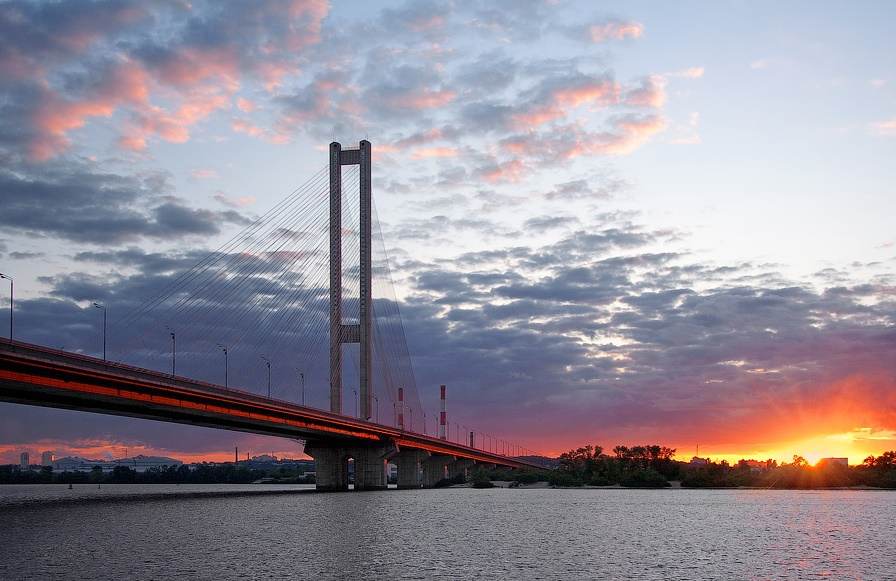
Kyiv Southern Bridge drone strike: Two Russian drones struck near a support structure of the Pivdennyi, or Southern, Bridge at about 11:30 a.m. local time on Thursday, according to Kyiv Mayor Vitali Klitschko. The span carries a six-lane road corridor and the Syretsko-Pecherska metro line across the Dnipro, joining the capital's eastern and western banks. Authorities temporarily stopped both road and metro traffic while emergency crews and engineers assessed the damage.
Kyiv's military administration said the blast pushed dust into the interior of a metro train as it crossed. Officials reported damage to supports, the road surface, barriers and the concrete protective structure around the metro line. Drone fragments also fell in the Dniprovskyi district near a metro station and started a fire that emergency services extinguished. Kyiv's city administration later said its initial inspection “did not find any critical damage,” and an AFP journalist reported traffic moving in both directions a few hours after the strike.
Why the first Kyiv bridge strike since 2022 matters
The immediate engineering result was limited; the strategic signal was not. AFP reported that this was the first time Russian drones had hit a major bridge in Kyiv since the full-scale conflict began in 2022. Political analyst Vadym Denysenko wrote on Facebook that such structures had recently been considered a “red line.” In that reading, the Dnipro bridge attack of October 2026 matters because Russia widened the target set, not because it disabled the crossing.
Kyiv's bridges are east-west lifelines. They move commuters, metro passengers, emergency services and road traffic across the river that divides the city. The Pivdennyi opened in 1990, extends 1,256 meters beneath a 135-meter pylon, and carries the E40/M03 road corridor as well as rail. Even a short closure tests contingency plans across a network whose crossings cannot simply be replaced.
The signal, then, may be the payload. A strike that reaches a previously untouched category of infrastructure forces defenders to plan for repetition. The counter-reading is equally important: traffic resumed within hours, the Klitschko Southern Bridge inspection found no critical damage, and a symbolic escalation that fails to impose lasting physical cost can look less like coercive leverage than an expensive demonstration.
Background: the Pivdennyi Bridge struck after a bridge-war taboo
Bridge warfare already had a powerful place in this conflict, but its geography had been different. Ukraine struck the Kerch Bridge linking Russia with occupied Crimea in October 2022 and again in July 2023. Those attacks caused prolonged disruption, required months of repairs and forced logistics to be rerouted. Russia, by contrast, had not hit a bridge in Kyiv before Thursday, according to AFP's account.
That asymmetry helped make crossings escalation-laden objects. Ukraine presented Kerch as military logistics infrastructure supporting Russian operations. Moscow treated the attacks as major escalations. Until now, Kyiv's Dnipro spans sat in a different category: indispensable urban infrastructure carrying civilians as well as transport capacity, exposed in theory but not directly struck.
The timing intensifies the message. Ukrainian officials said Wednesday's barrage against the energy sector marked the start of a deliberate cold-weather campaign against the power grid. A Russian drone had hit the National Academy of Sciences in central Kyiv on Monday, killing one person and wounding several, according to Ukrainian officials. The Institute of Nuclear Research was struck late Wednesday; authorities said radiation levels remained normal. Our report on Russia's overnight Kyiv strike and power-grid damage explains the opening barrage.
Russia has also increasingly used faster, jet-powered drones since late August, weapons Ukrainian officials say are more difficult for existing interceptors to destroy. The jet-powered drones Kyiv now faces compress warning time and complicate the geometry of defense. Together, the power-grid attacks and bridge strike suggest a Russia winter energy campaign in Kyiv that can pressure both electricity supply and physical mobility, though one bridge hit is not yet proof of a sustained bridge campaign.
Russia strikes a Kyiv bridge: who gains, who loses
Russia gains proof of reach. Two drones arriving at a nationally significant crossing in daylight can force Ukrainian planners to assign scarce air-defense coverage to bridges alongside power stations, government buildings, residential districts and military sites. It can also add pressure to Kyiv's requests for Western air-defense deliveries and reinforce Moscow's winter narrative that no category of infrastructure is beyond reach.
The immediate losers were Kyiv commuters and metro passengers, especially those aboard the train affected by dust from the blast. A daylight impact on a mixed-use bridge also creates a morale effect beyond the repair bill. Yet the limited physical result blunts Moscow's advantage. Hours of disruption do not deliver the military consequence that months of lost bridge capacity can produce.
Ukrainian analysts can reasonably describe the event as target-set widening: “bridges red line,” in Denysenko's formulation. Russia's Ministry of Defence said it struck a transport and logistics center in Kyiv and a data center in the Odesa region. Moscow can therefore frame the operation as an attack on logistics, not civilians, and Russia continues to deny targeting civilians. Independent observers must still note the gap between that claimed target and a metro-carrying bridge hit while city traffic was moving. The available reporting establishes the impact and brief closure; it does not independently establish the intended aim point.
The same attack wave also hit a Kyiv school while children and staff sheltered below. Our separate account, Russian Drone Strikes Kyiv School During School Day as 160 Shelter Below, tracks that incident and the absence of reported casualties there.
Data: 81% intercepted, but Kyiv air defenses overwhelmed at the margin
Ukraine's Air Force said Russia launched 107 drones overnight and that 87 were shot down — about 81%. That is a high interception share, but it also means 20 drones were not reported destroyed. Two reached a bridge category Russia had not hit in Kyiv during the full-scale war. The arithmetic shows why interception volume does not equal protection of every high-value target.
The Kerch comparison clarifies the difference between tactical effect and political effect. Ukraine's bridge strikes caused extended closures and rerouted logistics, imposing a measurable military cost. Thursday's Kyiv strike halted traffic for hours and produced no critical damage in the initial inspection. Its value was therefore more psychological and political: showing reach, crossing a threshold and making defenders account for the possibility of another attempt.
Cost asymmetry sharpens the problem. Faster drones may still be cheaper than the sophisticated interceptors used against them. If defenders fire expensive missiles at repeated waves, the attacker can strain inventories even when most aircraft are destroyed. If defenders hold those weapons back, individual drones have more opportunity to reach infrastructure. “Kyiv air defenses overwhelmed” should not be treated as a description of total collapse; it is a direction of travel when larger, faster and more varied waves create more opportunities at the margin.
Ukraine's own strike reach is expanding too. On the same day, President Volodymyr Zelenskyy announced the first combat use of a domestic ballistic missile, detailed in Ukraine Fires Its Own FP-7 Ballistic Missile in Combat for the First Time. Kyiv also reported attacks on the Samara refinery and other Russian targets; our analysis of Ukraine's Samara refinery and Black Sea strikes examines that parallel deep-strike campaign.
What the steel-cutter drone warhead warning points to next
The day before the bridge attack, Sergiy Beskrestnov, an adviser to Zelenskyy, wrote on Telegram that Russia was using drones designed to cut electricity pylons and steel bridge structures — “steel-cutter” warheads. That warning does not by itself identify the munition used at the Pivdennyi Bridge. It does, however, define the engineering problem Ukraine believes may be emerging: weapons optimized less for blast area than for severing load-bearing metal.
Scenario one: a symbolic one-off. The bridge strike remains an isolated demonstration and crossings return to a grey zone. Russia preserves the option to threaten them without spending repeated waves on structures designed to absorb stress. Ukraine reinforces key spans but does not radically redistribute air defenses.
Scenario two: bridges join the routine target set. Repeated attacks force Kyiv to spread interceptors thinner across Dnipro crossings. Even failed strikes create closures, inspections and commuter disruption. Moscow gains pressure without necessarily bringing a bridge down; Ukraine pays in alert fatigue and defensive coverage.
Scenario three: a sustained engineering campaign. Russia combines a steel-cutter drone warhead with faster jet-powered aircraft in repeated attempts against structural nodes. Success would depend on accuracy, payload, repetition and access to vulnerable components. The Pivdennyi's cable-stayed design and protected metro structure are not proof of either vulnerability or immunity; public reporting after one strike is too limited for that conclusion.
Ukraine's answer is likely to combine more air-defense systems, cheaper interceptors and accelerated domestic production. The same-day FP-7 debut shows Kyiv is also building its own tools of reach. Moscow can continue mass waves, vary flight profiles and target categories, or decide that the limited damage makes bridges a poor use of scarce systems. The winter infrastructure war is therefore a two-front contest: who can reach farther, and who can repair, intercept and adapt faster.
The next indicators are concrete. Watch whether Russian drones return to Kyiv's crossings, whether city authorities add barriers or inspection regimes, whether power and transport targets appear in the same waves, and whether Ukraine publishes evidence about the warhead. Until then, the firm conclusion is narrower than the symbolism: the Pivdennyi Bridge was struck, service was restored within hours, and a threshold that had held since 2022 no longer can be assumed.
Related coverage
Sources
- Reuters via TBS News — Russian drone strikes Kyiv school; pupils escape unhurt
- AFP via Le Pays de France — Two Russian drones hit major bridge in Kyiv
- Anadolu via EuropeSays — Report on the Southern Bridge strike
- EA WorldView — Ukraine War liveblog: energy and Kyiv attacks
- Archynetys — Russian drones strike Kyiv school and key bridge