Entertainment · Film · Television · Obituary
The Mirfield-born Shakespearean who taught two blockbuster franchises how authority sounds — measured, humane and unmistakably his — died at home in Los Angeles on Wednesday, in the care of his wife Sunny Ozell. His family’s statement revealed, for the first time, the two illnesses behind his final chapter, and the tributes that followed read like a roll call of modern screen acting.
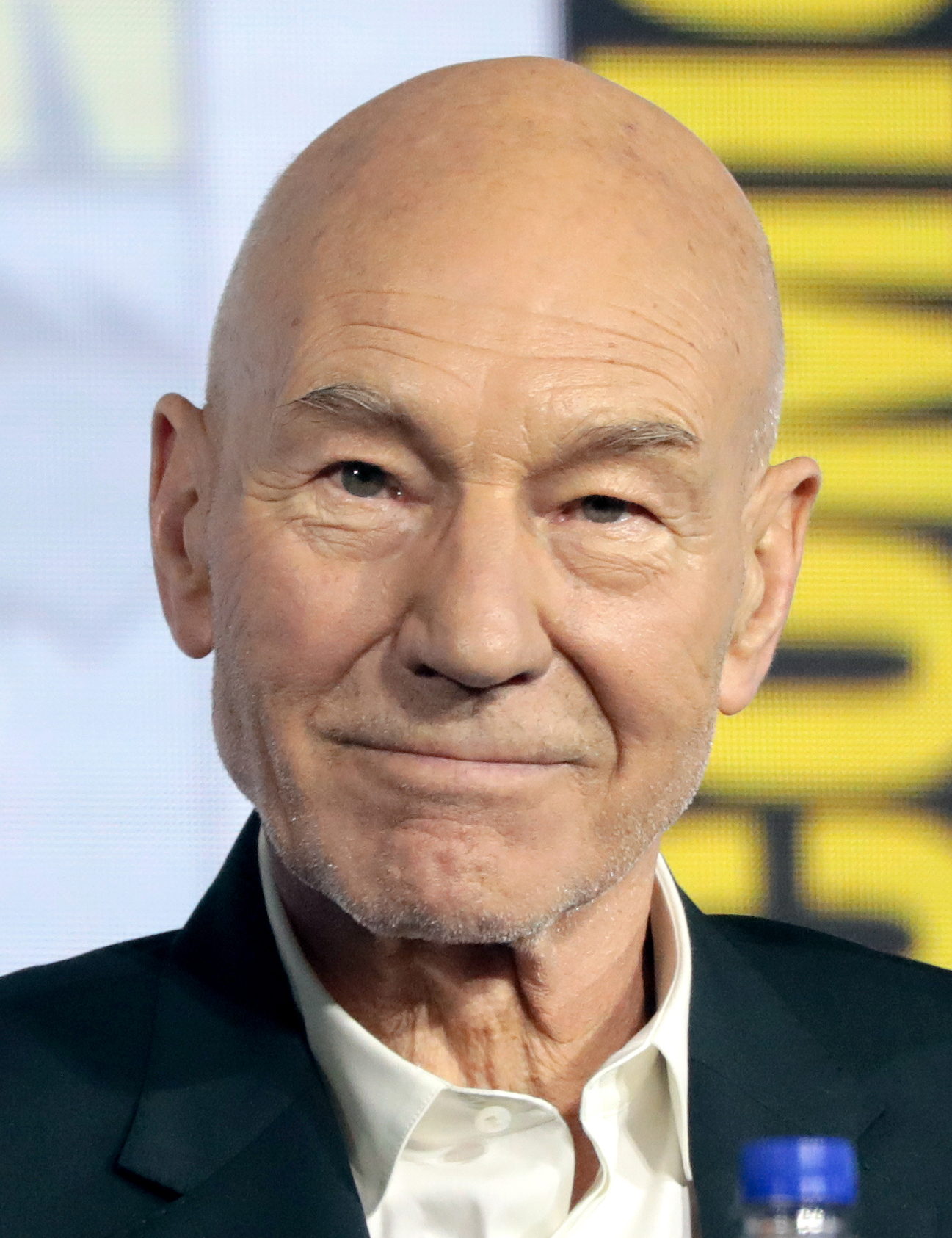
Patrick Stewart dies at 86 having done something no other actor of his generation quite managed: he became the moral centre of two different fictional universes, in two different centuries of his own career, without ever raising his voice to do it. The family of Sir Patrick Stewart announced on Thursday that the actor died on Wednesday, October 28, at his home in Los Angeles, in the loving care of his wife, the singer-songwriter Sunny Ozell, after what the statement called “a brief and poignant journey with Alzheimer’s Disease and Lewy Body Dementia.” Neither diagnosis had previously been publicly disclosed. Within hours, the condolences had assembled themselves into something close to a state occasion: from Ian McKellen, his friend of more than half a century; from Hugh Jackman, his X-Men co-star; from William Shatner, the original Star Trek captain; and from Marvel Studios’ Kevin Feige. Stewart is survived by Ozell and by his children, Daniel and Sophie, from his first marriage. And in a coda no publicist could have scripted, his final screen performance has not yet been seen: he appears posthumously in Marvel’s Avengers: Doomsday, which reaches cinemas on December 18, 2026.
The death and the family statement
The announcement came on Thursday, October 29, posted to Stewart’s own social media accounts and confirmed by his longtime spokesperson, Kelly Bush Novak. Its language was unusually intimate for a celebrity death notice, and deliberately so. Stewart died, the family said, at home in Los Angeles on Wednesday, “in the loving care of his beloved wife Sunny,” following his journey with Alzheimer’s disease and Lewy body dementia. The statement described his final days as held in the warm embrace of family and friends, surrounded by live music, prayer, tears and laughter — a farewell shaped, visibly, by the people who were actually there rather than by the machinery of fame.
Two facts in the statement reframed how the public will remember Stewart’s last years. The first is that he had been living with not one but two progressive neurological conditions. Alzheimer’s disease is the most common cause of dementia; Lewy body dementia, driven by abnormal protein deposits in the brain, is widely described by clinicians as the second most common progressive dementia after Alzheimer’s, and the two frequently overlap. The second is that none of this was public. Stewart worked — and worked visibly, completing a farewell season of Star Trek: Picard, publishing a bestselling memoir and filming his Avengers return — without ever making his health part of the story. The disclosure, when it came, came on the family’s terms and on the family’s timetable.
In lieu of flowers, the family asked that donations be made to the Johns Hopkins Alzheimer’s Disease Research Center Fund and to the Alzheimer’s Foundation of America’s Caregiver Resources — a choice that turns a private grief into a public instruction, and one consistent with the way Stewart used his fame throughout his life: sparingly, and pointed at something other than himself.
From Mirfield to the Royal Shakespeare Company
Patrick Stewart was born on July 13, 1940, in Mirfield, a mill town in West Yorkshire, and the distance between that beginning and the bridge of the Enterprise is the first thing to understand about him. His mother, Gladys, worked in the textile mills. His father, Alfred, had been a regimental sergeant major and came home from the Second World War carrying what would now be recognised as post-traumatic stress disorder; Stewart spoke in later life, with increasing openness, about the fear that shadowed his childhood home. The voice that would one day order Earl Grey tea across the galaxy was formed in a house where, by his own account, he learned early to read a room for danger.
A teacher, a scholarship and a stage
The hinge of the story is an English teacher at his school who put Shakespeare into his hands and made him read it aloud. Stewart left formal education young and worked at a local newspaper — reporting, among other things, on the theatre he was already beginning to perform in — before winning a scholarship to the Bristol Old Vic Theatre School, one of the great training grounds of British acting. At 26 he joined the Royal Shakespeare Company, and the RSC became his professional home for years: the classical repertoire, played in repertory, at the highest level, long before television fame was imaginable. Colleagues from that era consistently describe the same qualities audiences would later recognise on screen — precision, stillness, and a baritone that could fill a theatre without apparent effort.
Screen work accumulated alongside the stage: Gurney Halleck, the warrior-bard of David Lynch’s Dune in 1984, showed Hollywood what that presence looked like in close-up, and in 1999 his one-man theatrical Ebenezer Scrooge became a television A Christmas Carol. In 2010, Queen Elizabeth II knighted him for services to drama — an honour that formalised what the profession already believed. Yet the defining irony of Stewart’s career is that all of it, the decades of Shakespeare and the knighthood that crowned them, would come to be described as the preparation for a job his best friend told him not to take.
The Picard years: the captain who thought first
When Star Trek: The Next Generation launched in 1987, Stewart was 47, bald, British, classically trained and — by the conventional wisdom of American television — an unlikely leading man. Ian McKellen, his friend since their RSC days, advised him against signing: a syndicated space serial, McKellen argued, was beneath a serious stage actor’s trajectory. Stewart signed anyway, reportedly expecting the show to fail quickly and release him back to the theatre. Instead it ran for seven seasons, from 1987 to 1994, spawned four feature films with its cast, and made Jean-Luc Picard one of the most recognisable fictional leaders ever created.
How a cerebral captain redefined screen heroism
What Stewart and the show’s writers built, season by season, was a new grammar of command. Where the original series’ Captain Kirk led with instinct and fists, Picard led with deliberation: the conference room, not the fistfight, became the Enterprise’s decisive arena. Picard consulted, listened, weighed the ethical cost aloud and then decided — and Stewart’s gift was to make that process dramatic rather than administrative. His Picard was a diplomat who quoted Shakespeare, an archaeologist who loved the past, a commander whose authority came from being visibly the most thoughtful person on the bridge. In an era of action heroes defined by physical dominance, Picard’s heroism was intellectual and moral, and audiences — including a generation of scientists, diplomats and officers who cite him as a model — responded to it as permission to lead differently.
The role kept finding new registers. The four Next Generation films carried Picard into cinema through the 1990s and early 2000s. Then, a quarter-century after the series ended, Stewart returned in Star Trek: Picard on Paramount+, which ran from 2020 to 2023 — not as a victory lap but as a portrait of an old man reckoning with failure, guilt and time. It was, in retrospect, an extraordinary late-career act: an actor in his eighties using his most famous character to ask what a lifetime of command does to the commander. That he was doing so while privately beginning the journey his family has now disclosed gives those final episodes a weight no one watching at the time could have known.
Professor X, Logan and the longest Marvel career
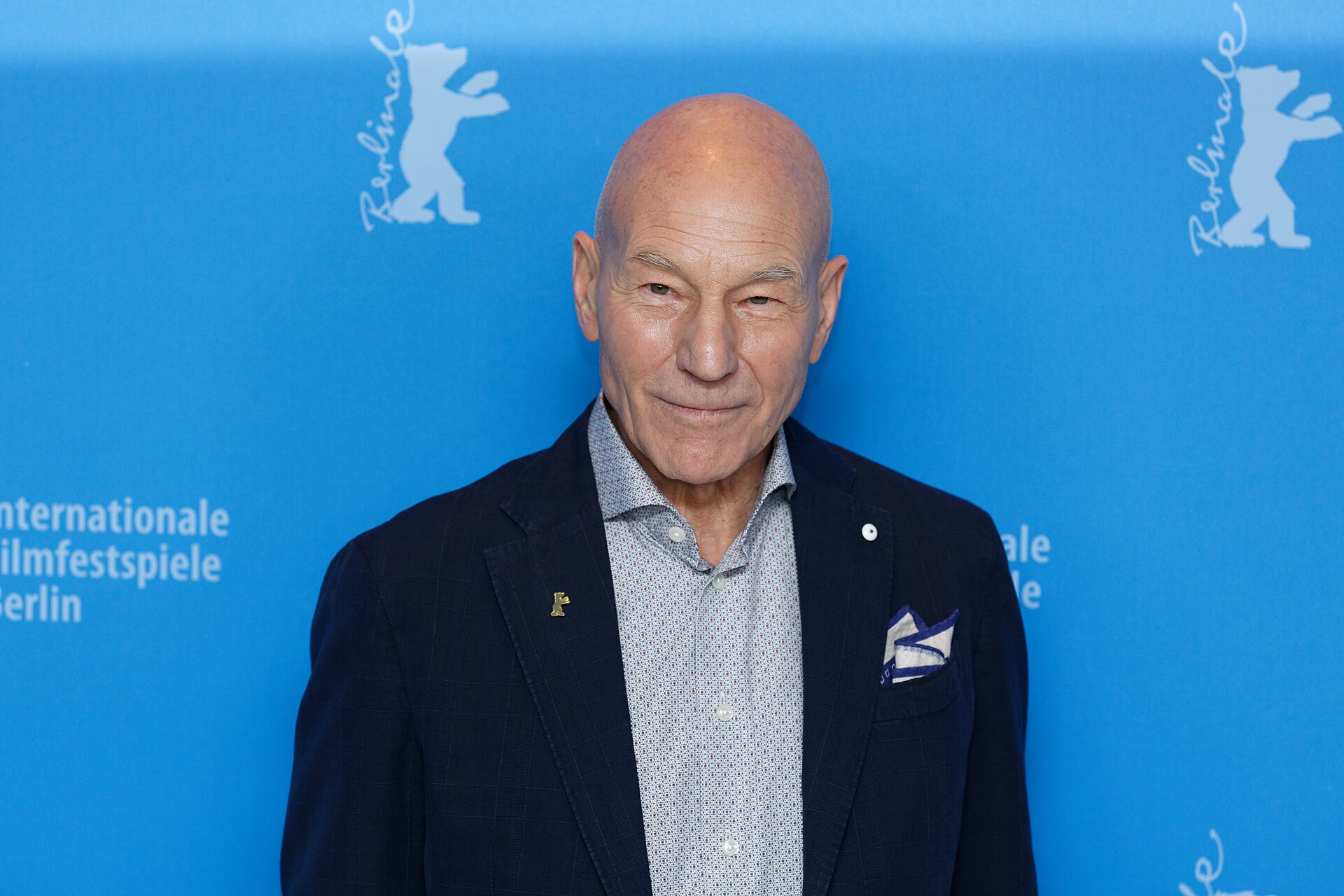
If Picard made Stewart beloved, Professor Charles Xavier made him immortal in a second mythology. Cast in X-Men in 2000 — fans had been drawing the telepathic professor with Stewart’s face for years before the filmmakers caught up — he played Xavier across the Fox X-Men films as the franchise’s conscience: the pacifist headmaster whose school for gifted youngsters was, in the fiction, a refuge, and in the culture, a metaphor that carried the films’ themes of tolerance and difference. Stewart’s Xavier and McKellen’s Magneto gave the series its philosophical axis — two old friends, divided by what oppression had taught them — and the casting carried its own poetry, since the two actors had shared stages since the 1970s.
The summit of that work came in Logan in 2017. Stewart’s Xavier, elderly, ill and losing control of the most dangerous mind on Earth, was no longer the serene mentor but a frightened old man being cared for by his former student — and Stewart played it without vanity, to some of the strongest reviews of his life. It was widely taken, at the time, as his farewell to the role. It was not. He returned as Xavier in the Marvel Cinematic Universe, and his appearance in Avengers: Doomsday — filmed before his death and released this December — extends a Marvel career that began in 2000 across more than a quarter of a century, one of the longest tenures any actor has held with a single superhero character.
The tributes
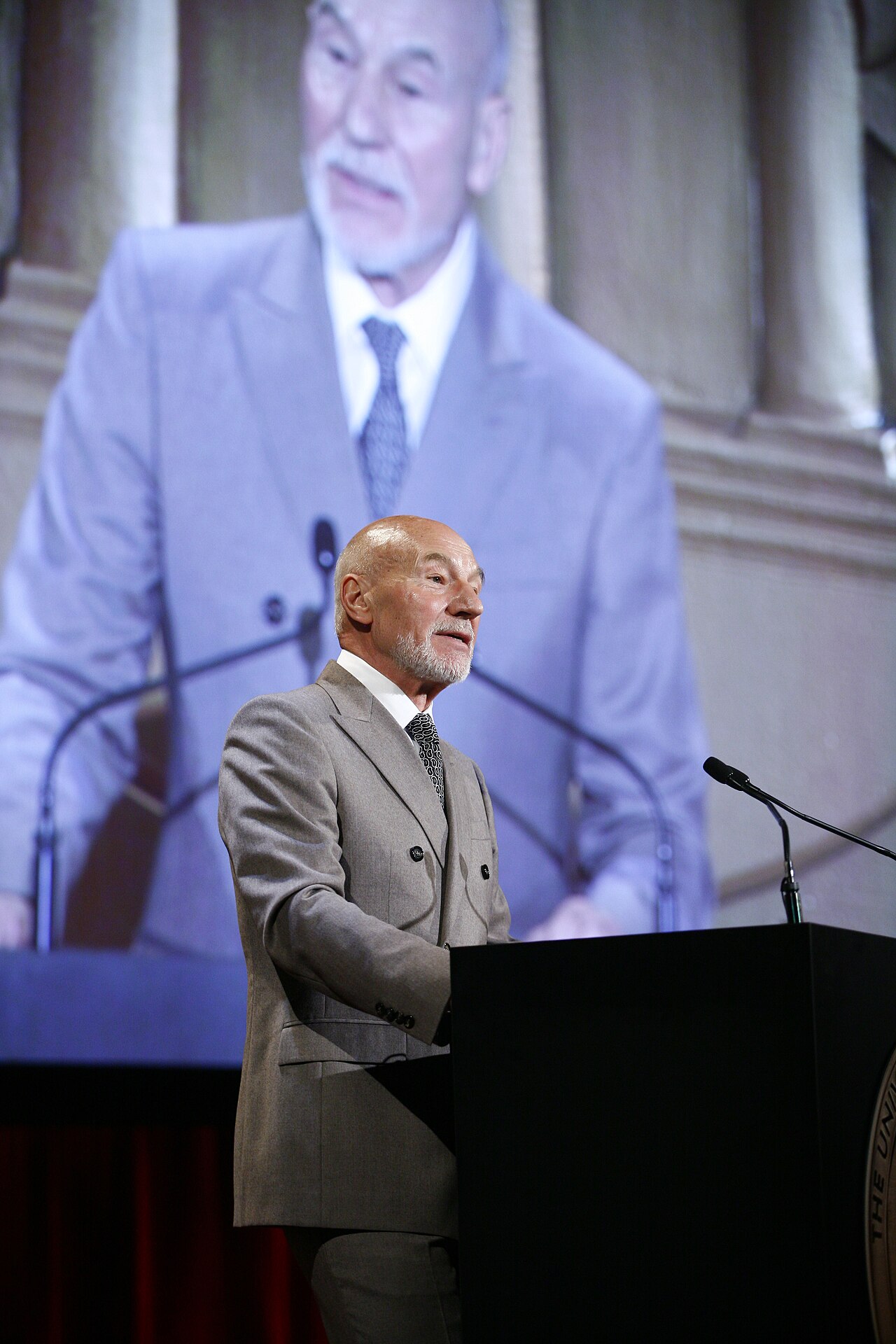
The tributes arrived in the order his life would have predicted: the theatre friend first. Ian McKellen, who officiated at Stewart’s wedding and shared both the RSC stage and the X-Men films with him, wrote the line that has been quoted around the world since Thursday: “He wore his heart on his sleeve, which made him a man to rely on, to admire and, in my case, love.” McKellen also noted the strange, fitting incompleteness of the moment — that Stewart’s farewell performance in Avengers: Doomsday is yet to be seen, so that the last word of the career still belongs, briefly, to the future.
Hugh Jackman, who played Wolverine opposite Stewart’s Xavier for seventeen years, wrote: “We lost one of the greats of stage and screen today… I will miss you, Patrick Stewart, all of my days.” William Shatner, whose Captain Kirk preceded Picard and shared one film with him, reached for the character to describe the man: “Captain Picard stood for the best of us, and so did the man who played him.” And Marvel Studios president Kevin Feige, speaking for the franchise Stewart helped to anchor, described him as “brilliant, charming, warm, generous, with a quiet strength and gravitas” — a list of adjectives that reads, tellingly, like a description of Picard and Xavier themselves. That convergence is the recurring theme of the tributes: colleagues keep describing the characters when they reach for the man, because Stewart spent fifty years making the distance between them very small.
Why this matters
Screen leadership was rewritten around intellect and decency
Stewart’s death closes one of the most consequential experiments in popular culture. Between 1987 and 2023, his Picard demonstrated — to hundreds of millions of viewers, across thirty-six years — that the most compelling person in a crisis could be the one who thinks, listens and refuses the easy violence. Media scholars have long noted how unusual that was in blockbuster storytelling, and how thoroughly it has since been absorbed: the thoughtful commander, the mentor whose power is restraint, is now a standard figure, and the template was substantially drawn from Stewart’s two great roles, which bookend the modern franchise era. Picard and Xavier are, structurally, the same argument made twice — that authority is a form of care — and Stewart is the only actor ever asked to make it at the centre of two separate universes.
A late disclosure, and what it teaches about Lewy body dementia
The family’s statement may prove almost as influential as the performances. Lewy body dementia remains one of the most under-recognised major dementias — frequently mistaken for Alzheimer’s or Parkinson’s, often diagnosed late, and little understood by the public despite being, as clinicians cited in coverage this week reiterate, the second most common progressive dementia after Alzheimer’s disease. When a figure of Stewart’s stature is named alongside it, the effect on awareness is immediate and measurable in the way searches, helpline calls and donations move after such announcements. The family pointed that attention somewhere useful: research at Johns Hopkins and caregiver resources through the Alzheimer’s Foundation of America. There is also a quieter lesson in the timing. Stewart disclosed nothing while he lived, worked at the highest level while he could, and let the diagnosis be shared when it could do educational good without defining his final years — a model of privacy that advocates for patients’ autonomy will recognise instantly.
Two franchises lose their moral centre at once
Finally, there is the simple industrial fact: Star Trek and Marvel are two of the largest storytelling enterprises on Earth, and both have now lost, in the same man, the performer who embodied their better angels. Star Trek had already said its farewell to Picard on screen, in a final season that reunited the Next Generation cast and closed the character’s arc with unusual grace — a goodbye that now reads as more complete, and more fortunate, than anyone knew. Marvel’s farewell is still to come, in December, and will now be watched in a different light. Franchises survive the loss of stars; what they cannot easily replace is a founding conscience. Both of Stewart’s universes were built, in part, on the credibility his presence lent their ideals.
What happens next
The immediate calendar is a memorial one. Tributes are expected from the Royal Shakespeare Company and the British theatre world that formed him, from the Star Trek and Marvel communities, and from the dementia charities the family has named, where donations in his memory were already the family’s stated wish in lieu of flowers. Any formal memorial arrangements will be announced by the family; none had been detailed at the time of publication.
The larger public moment arrives on December 18, 2026, when Avengers: Doomsday opens in cinemas with Stewart’s final performance as Professor X. Posthumous releases are always double events — a film and a farewell — but this one carries an unusual symmetry: McKellen, too, returns in the film, meaning the two friends’ last shared screen chapter closes a partnership that began on British stages in the 1970s. Expect the release to function, whatever Marvel plans, as the public’s goodbye. Beyond it, the legacy questions settle into their long phase: the memoir, Making It So, published in 2023, now stands as his authorised account of the Mirfield childhood, the RSC years and the fame that arrived at 47; the work itself — seven seasons of one series, a defining superhero role across twenty-six years, and a stage career that preceded both — is already in the permanent record. In the memoir, Stewart reflected that Picard, like him, had been taken far beyond the bounds of normal experience while remaining rooted in where he came from. It is the right epitaph, and he wrote it himself.
Related coverage
- Eva Marie Saint Dies at 102: The Last Golden-Age Star Who Won an Oscar on Her First Try
- Mike Ditka Dies at 86: The Bears Legend Who Became “Da Coach”
- Jim Bakker Dies at 86: PTL’s Rise, Fall and Legacy
Sources
- Reuters — “British actor Patrick Stewart has died, his family says” (October 29, 2026): the family statement, the Los Angeles death on October 28 and the Alzheimer’s and Lewy body dementia disclosure.
- CNN — “Patrick Stewart, ‘Star Trek’ and ‘X-Men’ actor, dead at 86” (October 29, 2026): spokesperson Kelly Bush Novak, the Next Generation and Picard years and the Jackman tribute.
- USA Today — “Patrick Stewart, ‘Star Trek’ and ‘X-Men’ icon, dead at 86” (October 29, 2026): the undisclosed diagnoses, the 2010 knighthood and the Avengers: Doomsday return.
- People — “Patrick Stewart, Legendary ‘Star Trek’ and ‘X-Men’ Actor, Dies at 86” (October 29, 2026): the family statement, his birth in Mirfield on July 13, 1940 to Gladys and Alfred Stewart, and the Bristol Old Vic scholarship.
- BBC News — coverage of Sir Patrick Stewart’s death at 86 (October 29, 2026): the British reaction and the Mirfield and Shakespeare record.
This article is based on the family statement posted to Patrick Stewart’s social media on October 29, 2026, as confirmed by spokesperson Kelly Bush Novak, and on reporting by Reuters, CNN, USA Today, People and BBC News. Quotations from Ian McKellen, Hugh Jackman, William Shatner and Kevin Feige are as published by those sources. Analysis is by Signal Post News.