Eva Marie Saint dead at 102
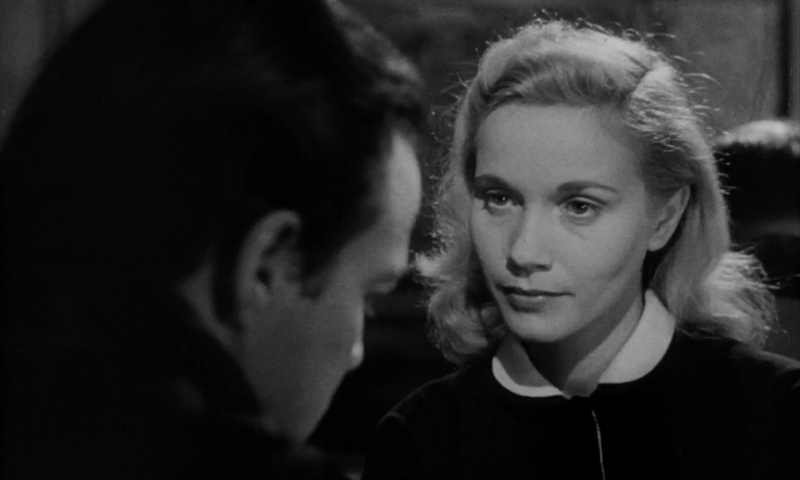
Eva Marie Saint dead at 102: the graceful blonde whose film debut in On the Waterfront won her an Academy Award and who became Alfred Hitchcock's cool, calculating Eve Kendall in North by Northwest died Tuesday of natural causes at her home in Los Angeles. She was 102. Her publicist, Jeff Sanderson, said she died surrounded by family and loved ones. Reuters, CNN and USA Today confirmed the news on October 6, 2026.
Saint's death closes a rare kind of American career: not the relentlessly public life of a star who mistook visibility for permanence, but a disciplined body of work that moved between live television, Broadway, studio pictures and prestige TV without allowing any one industry to consume the woman doing it. Her face belongs to two films that have never left the canon. Her choices, especially the parts she declined, explain the rest.
The announcement
Eva Marie Saint cause of death and the family she leaves
The Eva Marie Saint cause of death was natural causes, according to Sanderson. She died at her Los Angeles home with family and loved ones around her, a private ending for an actress whose best performances depended on what she could hold back. Saint had turned 102 on July 4, 2026. When she reached 100 in 2024, she celebrated amid four generations of her family — an image more faithful to her priorities than any red-carpet montage.
She is survived by her son, Darrell, her daughter, Laurette, four grandchildren and two great-grandchildren. Those names matter in an Eva Marie Saint obituary because she repeatedly described family not as an accessory to her career but as the structure around which she built it. Her longevity was biological; the coherence of her life was chosen.
From Newark to the Actors Studio
Saint was born July 4, 1924, in Newark, New Jersey, and studied at Bowling Green State University in Ohio. Her first break came not through Hollywood but through the unstable, inventive world of live television. She appeared on NBC's Campus Hoopla in 1946, learning a medium in which a performer had to find the emotional truth while the clock kept running and mistakes could not be edited away.
That discipline led to the Actors Studio and then Broadway. In 1953, she made her Broadway debut in Horton Foote's The Trip to Bountiful, earning a Theatre World Award. Lillian Gish, the silent-era giant at the center of the production, became a mentor. Elia Kazan noticed Saint there. The chain is almost too perfect: Gish, who had helped invent screen acting, guided a young actress whom Kazan would cast at the frontier of a new, psychologically raw film style.
Saint's path complicates the familiar idea that Hollywood simply discovered her. Live television sharpened her control; the stage gave it depth; the Actors Studio taught her to make restraint active. By the time the camera arrived, the apparent newcomer had already spent years learning how little she needed to do.
The debut that won everything
Eva Marie Saint On the Waterfront and the Oscar win on her first film
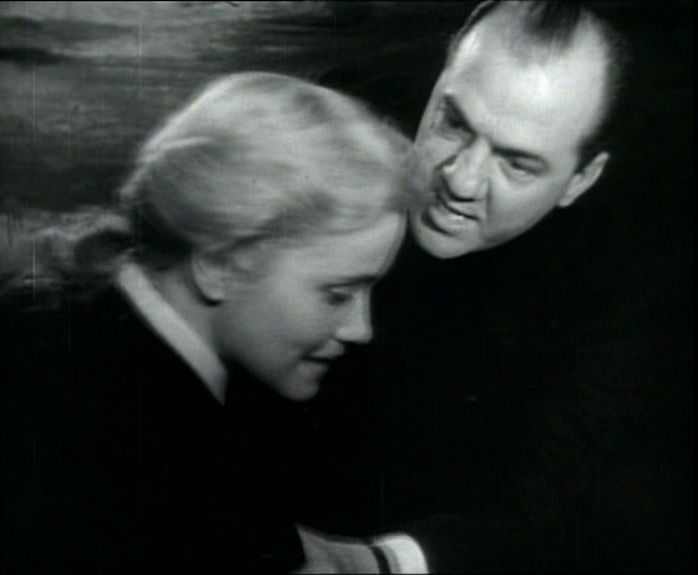
Kazan cast Saint as Edie Doyle in On the Waterfront in 1954 opposite Marlon Brando. She was 30, playing a convent-educated schoolgirl whose brother's murder pulls her into the moral crisis surrounding Brando's Terry Malloy. On paper, Edie could have been merely pure — a conscience in a coat. Saint made her tougher: compassionate without being gullible, frightened without surrendering judgment.
The film won eight Academy Awards, including Best Picture. The Eva Marie Saint Oscar win for Best Supporting Actress came on her first film, one of those facts that sounds like publicity copy until the performance is watched again. In scenes with Brando's volatile intimacy, she refuses to compete with him for noise. She makes stillness the source of tension. That is why the debut survives its mythology.
Saint accepted the Oscar heavily pregnant with Darrell. At the podium, she joked that she might “have the baby right here.” He was born two days later. The anecdote has lasted because it compresses the two lives she was already determined not to let Hollywood separate: the public triumph and the private obligation, each arriving on its own schedule.
Hitchcock's Eve Kendall
Why Eva Marie Saint North by Northwest remains modern
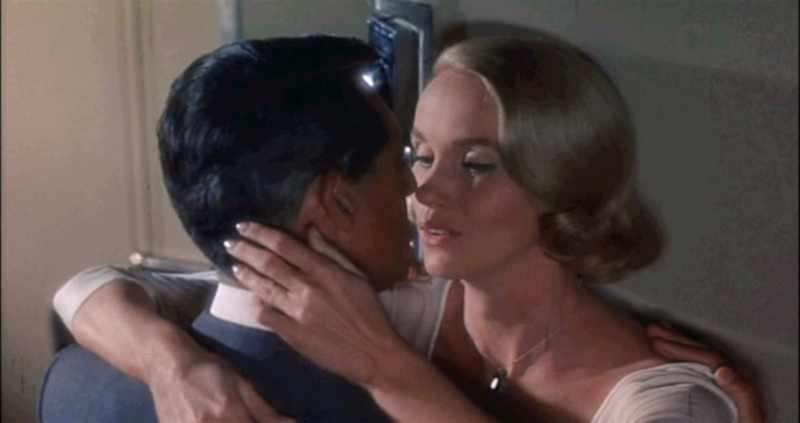
Five years later, Alfred Hitchcock recast Saint's composure as danger. In North by Northwest, she played Eve Kendall, the double agent who meets Cary Grant's hunted advertising executive on a train and appears to decide, with unnerving speed, exactly what she wants from him. Hitchcock directed Saint to lower her voice and hold Grant's gaze. The result was not simply another “cool blonde.” It was a woman whose control of the scene became the scene.
Eve remains one of the thriller canon's most analyzed female roles because the film keeps changing the audience's understanding of her without reducing her to a twist. She is seducer, protector, operative, captive and strategist, often in the same sequence. Grant's Roger Thornhill thinks he is improvising his way through danger; Eve knows which danger is real. Saint's lowered voice turns exposition into leverage.
The performance also reveals Hitchcock at his peak: architecture, desire and deception engineered with almost mathematical precision. Yet the machinery works because Saint supplies ambiguity the camera cannot solve. Her face says that Eve is calculating, but never exactly whom she is calculating for.
Seven decades, 161 credits
Eva Marie Saint movies, television and the art of the return
The best-known Eva Marie Saint movies are only the spine of a much larger record. She earned a Golden Globe nomination for A Hatful of Rain, joined Paul Newman in Exodus (1960), worked with John Frankenheimer on All Fall Down (1962) and Grand Prix (1966), appeared with Elizabeth Taylor and Richard Burton in The Sandpiper (1965), and helped give The Russians Are Coming, the Russians Are Coming (1966) its humane comic center.
Television was not a demotion or an afterthought. It was where she had started and where she repeatedly found mature roles that movies offered women less reliably. She appeared in How the West Was Won, Moonlighting and Frasier, and won an Emmy for the 1990 miniseries People Like Us. Her screen credits ultimately reached 161 or more across stage, film and television.
Later generations met her without always knowing the history behind the face. She played the kindly librarian in Because of Winn-Dixie (2005), Martha Kent in Superman Returns (2006), and voiced the elder Katara in The Legend of Korra (2014). Each return carried an unusual authority: not nostalgia pasted onto a cameo, but evidence that she could adjust her scale to a new medium and let the accumulated years register without performing “legend.”
The 65-year marriage that beat Hollywood
Eva Marie Saint husband Jeffrey Hayden and the cost of choosing family
Saint married producer-director Jeffrey Hayden on October 28, 1951. They remained together until his death on Christmas Eve 2016 — 65 years in a business that converts private strain into public copy. Their marriage was not incidental to her career story. It shaped the volume, rhythm and geography of the work she accepted.
“I guess I don't want to be a super-superstar,” she once said. “My family always comes first.” She turned down work to raise Darrell and Laurette, a choice that sounds uncomplicated only from a distance. The industry punishes absence, especially for actresses: momentum cools, executives discover a younger face, and roles once designed around a woman become supporting parts around a man.
The decision cost Saint ubiquity. It may also have bought her the life that made longevity possible — a durable marriage, present parenthood and the freedom not to measure herself by billing. Searching for Eva Marie Saint children or Eva Marie Saint husband Jeffrey Hayden leads to the counterfactual at the center of her career: how much larger might the filmography have been, and would “larger” have meant better? Her life argues that an actor's omissions can be as intentional as her credits.
That balance distinguishes her story from the public collapse examined in our recent Jim Bakker obituary, while the feeling of a public era ending echoes our farewell to Lionel Messi's Argentina career. The lives were radically different; the shared question is what remains when a familiar figure exits the stage.
WHY THIS MATTERS: the end of a living link
With Saint's death, the oldest-living-Oscar-winner title she had held since Olivia de Havilland died in July 2020 passes on. The title is trivia until one considers what the years contained. Saint linked the studio-system Golden Age to the Actors Studio's method revolution, live television's first flowering to premium-TV prestige, Kazan's waterfront to Hitchcock's Mount Rushmore, and black-and-white broadcast to a 21st-century superhero film.
Her career offers a model of stardom almost antagonistic to the current attention economy: prestige over ubiquity, longevity over heat. She did not need to be continuously visible to remain culturally present because the central performances were built for rewatching. In an era of feeds calibrated to punish silence, Saint's gaps look less like disappearance than command.
They also expose an economic change in Hollywood. The mid-budget adult dramas she headlined — moral conflicts, political epics, troubled marriages, professional people speaking in complete sentences — once formed a large share of studio output. Today those stories are more likely to become limited series or disappear between franchise films and inexpensive genre pictures. Saint did not merely outlive colleagues; she outlived the industrial assumptions that made her kind of career possible.
By the numbers
- 102 years of life, from July 4, 1924, to October 6, 2026.
- 75 years from her 1946 television breakthrough to a career extending through 2021.
- 161+ credits across stage, film and television.
- 1 Oscar, 1 Emmy and 1 Theatre World Award across three distinct performance traditions.
- 65 years of marriage to Jeffrey Hayden.
- 8 Academy Awards for On the Waterfront, the film that made her a movie star.
Numbers can establish duration and achievement, but they cannot capture the precision of a glance across a train compartment or the ethical pressure Edie Doyle brings into Terry Malloy's room. Saint's statistics are extraordinary. The performances explain why anyone counted.
What happens next
Tributes from the Academy and film institutions will be followed by the familiar wave of retrospectives, repertory screenings and rediscovery lists. A People photo retrospective traces the public image across those decades, but the most useful memorial will be to watch the work in motion: the tempo of her replies, the confidence of her silence, the way she makes a scene reorganize around attention rather than volume.
On the Waterfront and North by Northwest are permanent fixtures of film education and repertory cinema. That is why her death lands differently from most celebrity passings. The industry can close an obituary cycle; it cannot make those performances historical in the sense of finished or inaccessible. New viewers will continue to meet Edie Doyle and Eve Kendall in the present tense.
The oldest living Oscar winner is a title that must always pass. The work does not. Saint's films will do the lasting work of remembrance because they keep demonstrating the thing her career understood: permanence is not the same as constant exposure. Sometimes it is one first film, one lowered voice, one held gaze — and the patience to let them endure.