War · Africa · Niger
At least 38 people were killed when unidentified gunmen ambushed villagers from Tillim travelling under a self-defence escort to the weekly market in Tera, in Niger’s Tillaberi region, on Thursday — 37 at the scene and one more who died of wounds on Friday, according to a former elected official and local sources who spoke to AFP. The gunmen have not been identified, no group had claimed the attack by Friday, and Niger’s government had issued no official toll.
Track it live: Africa wars live tracker · Wars live tracker
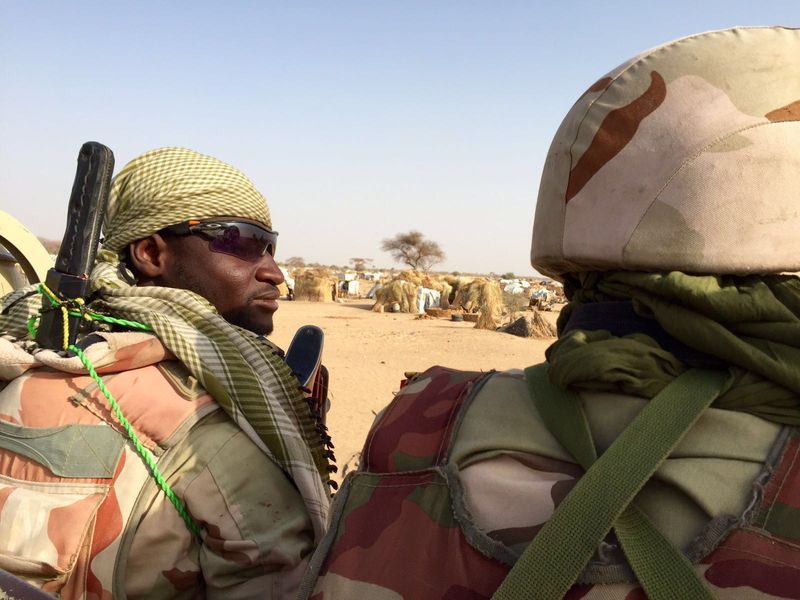
NIAMEY, Niger, November 14, 2026 — At least 38 people were killed on Thursday when unidentified gunmen ambushed villagers travelling from Tillim to the weekly market in Tera, in Niger’s Tillaberi region, under the escort of a local self-defence group, according to a former elected official and local sources who spoke to Agence France-Presse. Thirty-seven people were killed at the scene, and one more injured person died of wounds on Friday, the sources said. By the local sources’ breakdown, 11 of the dead were the self-defence fighters assigned to protect the convoy. The gunmen have not been identified, no armed group had claimed the attack in the reporting available on Friday, and Niger’s government had issued no immediate official statement — so the toll rests on local sources via AFP, has not been officially confirmed, and may change as fuller information reaches Tera.
The Tillim Tera attack: an escorted journey to market day
The victims were residents of Tillim, a village in the Tera area of Tillaberi, in Niger’s far west near the borders with Burkina Faso and Mali. On Thursday, November 12, they set out for the weekly market in Tera, the town that serves as the commercial hub for the surrounding villages — the trip on which rural households sell produce and livestock, buy food, medicine and household goods, and exchange news. Because the roads of Tillaberi are routinely attacked, they did not travel alone: members of a local self-defence group escorted the party, the arrangement that has become normal across the region. A former elected official told AFP that the group fell into an ambush by unidentified armed men on the way. Several wounded people were taken to a nearby hospital for treatment, the sources said.
The count: 37 dead at the scene, a 38th who died of wounds
The local sources’ accounting, as reported by AFP, breaks the toll down as 11 self-defence fighters, 20 men and 7 women — figures that sum to the 38 dead reported overall, 37 of them killed at the scene and one who succumbed to wounds on Friday. Residents also said children were among the casualties. That point needs stating precisely: the reporting carries no separate figure for children, and residents’ accounts place them within the casualties described above rather than as an additional count on top of the 38. How many of the wounded remain in serious condition, and whether the toll will rise further, was not established in Friday’s reporting. Every figure in this paragraph comes from local sources speaking to AFP; none has been confirmed by Nigerien officials.
A western Niger gunmen ambush with no named attacker
Just as important is what the reporting does not contain. The gunmen were described only as unidentified armed men. No group had claimed responsibility in the reporting available on Friday — claims in this conflict, when they come, usually arrive through the armed groups’ own channels and are then reported as claims, not facts. And there was no immediate official statement from Niger’s government: no confirmation, no official toll, no account of any military response. That silence is itself information, but it is not attribution. It would be easy, and wrong, to fill the gap with the names of the organisations that operate in the tri-border zone; AFP’s sources did not identify the attackers, and this article does not either. Who carried out the Tillim Tera attack is, on the evidence published so far, unknown.
Why this matters
Analysis. A market convoy is the most ordinary institution in rural Niger, and that is exactly why Thursday’s ambush carries weight beyond its toll. It tests, in a single morning, the three arrangements on which civilian life in Tillaberi now depends: the weekly market, the self-defence escort, and the junta’s promise that its regional security project is working. All three came out of Thursday damaged.
Market day is a lifeline — and the most predictable journey in Tillaberi
The Tera market ambush Niger is mourning this weekend was not an attack on a random gathering. A weekly market in the Sahel is infrastructure: it is where grain prices are set, where a family converts livestock into cash and cash into food, where medicine changes hands and where information travels faster than on any network. Its timing and routes are fixed by custom, which makes market day the most predictable civilian movement in the region — predictable to traders, and predictable to anyone planning an ambush. An attacker needs no intelligence apparatus to find a crowd on the Tillim–Tera road on a Thursday; the calendar does the work. The damage also compounds. Each ambush taxes every future market day: fewer traders make the journey, stalls stand empty, prices rise for the households least able to pay, and villages drift toward isolation. That is a slow economic siege laid on top of the violence itself, and it is one reason attacks on market routes feature so persistently in Sahel Tillaberi violence.
The Niger civilians killed Thursday were travelling under protection — and it was not enough
The escort deserves the closest attention, because it represents Niger’s governing bargain in the countryside. The regular army cannot be everywhere in a region as large and road-poor as Tillaberi, so the junta has tolerated village self-defence militias — local men, armed and organised by community, who guard villages and escort movement. Thursday shows both halves of that bargain. The escort existed because the threat was understood; the villagers of Tillim did everything the system asks of them. And the escort was overwhelmed anyway: 11 of the 38 dead — nearly three in ten — were the protectors. A Niger market convoy ambush on this scale sharpens the dilemma rather than resolving it. Without escorts, the roads are simply open. With them, a convoy becomes a defended, military-style target, and the line between civilian traveller and combatant blurs in ways that can expose whole villages to the logic of reprisal. None of that means the families of Tillim had a better option on Thursday morning. It means the option they had was a fragile one, and everyone in Tillaberi knows it.
Who benefits, who loses
Whoever planned the ambush gained the cheapest strategic effect available in this war: a demonstration, at no evident cost in held ground or acknowledged losses, that neither the army nor the militia system can guarantee a market road in the region ACLED ranks as the central Sahel’s deadliest for civilians. The loss falls first, overwhelmingly, on Tillim’s families and on Tera’s traders. But it also falls on Niger’s junta, whose authority rests on a promise to restore security, and on the regional project built around that promise: the confederation Niger has formed with the juntas of Burkina Faso and Mali, with a unified force of 5,000 troops as its military arm. That force exists precisely for borderlands like Tillaberi. An unanswered ambush on a market convoy, in the confederation’s own heartland, with no official statement by Friday, is the kind of event by which such projects are judged in the villages they claim to protect.
Sahel Tillaberi violence in numbers: 38 dead, in the region holding nearly half of Niger’s displaced
Set the toll against the region’s baseline and its scale sharpens. Niger has roughly 450,000 people registered as displaced, according to UN figures cited in the reporting — and just under half of them, on the order of 200,000 people, live in Tillaberi alone. Displacement on that scale is not background noise; it is the accumulated product of attacks like Thursday’s, each of which teaches another set of villages that home is not defensible. ACLED, the conflict-data organisation, ranked Tillaberi as the deadliest region for civilians in the central Sahel last year. Thursday’s figures show what that ranking looks like at ground level: not a pitched battle but a shopping trip that ended with 38 dead, 11 of them the men sent along to prevent exactly this. A single morning’s ambush will not move the regional statistics by itself. Its significance is that it is not an outlier — it is the mechanism, repeated, by which the statistics are made.
Context: the tri-border zone at the centre of the Sahel war
Tillaberi occupies Niger’s western wedge, where the frontiers of Niger, Burkina Faso and Mali converge. That tri-border zone has become the epicentre of insurgent violence in the central Sahel: armed groups linked to al-Qaeda and to Islamic State operate across borders that states struggle to police, moving through rural country where government presence is thin and roads are few. Villages, markets and travellers on those roads have been attacked again and again. To state that operating environment is not to attribute Thursday’s ambush — the groups active in the zone are rivals as much as neighbours, responsibility for any single attack has to be established rather than assumed, and in this case it has not been. Our earlier coverage traced the military side of the same insurgency in the September attacks that killed more than 50 Nigerien soldiers, where Islamic State’s Sahel affiliate was the reported actor — a contrast that underlines why Thursday’s unattributed ambush must be reported as exactly that.
The self-defence escorts are one pillar of the junta’s answer; the confederation with Burkina Faso and Mali is the other. The three juntas have bound themselves into a single bloc with a unified 5,000-troop force, presenting regional self-reliance as the alternative to the partnerships Niger discarded after its change of government. Neighbouring states are recalibrating in parallel: we reported last month on Algeria’s parliament approving its first foreign troop deployment since 1973, directed toward Niger, a sign of how far the Tillaberi emergency now reaches beyond Niger’s own borders. Against that architecture, Thursday’s facts are unadorned: a tolerated militia escorted a village to market, the escort was destroyed alongside the people it guarded, and by Friday the state had said nothing in public.
What happens next
The first test is factual. Niger’s government has yet to confirm the attack or publish its own toll; an official account, when it comes, will either corroborate the local sources’ figure of at least 38 or revise it, and the history of such events in Tillaberi says revisions are common as the wounded are counted and the missing accounted for. The second test is attribution: whether any armed group claims the ambush, and whether investigators — official or independent — produce evidence that identifies the attackers. The third is response: whether the junta reinforces the Tera corridor, changes the escort system that failed on Thursday, or answers through the confederation’s joint force. And the fourth, quietest test comes next Thursday, when Tera’s market is due to convene again and the villages around Tillim must decide whether the road is one they can still travel.
What to watch:
- An official statement or toll from Niger’s government, and how it compares with the local sources’ count of at least 38 dead.
- Any claim of responsibility by an armed group, and any evidence published to support attribution of the Tillim Tera attack.
- The condition of the wounded taken to hospital, and whether the toll rises as Friday’s survivors are accounted for.
- The junta’s response: reinforcements for the Tera corridor, changes to the self-defence escort system, or a role for the confederation’s unified 5,000-troop force.
- Whether Tera’s weekly market convenes as usual, how many traders and villages attend, and under what protection.
Do escorted convoys and village militias make rural Niger safer — or do they turn market day into a military operation that civilians lose either way? Follow Signal Post News for continuing coverage of Tillaberi, the tri-border insurgency and the Sahel juntas’ regional security project.
Sources
- News Central TV, carrying AFP reporting, “Armed Men Kill at Least 37 Civilians in Niger” (November 13, 2026) — the former elected official and local sources on the ambush of the Tillim–Tera market party, 37 killed at the scene and one further death from wounds on Friday, the breakdown of 11 self-defence fighters, 20 men and 7 women, residents’ accounts of children among the casualties, and the ACLED and UN context.
- Agence France-Presse reporting as republished by The Hindu (November 13, 2026) — the same AFP wire account of the ambush in western Niger, attributed throughout to local sources.
- QNC News, “At Least 38 People Lose Lives in Ambush on a Market Convoy in Western Niger” (November 14, 2026) — the combined toll of at least 38 and the treatment of wounded survivors at a nearby hospital.
- Attribution and figures note: all casualty figures in this article are those of local sources speaking to AFP and have not been officially confirmed; they may change. The ACLED ranking of Tillaberi and the UN displacement figures (roughly 450,000 registered displaced people in Niger, just under half of them in Tillaberi) are as cited in that reporting. No photograph of Thursday’s ambush has been published; the photograph illustrating this article is a 2016 VOA file image from Diffa, in southeastern Niger, and is captioned as such.