
Splashdown confirmed: Freedom comes home off the California coast
The SpaceX Crew-12 splashdown arrived exactly on the morning's schedule. At 11:34 a.m. ET — 8:34 a.m. on the California coast — on Thursday, October 8, 2026, Crew Dragon Freedom touched down in the Pacific Ocean roughly 50 miles west of Los Angeles, its four main parachutes holding the capsule steady as it settled onto the water at about 15 miles per hour. The SpaceX recovery ship Shannon was alongside within minutes, beginning the careful work of hauling the capsule aboard and bringing its crew — commander Jessica Meir and pilot Jack Hathaway of NASA, and mission specialists Sophie Adenot of the European Space Agency and Andrey Fedyaev of Roscosmos — home after nearly eight months in orbit.
NASA confirmed the landing live, closing a return journey of about 27 hours that began when Freedom undocked from the space-facing port of the station's Harmony module at 8:05 a.m. ET on Wednesday. The crew had launched in February 2026 aboard a Falcon 9 from Cape Canaveral, and their mission ran longer than the standard crew rotation — a deliberate choice that gave researchers more continuous time with their experiments and reduced the number of launches needed to keep the station occupied. With Crew-13's arrival on October 1, the handover was already complete before Freedom ever left the station.
Crew-12 splashdown time today: the timeline that mattered
Thursday's return followed the script that has made Dragon splashdowns feel almost ordinary — which is itself the point. After a final series of departure burns to clear the station, Freedom committed to coming home with its deorbit burn: a roughly nine-minute firing of its Draco thrusters beginning at about 10:46 a.m. ET that slowed the capsule just enough for gravity to take over. The plunge back ran at nearly 5 miles per second — around 18,000 miles per hour — wrapping the capsule in the familiar fireball of superheated plasma before the trunk section was jettisoned and the drogue and main parachutes deployed for the final descent to a 15-mph ocean touchdown. From undocking to splashdown: 27 hours, one burn, four parachutes, zero surprises. That reliability is the product, not the backdrop.
Meet the crew: Jessica Meir, Jack Hathaway, Sophie Adenot and Andrey Fedyaev
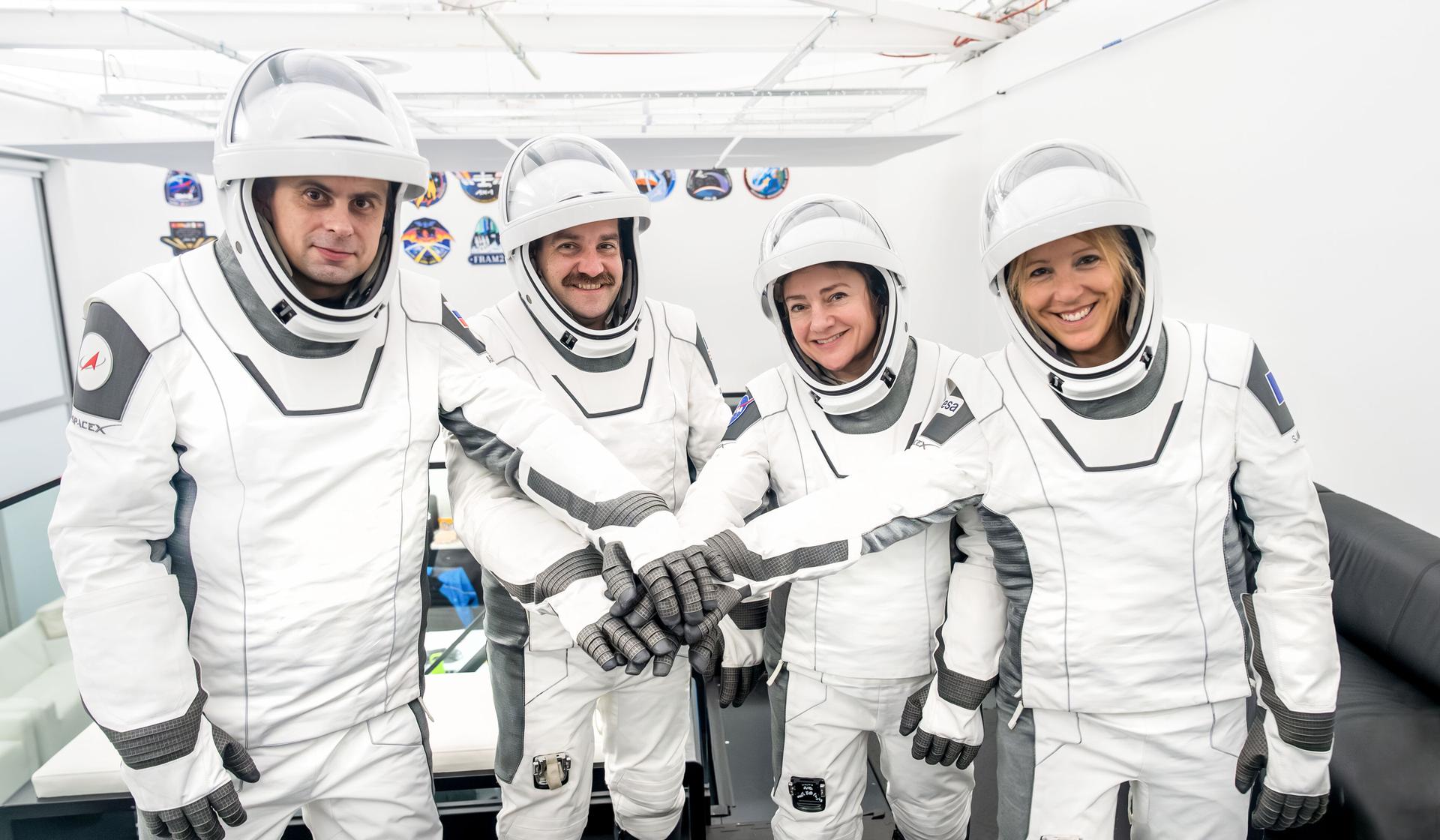
Meir, the NASA commander, was the mission's most seasoned spacewalker. She completed four spacewalks totaling roughly 27 hours outside the station — the kind of cumulative EVA time that puts an astronaut in rare company. Adenot, flying for the European Space Agency, performed three spacewalks of her own. Hathaway, the pilot, and Fedyaev, the Roscosmos mission specialist, completed a crew that drew on three space agencies across two continents — and, through Fedyaev's seat, a U.S.-Russian partnership that has now survived years of geopolitical strain without breaking.
Jessica Meir and Jack Hathaway led the NASA-SpaceX Crew-12 mission's Pacific Ocean homecoming
The composition matters more than the headcount. Every recent crew rotation has carried a Russian cosmonaut alongside NASA astronauts, a seat-swap arrangement that keeps both countries' crews trained on both countries' vehicles. That it continued through Crew-12 — with command of the station passing from Meir to Roscosmos cosmonaut Pyotr Dubrov on October 4 — says something the diplomats rarely say out loud: in orbit, the partnership still works. Dubrov will hold command into spring 2027, serving alongside Anna Kikina of Roscosmos and Anil Menon of NASA.
Why this matters: the West Coast era, crew cadence and a maturing machine
It is tempting to file each crew rotation as interchangeable — one team up, one team down. The SpaceX Crew-12 splashdown deserves better than that, because it sits at the intersection of three shifts that are quietly redefining American human spaceflight.
First, geography. When NASA and SpaceX moved splashdown recovery operations from Florida to the West Coast in early 2025, it was a logistical decision with symbolic weight: the commercial crew program had outgrown its original Atlantic infrastructure. Thursday's landing, about 50 miles west of Los Angeles, follows Artemis II's splashdown off San Diego in April. The Pacific is now the home waters of American human spaceflight — a full-circle return to the ocean recoveries of the Mercury and Apollo eras, this time as routine operations rather than national drama.
Second, cadence. Crew-12's nearly eight months aboard the station exceeded the standard six-month rotation that Crew-13 has just begun. Longer expeditions are deliberate: fewer launches to keep the station crewed, more continuous time for experiments that cannot be paused and restarted. The trade is human — eight months of microgravity, radiation exposure and confinement — which is exactly why missions like this one fly the bone-loss and stem-cell studies they do.
Third, maturity. This was SpaceX's 20th crewed flight. A company that first carried humans to orbit in 2020 has now flown twenty crewed missions in six years — better than three a year, a tempo no government human-spaceflight program has sustained in the modern era. The twentieth flight is not a marketing milestone. It is the point where a transportation system stops being an experiment and becomes infrastructure.
SpaceX 20th crewed flight marks the end of the novelty era
There is a useful comparison sitting inside our own coverage: just one week ago, Crew-13 set the fastest U.S. launch-to-docking record at 7 hours 55 minutes. Launches now produce records; landings produce shrugs. That asymmetry is the signature of a mature system — the drama has moved from “will it work” to “how fast, how cheap, how routine.” When a splashdown 50 miles off Los Angeles barely interrupts the morning news cycle, commercial crew has won.
Context: how the Pacific became home
For most of the commercial crew era, Dragon capsules came home to the waters off Florida — the Gulf and the Atlantic — where recovery ships, calm seas and proximity to Kennedy Space Center made operations straightforward. The early-2025 move to the West Coast reflected a program scaling up: more flights, more capsules, and a recovery infrastructure that needed room to grow. The Pacific offers wider recovery zones and, for missions returning from the station's high-inclination orbit, favorable geometry. Thursday's splashdown is the proof that the new pipeline works end to end: undock, deorbit, reentry, recovery — all executed from Western ranges and waters.
A SpaceX splashdown off California is now the routine
Expect this to become the default image of American crew returns: a Dragon capsule under orange-and-white canopies, a gray recovery ship on a blue Pacific, the Los Angeles basin somewhere over the horizon. Artemis II proved the template in April with a crewed lunar-flyby recovery off San Diego; Crew-12 confirms it for the workhorse rotation missions. The Atlantic had a sixty-year run. The Pacific era has begun.
The science haul: stem cells, crystal growth and bone loss

Freedom's crew is bringing home more than themselves. The mission's research manifest ran to dozens of experiments, with three threads that illustrate why the station still earns its keep: stem-cell research, crystal growth in microgravity, and bone loss.
The stem-cell work is the most consequential. In microgravity, stem-cell-derived tissues age and degrade along pathways that mirror disease on Earth — heart disease, Parkinson's — but on an accelerated clock. The station is, in effect, a time machine for degenerative disease: months in orbit compress years of terrestrial decline into an observable window. Every long-duration crew extends that window.
Crystal growth sounds esoteric until you remember that many modern drugs are proteins, and protein crystals grown without gravity's distortions reveal structures that Earth-grown crystals blur. Better structures mean better drug design. And the bone-loss studies are the practical core of exploration: astronauts shed bone density at roughly 1 to 2 percent per month in microgravity despite hours of daily exercise. Understanding the mechanism is the difference between a Mars mission that arrives with a functional crew and one that arrives with fractures waiting to happen.
The numbers behind the mission
A few figures, placed in context. Nearly eight months in orbit versus the standard six: Crew-12's extended stay bought researchers roughly a third more continuous experiment time than a normal rotation, at the cost of a third more radiation and confinement for the crew. Twenty-seven hours from undocking to splashdown, against a nine-minute deorbit burn: the burn is a fraction of one percent of the journey, and the rest is orbital mechanics doing the slow work. Nearly 5 miles per second at reentry — about 18,000 miles per hour, roughly twenty-three times the speed of sound: the heat shield's job is to turn that kinetic energy into heat and throw the heat away, and the 15-mph splashdown is the gentle epilogue to the most violent part of any spaceflight. Twenty-seven hours of spacewalking for Meir across four EVAs, plus three for Adenot: cumulative EVA time is the quiet credential of a veteran astronaut. And 20 crewed flights for SpaceX: the entire Space Shuttle program flew 135 missions over 30 years, and SpaceX has now flown a seventh of that total in six.
Who benefits and who stays exposed
NASA benefits first. Every clean rotation validates the commercial crew model — buying transportation as a service instead of owning the vehicles — and every extended mission like Crew-12's stretches the science return per launch dollar.
SpaceX benefits next. Twenty crewed flights is a moat: no competitor can credibly bid against that flight history. The company's scale keeps compounding — from crew rotations to Apollo's $40 billion debt financing to put Nvidia chips in orbit, the same launch cadence that carries astronauts now carries the infrastructure of the orbital economy.
The researchers benefit in the most literal sense: their stem cells, crystals and bone-density scans are on their way to laboratories.
Who stays exposed? NASA's redundancy problem. Boeing's Starliner was supposed to give the agency a second American crew vehicle; its next crewed flight is not expected before 2028 at the earliest. Until Starliner flies crew, every Dragon success is also a reminder of single-provider risk. And the station itself is aging — each handover is smooth, but the hardware underneath is not getting younger.
Sophie Adenot and Andrey Fedyaev flew as one crew while geopolitics churned below
The least remarked-upon fact of the mission may be the most remarkable. A European astronaut and a Russian cosmonaut launched together, worked together for eight months, and came home together — while their governments' relations remained frozen. The ISS partnership has now outlasted multiple terrestrial crises by simply refusing to let them aboard. That is not naivety; it is design. The station's interdependence — American power, Russian propulsion, European and Japanese modules — makes unilateral action impractical, which turns out to be a feature. Crew-12 is the latest evidence that the arrangement holds.
What happens next: Crew-13, a new commander and the Artemis horizon
The station is already in its next chapter. Crew-13 — NASA's Jessica Watkins and Luke Delaney, the Canadian Space Agency's Josh Kutryk and Roscosmos' Sergey Teteryatnikov — docked on October 1 for a six-month science mission, and the handover from Crew-12 was completed before Freedom departed. Command now sits with Roscosmos cosmonaut Pyotr Dubrov, who accepted it from Meir on October 4 and will hold it into spring 2027 alongside Anna Kikina and NASA's Anil Menon.
Beyond the station, the trajectory points at the Moon. Artemis II's Pacific splashdown in April proved the recovery pipeline for deep-space crews; the lunar surface missions now in preparation will demand everything the station program has learned about long-duration human health — the same bone-loss and stem-cell questions Crew-12's experiments were designed to answer. And the vehicle that may eventually carry those crews, Starship, is still proving itself flight by flight, as our coverage of its first orbital flight laid out. For now, the workhorse is Dragon, the ocean is the Pacific, and the schedule — twenty flights and counting — holds.
Crew-13 ISS handover is already complete
The cleanest handovers are the ones nobody notices. Crew-13's arrival, the command transfer to Dubrov, and Crew-12's departure formed a single continuous operation across eight days — the station never uncrewed, the research never paused. That continuity is the real product of the commercial crew era: not any single splashdown, however photogenic, but the unbroken human presence that makes each one possible. The Crew-12 astronauts' return to Earth closes one expedition; the ISS crew return of October 2026 was never really an ending at all.
Sources and reporting notes
- NASA: Expedition 75 Welcomes Crew-13 and Preps for Crew-12 Departure
- NASA news release: NASA to Stream SpaceX Crew-12 Return, Splashdown Live
- WEKU/NPR: 4 People on NASA's Crew-12 Mission Return to Earth After 8 Months in Space
- New York Post: Dramatic SpaceX Astronauts' Reentry Ahead of LA Ocean Splashdown