War · Myanmar · Rakhine
A Myanmar airstrike IDP camp strike hit Byar La camp in Ponnagyun township on Friday evening, killing 12 displaced people — among them a five-year-old child — and injuring 18, according to witnesses and a rescue worker who spoke to AFP. It was the second time in six weeks that the same camp has been bombed.
Track it live: live war tracker
PONNAGYUN, November 14, 2026 — A Myanmar military airstrike struck a camp housing people displaced by the country's civil war on Friday evening, killing 12 people in Rakhine State, witnesses and a rescue worker told AFP. The strike hit Byar La IDP camp in Ponnagyun township, northeast of the state capital Sittwe, at around 7:00 p.m. on Friday, November 13. Among the dead was a five-year-old child; 18 other people were injured, according to the same accounts. The Global Arakan Network, citing the ONN news source, independently reported the same time, place and toll on Saturday — around 7:00 p.m., Byar La camp, 12 killed including a five-year-old, at least 18 injured — giving the core facts two separate published sources. Every toll in this article is attributed to those who reported it, because no independent verification mission has access to the camp: Rakhine is blockaded, largely held by the Arakan Army, and reached by outside journalists only rarely. What follows separates what witnesses and rescuers said happened from the wider war in which it happened, and it states plainly the one response that could not be obtained: the Myanmar military's. AFP reported that it was not possible to contact the military for comment on the attack. No statement from the military about Friday's strike is quoted in this article, because none was available in the reporting checked — and none is invented here.
Friday evening at Byar La
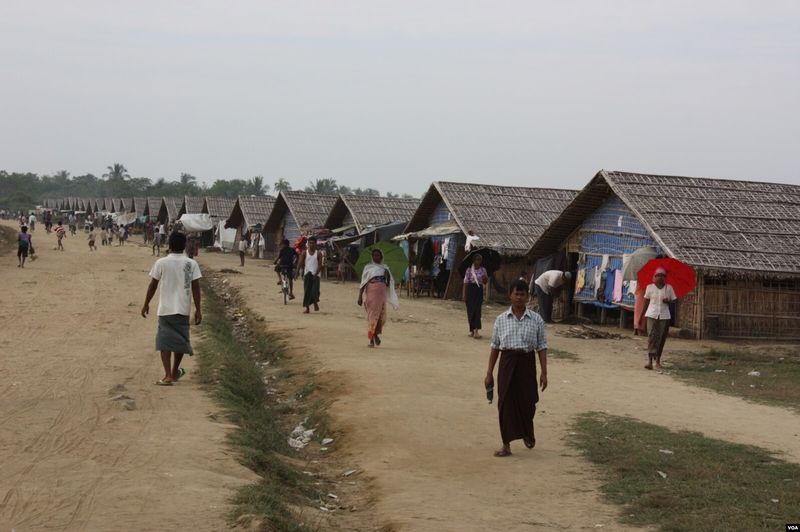
A camp of bamboo houses, four years settled
Byar La is not a transit site thrown up last month. Many of its residents have lived there for about four years, according to Khine Hein Htet, chairman of the Phyusin Yin Khwin Foundation, a rescue and emergency service that responded to the strike — people displaced by earlier rounds of the Rakhine fighting who built bamboo houses, opened small shops and settled into the suspended permanence that displacement camps acquire when a war outlasts every prediction of its end. The camp sits in Ponnagyun township, inland and northeast of Sittwe, in the part of Rakhine where the Arakan Army's control is most complete and the military's presence is exercised mainly from the air. At around 7:00 p.m. on Friday — after dark, in the hour when camp families are home from the day's work and children are inside — the strike came. Both AFP's witnesses and the Global Arakan Network's account place it at the same hour, and both describe a jet-delivered bombing of the camp itself.
“We never thought this camp would be targeted”
Khine Hein Htet confirmed the toll that witnesses gave: 12 dead, among them a five-year-old, and 18 injured. He also gave AFP the sentence that frames how the camp's residents understood their own exposure. The camp, he said, was not a combat area. “We never thought this camp would be targeted.” That assessment — a rescue chairman's, about the place he was working — is the factual counterweight in this story: whatever the military's purpose in Friday's strike, a claim it has not made publicly and could not be asked about, the camp's own service providers describe a settled civilian site with no fighting in it. The injured were treated and moved by the rescue services that the foundation and local networks run in place of the state systems the blockade has thinned; AFP's report does not detail their conditions, and none is speculated on here.
The witness: a shopkeeper who lost three generations
Chit Su Wai, 27
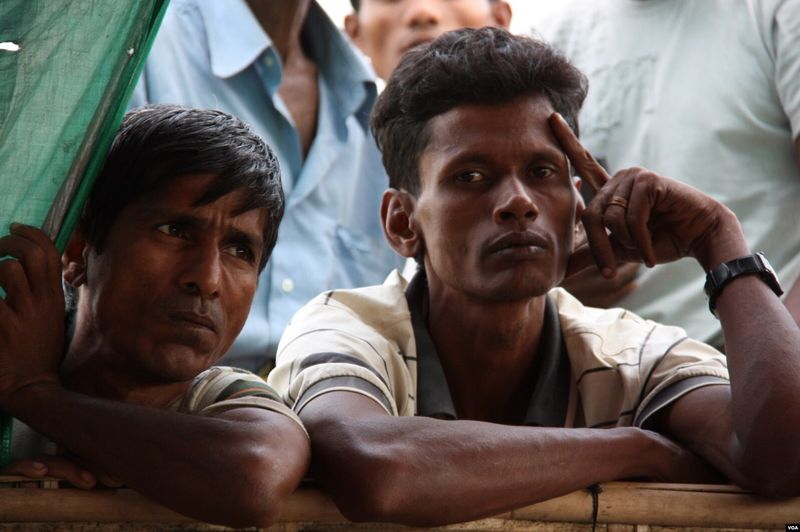
The human centre of AFP's reporting is Chit Su Wai, a 27-year-old shopkeeper in the camp, who described — sobbing, the agency noted — how her daughter, her aunt and her mother were killed on Friday evening. Three generations of one family, in one strike, in a camp they had lived in for years because the war had already taken their home village out of reach. Her account is the source of the death toll as witnesses gave it, and it aligns with the rescue foundation's confirmation; the two together, witness and responder, are the standard on which reporting from a closed war zone rests, and they are presented here as exactly that — testimony, mutually corroborating, from the people who were there and the people who carried the dead. No fuller casualty list has been published in the reporting checked, and this article does not construct one.
Saturday morning: what the camp looked like
AFP's account of the scene on Saturday describes the physical signature of a bomb in a bamboo settlement: collapsed bamboo houses — the camp's homes are built of the material that grows around it, light and quick to raise and offering nothing against blast — and an upturned vehicle lying among scattered household goods. The detail matters beyond its pathos. A camp of bamboo shelters and household possessions is legible, from the ground at least, as what its residents and its rescue chairman say it is: a place where displaced families live. The investigation of intent — who selected the target, on what information, expecting to hit what — belongs to a military that has not commented and to investigators who cannot reach the site. What the Saturday scene establishes, on AFP's reporting, is only the effect: a residential camp, wrecked in the pattern a strike leaves.
The same camp, six weeks earlier
October 4: two jets, consecutive passes, six dead
Friday's strike was not Byar La's first. On October 4, 2026, two military jets made consecutive passes over the same camp and bombed it, killing six people and injuring 11, in an attack reported by Reuters in the October 5 news cycle and covered by this newsroom at the time in our report on the Myanmar junta airstrikes on Ponnagyun IDP camps. A second camp in the township was hit the following morning, killing two more people, per the Arakan Army and youth association spokespeople cited then. The October and November strikes must be kept distinct — different dates, different tolls, separate attacks — because their relationship is precisely the story: the same named camp, the same township, bombed on October 4 and again on November 13. The Global Arakan Network's Saturday report draws the line explicitly, noting the October 4 attack at approximately 5:10 p.m. by two fighter jets in consecutive passes before reporting Friday's. For the families who rebuilt after October — who re-raised bamboo walls in the same plots because there was nowhere else in a blockaded state to go — Friday evening was the second time.
Why this matters
Analysis. A single camp strike in a five-year war competes for attention with a dozen larger numbers. Three features give Friday's its weight.
Repetition changes the category of the event
First, repetition. A camp struck once can be argued over — mistaken identity, faulty intelligence, a target wrongly placed. A camp struck twice in six weeks, at the same coordinates, after the first strike was reported internationally, is harder to file as accident, whatever the intent in either cockpit or command chain — and intent is exactly what cannot be established from outside, which is why this article attributes rather than concludes. What repetition establishes without any inference about intent is exposure: the displaced of Ponnagyun township now know, as a matter of record, that a camp can be bombed, reported, and bombed again. The Arakan Army has in recent days urged the public to remain vigilant against airstrikes at every moment, per the Global Arakan Network — advice whose limits, in a bamboo camp with no shelters and no road out of a blockaded state, are self-evident.
The air war is the war, in Rakhine
Second, the method. Rakhine is controlled almost entirely by the Arakan Army; the military holds Sittwe's enclave and the skies. A force that cannot move on the ground projects power from the air, and the objects beneath that air power are the towns, markets, clinics and camps of the population the other side governs. Friday's strike sits in a documented early-November pattern: a week of military airstrikes across Arakan Army-held Rakhine towns earlier this month killed at least 20 civilians by local counts reported by Burma News International and Mizzima — attributed local counts, cited here as such — and strikes on a maternity clinic and a bridge in the state were reported at the start of the month. Byar La is the latest entry in that ledger, not an exception to it.
Accountability has a forum problem
Third, the response gap. United Nations investigators concluded in August that Myanmar's military has deliberately attacked civilian buildings including schools and hospitals — the finding at the centre of this newsroom's coverage of how the Myanmar civil war death toll passed 100,000 amid UN findings of deliberate attacks. Friday's strike will be added to that evidentiary pile by the same local documenters who reported it. But documentation is not adjudication: there is no court with custody of a single suspect, no ceasefire mechanism with access to Ponnagyun, and — as AFP's unanswered calls restate — no comment from the institution accused. The gap between what can be recorded and what can be answered for is the structural fact of this war's fifth year.
Background: how Rakhine got here
A coup, a war, and an army that took a state
Myanmar has been consumed by civil war since the military seized power in a coup five years ago, provoking armed resistance from pro-democracy fighters and from the ethnic armed organisations that have contested the country's borderlands for generations. In Rakhine, the Arakan Army — the armed wing of the state's Rakhine nationalist movement — fought the military to a standstill, then, from late 2023, took town after town until it controlled almost the entire state except the Sittwe enclave. The military's answer has been blockade and bombardment: Rakhine is cut off by land and sea, its trade strangled, its towns struck regularly from the air. The displaced — in camps like Byar La, some of them populated by people first uprooted in earlier Rakhine conflicts years before the coup — live inside that equation: governed by one side, reachable mainly by the other side's aircraft.
The war's arithmetic
The Armed Conflict Location & Event Data monitor, ACLED, estimates that more than 100,000 people have been killed in Myanmar on all sides since the civil war began — combatants and civilians together, in an estimate that its compilers present as a floor built from reported events in a war much of which is unreported. Twelve names in Ponnagyun are a rounding error in that arithmetic, which is not a reason to round them away: the toll's meaning is statistical, but the strike's meaning is local and specific — a named camp, a second bombing, a shopkeeper's three generations. Both registers are kept in this article because both are true.
What happens next
Analysis — scenarios, not predictions. In the near term, the camp's survivors face the choices displacement imposes twice over: rebuild again on the same plots, move to another camp in the township with no greater protection, or attempt journeys the blockade makes dangerous in every direction. Rescue and burial work by the Phyusin Yin Khwin Foundation and local networks will proceed as it did in October, and local documenters will file Friday's strike into the record that UN mechanisms draw on. Militarily, nothing in the reported pattern suggests the air campaign over Arakan Army-held Rakhine is pausing: the early-November tempo of strikes across the state's towns, of which Byar La is the deadliest single incident reported this week, is set by the military's one remaining instrument in the state, and no ceasefire channel covering Rakhine exists in the reporting checked. Internationally, the strike will test — as October's did — whether a second bombing of a named, previously reported camp draws any response beyond documentation. October's drew condemnation and no consequence visible from Ponnagyun. The honest forecast is the one the camp's residents have already made with their feet: they stayed after October because there was nowhere else to go, and the question Friday leaves is not whether Byar La will be rebuilt, but how many times.
Related coverage: Myanmar Junta Airstrikes on Ponnagyun IDP Camps, October 2026 · Myanmar Civil War Death Toll Passes 100,000, UN Finds Deliberate Attacks
Sources
- AFP, via The Business Standard, November 14, 2026 — “Myanmar airstrike on displaced persons camp kills 12: witnesses”: the primary report for this article — the Friday-evening strike on Byar La camp; Chit Su Wai's account of losing her daughter, aunt and mother; the toll of 12 killed, including a five-year-old, and 18 injured, confirmed by Khine Hein Htet of the Phyusin Yin Khwin Foundation, including his statement that the camp was not a combat area and “We never thought this camp would be targeted”; residents' four years in the camp; the Saturday scene of collapsed bamboo houses and an upturned vehicle; the military being unreachable for comment; and ACLED's estimate of more than 100,000 killed on all sides.
- Global Arakan Network, November 14, 2026 (source: ONN) — “12 Killed, Including a 5-Year-Old Child, and Many Injured as Junta Fighter Jet Bombs Byar La IDP Camp in Ponnagyun”: the independent corroborating report of the same strike — around 7:00 p.m. on November 13, 12 killed including a five-year-old, at least 18 injured — and its record of the earlier October 4 attack on the same camp by two fighter jets in consecutive passes. The outlet's characterisations of the military are its own and are not adopted in this article's voice.
- Reuters, October 5, 2026 news cycle, as previously reported by this newsroom: the October 4, 2026 strike on the same camp — two jets, consecutive passes, six killed and 11 injured — and the following morning's strike on a second Ponnagyun township camp; see the related coverage linked above.