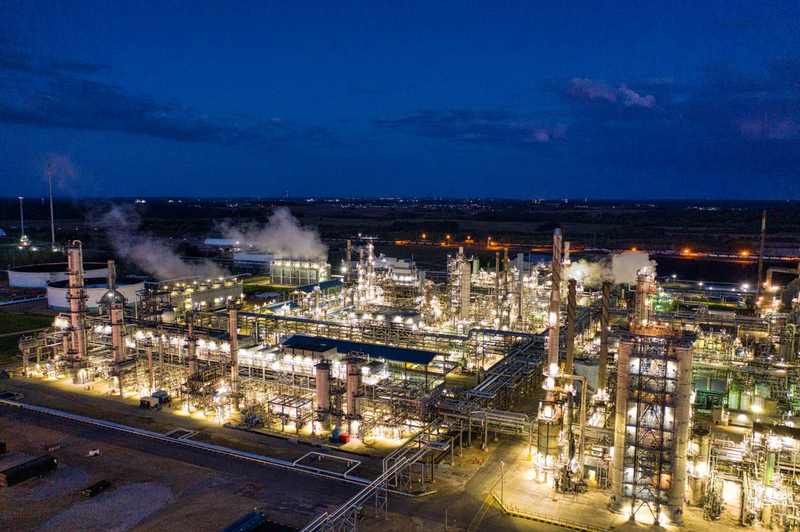
Lukoil Ukhta refinery drone strike
A 1,500-km deep strike on a Lukoil plant supplying fuel to Russia's army marks Kyiv's accelerating campaign against Russian oil — and Moscow's fuel crisis is deepening.
The Lukoil Ukhta refinery drone strike extends Ukraine's campaign against Russian energy infrastructure far beyond the immediate battlefield. Ukraine said Friday that it attacked the oil-processing plant in Russia's Komi Republic, about 1,500 kilometers northeast of Moscow. President Volodymyr Zelenskyy also confirmed a strike a day earlier on the Omsk refinery, Russia's largest, making Ukhta the fourth Russian processing facility Ukraine says it hit this week.
“We continue to respond to Russia's attacks on Ukraine and we do so with precision,” Zelenskyy said in a Telegram statement reported by Bloomberg. Lukoil did not respond to Bloomberg's request for comment. Komi Republic authorities confirmed an incident at Ukhta and said there were no casualties, while local reports described explosions, an evacuation of workers, intermittent mobile service and a temporary suspension of operations at Ukhta airport.
Ukraine's military intelligence agency, the HUR, said a petroleum-products tank was damaged and spilled fuel, and that a gas-and-condensate unit used to make propane-butane and gasoline was also hit. Those damage claims have not been independently quantified. The strategic signal, however, is clear: distance no longer offers Russia's interior energy assets the protection it once did.
Why this matters
Refineries sit at the hinge between crude oil in the ground and the usable fuels that keep an economy and a military moving. Russia can continue producing crude while still feeling pain if damaged processing plants cannot turn enough of it into diesel, gasoline and jet fuel. That is why Ukraine's campaign is designed less as a contest over one installation than as a cumulative pressure strategy.
Kyiv's stated objective is to reduce the revenue and refined products available to sustain Russia's war. The advantage for Ukraine is asymmetric: a relatively small drone can force a large industrial site to halt units, inspect pipelines, divert air defenses and spend scarce maintenance capacity. Even limited physical damage can impose wider costs when repeated across multiple regions.
The losses are also distributed unevenly. Lukoil faces repair costs, downtime and operational uncertainty. Russian consumers face shortages, purchase limits and price pressure. Regional governments must decide how to allocate fuel between households, transport, farming, industry and military demand. Ukraine gains leverage only if those disruptions persist; a quickly repaired unit produces headlines but may not materially change the war economy.
Four strikes in one week
The week's sequence matters more than any single target. Ukrainian drones earlier attacked Gazprom processing facilities at Salavat in the Urals and Astrakhan near the Caspian Sea. Ukraine then confirmed Thursday's strike on the Omsk refinery, before announcing Ukhta on Friday.
That makes four processing sites — Salavat, Astrakhan, Omsk and Ukhta — across a geographic spread that complicates air-defense planning. Concentrating defenses around western border regions leaves deeper facilities exposed. Spreading defenses across Russia's enormous territory dilutes protection around military bases, cities and other infrastructure.
Bloomberg reported that attacks on Russian oil assets have already reduced petroleum-product output, contributed to domestic shortages and rationing, and prompted Moscow to temporarily ban exports of most diesel, jet fuel and gasoline. Export restrictions can protect domestic supply in the near term, but they also reduce hard-currency sales and signal that officials see the imbalance as more than a local disruption.
The same week, Ukraine also struck Yandex data centers, according to Bloomberg. That widening target set suggests a campaign against systems that support the Russian state's economic and operational resilience, not only the refinery chain. Russia, meanwhile, has continued round-the-clock attacks on Ukrainian civilian infrastructure, residential areas, data centers, grain-export facilities and the power grid. Each side presents its strikes as a response to the other's escalation.
What 80,000 barrels a day means
The Ukhta plant has a design capacity of roughly 80,000 barrels of crude a day. In isolation, that is modest beside Omsk, Russia's largest refinery. The comparison is important: losing some output at Ukhta would not equal losing Omsk, and design capacity is not the same as actual lost production.
But smaller facilities matter when several are affected in close succession. Refining networks are interconnected through crude supply, storage, product pipelines, railcars and regional distribution. A disruption in one place can sometimes be offset elsewhere; four incidents in a week narrow that room. The decisive measure will be not the headline capacity, but how many units were damaged, how long repairs take and whether other plants can absorb the displaced demand.
There is also a winter factor. Cold-weather fuel demand, agricultural needs, transport and military logistics all compete for refined products. If repeated strikes overlap with planned maintenance or seasonal demand, the same amount of physical damage can produce a larger market effect than it would during a period of comfortable inventories.
From February to Ukhta again
Ukhta was last targeted in February, making Friday's attack part of an emerging pattern rather than a first test. Repeated targeting can force operators to repair the same vulnerabilities, harden storage and processing units, and keep emergency procedures active. It can also reveal whether previous defenses were sufficient.
The distance is central to the story. Bloomberg placed Ukhta roughly 1,500 kilometers northeast of Moscow; other reporting described the route from Ukraine as more than 2,000 kilometers. Both figures point to a deep-strike milestone, but they measure from different reference points and do not establish the launch location.
It remains unknown whether the drones flew the full distance from Ukrainian territory or were launched closer to the target. The uncertainty matters because Ukraine's June 1 “Spiderweb” operation demonstrated a different model: systems positioned inside or near Russia before launch. A long-range flight would highlight endurance and navigation. A closer launch would highlight covert logistics. Either explanation creates a different problem for Russian defenses.
Who benefits, who loses — and the escalation risk
Ukraine benefits if refinery strikes reduce Russian fuel availability, absorb air-defense resources and weaken the flow of oil revenue into the federal budget. The campaign also gives Kyiv a form of pressure at a time when Russian attacks continue against Ukraine's power system and export infrastructure.
Russian consumers and businesses can lose even when a damaged plant is far away. Rationing and export controls shift supply through the whole market. Lukoil's exposure includes direct repair costs, possible production losses and the risk that repeated attacks raise insurance and security expenses across its network.
Critics argue that the campaign carries escalation and market risks. Damage to energy infrastructure can provoke retaliation, widen the target set and add volatility to global fuel markets. President Donald Trump has urged Zelenskyy to ease refinery strikes, a pressure point examined in our report on Trump's push to curb attacks on Russian refineries. Supporters of the strikes answer that Moscow's ongoing campaign against Ukrainian energy and civilian systems leaves Kyiv with little incentive to hold back unilaterally.
The argument is therefore not simply whether a refinery is a legitimate military-economic target. It is whether the accumulated pressure improves Ukraine's negotiating position faster than it increases retaliation, civilian fuel stress and diplomatic resistance. That balance can change with repair times, battlefield conditions and the progress — or collapse — of talks.
What happens next
The first scenario is continued Ukrainian pressure. If Kyiv keeps striking refineries faster than Russia can repair or protect them, winter shortages and regional rationing could deepen. Moscow would likely prioritize military supply, restrict exports further and redirect product flows, shifting more of the burden onto consumers and commercial users.
The second scenario is adaptation. Russia can disperse air defenses, add electronic warfare around priority plants, strengthen tanks and critical units, and improve local detection. But every extra layer has an opportunity cost. Protecting Ukhta, Omsk and other distant facilities means hardware and personnel are unavailable somewhere else.
The third scenario is diplomatic pressure. Washington or other partners could push Kyiv to moderate refinery attacks in exchange for movement in negotiations or assurances on energy markets. The question is whether that restraint would be reciprocal. The broader intersection of oil assets and diplomacy is explored in our coverage of U.S.-Russia-Ukraine talks and the Lukoil oil deal.
For now, Ukhta adds another point to a weeklong pattern. The physical damage may prove limited or significant; the available reporting does not yet establish the duration of any outage. The strategic effect is easier to see. Russian planners must now treat a refinery deep in the Komi Republic as part of the active battlespace, while Ukraine must decide how far to press an energy campaign that produces leverage, risk and civilian consequences at the same time.
Related coverage
- Ukraine strikes Omsk, Russia's largest refinery
- Trump urges Zelenskyy to ease Russian refinery strikes
- Oil, Lukoil and the pressure surrounding U.S.-Russia-Ukraine talks
Sources
- Bloomberg via Rigzone — Ukraine's confirmation, plant capacity and the week's refinery strikes
- The Gaze, citing Deutsche Welle and Ukraine's HUR — reported damage, local response and range questions
Damage claims and operating effects remained subject to further verification at publication. Lukoil had not responded to Bloomberg's request for comment.
Reporting published October 9, 2026, with competing claims attributed and unresolved damage assessments identified.