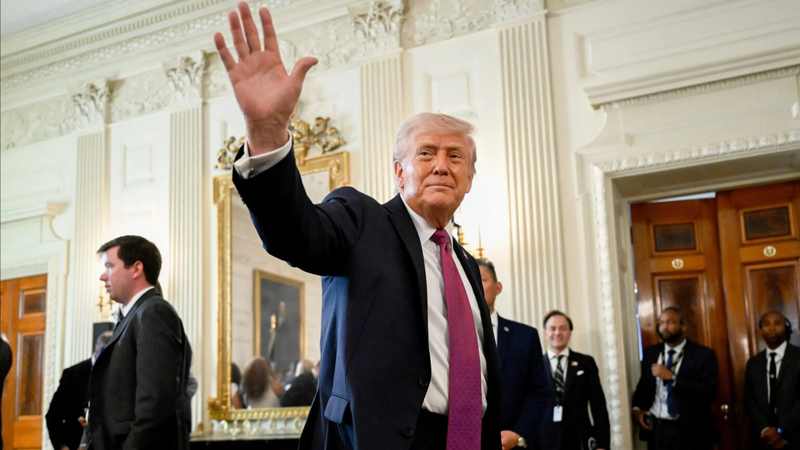
Donald Trump stayed silent on the Hasan execution livestream on Friday — publicly approving Nidal Hasan's firing-squad execution at a White House event while saying nothing about the Pentagon's unprecedented plan to broadcast it. The president confirmed Hasan would be “executed by firing squad,” but when the subject turned to the livestream, there was no comment at all. The White House directed every question to the Pentagon — an awkward dodge on a decision that has split Trump's own party and drawn condemnation from religious leaders and lawmakers in both parties.
That distinction is now central. The sentence, the method and the date have been set. The disputed question is whether the government should place the final moments of a condemned prisoner before an unrestricted public audience. By affirming the execution while declining to address the cameras, Trump separated the politically popular demand for punishment from the much less settled argument over how punishment should be displayed.
What Trump said — and didn't say
Friday's White House event was Trump's first on-camera engagement with the execution since Defense Secretary Pete Hegseth announced the livestream plan Thursday. Trump has approved the execution itself — at a Texas rally Wednesday he said, “we are going to deliver final justice to an evil killer,” and the Pentagon says the firing-squad method followed Hegseth's recommendation with Trump's sign-off.
But on the broadcast — the part generating nearly all the controversy — the president had nothing to say. The silence is the story: the White House wants the execution but does not want to own the cameras. Referring questions to the Pentagon may keep the technical decision inside the chain of command, but it does not erase presidential responsibility for an execution Trump has publicly endorsed.
That split also leaves Hegseth as the administration's principal public advocate for the livestream. It gives the Pentagon room to describe the plan as an operational matter, while critics can argue that a choice this consequential cannot be reduced to logistics. The longer Trump declines to address it, the more the silence reads as a political calculation rather than a missing detail.
Why this matters
No American execution has ever been broadcast to the public in the television or internet age; the last public execution in the United States was in 1936. A livestream would shatter an 80-year norm and force every institution — courts, Congress and the military — to decide where transparency ends and spectacle begins.
Hegseth's rationale is deterrence: “people need to understand that there's serious consequences.” Supporters argue that the public has a right to see justice carried out, particularly in a case involving an attack on service members at a military installation. In that view, openness demonstrates that the sentence is real, lawful and enforced rather than hidden behind institutional walls.
Critics counter that a broadcast turns punishment into programming, with unknowable effects on victims' families, military morale and America's standing. A public feed would not be confined to a courtroom, a controlled witness room or even a single television audience. It could be clipped, replayed and recirculated indefinitely, detached from the legal record and transformed into propaganda by anyone with an internet connection.
The timing matters too. The execution announcement came 25 days before the November 3 midterms, so every element of the story doubles as a political signal. A hard-line message about justice may appeal to voters who want visible consequences for mass violence. The livestream, however, asks a different question — whether severity is strengthened or cheapened when the state turns death into a public event.
The backlash: from 'beyond disgusting' to 'medieval'
Senator Thom Tillis, a North Carolina Republican, wrote on X Thursday: “Hasan should face the death penalty, but making his execution public and streaming it? Beyond disgusting... Public executions are what oppressive dictatorships like Iran and Afghanistan do. It should not be happening in America.” Tillis, a frequent Trump critic who is not seeking reelection, gave cover to other Republicans uneasy with the plan without asking them to oppose the execution itself.
Senator Chris Murphy, a Connecticut Democrat, learned of the plan live on CNN with Erin Burnett and called it “disgusting” and “medieval,” asking, “what is he mimicking ISIS executions?” His reaction illustrated how rapidly the controversy moved beyond the usual death-penalty divide. The first congressional fault line is not simply for or against capital punishment; it is over whether the government should make an execution available as mass media.
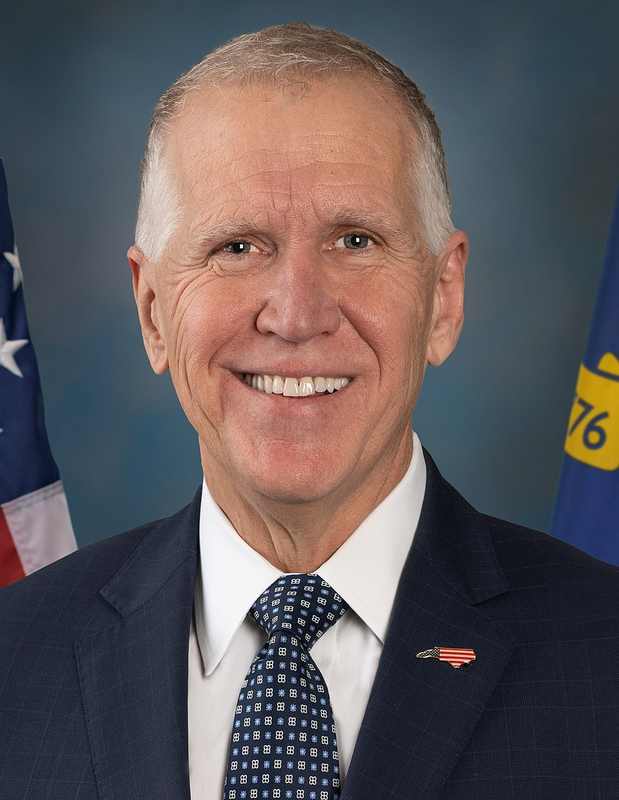
On Friday, Archbishop Paul Coakley, president of the U.S. Conference of Catholic Bishops, called the plan a “barbaric promotion of a culture of death” that “must be reconsidered.” He wrote: “Our God is the God of life. In no way can Hassan's actions be condoned but this decision is a barbaric promotion of a culture of death.”
The objections arrive from different moral and political traditions. Tillis accepts the death sentence but rejects the spectacle. Murphy attacks the plan as a descent into the imagery of extremist violence. Coakley challenges both the cultural message and the premise that public display serves justice. Their overlap matters because it makes the broadcast harder to defend as a conventional partisan choice.
The legal question
A public livestream could collide with Army Regulation 190-55, which governs military capital punishment, specifies who may witness an execution and bars minors from watching. Those limits were written for controlled physical access, not for a feed capable of reaching millions of homes and phones at once. That mismatch is likely to sit at the center of any challenge.
The Army's provost marshal general may waive provisions of the regulation, but only so long as the waiver violates no law or higher binding regulation. Expect defense counsel and civil-liberties groups to test that boundary in court before December 3; the waiver decision itself could become the first legal battleground. A judge may have to decide whether a livestream is merely a modern extension of authorized witnessing or a fundamentally different act with consequences the regulation was designed to prevent.
The bar on minors raises an obvious practical problem. An open stream cannot reliably control the age of its audience, and warnings do not amount to enforcement. Even if the Pentagon adds delay, identity checks or platform restrictions, each safeguard would weaken the claim that the execution is truly public while creating new questions about who may watch and who makes that decision.
How we got here
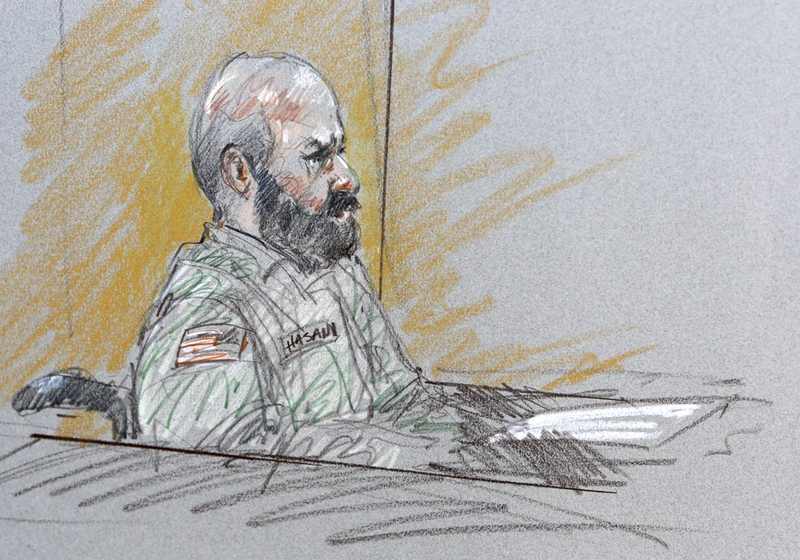
On November 5, 2009, Hasan — then an Army major and psychiatrist — opened fire at Fort Hood's Soldier Readiness Processing Center in Texas, killing 13 people and wounding 32 in the deadliest mass shooting on a U.S. military installation. Convicted in 2013 and sentenced to death, he has spent more than 13 years on death row.
On October 7, Hegseth told influencer Jack Posobiec in an interview aboard the USS Abraham Lincoln: “We'll make sure that people are able to watch it, that it's public, because people need to understand that there's serious consequences for these types of things.” He confirmed the livestream on X on October 8.
Acting Army Secretary Adam Telle set the date: December 3 at 1 p.m. Central Time, matching the approximate time of the 2009 attack. It would be the first U.S. military firing-squad execution since 1945 and the first U.S. military execution of any kind since 1961. Those historical markers explain why the mechanics of the event matter far beyond Hasan's case. Whatever the Pentagon decides could become a template for military executions that follow.
The case has therefore moved through three distinct stages: a long-settled conviction, an approved death sentence and now an unsettled plan for public transmission. Debate over the third should not be confused with doubt about the first two. Several of the most forceful critics have explicitly said Hasan should face the death penalty while insisting that the government should not broadcast it.
What happens next
Three clocks are now running. The Pentagon must decide whether to issue the Regulation 190-55 waiver. Courts will likely hear challenges within weeks. And Congress — where even Republicans are wincing — could move to restrict or require the broadcast. Each route carries different authority, and a late ruling could leave the execution schedule intact while changing only who is permitted to see it.
There are three plausible scenarios. The livestream proceeds as Hegseth promised; it is scaled back to a restricted official feed; or a court blocks the broadcast while the execution itself goes forward. A restricted feed might satisfy demands for institutional witnesses without placing the images before the entire public, but it would also represent a significant retreat from Hegseth's promise that “people are able to watch it.”
What is no longer in doubt is the execution: Trump has approved it, the date is set, and December 3 at Fort Hood is now one of the most watched dates on the American calendar — in every sense. What remains undecided is whether the administration will treat that attention as scrutiny to be managed or an audience to be invited.