War · Europe · Estonia · Russia
Estonia closes Russia border crossings \u2014 all of them, at Narva in the north and at Luhamaa and Koidula in the south-east \u2014 from December 1, after investigators foiled a pre-dawn arson attack on a drone factory outside Tallinn that the government says was ordered by Russia’s GRU military intelligence service. The Kremlin calls the accusation baseless. Estonia has not published the evidence it says it holds, and that gap between assertion and proof is now part of the story.
Track it live: Live war trackers
TALLINN, November 16, 2026 — The Estonia closes Russia border decision is, on its face, a disproportionate answer to a failed crime: an arson attack that injured nobody, damaged a factory’s windows, and ended with eight arrests. Borders between NATO and Russia do not close over broken glass. They close when a government decides that a single incident is no longer a single incident — that it is one move in a campaign, and that the cost of answering it has become lower than the cost of absorbing the next one. That is the judgement Tallinn announced on Sunday, and it is worth reading carefully, because Estonia is not a bystander in Russia’s war against Ukraine. It is a front-line NATO and European Union member that has made itself one of Kyiv’s most committed supporters, and it has now chosen the most visible peacetime instrument it owns — its own frontier — to make a point about sabotage.
Foreign Minister Margus Tsahkna announced the closure on X on Sunday, November 15, saying there was “clear evidence” that Russia’s GRU had ordered sabotage against an Estonian defence company. “Russia must understand hostile actions against Estonia come with consequences,” he wrote, according to Reuters. The crossings close on December 1. No end date was given. Prime Minister Kristen Michal framed the step the same way: as part of the answer to what he called Russia’s hybrid war, intended to reduce risk and send a clear message. Those two phrases — hybrid war, clear message — are the whole policy. The border is not being closed because closing it stops saboteurs. It is being closed because leaving it open, after a second attack on the defence industry in four months, would send a message too.
The 3 a.m. attack at Threod Systems
The trigger came in the small hours of Saturday, November 14. At about 3 a.m., attackers struck the premises of Threod Systems in Viimsi, a coastal municipality just north of Tallinn, according to Estonian officials cited by Reuters. Windows were smashed and flammable liquid was poured inside, in what investigators describe as an attempt to set off an explosion or a major fire. The company’s security foiled the attack. Nobody was injured. Threod is not a random industrial tenant: it makes long-range reconnaissance and attack drones, and it supplies Ukraine — which is precisely the profile that, in the pattern European governments now describe, makes a defence supplier a target for deniable, low-technology violence far from the front line.
The investigation moved quickly, and its speed is part of Tallinn’s case. The Internal Security Service, known as KAPO, working with the Police and Border Guard Board, detained eight people — all of them living in Latvia, not in Estonia and not in Russia. Prosecutor General Astrid Asi sought arrest warrants for five of them. KAPO’s director general, Margo Palloson, said counterintelligence work had confirmed that the operation was coordinated by the GRU. Note the structure of that claim, because everything that follows depends on it: Estonia is not saying that Russian officers crossed its border with petrol cans. It is saying that Russian military intelligence recruited, tasked or directed people living in a neighbouring country to do it. That is the standard architecture of the sabotage cases European security services have described since 2022 — cut-outs, criminal intermediaries, residents of third countries — and it is also, by design, the hardest kind of claim for an outsider to verify from the outside.
Three crossings, a two-week window, and no end date
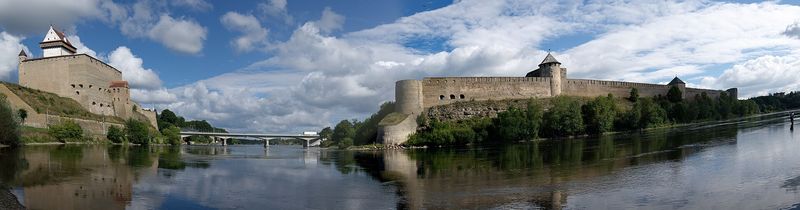
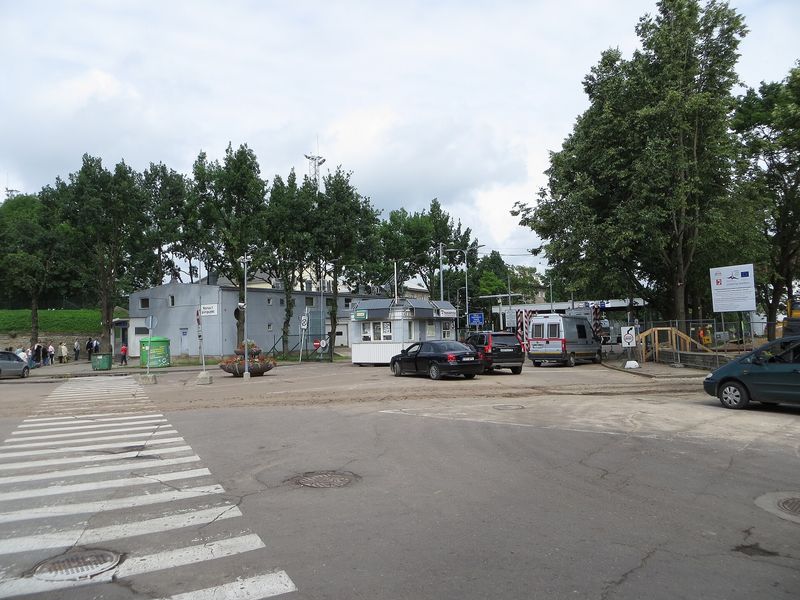
The practical content of the announcement is simple to state and large to live with. Estonia will close all of its border crossings with Russia from December 1: Narva, the principal northern crossing, where the Estonian city of Narva faces the Russian town of Ivangorod across the Narva River, and Luhamaa and Koidula in the south-east. Between them, the crossings carry pedestrians and freight, Estonia’s public broadcaster ERR reported via Reuters. Interior Minister Igor Taro is to propose the formal closure of the road crossings to the government next week, which means the announcement is a political decision whose legal instrument is still being drafted — a sequence worth noting, because it tells you the government wanted the signal out before the paperwork.
The human timetable is the two weeks between now and December 1. Estonians who are currently in Russia have roughly that long to come home before the door shuts, and the same compressed window applies, in the other direction, to hauliers, cross-border workers, families split by the frontier and the everyday traffic of a border city. Narva is a predominantly Russian-speaking city whose economy and family life have been entangled with Ivangorod’s for generations; a closure there is not an abstraction. Freight that moved through Luhamaa and Koidula will have to reroute, at cost, through Latvia or not at all. None of that is an argument that Tallinn is wrong. It is a reminder that a border closure is a tax a country levies on its own borderland first, and that governments pay it only when they judge the alternative — being seen to absorb sabotage without consequence — to be more expensive still.
And then there is the missing date. Tallinn gave a start and no end: not a two-week closure, not a closure until an investigation concludes, not a closure tied to any stated Russian action that could reverse it. An open-ended measure is a stronger signal and a weaker negotiating instrument at the same time. It tells Moscow the step is not a bargaining chip with a price attached. It also leaves Estonian businesses, and Estonians with family across the river, planning around an indefinite noun.
The Kremlin’s denial, and the evidence Estonia has not shown
On Monday, November 16, the Kremlin answered. Spokesman Dmitry Peskov rejected the accusation completely, calling it “entirely baseless” and saying, in Reuters’ reporting, “we completely reject these accusations.” He placed Estonia’s claim in what Moscow presents as a pattern of false allegations from European governments. The denial was total, unqualified and immediate — which is to say, it was the denial this Kremlin gives in every such case, and it therefore carries almost no information in either direction. It neither confirms nor meaningfully weakens Tallinn’s account. It simply completes the ritual: accusation, rejection, and a public left to judge two governments’ credibility rather than any shared body of fact.
So the honest sentence has to be written plainly: Estonia has not published the underlying evidence for the GRU’s role. Tsahkna cited “clear evidence”; Palloson said counterintelligence had confirmed GRU coordination; the detentions and the warrant applications are real, checkable facts. But the material that would let an independent reader test the central claim — communications, payments, handler links, the chain from a Russian service to eight residents of Latvia — has not been made public. There are respectable reasons for that: sources and methods, live prosecutions, the protection of the very counterintelligence work that produced the conclusion. There is also a cost, and it compounds. Every unpublished attribution asks allies, journalists and citizens to extend trust on credit, and the credit is spent a little more each time a government reaches for its largest response on the strength of evidence only it has seen. Readers should hold both halves of that at once: Estonia’s security service may well be right, and the public record, as of Monday, does not prove it.
A campaign, not an incident: Milrem in August, Threod in November
Tallinn’s strongest argument is not about November 14 at all. It is about August. The Threod attack is the second on an Estonian defence company that the government attributes to the GRU in a matter of months: in August, an arson attack hit Milrem Robotics, the Estonian maker of unmanned ground vehicles whose products, like Threod’s drones, serve Ukraine’s war effort. Signal Post News covered that case at the time: Estonia blames Russia for the arson attack on Milrem Robotics. Two attacks change the analytical category. One arson can be vandalism, extortion, a disgruntled insider, a crime in search of a motive. Two arsons, against two companies in the same small country’s Ukraine-supplying defence sector, in one season, begin to look like a target list — and a target list implies a targeting organisation.
That reading also fits the wider European picture that security officials have been assembling in public for two years: parcel fires in logistics networks, vandalism against rail and energy infrastructure, recruitment of petty criminals through messaging apps, plots against defence plants in several countries — a campaign designed to sit below the threshold of war while raising the cost, the fear and the insurance premium of supplying Ukraine. Estonia’s contribution to that picture is now two data points of its own, and a government that believes it is looking at a campaign will not calibrate its answer to the damage done by the last attack. It will calibrate to the attacks it expects next. Viewed that way, the border closure is not really about Threod’s windows. It is a deterrent addressed to the planning of the third attack: a demonstration, priced in advance, that each operation will cost Russia something it values — in this case, the remaining normality of its western frontier.
The war that forms the backdrop is tracked day by day on this site’s Ukraine war map, and the connection is not decorative. Estonia’s exposure exists because of its choices about Ukraine: the drones Threod builds, the vehicles Milrem builds, and Tallinn’s political decision to be conspicuously, disproportionately generous to Kyiv for a country of 1.4 million people. Sabotage, if the attribution holds, is the price of that posture being collected in Viimsi at 3 a.m. The closure is Tallinn’s answer that the price will be billed onward.
Why this matters
A signal that works even though the attackers came via Latvia
The obvious objection writes itself: the eight detained people lived in Latvia, so what does closing the Russian border do? As border security, very little directly — and Tallinn surely knows it. The closure’s logic is not interdiction but communication and risk reduction on the government’s own terms: fewer crossings mean fewer legal channels through which hostile services can move people, money and materiel under cover of ordinary traffic; a closed frontier is simpler to watch than an open one. Above all, the measure is legible. Diplomacy offers many ways to protest; most are invisible to the public on the other side. A shut border is understood by everyone, instantly, including the Russian public in Ivangorod looking across the river at a bridge that no longer opens. In deterrence, legibility is value.
The costs land on Narva and on freight first
Signals are not free, and this one’s invoice arrives in Estonia first. Narva’s cross-border life — family visits, medical trips, small trade, the simple fact of a neighbouring town being next door — stops on December 1 for an unknown duration. Freight through Luhamaa and Koidula reroutes or dies. Every euro of that is paid by Estonians and by the Russians and third-country nationals who used those crossings lawfully, none of whom poured anything through Threod’s windows. A serious assessment has to count that, and to ask the question Tallinn’s critics will ask in parliament: what, measurably, does Estonia get for it? The government’s answer — reduced risk, a clear message, consequences made visible — is a strategic claim, not a measurable one, and it will be judged over the winter by whether a third attack comes.
NATO’s flank, and the neighbours watching
Estonia did not act in a diplomatic vacuum. Tsahkna said he had informed Finland, Latvia and Lithuania, and that he would take the case to European Union foreign ministers meeting on November 16–17. That itinerary matters more than the border itself. If the closure remains a solitary Estonian gesture, Moscow can price it as the act of one small, hawkish state. If it becomes the template — if Latvia, which hosted the alleged perpetrators, or Lithuania, or Finland, which already closed its own Russian border in an earlier migration crisis, begin aligning their frontiers and their attribution language — then November 14 becomes the date the EU’s eastern edge started hardening as a single system. Watch the ministers’ meeting language this week for the word “consequences” in other mouths.
Who gains, who pays, and what the critics say
Tallinn’s government gains the thing it most needs if its attribution is right: a reputation, in Moscow’s planning rooms, for answering. Deterrence is a reputation business, and small states live or die by whether larger predators believe the price list is real. Ukraine gains a demonstration that supplying it is defended, politically, by the supplier states themselves. The GRU, if it ran the operation, loses a quiet channel and gains a headline it did not want; if it did not, it has been handed a grievance it will use. The clearest losers are unglamorous: Narva’s families, the hauliers, the five suspects now facing an Estonian court process whose evidence the public cannot yet see, and the principle — worth defending even in wartime’s shadow — that state accusations of this weight should eventually be shown, not merely asserted.
The critics’ case has three planks, and none is frivolous. First, evidence: a response this large, on attribution this consequential, published with no underlying proof, asks for a trust that democratic governments should spend carefully. Second, proportionality: the attack failed, hurt no one and was stopped by a factory’s own security; the response closes a national frontier indefinitely. Third, duration: a measure with no end date and no stated condition for lifting it can harden into permanence by inertia, long after the deterrent moment has passed. The government’s replies are available — intelligence cannot be published mid-prosecution; proportionality should be judged against the campaign, not the incident; open-endedness is the point of a deterrent — but they are replies, not refutations, and the argument will run in Tallinn all winter.
What happens next
The near term is procedural, and procedure will test how solid Sunday’s announcement is. Interior Minister Igor Taro takes the formal road-closure proposal to the government next week; watch whether the cabinet adopts the December 1 date and the all-crossings scope exactly as announced, or whether freight, humanitarian or local-traffic exceptions begin to appear. The court process against the detained suspects will produce the first public evidence of any kind — even the framing of charges will say more about the alleged GRU chain than any ministerial statement so far. The EU foreign ministers’ meeting on November 16–17 will show whether Estonia’s language is adopted collectively or noted politely. And December 1 itself will be a photograph: barriers at Narva, queues or silence at Luhamaa and Koidula, and a two-week scramble of Estonians in Russia deciding, now, how to get home.
Beyond that, the questions multiply outward. Will Latvia, the country the suspects lived in, announce its own measures — and what does it say that the alleged network was based there? Will Finland and Lithuania treat the Threod case as a reason to review their own crossings and their own defence suppliers’ security? Will Moscow retaliate in kind against Estonian interests, or in the asymmetric coin it prefers? And underneath them all sits the only question that will ultimately grade Tallinn’s gamble: whether the sabotage campaign against the small state that answered it hardest now goes quiet — or simply moves, as campaigns do, to the next address on the list. Estonia has bet its border that being expensive to attack is safer than being quiet. The winter will grade the bet. For the wider war’s daily movement, see this site’s reporting on Ukraine’s latest strikes inside Russia.
Sources
Reuters, November 15, 2026 — “Estonia to close Russian border crossings after attempted arson attack” (https://www.reuters.com/world/europe/estonia-close-russian-border-crossings-after-attempted-arson-attack-2026-11-15/): Tsahkna’s announcement of the December 1 closure of all crossings, the “clear evidence” of GRU involvement and the “consequences” warning; the attempted arson at Threod Systems in Viimsi at about 3 a.m. on November 14; the detention of eight people living in Latvia by KAPO and the Police and Border Guard Board; Prosecutor General Astrid Asi’s warrant applications for five; KAPO Director General Margo Palloson’s statement that counterintelligence confirmed GRU coordination; Prime Minister Kristen Michal’s hybrid-war framing; Interior Minister Igor Taro’s planned formal proposal; the August Milrem Robotics arson as the second such attributed attack; and ERR’s reporting, via Reuters, on the Narva, Luhamaa and Koidula crossings and their pedestrian and freight traffic. Reuters, November 16, 2026 — “Kremlin denies Estonian accusation Russia was behind attempted arson” (https://www.reuters.com/world/europe/kremlin-denies-estonian-accusation-russia-was-behind-attempted-arson-that-2026-11-16/): Kremlin spokesman Dmitry Peskov’s complete rejection of the accusation as “entirely baseless.” ERR (Estonian Public Broadcasting), as reported by Reuters: crossing details. The GRU attribution is Estonia’s claim, the denial is the Kremlin’s; Estonia has not published the underlying evidence, and this article says so in the text. Photographs are file photos via Wikimedia Commons and do not depict the November 14 attack.