Estonia blames Russia arson attack

TALLINN — Estonia blames Russia arson attack: Estonia said on Tuesday that an arson attack last month on Milrem Robotics, the Estonian defense company whose unmanned ground vehicles serve with Ukrainian forces, was sabotage commissioned by Russian security services. The country's Internal Security Service, KAPO, said it had concluded that the fire at the company's Tallinn premises on the night of August 14–15 was "a deliberate and pre-planned act" that was "directly attributable to the Russian Federation."
Foreign Minister Margus Tsahkna said the attack was "absolutely unacceptable" and that Russia's chargé d'affaires in Tallinn was being summoned to his ministry. Writing on X, Tsahkna said Estonia could conclude "with certainty" that the arson was "an act of sabotage ordered by the special services of the Russian Federation" — and warned that it was "part of Russia's broader campaign across Europe, aimed at intimidating us and weakening our support for Ukraine."
The Kremlin rejected the accusation outright. Spokesman Dmitry Peskov called the claims "unfounded" and "ill-considered," saying they were "absolutely not reflecting the reality" and contained no substantiation. "We cannot take such statements seriously, and we won't," he said.
Why this matters
Formal, named attribution of sabotage to a foreign intelligence service is rare — governments usually hedge, citing ongoing investigations — and that is precisely what makes Tuesday's announcement significant. Estonia did not merely say it was investigating a possible Russian link, as Prime Minister Kristen Michal did in August. It moved, deliberately and publicly, from suspicion to accusation: commissioned, pre-planned, directly attributable. In the careful language of intelligence services, that is about as loud as it gets.
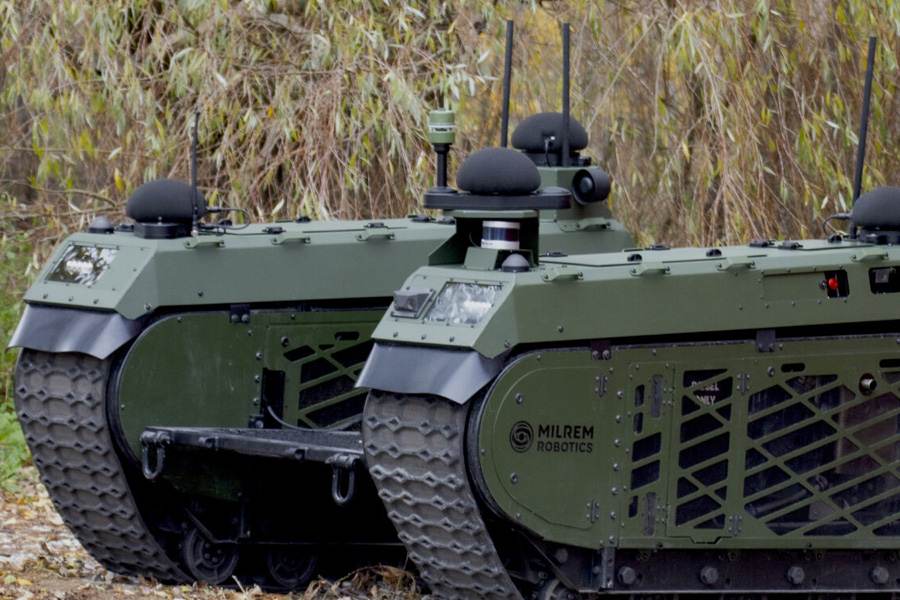
The timing and the target both matter. Milrem Robotics is not a random factory. Its THeMIS tracked robots are among the most visible symbols of European defense-tech support for Ukraine — evacuating wounded soldiers, clearing mines and hauling supplies where sending humans would mean sending targets. Fifteen are already operational in Ukraine, with more than 150 additional units funded through the Netherlands on the way. Striking the company that builds them, in the NATO capital that hosts it, sends a message Moscow has been broadcasting across the continent for two years: supporting Kyiv carries costs at home. Estonia's answer — "we will increase both our support for Ukraine and the pressure on Russia," in Tsahkna's words — is designed to show the message failed.
There is a third layer, and it is the one NATO planners lose sleep over. Arson at a defense plant sits in the gray zone that hybrid warfare was invented for: too serious to ignore, too deniable to answer with tanks. Every successful operation of this kind teaches Moscow something about European physical security, emergency response times and political pain thresholds — and teaches European publics, drip by drip, that the war in Ukraine has a front line running through their own cities. How Tallinn, Brussels and Washington calibrate the response will set the template for the next dozen attributions.
How we got here: 45 days from fire to accusation
The fire broke out overnight on August 15 at a building on Betooni Street in Tallinn used by Milrem Robotics, and was quickly brought under control, the BNS news agency reported at the time. Within days the case had a cross-border dimension: on August 17 two Latvian suspects were detained in neighboring Latvia, with a third following the next day. All three were handed over to Estonia.
KAPO's security service chief Margo Palloson told broadcaster ERR that the perpetrators were Latvians who had been living in Russia and had taken part in previous attacks — and that while Russia was "constantly planning, looking for opportunities, trying to find people who would carry out attacks," last month's arson was its first successful attack in Estonia this year. That detail reframes the story: not an isolated fire, but the one operation, out of an unknown number of attempts, that got through.
Prime Minister Michal said Tuesday's conclusion rested on information gathered by KAPO. Estonia did not disclose its evidence, citing the confidentiality of security-service work — the standard, and most contested, part of any attribution. KAPO said the Milrem attack's "modus operandi" was consistent with other acts of sabotage carried out in Europe on behalf of Russia. The company itself said the arson had no material impact on its operations or vehicle deliveries to customers, and declined to speculate on the motive.
The campaign: 200 incidents and counting
Estonia's accusation lands in the middle of what Western officials describe as a sustained Russian sabotage and disruption campaign aimed at undermining support for Ukraine and destabilizing European nations. The Associated Press has tracked around 200 incidents of sabotage and malign activity across Europe blamed on Russia since the full-scale invasion began on February 24, 2022 — a drumbeat of warehouse fires, damaged infrastructure and recruited proxies that rarely makes headlines individually but amounts, in aggregate, to a second front.
KAPO's own warning on Tuesday named the target set explicitly: defense-industry companies — "particularly those involved in drone technology" — as well as organizations supporting Ukraine, "have been among the targets of Russian security services, since the beginning of Russia's war of aggression against Ukraine." Estonia and its partners have identified and detained more than 20 people involved in physical attacks conducted for Russia since the full-scale war began, according to reporting on the case.
The numbers tell the story of an industrial-scale effort, not a series of coincidences. Recruiting nationals of third countries — in this case, Latvians reportedly living in Russia — to strike targets in a fourth is the tradecraft signature of the campaign: cheap, deniable, and designed to blur the line between crime and warfare until attribution becomes a political choice rather than a forensic certainty.
Who benefits, who loses — and what the skeptics say
For Moscow, the logic of the campaign is intimidation at wholesale prices: a torched building in Tallinn costs a fraction of a missile and forces every European defense firm to spend on security, insurance and contingency planning. For Tallinn, going public with the attribution converts a security failure into a diplomatic asset — rallying statements poured in within hours, with Swedish Prime Minister Ulf Kristersson calling the case "extremely serious" and pledging that Sweden stood fully behind Estonia, and French President Emmanuel Macron warning that "the multiplication of these hostile acts represents a dangerous escalation by Russia, which will only lead it into a dead end."
The honest caveat is the evidence gap. Estonia has not published what KAPO collected, and Peskov's dismissal — "unfounded," "ill-considered," no substantiation — will persuade those already inclined to doubt Western attributions. Intelligence-based accusations without public proof ask the audience to trust the service making them, and trust in institutions is not evenly distributed. Tallinn is betting that the pattern — the suspects, the tradecraft, the consistency with the wider campaign — is persuasive enough without showing its sources, because showing them would burn the methods that produced them.
Milrem itself is the quiet winner of the news cycle's second half: a defense firm singled out by Russian intelligence for the crime of building robots that save Ukrainian lives is a company whose order book is unlikely to suffer. The firm noted the attack did not affect production or deliveries — the operational equivalent of shrugging.
What happens next
The immediate moves are diplomatic. Summoning the chargé d'affaires is step one; step two, historically, is expulsions — of diplomats, of suspected intelligence officers operating under cover, or both. Watch whether other EU capitals follow with coordinated measures, as they have after previous attributions: the campaign framing ("broader campaign across Europe") is an explicit invitation for a collective response, and Macron's "dangerous escalation" language suggests Paris is already there.
Beyond diplomacy, expect the practical fallout to land on Europe's defense-industrial base: hardened facilities, vetted workforces, and governments quietly asking how many other Betooni Streets are on someone's target list. KAPO's warning was not subtle — drone makers and Ukraine-supporting organizations should assume they are being scoped. The uncomfortable question for NATO is the one Estonia just forced onto the agenda: at what point does a campaign of deniable arson across allied territory demand more than statements of solidarity? Tallinn has named the arsonist. What the alliance does with the name is the next chapter.
Sources
- Reuters — "Estonia says Russia ordered August arson attack on defence company," September 29, 2026 (reporting by Essi Lehto).
- Associated Press — "Estonia blames Russia for arson attack on defense company that provides vehicles to Ukraine," September 29, 2026.
- Breaking Defense — "Estonia accuses Russia of ordering August arson attack on Milrem," September 29, 2026.
- The Insider — "Estonia accuses Russia of ordering arson attack on drone manufacturer Milrem Robotics," September 29, 2026.