World · Europe · Canada · European Union
Twenty-plus deals on trade, defence, research and critical minerals — and a membership label that does not exist in any EU treaty — made Montréal the place where the map of the West was quietly redrawn this week.
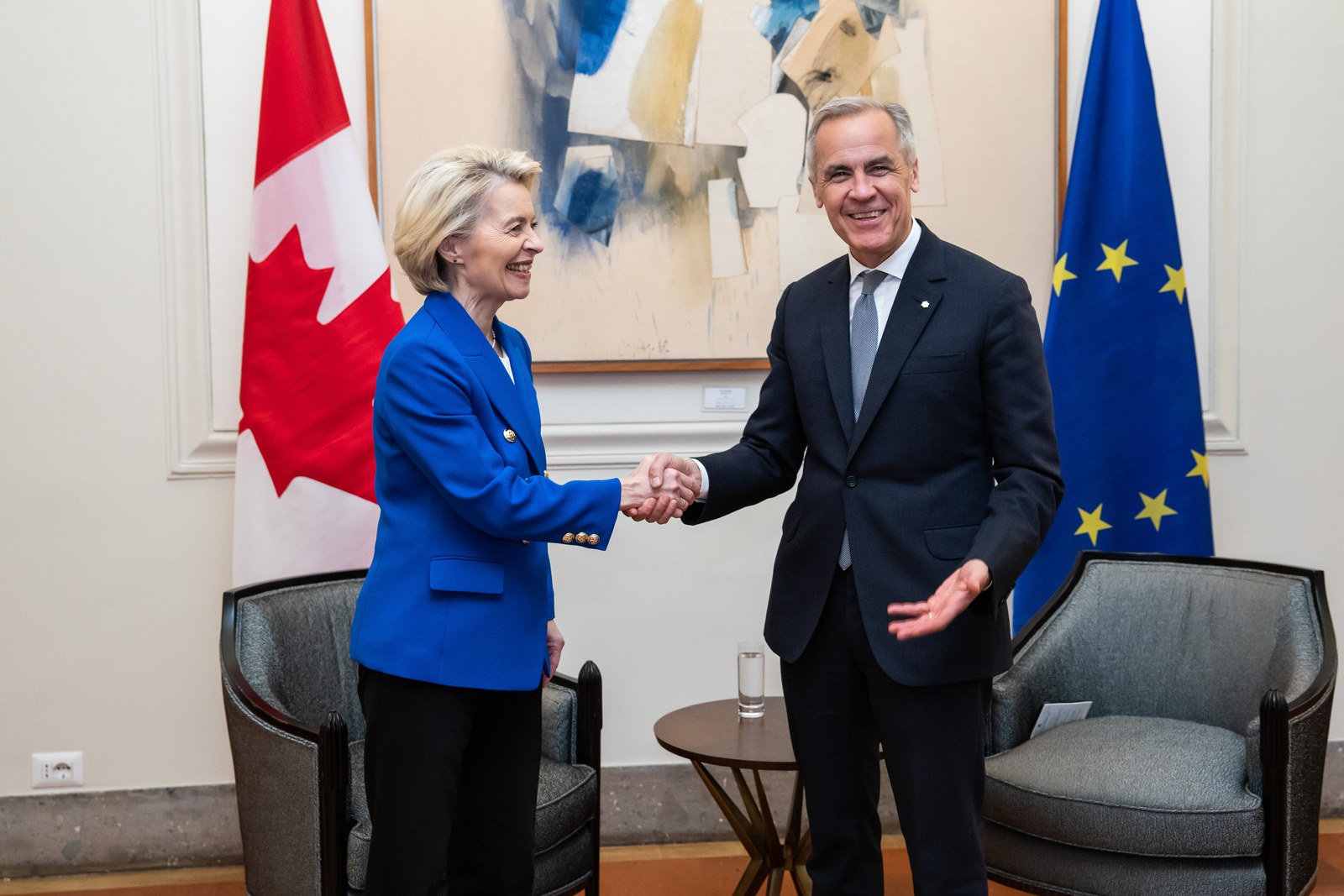
Canada and the European Union closed their 21st bilateral summit in Montréal on Friday, October 30, by launching what both sides call an Alliance for the Future — and by confirming that they are working toward the deepest partnership the EU has ever offered a country outside Europe, short of accession: Canada becoming the European Union's first Associate Member.
Prime Minister Mark Carney hosted European Council President António Costa and European Commission President Ursula von der Leyen for the two-day summit on October 29-30. In the Canadian government's own words, the two sides 'are working towards the deepest possible partnership – short of accession – with Canada becoming the European Union's first Associate Member,' and will spend the coming months determining 'the substance, scale, and scope of this form of membership.' More than twenty new measures were announced in a single day, spanning competition policy, digital trade, supercomputing, defence contracts, critical minerals and a possible transatlantic data cable.
Carney framed the moment in the language of sovereignty: 'Our Alliance with the European Union is built on shared history, common values, and mutual respect... That is what sovereignty looks like: the freedom to live our lives as we choose, on our own terms.'
What was actually signed: affordability, opportunity, sovereignty
Strip away the summit language and the package has three concrete layers.
Affordability: competition, payments and banking
Canada and the EU concluded negotiations toward a new Canada-EU Competition Agreement, allowing authorities on both sides of the Atlantic to coordinate crackdowns on anti-competitive practices by companies operating in both markets. Over the coming months the two sides will negotiate connecting their instant payment systems so Canadians can send money to people and businesses in the EU seamlessly, and a new Joint Working Group will explore opening their banking, insurance and fintech markets further to each other's firms.
Opportunity: supercomputers, digital trade, Erasmus and Horizon
Canada has joined the European High Performance Computing Joint Undertaking, giving Canadian researchers, innovators and businesses access to JUPITER, one of the world's most powerful supercomputers. The two sides concluded a Canada-EU Digital Trade Agreement — Canada's first agreement dedicated entirely to digital trade — updating the rules for selling goods and services online across Europe. Ottawa will now negotiate expanded participation in Erasmus+, Europe's flagship student and skills exchange programme, and negotiations for Canada to join the next Horizon Europe research programme, the world's biggest research collaboration. The digital stakes are not small: Canadian businesses exported nearly $15 billion in digitally deliverable services to the EU in 2024, and Canada's digital sector employs roughly 800,000 workers.
Sovereignty: helmets, waterbombers, satellites and critical minerals
On defence and security, Montréal-based Galvion will supply military helmets to Latvia — home to Canada's largest military deployment abroad — under a contract worth more than $44 million, Canada's second award through the EU's SAFE defence programme, following Montréal-based Marconi's radios for Poland's Cyber Command. Up to $2.5 billion in financing will let Alberta-based De Havilland dramatically increase production of its waterbombers in Wheatland County, Alberta, for European and Canadian wildfire fleets. The two sides will deepen cooperation on IRIS², the EU's secure satellite constellation for governments, defence and emergency services, and Canada will partner with the EU's Galileo navigation programme and the European Space Agency, including in the Arctic. Canada also signed a treaty framework allowing the European Investment Bank to invest in Canadian critical minerals projects, launched work on a raw materials stockpiling and investment framework, took first steps toward a secure transatlantic data cable, agreed to study increased LNG exports to Europe, and — in reporting from the summit — pledged an initial €500 million (about C$775 million) contribution as Canada joins an EU loan programme for Ukraine.
The label fight: 'associate member' survived — barely
The most contested words in Montréal were two: associate member. The status does not exist in the EU treaties, and reporting by Euronews, The Guardian, dpa and CBC in the days before the summit said Germany led a push by member states to strip the term from the joint declaration, arguing the substance of the partnership should be settled before it receives a label with potential legal implications; Berlin's Chancellor Friedrich Merz had himself floated a similar status in May as a step for Ukraine. Von der Leyen, who first proposed the idea in her September 16 State of the Union address — with Carney in the audience — without first consulting national governments, held her line in Montréal, describing the plan as 'an association without accession' because, she said, 'the treaties are clear and don't allow' full membership for a country outside Europe. Carney publicly played the dispute down — 'the good news is it doesn't matter about specific names or nomenclature,' he told reporters on October 27 — then used the term three times at Friday's closing press conference: 'With Canada becoming the European Union's first associate member, in the coming months, we will determine the full substance, scale and scope of this new form of membership.' Costa chose the safer formula: 'an ever-closer association — everything short of a full EU membership.' Von der Leyen described three pillars for whatever emerges: policy alignment from inception to implementation on everything from climate and energy to AI and security; fuller Canadian participation in EU programmes including Horizon Europe, Erasmus+ and the SAFE defence programme; and governance links, parliament to parliament, court to court and business to business.

Why this matters
The Montréal summit is the clearest institutional answer yet to a question that has hung over Western politics since Washington's trade war on its own allies: what do middle powers do when the largest power in their alliance becomes the source of uncertainty? Ottawa's answer is to stop treating sovereignty as something defended alone. The Canadian government's framing is explicit — in a more dangerous and divided world, sovereignty now 'requires secure access to critical minerals, semiconductors, payment systems, energy, vaccines, space-based communications, and artificial intelligence.' Almost every measure announced in Montréal maps onto that list: payment-system links reduce dependence on a single financial plumbing; the EIB framework and stockpiling work target minerals; Galileo and IRIS² target navigation and secure communications; JUPITER targets compute. Read that way, the Alliance for the Future is less a trade deal than an insurance policy — written, notably, by two parties who both still describe the United States as an ally. The context on this site is part of the same story: Carney has publicly war-gamed even extreme tail risks in the Canada-U.S. relationship, and Alberta's referendum on staying in Canada showed how much domestic politics now rides on the country's direction. A Canada that is the EU's first associate member is a Canada whose centre of gravity has measurably shifted east across the Atlantic.
How we got here
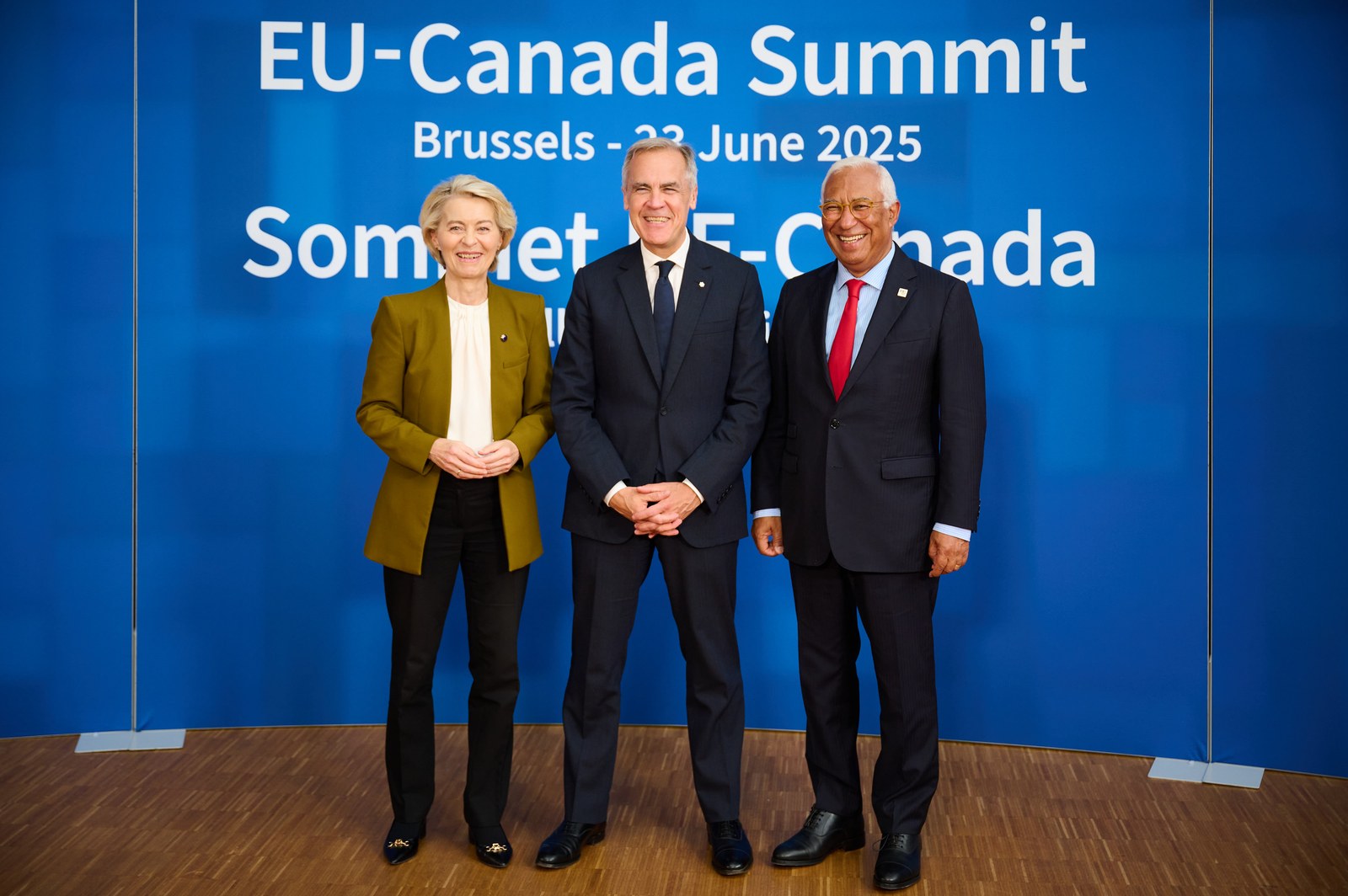
The acceleration has been remarkably fast. At the June 2025 Canada-EU summit in Brussels, the two sides announced a New EU-Canada Strategic Partnership of the Future and a Security and Defence Partnership. In February 2026, Canada became the first non-European country to join the EU's SAFE defence initiative. In May 2026, Carney became the first non-European leader to take part in a European Political Community summit, in Armenia. In September he addressed the European Parliament in Strasbourg, where von der Leyen used her State of the Union speech to float associate membership. The foundation is older: the CETA trade agreement has been provisionally in force since 2017 — though, as Le Monde noted this week, it still has not been ratified by nine EU member states, including France and Italy — and the EU is already Canada's second-largest global trading partner, with trade worth approximately $178 billion in 2025.
Who gains, who pushes back — and what the numbers say
The clearest winners are Canadian exporters and researchers: a digital trade agreement on top of CETA, a path into Horizon Europe's next framework, Erasmus+ access for students, EIB money for minerals projects, and SAFE contracts already landing in Montréal and Alberta. The EU gains a G7 energy and critical-minerals partner inside its own programmes at the moment it is trying to de-risk supply chains from both China and the United States — the same week Brussels was also holding difficult trade talks with Beijing. The sceptics' case is equally concrete. Associate membership currently confers nothing: no vote, no seat in the Council, no customs or single-market rights, and no legal existence until the EU invents one — which requires member states, several of which have not finished ratifying a trade deal signed a decade ago. German and French diplomats' insistence on substance before labels is not pedantry; any framework that looks like membership rights without membership obligations will be contested in 27 capitals. There is also a hard question for Ottawa: how much regulatory alignment with Brussels — on digital rules, competition and AI — Canada can accept in exchange for access, and whether 'association' quietly becomes rule-taking. Supporters answer that the alternative on offer in 2026 is dependence without a seat at any table at all.
What happens next
The timetable is firmer than the substance. A joint meeting of the European Commission's College of Commissioners and the Canadian cabinet is planned in Canada this spring — March, according to Carney — and Carney will then attend the European Council in June. Negotiations open on payments links, banking and insurance access, Erasmus+ expansion and Horizon Europe association, while the EIB framework and the raw materials stockpiling work begin. The test by the 2027 summit will be whether 'associate member' has acquired a legal definition, a budget line and at least one programme Canada sits inside as of right — or whether it joins the long list of summit phrases that described an ambition rather than a fact. On the evidence of Montréal — twenty measures, five signed agreements and a label its own hosts could not agree to drop — both sides are betting it becomes the former.
Sources
- Prime Minister of Canada — "Canada and the European Union announce new Alliance for the Future" (October 30, 2026).
- EU Perspectives — "EU-Canada summit: Five agreements signed, one disagreement lingering" (October 30, 2026).
- Brussels Signal — "EU and Canada meet in Montreal" (October 2026).
- Le Monde — "Ahead of EU-Canada summit, European leaders clash over terminology" (October 28, 2026).
- Canadian Press reporting via Central Alberta Online — "Canada, European Union close Montreal summit with 'alliance for the future' pact" (October 30, 2026).
This article is based on the Prime Minister of Canada's announcement of October 30, 2026, and reporting by EU Perspectives, Brussels Signal, Le Monde and the Canadian Press from the 21st Canada-EU Summit in Montréal. Quotations are as published by those sources. Analysis is by Signal Post News.