World / Economy
With a record €1 billion-a-day trade deficit, Chinese rare-earth curbs, and an EU leaders' summit two weeks away, Europe's trade chief has days to turn months of working-group diplomacy into something tangible.

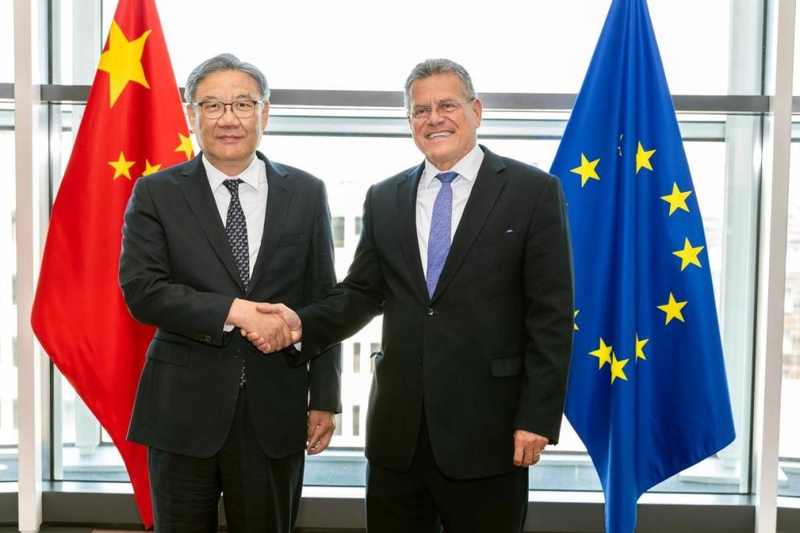
The EU China trade talks October 2026 session opened in Beijing on Thursday with European Trade Commissioner Maroš Šefčovič meeting Chinese Commerce Minister Wang Wentao over a commercial imbalance now measured at more than €1 billion a day. Šefčovič is in China on October 8–9 for the second session of the Trade and Investment Council the two officials co-chair. Europe wants tangible movement before EU leaders meet in Brussels on October 15–16; Beijing says the dispute should be handled through open cooperation and equal dialogue rather than pressure.
The agenda is unusually concentrated. Brussels wants relief from Chinese export pressure in electric vehicles, steel and batteries, wider access for European companies—including public contracts—and confidence that rare-earth supplies will keep moving. China, meanwhile, wants the EU to stop treating Chinese industry as the cause of Europe's own competitiveness problems. It has signaled possible room for purchase agreements and lower tariffs while rejecting the idea that imbalance alone proves unfair conduct.
Why this matters: a trade meeting has become a test of European power
This is not simply a negotiation over how many cars, batteries or machine tools cross a border. It is a test of whether the European Union can convert the scale of its single market into bargaining power without damaging industries that rely on Chinese inputs or consumers who benefit from lower-priced imports. The EU has spent years describing its policy as de-risking rather than decoupling. The Beijing meeting asks what that distinction means when talks do not deliver quickly enough.
The deeper significance is timing. The United States has already pushed its China trade relationship toward tariffs, restrictions and negotiated pauses. Europe has tried to preserve more space for dialogue, but its political tolerance is narrowing as deficits rise and factories face cheaper imported competition. Commission President Ursula von der Leyen told the European Parliament last month that the imbalance had reached a “tipping point” and said Europe would use “all tools at its disposal.” Those words turn Šefčovič's trip into a credibility test, not a ceremonial exchange.
There is also a wider coalition forming around the European complaint. G20 finance leaders, with China excepted, agreed in September to act against “non-market” distortions that aggravate global imbalances. Beijing's answer is that this language can disguise protectionism: in its view, politicians are exaggerating overcapacity and trade gaps to justify restricting competitive Chinese companies. Both positions can be true in part. Subsidies and unequal access can distort trade, while defensive measures can also shield less efficient producers and raise prices.
How the October deadline took shape
The immediate path to Beijing began in June, when Šefčovič and Wang met in Brussels and created working groups on four tracks: the trade and investment balance, export controls, intellectual property and reform of the World Trade Organization. Those technical groups were meant to produce measurable choices rather than another catalogue of grievances. October was set as the point when ministers would judge whether the process had yielded enough progress to continue.
The political trajectory predates that June framework. Since 2024, the EU has applied additional duties of 7.8% to 35.3% on Chinese battery-electric vehicles after concluding that state support had distorted competition. Brussels presented the duties as targeted trade defense, not a blanket effort to exclude Chinese brands. Beijing argued that the investigation and tariffs were discriminatory and has warned that further restrictions would invite a response.
The tariff design also exposed how quickly trade flows adapt. Plug-in and conventional hybrids were not covered by the battery-electric-vehicle duties. Chinese hybrid exports to the EU rose from about 3,800 vehicles in October 2024 to roughly 50,000 in July 2026. That is an increase of more than thirteen times in less than two years. For Europe, the surge suggests that a product-specific defense can redirect exports rather than reduce the underlying pressure. For Chinese manufacturers, it shows that companies are responding legally to the categories Europe itself created.
The arithmetic behind Europe's urgency
China's bilateral goods surplus with the EU reached a record €360.6 billion in 2025, 15% higher than in 2024, according to an EUobserver briefing republished by EuropeSays. It widened by about another 10% in the first four months of 2026. Put into daily language, more than €1 billion a day is roughly €365 billion over a full year—close to the scale of the 2025 annual figure. The shorthand is not rhetorical decoration; it accurately conveys a structural gap.
Deficits do not automatically prove wrongdoing. They can reflect exchange rates, consumer preference, different saving rates, energy costs and the composition of each economy. But the breadth of the surge worries European officials. The Commission's chief trade enforcement officer said nearly one-quarter of all imports were rising at a worrying rate, pointing to machinery, textiles, basic metals and chemicals. That pattern matters because it extends beyond one politically visible industry.
The central policy question is therefore not whether Europe can force bilateral trade into perfect balance. It cannot. The question is whether negotiated changes can slow the most disruptive flows while improving the ability of European firms to sell in China. Brussels is seeking limits on subsidized overcapacity, more open public procurement and possibly Chinese export caps in selected sectors. Beijing appears willing to discuss purchases of European goods and some tariff reductions, but its commerce ministry says the EU should not make China the explanation for Europe's domestic problems.
Rare earths are the quiet leverage in the room
The most immediate risk may not be visible in a trade-deficit chart. Chinese controls on rare earths and other critical minerals affect motors, wind turbines, electronics, defense systems and factory equipment. A one-year moratorium on additional restrictions—which also applies to the United States—expires in the coming weeks. Šefčovič wants assurances that European supply chains will not be disrupted after China said in June that existing controls would not cut off EU companies.
That assurance matters because licenses and shipment timing can become leverage even without a formal embargo. Some German companies have reportedly been stockpiling materials in case the talks fail or new controls follow Europe's “Made in Europe” industrial plan. Inventory can buy time, but it cannot replace a diversified supply chain. Processing capacity remains concentrated, and building alternatives takes years rather than weeks.
Rare earths also complicate a tougher European response. France and Germany are pressing for an instrument that could cut China off from the EU market within 24 hours when vital economic interests are threatened. A rapid tool may strengthen deterrence, yet using it could expose European manufacturers to retaliation in materials they cannot readily source elsewhere. The credible threat is therefore strongest when Europe also invests in alternative supply, refining and recycling.
Who benefits—and who carries the cost
European carmakers and steel producers
European producers stand to gain if the talks slow subsidized imports or create more predictable access to China. Carmakers need time to reduce costs and expand competitive electric and hybrid lineups; steelmakers want relief from price pressure they say does not reflect market economics. But protection alone cannot guarantee competitiveness. If temporary defenses are not paired with investment, cheaper energy and faster product cycles, the same vulnerability will return.
Chinese exporters and European consumers
Chinese exporters benefit from scale, integrated supply chains and a large domestic manufacturing base. Caps or new duties would narrow their access to a 450-million-person market and could encourage more production inside Europe. European consumers, meanwhile, benefit from lower prices and wider choice. They could pay more if restrictions reduce competition, though supporters of intervention argue that short-term savings should be weighed against the long-term cost of losing industrial capacity and skilled employment.
Critics on both sides
European critics of a softer line say months of working groups have not changed the headline numbers and that dialogue without enforceable commitments lets the imbalance deepen. Critics of a harder line warn that Europe risks copying protectionist tactics, provoking retaliation and asking households to subsidize incumbent producers. China's case emphasizes efficiency, competition and the danger of politicizing normal trade; Europe's case emphasizes state support, asymmetric market access and strategic dependence. A durable settlement has to address both the price of inaction and the price of escalation.
Parallel diplomacy raises the stakes
The trade channel is not operating alone. French President Emmanuel Macron's diplomatic adviser, Emmanuel Bonne, is due in China from October 9 through 13 for talks with Foreign Minister Wang Yi on strategic communication and global issues, according to Reuters' October 8 report. The overlap gives Paris a chance to reinforce the economic message while testing whether broader diplomatic cooperation can lower the temperature.
It also shows that member states are not outsourcing the relationship entirely to Brussels. National capitals have different exposures: German industry has deep commercial ties to China, France is more willing to deploy strategic trade tools, and smaller economies fear being caught between larger powers. Šefčovič must negotiate with Beijing while maintaining a European coalition strong enough to support whatever he brings home.
What happens next
Scenario one: a tangible package reaches EU leaders
The best near-term outcome is not a grand bargain. It is a package concrete enough for the October 15–16 summit: faster rare-earth licensing, verifiable purchases of European goods, progress on procurement access, and a framework for managing export surges. Even limited deliverables could justify more talks if they come with dates, monitoring and consequences. The June working groups would then become a mechanism for enforcement rather than an end in themselves.
Scenario two: vague promises shift Europe toward enforcement
If Beijing offers only general assurances, France and Germany are likely to push the summit toward “Made in Europe” preferences, sector-wide investigations and the proposed rapid cut-off tool. That path would sit alongside Europe's existing sanctions and economic-security architecture; the bloc's willingness to use autonomous tools is already visible in its recent sanctions measures involving Russia. The danger is an escalating cycle in which each side describes its measures as defensive and the other's as coercive.
Scenario three: the talks buy time while the U.S. track stays paused
Europe is also watching the parallel American channel. The U.S.–China trade truce has been extended to January 10, 2027, temporarily containing another front of the dispute. That breathing space may make a European settlement easier because Beijing faces less simultaneous pressure, or harder because trade can be redirected toward Europe. Either way, Brussels cannot treat the U.S. pause as insulation from the consequences.
The deadline after the deadline
The most important result of Beijing may be whether the two sides agree on what counts as progress. Europe wants quantities, access and supply assurances it can measure. China wants recognition that commercial success is not itself evidence of distortion and that disputes should be settled without discriminatory barriers. Those positions leave room for a negotiated package, but only if both sides accept verification.
Šefčovič's challenge is to return with enough substance to hold together governments that want tougher action and industries that fear retaliation. Wang's challenge is to offer enough movement to keep Europe's market open without accepting a precedent that export success can be negotiated away. The October session will not rebalance a €360.6 billion relationship in two days. It can, however, show whether the next phase will be governed by rules and monitored commitments—or by faster restrictions and countermeasures.
Sources: Reuters, October 7; Reuters, October 8; EUobserver briefing via EuropeSays; European Commission trade policy; European Business Magazine analysis.