A Gaza ceasefire collapse warning has come from the one institution that was supposed to prevent exactly that. The Board of Peace — established and headed by President Donald Trump to oversee the Gaza truce — has faulted both Israel and Hamas for failing to meet their commitments, in a 12-page report to the UN Security Council that warns the ceasefire is in danger of collapse and that more than two million Palestinians face another winter in tents and rubble while the peace plan stalls.
Track it live: Israel/Gaza war map · Live wars tracker
November 18, 2026 — The Gaza ceasefire collapse warning at the centre of this story is not an opposition talking point or an adversary’s propaganda. It is the considered judgement of the Board of Peace itself, delivered in its second report to the UN Security Council since the US-backed ceasefire took effect on October 10, 2025 — thirteen months ago. The 12-page report, submitted on Tuesday, November 17 and seen by Reuters, faults both Israel and Hamas for failing to meet the commitments each made under Trump’s plan, and it warns in plain language that the truce cannot hold on its current trajectory. “The distance between what has been agreed and what is happening on the ground nonetheless remains the principal risk to the process,” the report says. “A ceasefire that delivers nothing visible cannot be sustained indefinitely.” The board is expected to present its findings to the Security Council in New York at the end of November. The warning lands against a backdrop of continuing low-level fighting that our recent coverage has tracked day by day, including the killing of a senior Hamas commander in Khan Younis — see our report on the Hamas Rafah commander killed in Khan Younis.
What the Board of Peace report says
The report’s central finding is symmetrical, and the symmetry is the story. The board does not single out one party. It finds that the commitment to cease all military activities “has not been met in full by the parties”: Israel has carried out near-daily strikes against Hamas targets, and Hamas fighters have also continued attacks on Israeli troops. Each side’s violations, in the board’s telling, feed the other’s excuse for inaction on the political track. “Every day that Israel continues strikes against Hamas targets, it delays putting Hamas’ agreement to the roadmap to the test,” the report says, in a passage quoted by the Associated Press. And, in the sentence that captures the board’s even-handed frustration: “Neither party may treat the other’s delay as licence for its own inaction.”
The consequences of failure are spelled out with unusual bluntness for a diplomatic document. “Should it collapse, there would be no road map to return to, no administration to deploy and no enabling environment to rebuild,” the report warns. That is not merely a prediction of renewed fighting. It is a statement that the entire architecture built since October 2025 — the roadmap, the transitional administration, the stabilisation force, the reconstruction programme — exists only inside the ceasefire’s shelter, and would not survive its loss. The board also restated the political destination the process is supposed to serve: the end result, it said, “must lead to the credible pathway to Palestinian self-determination and statehood … and no unilateral step should be allowed to foreclose it.”
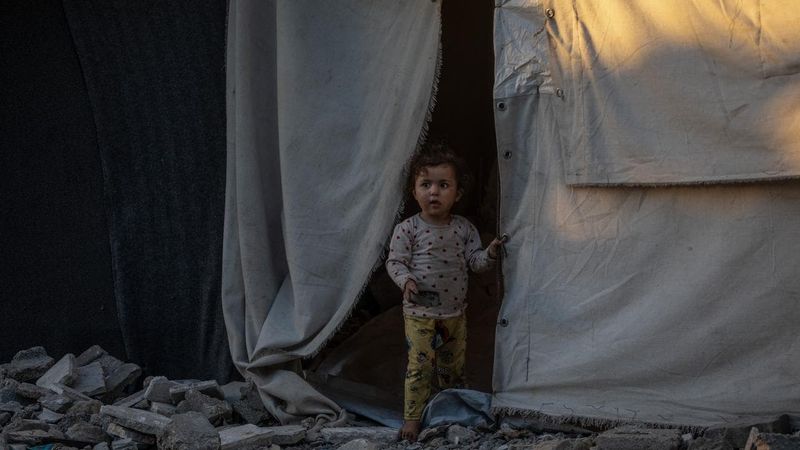
On the ground, the report describes a territory frozen in a configuration nobody chose as an end state. Gaza’s more than two million Palestinians live confined to around a third of the coastal territory, mostly in makeshift tents and damaged buildings, under Hamas control, Reuters reported. Israel occupies the other two-thirds, which are largely razed and depopulated. The ceasefire lines have hardened into a partition that the plan was supposed to dissolve — through Israeli withdrawal, Hamas disarmament and reconstruction — and instead has merely preserved.
The July roadmap Israel rejected
The plan’s central bargain was sequenced disarmament-for-withdrawal. Under the wider plan, Hamas would disarm, Israeli troops would withdraw, and reconstruction would begin. In July — the Associated Press dates Hamas’s agreement to July 30 — Hamas agreed to a Board of Peace roadmap under which it would surrender its weapons and transfer governance of Gaza to a civilian transitional authority. That agreement was the plan’s hinge: it was meant to unlock everything downstream of it.
Israel rejected the roadmap. The Israeli position, as recorded in the reporting, is that Israel will not withdraw until Hamas is dismantled — a condition that, from the board’s perspective, inverts the sequence the roadmap proposed and leaves Hamas’s July agreement untested. On Wednesday, Defence Minister Israel Katz restated that position in its hardest form: Israel would not withdraw from Gaza until Hamas was dismantled and Gaza demilitarised, Reuters reported. The board’s report does not adopt Israel’s sequencing, nor Hamas’s. Its complaint is procedural and pointed: a roadmap one side has accepted and the other has rejected cannot be implemented, and the months spent not implementing it are the months in which the ceasefire’s credibility drains away.
The report also records a Hamas practice with direct effects on civilian life: Hamas has been collecting taxes on goods entering Gaza, the board said, a practice Reuters reported is impacting the availability of basic commodities. For the board, the tax finding matters because it shows an armed authority still exercising the functions of government — collecting revenue at the crossings — thirteen months after it was supposed to begin handing those functions to a transitional administration.
The police and administration decisions that never came
If the roadmap dispute is the plan’s headline blockage, the report’s most specific criticism of Israel concerns what it calls an “absence of decisions.” The board faults Israel for taking no decisions on the arrangements needed to train, deploy and return a civilian Palestinian police force to Gaza — the force that would, in the plan’s logic, provide day-to-day security as Hamas disarms and Israeli troops pull back. Without a police decision, there is no credible answer to the question every subsequent step depends on: who keeps order in the space each side vacates?
The same absence extends to government itself. The technocratic civil administration the board created to run Gaza in transition has still not been allowed by Israel to take up its job, the report says. And because the administration cannot deploy, the international stabilisation force — the external security presence that is key, in the plan’s design, to Israeli withdrawal, Hamas disarmament and reconstruction alike — is delayed in turn. The blockages form a chain, and the report traces it link by link back to decisions that sit, unmade, in Jerusalem. Its appeal is direct: “The Board of Peace calls on the government of Israel to take these decisions without delay.”
Context matters here. Reuters notes that Prime Minister Benjamin Netanyahu’s coalition remains in power in a caretaker capacity after losing its majority in an inconclusive election last month — a government structurally inclined to defer exactly the kind of consequential, contested decisions the board is demanding. That is context, not exculpation, and the report does not treat it as an excuse. Neither Netanyahu’s office nor a Hamas political-office spokesperson immediately responded to Reuters’ requests for comment on the report.
Another winter in tents and rubble
The report’s most human passage is also its most urgent, because it is governed by a calendar nobody can negotiate with. Gaza’s displaced population faces “another winter in tents and rubble,” the board warns — the second winter since the ceasefire, spent in the same makeshift shelter that was supposed to be temporary. Restrictions imposed by Israel on supplies and equipment, together with funding shortfalls, have hindered preparedness and response for the seasonal flooding that winter brings, the report says. Heavy rain inundated displacement camps last week, and more rain is expected later this month. Our coverage of the flooding’s scale is in our report on Gaza’s winter floods and the WHO warning for displaced families and in our report on the storm that flooded 70,000 tents.
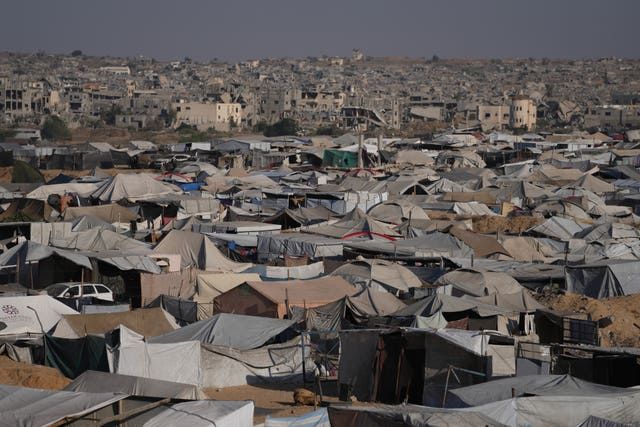
The board’s asks on winter are concrete: an immediate scaled-up entry of shelter and winterisation materials, and approvals for the pumps, generators and heavy machinery needed to drain flooded camps and keep basic services running. These are not items on a peace conference agenda; they are the difference between a miserable winter and a lethal one for families living under canvas on saturated ground. That the overseer of a peace plan is reduced to pleading for pumps and generators, thirteen months into a ceasefire, is itself a measure of how little of the plan has been built.
Why this matters
Analysis: ceasefire reports are routine; overseers do not usually warn that their own process is about to fail. Three features make this report different, and each deserves to be weighed separately from the facts above.
The overseer is faulting its own process
The Board of Peace is not a neutral UN agency or a hostile critic. It was established and is headed by Donald Trump, the author of the peace plan it oversees, and it operates with strong international backing. When such a body tells the Security Council that both parties are failing — and names Israeli governmental indecision as a specific, remediable cause — it is spending institutional credibility that a Trump-created body would be expected to hoard. That choice suggests the board believes the greater risk to its credibility is not candour now but collapse later, on its watch, after it stayed silent. It also creates a public record that neither government can easily dismiss as bias: the criticism of Israel comes from Trump’s own board, and the criticism of Hamas comes from the body whose roadmap Hamas accepted.
A ceasefire that delivers nothing loses its constituency
The report’s most quoted sentence — “A ceasefire that delivers nothing visible cannot be sustained indefinitely” — is an analytical claim, and it is the correct frame for the data. A truce that stops major fighting but delivers no withdrawal, no disarmament, no police, no administration, no reconstruction and no winter shelter asks every constituency to sustain it on faith alone. Israelis are asked to accept Hamas still armed and taxing goods at the crossings. Palestinians are asked to accept a third of their territory, tents, and an occupying army in the rest. Each side’s public can see the other side’s non-delivery more clearly than its own, which is precisely the dynamic the board’s “licence for its own inaction” sentence targets. Ceasefires do not usually die in a single dramatic breach; they die when the political cost of defending them exceeds the cost of abandoning them, on both sides at once. The board is warning that Gaza is approaching that point.
Collapse would not restore the status quo ante
The report’s bleakest judgement is that failure is not reversible. “No road map to return to, no administration to deploy and no enabling environment to rebuild” means the plan’s assets are perishable: a transitional administration that never deploys dissolves, a stabilisation force that never assembles is not re-raised on demand, donor funding pledged against a live process is not re-pledged for a dead one, and Hamas’s July agreement to a disarmament roadmap — whatever its sincerity, and the board pointedly notes it has never been put to the test — would not automatically be re-offered after a collapse into renewed war. The alternative to the plan, on the board’s own account, is not a better plan. It is nothing, followed by fighting.
Context: two reports, six months apart, the same diagnosis
The November report is the board’s second to the Security Council, and its resemblance to the first is itself the news. The first report was delivered in May by the board’s director-general, Nickolay Mladenov, a former UN Middle East envoy, who already acknowledged then that the truce had stalled, with the Hamas-disarmament deadlock paralysing progress. Six months later, the second report echoes the same issues: the same sequencing dispute, the same undeployed administration, the same absent police decisions, the same undelivered stabilisation force. A diagnosis repeated unchanged after six months is no longer a warning about a risk; it is a description of a condition.
The longer arc runs from the ceasefire of October 10, 2025 and Trump’s 20-point plan, endorsed by the Security Council, which our anniversary coverage examined in our report on the Trump Gaza plan one year on, with the ceasefire stalled. That plan’s theory was that a ceasefire, an overseer and a sequenced roadmap could convert a military stalemate into a political transition. Thirteen months on, the ceasefire and the overseer exist; the transition does not. The November report is the overseer’s formal notice that the theory is failing on its implementation, not its design.
The toll, stated exactly as reported
The human numbers frame everything above, and they are stated here exactly as the wire reporting attributes them. Around 1,200 people were killed in Israel in the Hamas-led attacks of October 2023 that began the war, Reuters reported. Israel’s assault since then has killed 74,000 Palestinians, Reuters reported. Since the ceasefire of October 2025 — during the truce itself — more than 1,600 Palestinians have been killed, a figure the Associated Press put at as many as 1,650, citing Gaza health authorities, and five Israeli soldiers have been killed, Reuters reported. Read those ceasefire-period figures slowly: a truce under which more than sixteen hundred people have been killed in thirteen months is a truce in name and in the absence of full-scale war, but not in the experience of the people living under it. That gap between the ceasefire’s name and its reality is the ground in which the board’s warning grows.
Angles: how each side hears this report
Israel’s stated position, restated by Katz on Wednesday, is that withdrawal before Hamas is dismantled and Gaza demilitarised would hand the territory back to the organisation that attacked Israel in October 2023. From Jerusalem’s perspective, the roadmap’s sequence asks Israel to surrender its leverage — territory — before Hamas surrenders its capability — weapons — and the near-daily strikes are, in that telling, enforcement rather than violation. The report does not accept that telling, but readers should hold it clearly: it is the argument the board’s demand for “decisions without delay” must overcome.
Hamas’s position, as recorded in the reporting, is that it accepted the roadmap in July — weapons surrendered, governance transferred — and that Israel’s rejection, continued strikes and restrictions are what stalled the process. Against that, the board records Hamas’s continued attacks on Israeli troops and its taxation of goods entering Gaza, both of which sit awkwardly beside the posture of a movement preparing to hand over power. The board’s institutional interest cuts across both accounts: it needs a success to justify its existence, which gives it reason to pressure both parties — and, sceptics among Western allies would add, reason to distribute blame evenly whether or not the evidence distributes evenly. Reuters notes the board has met scepticism from many Western allies despite the strong international backing for Trump’s plan. Civilians, finally, hear the report from inside the tents it describes: for them the argument about sequencing is an argument about whether the pumps, generators and shelter materials arrive before the next rain does.
What happens next: three scenarios
The immediate date is the end of November, when the board presents its findings to the Security Council in New York. Beyond that presentation, three scenarios cover the plausible range. In the first, the report works as intended: the public, even-handed warning concentrates minds, Israel takes the police and administration decisions the board demands, Hamas’s roadmap agreement is put to the test the board says Israeli strikes keep postponing, the stabilisation force assembles, and winterisation aid surges. Nothing in the past six months makes this the likeliest outcome, but it is the only one in which the plan survives in recognisable form.
In the second scenario, the report is noted and filed, and the frozen truce freezes harder: no collapse, no implementation, the partition of Gaza hardening month by month while the board issues a third report next spring saying what the second said in November. This is the “indefinite” outcome the board warns cannot be sustained — which does not mean it cannot last a long time, only that it decays as it lasts, and that each month of it raises the eventual cost. In the third scenario, the decay reaches the board’s stated end point: a major breach, a collapse, and the discovery that the report’s bleakest sentence was literal — no road map to return to, no administration to deploy, no enabling environment to rebuild, and a war resumed over a population that spent its ceasefire in tents. The board has now said, on the record and to the Security Council, that this is where the current path leads. Whether anyone with the power to change the path acts on the warning is the question the end of November will begin to answer.
Sources
Sources: Reuters, November 18, 2026 — “Trump’s Board of Peace faults Israel and Hamas for failure to end Gaza war” (reuters.com): the 12-page report seen by Reuters, the board’s second report to the UN Security Council, submitted Tuesday, November 17, to be presented to the Council at the end of November; faulting of both parties; the quotations “principal risk to the process,” “cannot be sustained indefinitely” and “no road map to return to”; the July roadmap and Israel’s rejection; the absence of Israeli decisions on a civilian Palestinian police force and the undeployed technocratic administration; Hamas taxation of goods; Gaza’s population confined to around a third of the territory; tolls of around 1,200 killed in Israel in October 2023, 74,000 Palestinians killed since, and more than 1,600 Palestinians and five Israeli soldiers killed since the October 2025 ceasefire; Defence Minister Israel Katz’s Wednesday statement; the caretaker status of Netanyahu’s coalition; Western-allied scepticism toward the board; and the absence of immediate responses from Netanyahu’s office and a Hamas spokesperson. Associated Press via AAP, November 18, 2026 — “Gaza facing ‘another winter in tents and rubble’” (aapnews.aap.com.au): the report obtained by AP and submitted Tuesday; Hamas’s agreement, dated July 30, to the Board roadmap to surrender weapons and transfer governance; the quotations “Neither party may treat the other’s delay as licence for its own inaction,” “Every day that Israel continues strikes against Hamas targets, it delays putting Hamas’ agreement to the roadmap to the test” and the “credible pathway to Palestinian self-determination and statehood” passage; the winter, flooding, shelter and equipment findings; and the figure of as many as 1,650 Palestinians killed since the ceasefire, per Gaza health authorities. Al Jazeera, November 18, 2026, also reported the board’s warning that the Gaza ceasefire faces imminent collapse without action. Photographs: EPA via AAP and AP via Press Association, credited in the captions; both are published here as news photographs of Gaza displacement and do not depict the report’s submission.