War · Middle East · Gaza
The first winter storm of the season was, by meteorological standards, an ordinary night of heavy rain. In a territory where most of more than two million people now sleep under canvas, it was enough to flood at least 70,000 tents in twelve hours, trigger 1,500 distress calls and leave tens of thousands of displaced families bailing water out of the only shelter they have.
Track it live: wars tracker and Israel war map
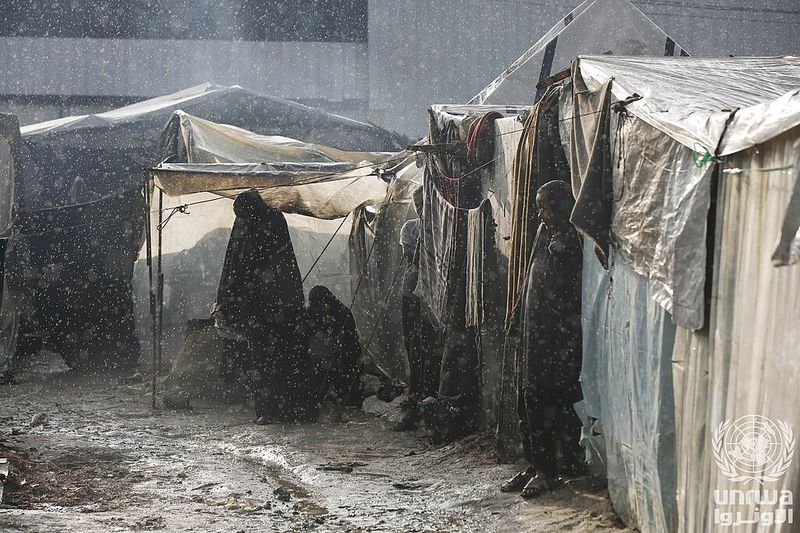
GAZA, November 7, 2026 — The pattern repeated at camp after camp was the same: Gaza rain floods tents displaced families cannot replace, and by morning the water is inside everything they own. Heavy rain overnight flooded tens of thousands of tents housing displaced Palestinians across the Gaza Strip, Reuters reported on Saturday, in the first winter storm of the season. The Hamas-run Gaza government media office said at least 70,000 tents had been flooded in the past 12 hours, affecting tens of thousands of displaced people and causing injuries, though no fatalities were reported. BBC News, reporting the same flooding on Saturday, likewise described tens of thousands of tents inundated after heavy rains. Most of Gaza’s more than two million residents were displaced by the war, and most now live in tent camps — which is why a single night of rain registered not as bad weather but as a mass shelter emergency.
Gaza’s civil defence said it had received 1,500 distress calls as the water rose, and that three abandoned houses collapsed during the storm without causing injuries. Municipal and civil defence officials said fuel shortages and damaged equipment left their crews unable to cope with the scale of the flooding — a constraint that matters because the same crews are the territory’s first responders for everything from pumping out flooded lanes to reaching families whose shelters have given way. In al-Mawasi, the coastal camp zone in the south where more than 900,000 displaced people are sheltering, the rain began at about 10 p.m. on Friday, Al Jazeera reported, and more than 125,000 families living along the coast were at particular risk as the storm moved through.
Water 30 to 40 centimetres deep inside the shelter sites
Al Jazeera reported that water levels rose 30 to 40 centimetres — roughly 12 to 16 inches — at several shelter sites within about ten hours. Civil Defence spokesman Mahmoud Basal said some shelter centres were completely flooded, with everyone inside forced out into the rain. Flooding was reported in Gaza City in the north, in Khan Younis in the south and in Deir el-Balah in the central Strip — a spread that underlines how little of the territory’s camp geography the storm spared. Families were seen wading through ankle-deep water, carrying what they could; mattresses and blankets were soaked through, and children walked barefoot through a mixture of mud and sewage, Al Jazeera reported.
The voices from inside the tents were not describing an abstraction. Olfat Magdoub, filmed sweeping water out of her tent, put the arithmetic of exhaustion into one sentence: “This is the first day of rain… we are already overwhelmed.” Rafiq Ghattas, another displaced resident, described the absence of any buffer at all: “We have no resources, no tarpaulins, no tents.” Read together, the two quotes frame the emergency more precisely than the headline number does. The crisis is not only that tents flooded; it is that the families inside them have no dry replacement for anything the water touched — no spare tent, no spare tarpaulin, in many cases no spare blanket — at the very start of a winter that will bring more rain.
Why this matters
The first storm of winter functions as a stress test, and what it tested was not the weather service. It tested the ceasefire’s central unkept promise: reconstruction. The United States-brokered ceasefire agreed last year called for eventual reconstruction of the Gaza Strip, but Reuters reported that little progress has been made, with no agreement reached on Hamas disarmament or on an Israeli troop withdrawal, and Israeli forces still controlling about two-thirds of the territory. A year on, the housing stock that war destroyed has not been rebuilt, so the population still sleeps in the emergency shelter that was meant to be temporary. Friday night is what that gap looks like when it rains: an emergency measured not in damaged buildings but in tens of thousands of flooded tents, because tents are where the housing is.
The shelter arithmetic underneath the storm is stark, and it was documented before the rain arrived. In a situation report dated November 5, the United Nations Office for the Coordination of Humanitarian Affairs (OCHA), citing the Shelter Cluster, estimated that as of November 1 Gaza needed about 121,000 tents and 1.7 million mattresses — against stocks inside the territory of about 2,800 tents and 4,993 mattresses. OCHA warned that funding, procurement and entry delays could push much of the shelter pipeline into the second half of winter. Gaza’s emergency committee, for its part, said more than one million displaced people face winter dangers and that the territory urgently needs about 200,000 tents, plus heating supplies. Set the night’s damage against those numbers and the structural problem comes into focus: a single storm flooded roughly twenty-five times as many tents as the aid system currently holds in reserve inside Gaza.
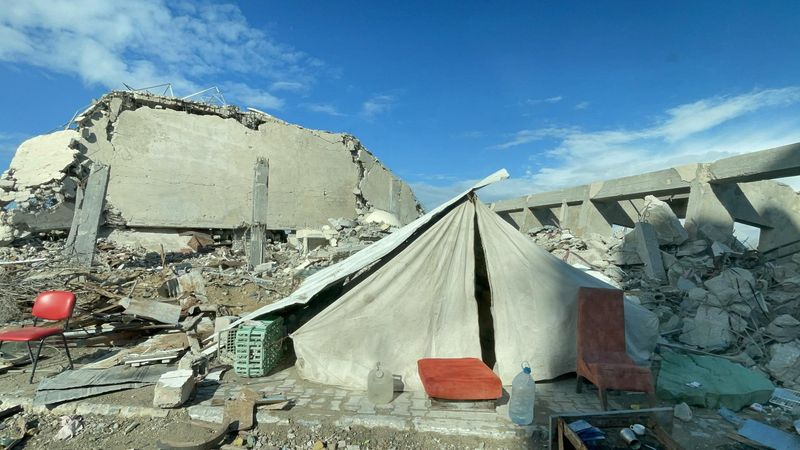
The second-order risk is the water itself. In functioning cities, storm water drains away; in Gaza’s camps it mixes with sewage. Families were reported wading through water that combined rain, mud and sewage, and aid officials have long warned that flooded lanes, overwhelmed sanitation and soaked bedding create the conditions in which waterborne and respiratory disease spread through crowded camps — illnesses that hit children and the elderly first, in a health system the war has already badly damaged. The storm’s damage therefore does not end when the water recedes: it continues in wet mattresses that cannot be dried, in contaminated lanes, and in clinics asked to treat preventable disease with depleted supplies.
None of this is what rain does on its own. Rain becomes a humanitarian emergency only where the systems that normally absorb it have been destroyed first: permanent housing gone, drainage and sewage networks damaged, fuel for pumps and trucks short, rescue equipment worn or broken, and a replacement-shelter pipeline measured in thousands against needs measured in hundreds of thousands. That is the analytical core of Saturday’s story. The storm was the trigger; the emergency was built over two years.
The numbers behind the flooding
- 70,000 tents in 12 hours: the Hamas-run Gaza government media office said at least 70,000 tents were flooded in the twelve hours of the storm, affecting tens of thousands of displaced people, with injuries but no reported fatalities. The figure is an official claim from Gaza’s authorities; Reuters and the BBC independently corroborated flooding on a scale of tens of thousands of tents.
- 1,500 distress calls: Gaza’s civil defence said it received 1,500 distress calls during the storm — roughly 150 an hour across the night — and reported three abandoned houses collapsing without injuries.
- 30 to 40 centimetres of water: Al Jazeera reported water rising 30–40 cm (12–16 in) at several shelter sites within about ten hours, with some shelter centres flooded completely.
- 200,000 tents requested vs about 2,800 in stock: Gaza’s emergency committee said the territory urgently needs about 200,000 tents and heating supplies. The Shelter Cluster estimates cited by OCHA put the assessed tent need at about 121,000, against roughly 2,800 tents actually stocked inside Gaza as of November 1.
- 900,000 people in al-Mawasi alone: more than 900,000 displaced people are sheltering in the al-Mawasi coastal zone, Al Jazeera reported, with more than 125,000 families along the coast at particular risk from flooding.
Background: two years of war, a ceasefire, and a rebuild that has barely begun
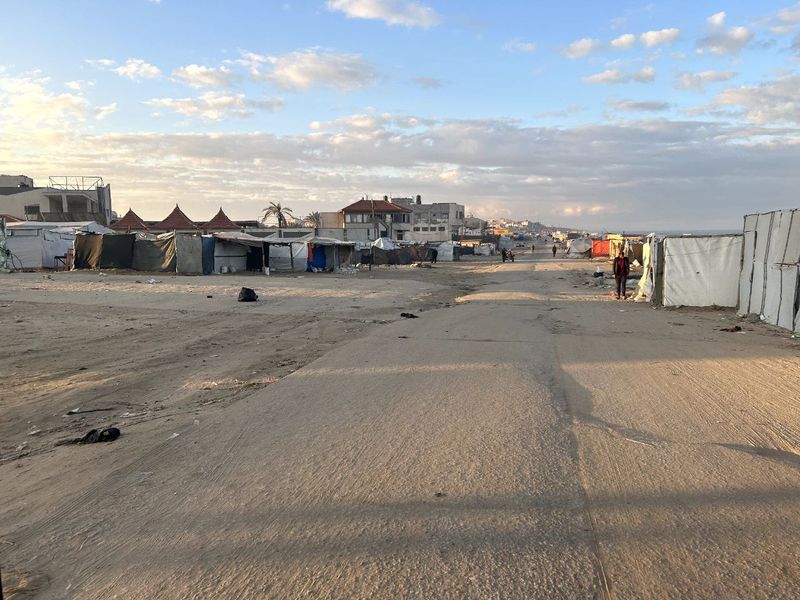
The war that emptied Gaza’s cities began after the Hamas-led attack on Israel of October 7, 2023, and the Israeli military campaign that followed it. Over the following two years, most of the territory’s more than two million residents were displaced — many repeatedly — as fighting moved from district to district, and the majority ended up in tent camps and makeshift shelters, from the coastal strip at al-Mawasi to school buildings and the ruins of damaged homes. Our coverage of the Gaza ceasefire’s one-year anniversary traced how the truce agreed last year stopped the largest-scale fighting without producing the reconstruction it envisaged, and our reporting on displacement along Gaza’s “yellow line” documented how much of the population remains unable to return home. Friday night’s flooding is the latest chapter of that same story, told by weather instead of weapons: the camps that were supposed to be a way-station have become the territory’s housing, and they were never built to survive a winter.
What each side says
Gaza’s civil defence and Hamas-run authorities describe a rescue system overwhelmed by design and by shortage. The civil defence reported the 1,500 distress calls and the collapsed houses; its spokesman, Mahmoud Basal, said entire shelter centres flooded and emptied. Municipal and civil defence officials told Reuters that fuel shortages and damaged equipment made it impossible to cope — a claim about capacity that is consistent with the volume of calls. The Hamas-run government media office supplied the 70,000-tent figure and accused Israel over the conditions in the camps; Signal Post News reports those accusations as claims made by Gaza’s authorities, and notes that the underlying flooding itself was corroborated by multiple outlets.
COGAT, the Israeli military agency that coordinates aid, did not immediately comment on the Hamas accusations, Reuters reported. It said on Friday — before the heaviest rain — that it had stepped up efforts to improve sanitary conditions in Gaza ahead of the expected heavy rain, in coordination with international organisations. Four additional vacuum trucks entered Gaza this week via the International Committee of the Red Cross, COGAT’s account noted, joining eight brought in over the past month for sewage pumping, waste removal and water and sewage repairs. Those trucks speak to the same problem the civil defence describes — sanitation systems under strain — from the other side of the argument about who is responsible for fixing them.
Aid agencies frame the night as a pipeline failure foretold. The OCHA situation report of November 5 — two days before the storm — had already laid out the gap between assessed shelter needs and the stocks physically inside Gaza, and warned that delays in funding, procurement and the entry of supplies could push much of the shelter pipeline into the second half of winter. The emergency committee’s call for about 200,000 tents and heating supplies, and its warning that more than one million displaced people face winter dangers, extends the same point: on the agencies’ own numbers, the system entered the rainy season without the inventory to replace what one storm destroyed.
What happens next
More rain is coming — that is the one certainty of a Mediterranean winter, and it is why Friday night reads as a warning rather than an episode. Three things will decide how the next storm goes. The first is the winterization race: how many tents, tarpaulins, mattresses and heating supplies can actually be brought in and distributed before the heaviest rains, measured against the gap OCHA documented on November 5. The second is drainage and sanitation: whether the vacuum trucks and repairs both sides describe can keep sewage out of the floodwater in the densest camps, al-Mawasi above all. The third is political: whether the stalled questions behind the ceasefire — disarmament, withdrawal, and the reconstruction both were supposed to unlock — move at all, because every scenario in which families spend a second winter under canvas begins with those files staying closed.
The scenarios branch from there. In the best case, the storm accelerates the shelter pipeline, stocks are rebuilt faster than the OCHA timeline feared, and the next heavy rain is a hardship rather than a territory-wide emergency. In the harder case — the one the current numbers describe — each successive storm floods tents that were never replaced from the last one, distress calls rise, and the winter becomes a slow emergency of disease, cold and exhaustion rather than a single dramatic night. What to watch is concrete: the arrival and distribution of tents and winter supplies, the civil defence’s call volumes in the next storm, and any movement on reconstruction. Olfat Magdoub’s sentence, spoken while sweeping out her tent on the first day of rain, is the benchmark against which the winter will be measured: “we are already overwhelmed.” The season has only just begun.
Sources: Reuters, reporting from Gaza and Cairo by Dawoud Abu Alkas and Nidal al-Mughrabi (November 7, 2026), on the flooding of tens of thousands of tents, the Gaza government media office’s figure of at least 70,000 flooded tents, the civil defence’s 1,500 distress calls, fuel and equipment shortages, COGAT’s stated preparations and vacuum-truck deliveries, and the stalled reconstruction under last year’s ceasefire; Al Jazeera (November 7, 2026), on water levels of 30–40 cm at shelter sites, Civil Defence spokesman Mahmoud Basal’s account of fully flooded shelter centres, flooding in Gaza City, Khan Younis and Deir el-Balah, conditions in al-Mawasi and the emergency committee’s call for about 200,000 tents; BBC News (November 7, 2026), corroborating that tens of thousands of tents were flooded after heavy rains in Gaza; UN OCHA situation report (November 5, 2026), citing Shelter Cluster estimates as of November 1 of a need for about 121,000 tents and 1.7 million mattresses against stocks inside Gaza of about 2,800 tents and 4,993 mattresses. Figures attributed to Gaza’s Hamas-run authorities and to COGAT are reported as those parties’ claims and statements.