World · India · Assam
The Assam Kaziranga bus crash killed 26 people on Friday afternoon when a passenger minibus and a container truck met head-on on National Highway 715 at Rangajan, beside the Hathikuli Tea Estate in the Kohora range of Kaziranga National Park — on a stretch of highway where speed is restricted precisely because it runs through one of the world’s great wildlife corridors, and in a vehicle that transport officials say had already been fined repeatedly for overspeeding on that same corridor.
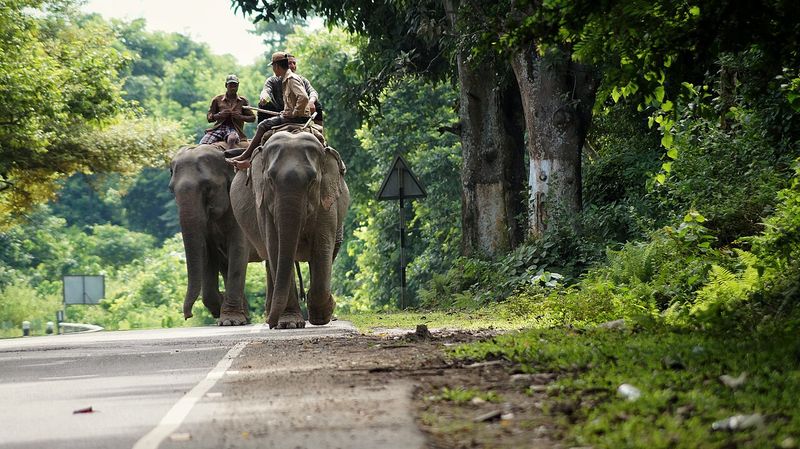
GOLAGHAT, Assam, November 15, 2026 — The Assam Kaziranga bus crash is now Assam’s deadliest road disaster of the year, and its outline, two days on, is both clear and unfinished. On Friday afternoon — reports vary on the exact hour, and this article does not pin one — a passenger minibus, a Force Traveller travelling from the Golaghat and Bokakhat side towards Nagaon, collided head-on with a container truck travelling from Tezpur towards Dibrugarh and Upper Assam. The vehicles met at Rangajan, near the Hathikuli Tea Estate, in the Kohora range of Kaziranga National Park, on National Highway 715 in Golaghat district. Twenty-six people are dead, a toll confirmed by Dr Dipam Kumar Barman of Kohora Model Hospital and by a Golaghat Executive Magistrate, the Press Trust of India (PTI) reported. The count of the dead rose as the weekend began — 23 in Friday’s first scans, 25 by Friday night, 26 in the confirmed Saturday figure — and the count of the injured was still moving on Saturday, for reasons this article sets out carefully below, because on a story like this the numbers are the story, and getting them precisely attributed matters more than getting them quickly.
What happened at Rangajan
What is established is the geometry of the collision, and it is the worst geometry a road can produce. Two vehicles, travelling in opposite directions on a two-way highway, met front to front. The minibus was the smaller vehicle by an enormous margin: a Force Traveller is a light passenger van, built to carry people in rows of seats behind a driver, with none of the mass, height or engineered crush structure of the container truck it struck. In a head-on collision between a loaded passenger minibus and a container truck, the physics are not a contest, and the toll — 26 dead out of a vehicle whose seated capacity was around 30 — reflects that asymmetry. Survivors were taken to hospitals in the Kohora and Golaghat area; the dead were moved, as Saturday’s work began, to Swahid Kushal Konwar Civil Hospital in Golaghat for autopsy.
Beyond the geometry, the honest account of Friday afternoon is a short one. Police have given a preliminary view of the cause, set out in full below, and a forensic team has been at the site. A video said to be dashcam footage from the truck has circulated online and appears to show the minibus veering into the truck’s lane; it is a purported video, widely shared, and it is not an official finding. No final determination of cause has been made by any authority, and none is reported here as fact. What the rest of this article does is separate, at each step, what officials have confirmed, what they have said provisionally, what they have alleged, and what remains unknown — because in the first 48 hours of a mass-casualty crash, those four categories are routinely collapsed into one, and the collapse is where misreporting lives.
The toll: 26 dead, and an injured count that moved
The dead
The death toll of 26 was confirmed by Dr Dipam Kumar Barman of Kohora Model Hospital and by a Golaghat Executive Magistrate, PTI reported — a doctor and a district official, the two confirmations that turn a reported toll into an established one. The figure had climbed through Friday: 23 dead in the first comprehensive scans of the crash on Friday, 25 by Friday night, and 26 in the confirmed count that followed. A rising toll in the first day of a crash of this kind usually reflects the same grim arithmetic — the critically injured dying in hospital, and the dead being recovered and counted as the wreck is fully cleared — and officials have presented the 26 figure as the confirmed toll, not a provisional one.
The injured: both figures, attributed
The injured count requires more care, because two different figures are on the record and they do not agree. Initial PTI reports put the injured at 20. The latest PTI update, on Saturday, citing Minister Ranoj Pegu, put the injured at 18, of whom seven were critical. This article carries both figures, with their sources, rather than flattening them into one: an injured count that falls from 20 to 18 between an initial wire report and a minister’s Saturday update can reflect patients discharged, patients transferred and counted elsewhere, or early double-counting corrected — and, on the record available, it is not possible to say which. What can be said is that the most recent official figure is 18 injured with seven critical, per PTI’s Saturday update via Minister Pegu, and that the earlier figure of 20 injured stands in the initial PTI reporting. If the seven critical patients’ condition changes, the toll itself may not yet be final; that, too, is stated as a possibility, not a prediction.
How many people were on the minibus? Nobody has established it
The single most consequential unknown in this crash is also the simplest question: how many people were aboard the minibus when it hit the truck? It has not been firmly established, and any report that gives one number as settled fact is ahead of the evidence. The figures on the record span an extraordinary range. Reports have put the number aboard at more than 35. Golaghat’s Senior Superintendent of Police, Swapnaneel Deka, estimated around 45. And a survivor claimed the vehicle was carrying around 60 people — against a capacity of roughly 30. That survivor’s claim is unverified, and it is under inquiry; it is reported here because officials are examining it, not because it is established. Read the three figures together and they describe a vehicle that was, on every account including the most conservative, carrying more people than the 26 dead alone would suggest at first glance — and, on the police estimate and the survivor’s claim, carrying substantially more people than it was built to carry. Overloading is one of the two subjects — with speeding — that the district administration has ordered a thorough inquiry into. Until that inquiry reports, the aboard figure remains what it is on the record: a range of attributed estimates, not a number.
The police account — preliminary, and labelled as such
The police account of the crash, given by SSP Swapnaneel Deka to PTI, is this: the minibus was travelling at very high speed, in violation of the speed restrictions that apply in the Kaziranga corridor; its driver lost control; and the vehicle collided with the oncoming truck. A forensic team has examined the site. That account is a preliminary view — the assessment of the district’s senior police officer in the first phase of an investigation, offered while forensic work continues — and it is reported here in exactly those terms. Rash and negligent driving, on the present record, is the police’s preliminary characterisation, not a court’s finding and not an inquiry’s conclusion. No foul-play claim has been made by police: on every official account, this was a crash, not an attack, and nothing in the reporting suggests otherwise.
Two supporting details belong beside the police account, each with its own weight. The first is the video: footage described as the truck’s dashcam recording has circulated online since the crash and appears to show the minibus veering across into the truck’s path. It is consistent with the police’s preliminary view. It is also, at this stage, a purported video — its provenance has not been certified by any authority as evidence, and a clip’s circulation is not a forensic finding. The second detail is documentary, and it is harder: the minibus’s own enforcement history, which transport officials placed on the record on Saturday, and which transforms this crash from a story about one afternoon’s driving into a story about a system that had already caught this vehicle, repeatedly, and let it keep carrying passengers.
A vehicle the system had already caught
The minibus was registered to Anjir Ali of Nagaon, a district transport official told PTI and Jagran. Its record, on the official’s account, includes a fine of Rs 4,000 imposed in Jorhat on March 3 after the vehicle was recorded travelling at 102 kilometres per hour — and, beyond that single fine, repeated overspeeding violations and multiple challans, the official said, including on the Kaziranga corridor itself. Each element of that paragraph is attributed to the transport official who stated it, and the inquiry will test it. But if the record is as the DTO describes, then the central fact of this disaster is not that a speeding minibus escaped official notice. It is that official notice — fines, challans, a documented pattern on the very corridor where the crash happened — did not at any point take the vehicle, its permit or its driver off the road. A Rs 4,000 fine is a price, not a prohibition; an operator who can pay it treats it as a cost of business, and the passengers who boarded on Friday had no way of knowing that the vehicle’s speed had already been the subject of repeated official action. That gap — between enforcement as revenue and enforcement as removal — is where the inquiry’s most important questions sit.
The victims: an identification still in progress
The driver, Abdul Mujid, was among the dead. Among those identified in the early lists were a 12-year-old boy, Anurag Goala; Jyoti Majhi; Darpana Majhi; Rashid Ali; Hafiza Khatun; Farhana Yasmin; and the vehicle’s handyman, known in the reporting as Subhash. Those names are carried here as what they are: names from early identification lists, which grew from 14 identified at first to 23 or 24 by Saturday, with two of the dead still unidentified as the weekend began. Identification was still in progress, and this article does not publish anything resembling a full list, because no complete, confirmed list exists yet to publish. Autopsies were under way on Saturday at Swahid Kushal Konwar Civil Hospital in Golaghat, after which the identified dead would be released to their families.
The response: ministers, compensation and an inquiry
The state government’s response moved on two tracks over the weekend — presence and money — while the district set the inquiry in motion. Chief Minister Himanta Biswa Sarma deputed Minister Ranoj Pegu to the crash site and the hospitals, and Sarma himself was scheduled to visit bereaved families and the injured in Golaghat on Saturday. Minister Atul Bora, the local MLA, had supervised relief work on Friday, in the crash’s immediate aftermath. From Delhi, Prime Minister Narendra Modi announced compensation from the Prime Minister’s National Relief Fund: Rs 2 lakh to the next of kin of each of the dead, and Rs 50,000 to each of the injured. President Droupadi Murmu expressed grief at the loss of life. And the Golaghat district administration ordered a thorough inquiry into the two questions the first 48 hours had already framed: overloading, and speeding.
The politics arrived on schedule, and is reported with its label on. Congress MP Gaurav Gogoi blamed alleged corruption and poor road construction for the disaster — an opposition claim, made by an opposition politician, which the inquiry has neither adopted nor tested, and which is recorded here as a claim rather than a finding. The distinction matters in both directions: an opposition’s allegation is not evidence, and an inquiry ordered by a district administration is not an acquittal. What would actually answer the political argument is the inquiry’s handling of the documentary record — the challans, the fines, the corridor’s speed-enforcement logs — because that record, unlike the rhetoric, can be checked.
Why this matters
Analysis, labelled as such. The first significance of the Rangajan crash is what it reveals about the distance between a rule and its enforcement. The Kaziranga corridor is not an ordinary stretch of highway where speed limits are a formality. It is a designated animal corridor through a national park, where speed restrictions exist because elephants, rhinos and deer cross the road, and where the state has every institutional reason — conservation law, tourism, international attention — to police speed seriously. If, on the transport department’s own account, a passenger vehicle could accumulate repeated overspeeding challans on that corridor, be fined in March for travelling at 102 km/h, and still be carrying a full — possibly grossly overloaded — load of passengers in November, then the failure is not a missing rule. The rules existed, were applied, generated paperwork, and changed nothing. Enforcement that ends at a payable fine is, for a commercial operator running on thin margins and tight schedules, simply a toll — and a toll does not slow anyone down.
The second significance is economic, and it explains why vehicles like this one are full. A minibus on the Golaghat–Nagaon run sells the cheapest fast seat between the towns of the valley. Every additional passenger carried beyond the legal load is revenue collected at no additional cost — the same fuel, the same driver, the same trip — which is why overloading is not an aberration in informal and semi-formal passenger transport but a standing temptation built into its economics, resisted only where inspection is real and penalties bite. The survivor’s unverified claim of some 60 people in a vehicle built for about 30, if the inquiry were to sustain even a substantially lower figure, would describe not a driver’s whim but a business model. And speed compounds it: a schedule that can only be kept by driving fast through a restricted corridor is a schedule that prices its passengers’ safety at zero. The inquiry’s terms — overloading and speeding, together — suggest the district understands the two as one system, and it is right to.
The third significance is the corridor itself, where two public goods have been set against each other for decades. NH 715 is Upper Assam’s artery: the container truck in this collision, running from Tezpur towards Dibrugarh, was doing exactly what the highway exists to do, and the tea gardens of Hathikuli, the towns of the valley and the park’s own tourism all depend on the same road. Kaziranga’s animals depend on crossing it. Every serious proposal for the corridor — stricter automated speed enforcement, fenced crossings, elevated sections that lift traffic above animal movement — is an attempt to stop asking drivers to reconcile, at highway speed and on a schedule, two claims that should never have been left to individual judgement. A crash that kills 26 people on the corridor’s most sensitive stretch will inevitably reopen that argument, and the inquiry’s findings on speed will be read, in Dispur and in Delhi, as evidence in it.
Context: India’s roads, and the crashes that change nothing — until one does
India’s road-safety record is, by the consistent account of its own official statistics and of every international assessment, among the most lethal in the world, and its highways kill in patterns that repeat with grim regularity — head-on collisions on two-way roads, overloaded passenger vehicles, speed as the common accelerant, and enforcement that documents violations more reliably than it prevents them. The Rangajan crash fits that pattern so exactly that its individual details can obscure its typicality. What distinguishes a crash that produces reform from one that produces only a news cycle is usually whether the paper trail — the prior fines, the ignored challans, the known pattern — becomes the story. Here, unusually, officials themselves put the paper trail on the record within a day. What they do with it is the test.

Assam’s own geography sharpens the pattern. The Brahmaputra valley’s towns strung along the highways, the tea-garden workforce whose families travel these routes, and the rivers that make bridges and embankments the valley’s chokepoints all concentrate the state’s movement onto a small number of two-way corridors, of which the Kaziranga stretch is the most sensitive and the most symbolic. This newsroom’s recent coverage of the region’s transport dangers — a passenger van that plunged into the Yasin River in Pakistan’s Ghizer district, killing 11, and the train collision south of Cairo that killed seven and injured more than 100 — describes the same underlying condition: mass movement carried by vehicles and infrastructure whose safety margins are consumed, trip by trip, by speed, load and deferred enforcement. Rangajan is the Assamese instance of a regional fact.
What happens next
Analysis — scenarios, not predictions. The immediate sequence is administrative and human. Autopsies at Swahid Kushal Konwar Civil Hospital will be completed and the identified dead released to their families; the two still-unidentified dead, as of Saturday, will be identified or held for further process; the seven critical patients named in PTI’s Saturday update will decide, in the hardest sense, whether 26 is the final toll. The chief minister’s scheduled visit to Golaghat’s bereaved families and injured will put the state government’s face to its compensation and its inquiry. And the district inquiry into overloading and speeding will work through the questions the first two days have queued for it: how many people were aboard; what the forensic examination establishes about speed and lane position; whether the purported dashcam video is authenticated and entered as evidence; and what the minibus’s complete challan and permit history shows about who knew what, and when.
Beyond the inquiry, the watchpoints are enforcement’s, and they are measurable. Does the corridor get sustained, visible speed enforcement — patrols, cameras, impoundment for repeat offenders — or a fortnight of checkpoints that fades with the news cycle? Are repeat overspeeding challans on passenger vehicles converted, anywhere in Assam’s system, into permit suspensions, so that a file like this vehicle’s triggers removal rather than another fine? The families who boarded a minibus on Friday afternoon were passengers, entitled to assume that a vehicle repeatedly caught speeding on a restricted corridor would not be waiting for them at the stand. Whether that assumption is true for the next passengers is now, formally, a district inquiry’s question — and, in the weeks after it reports, a state government’s answer.
Related coverage: Yasin River Van Plunge Kills 11 in Ghizer District · Egypt Train Collision Near Al-Ayyat Kills Seven, Injures More Than 100 South of Cairo · Bhutan Glacial Lake Bursts, Washes Away Gasa Hot Springs as India Evacuates Thousands Along the Sankosh
Sources
- Press Trust of India (PTI), November 14–15, 2026, as carried by Nagaland Post and SahilOnline — a passenger minibus (Force Traveller) travelling from the Golaghat/Bokakhat side towards Nagaon collided head-on with a container truck (Tezpur towards Dibrugarh/Upper Assam) at Rangajan, near Hathikuli Tea Estate, Kohora range, National Highway 715, Golaghat district, on Friday afternoon; death toll confirmed at 26 by Dr Dipam Kumar Barman (Kohora Model Hospital) and a Golaghat Executive Magistrate, rising from 23 in Friday scans and 25 on Friday night; injured put at 20 in initial PTI reports and at 18, seven of them critical, in PTI’s latest Saturday update citing Minister Ranoj Pegu; SSP Swapnaneel Deka’s preliminary view that the minibus was at very high speed in violation of Kaziranga-corridor speed restrictions and its driver lost control, with a forensic team at the site; the aboard count not firmly established (reports of 35-plus, the SSP’s estimate of around 45, and a survivor’s unverified claim of around 60 against a capacity of about 30, under inquiry); the district transport official’s account that the minibus, registered to Anjir Ali of Nagaon, was fined Rs 4,000 in Jorhat on March 3 for travelling at 102 km/h and had repeated overspeeding violations and multiple challans on the corridor.
- The Hindu, November 14, 2026, via Indus Pulse, and Hindustan Times and Indian Express reporting as summarised by KahaanKyaHua — corroborating coverage of the collision, the rising toll, the identification of victims (14 identified at first, rising to 23–24 by Saturday with two still unidentified; among them the driver Abdul Mujid, 12-year-old Anurag Goala, Jyoti Majhi, Darpana Majhi, Rashid Ali, Hafiza Khatun, Farhana Yasmin and the handyman Subhash), autopsies at Swahid Kushal Konwar Civil Hospital, Golaghat, and the district administration’s order of a thorough inquiry into overloading and speeding.
- Jagran, November 14–15, 2026 — updates on the response: Minister Ranoj Pegu deputed by Chief Minister Himanta Biswa Sarma to the site and hospitals; Sarma scheduled to visit bereaved families and the injured in Golaghat on Saturday; Minister Atul Bora, the local MLA, supervised relief on Friday; Prime Minister Narendra Modi’s announcement of PMNRF ex-gratia of Rs 2 lakh for the next of kin of each deceased person and Rs 50,000 for each injured person; President Droupadi Murmu’s expression of grief; and Congress MP Gaurav Gogoi’s claim blaming alleged corruption and poor road construction, reported in this article as an opposition claim only.
- Signal Post News, November 2026 — Yasin River Van Plunge Kills 11 in Ghizer District; Egypt Train Collision Near Al-Ayyat Kills Seven, Injures More Than 100 South of Cairo; Bhutan Glacial Lake Bursts, Washes Away Gasa Hot Springs as India Evacuates Thousands Along the Sankosh.
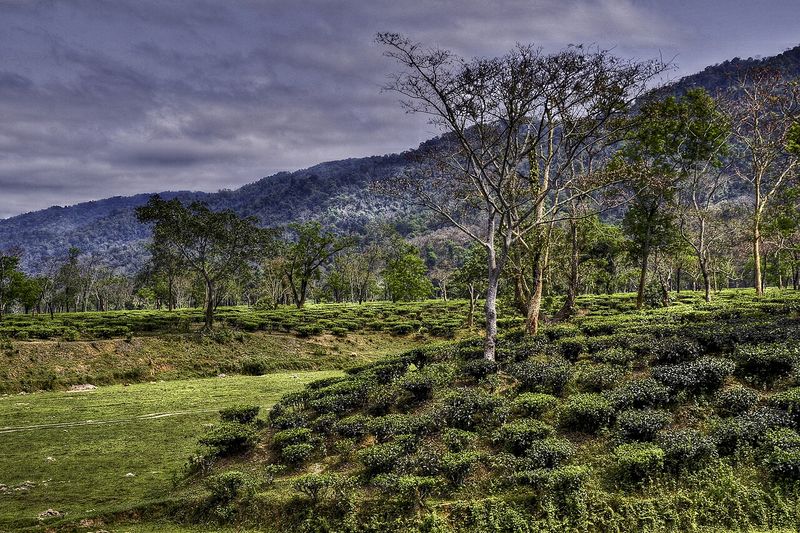
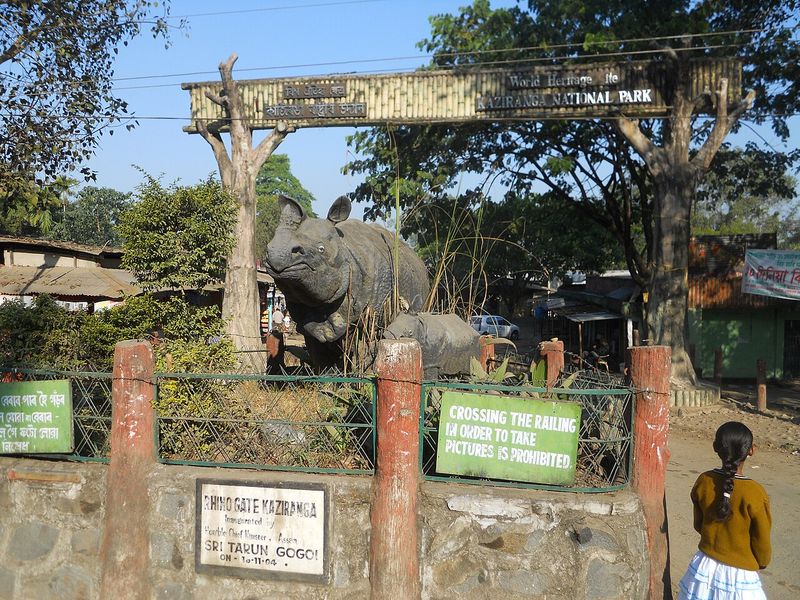
- Photos: file photos via Wikimedia Commons, as credited in the captions — Kaziranga forest rangers riding elephants along the national highway through Kaziranga (Horshadeep Saikia, CC BY-SA 4.0); an Assam tea garden (Diganta Talukdar, CC BY-SA 4.0); the Rhino Gate entrance to Kaziranga National Park (Bikash Sharma, CC BY-SA 3.0); and a wooden bridge on the track to Kaziranga’s Agoratoli range (KAUSIKA BORDOLOI, CC BY-SA 4.0). No photograph of the November 13, 2026 collision is published, and no graphic imagery of victims is used.