World · ASEAN · Philippines
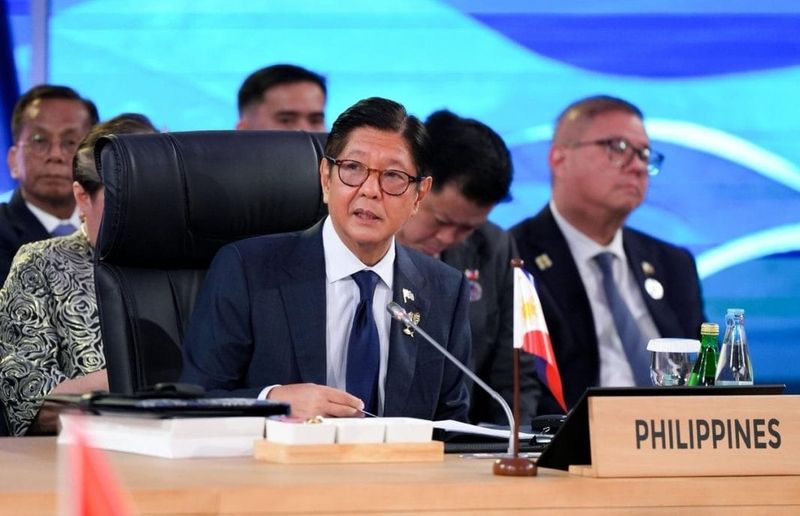
The ASEAN summit Manila 2026 convened on Sunday under the theme “Navigating Our Future, Together” — and the future arrived with a fuel emergency attached. President Ferdinand Marcos Jr. opened the 49th ASEAN Summit at the Philippine International Convention Center in Pasay with his country under a declared national energy emergency, the South China Sea code of conduct unfinished, Myanmar’s chair still empty, and the week’s biggest guest, Donald Trump, not due until the final day. What the eleven-member bloc does between now and Tuesday will say as much about Southeast Asia as anything Trump says when he lands.
MANILA, November 15, 2026 — Summits are usually described by their communiques. This one is better described by its absences and its arrivals board. The 49th Summit of the Association of Southeast Asian Nations opened on Sunday at the Philippine International Convention Center in Pasay City, a three-day gathering of the bloc’s eleven members — including its newest, Timor-Leste — chaired by President Ferdinand Marcos Jr. and attended, in person or in sequence, by at least nineteen leaders and senior figures from inside and outside the region. The United States, China, South Korea, Japan, Australia and others are all in the building or on their way to it. The war-driven energy shock radiating from the Middle East, and specifically from the US–Israel war on Iran, sits at the top of the agenda alongside the South China Sea and Myanmar. And the single most consequential participant, US President Donald Trump, is scheduled to arrive only on Tuesday, the final day, for a special summit with ASEAN leaders, a bilateral with Marcos and the first Quad meeting in two years.
That sequencing is the week’s first fact. ASEAN is holding its summit in the shadow of a guest who has not yet arrived — which means the bloc’s own business, conducted Sunday through Monday, is happening in a rare window in which Southeast Asia talks to itself, and to Beijing, before Washington takes the floor. What it did with that window on day one tells a coherent story: a region organising against an energy crisis it did not create, failing again to settle the maritime dispute it cannot escape, keeping Myanmar’s generals outside the door, signing the digital-economy agreement that represents its economic future — and, in the corridors, doing defence and environmental business with a directness the plenary hall rarely manages.
An energy emergency hosts a summit
The Philippines did not choose the energy crisis as its summit theme; the crisis chose it. Manila has declared a national energy emergency as the Middle East war — the US–Israel war on Iran and the shipping and supply disruption around it — has driven fuel costs and supply anxiety across an import-dependent region. For ASEAN’s members, who between them import the bulk of their oil and gas and whose economies run on some of the world’s busiest shipping lanes, energy security has stopped being a ministry portfolio and become the summit’s organising anxiety. Joint oil reserves and fuel-sharing proposals are expected to feature in the Manila discussions: mechanisms by which the bloc’s members would pool strategic stocks and share supply in a crunch, converting eleven separate exposures into something closer to a collective buffer.
The proposals matter beyond their tonnage. ASEAN has talked about energy cooperation for decades, usually in the language of connectivity and long-term planning. A joint-reserve arrangement negotiated under emergency conditions, by a host country itself under a declared energy emergency, would be something different: crisis infrastructure, built because the alternative — eleven governments bidding against each other for cargoes in a panic — is a memory several of them already have. Whether Manila produces a signed mechanism or a statement of intent is one of the week’s genuine open questions, and the answer will be read in every capital that watches its fuel gauge more nervously than its communique drafts.
The South China Sea: seventy percent of a code
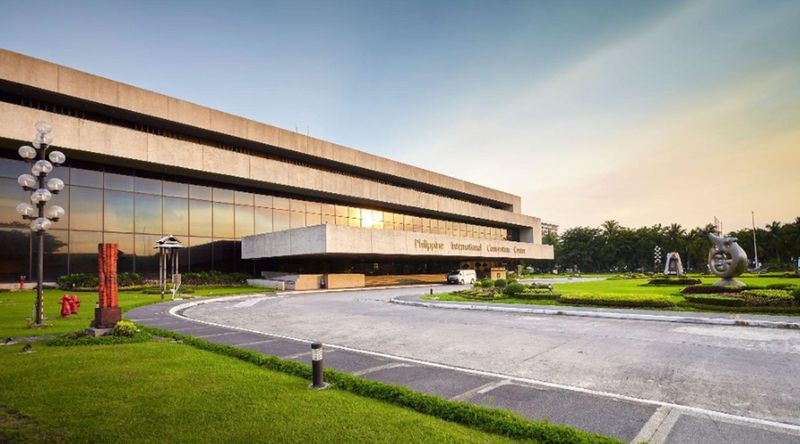
If energy is the summit’s emergency, the South China Sea is its chronic condition. ASEAN and China have been negotiating a Code of Conduct for the disputed waters for years, and the Philippines — whose vessels have faced Chinese coast guard and maritime militia pressure at Second Thomas Shoal, Scarborough Shoal and elsewhere in its exclusive economic zone — had hoped its chair year might finish the job. The Philippine Department of Foreign Affairs puts the negotiation at roughly 70 percent progress. That figure requires translation: it describes the state of the process, not agreement on text. The remaining distance is not editorial. It is the distance between a code China will sign and a code the claimant states can accept, on questions of scope, bindingness and the waters the code would cover.
Manila therefore hosts the familiar double reality of ASEAN maritime diplomacy. In the plenary, the code advances by percentages. In the water, the confrontation continues on its own schedule, indifferent to drafting. The summit cannot resolve that gap, and no serious participant expects it to. What it can do — and what the Philippines has spent its chair year attempting — is keep the negotiation alive, keep the claimants inside one process, and keep the alternative, a purely bilateral contest between Manila and Beijing, from becoming the region’s default. Seventy percent, held, is the achievement. It is also the indictment, and the summit will carry both readings home.
Myanmar: the empty chair endures
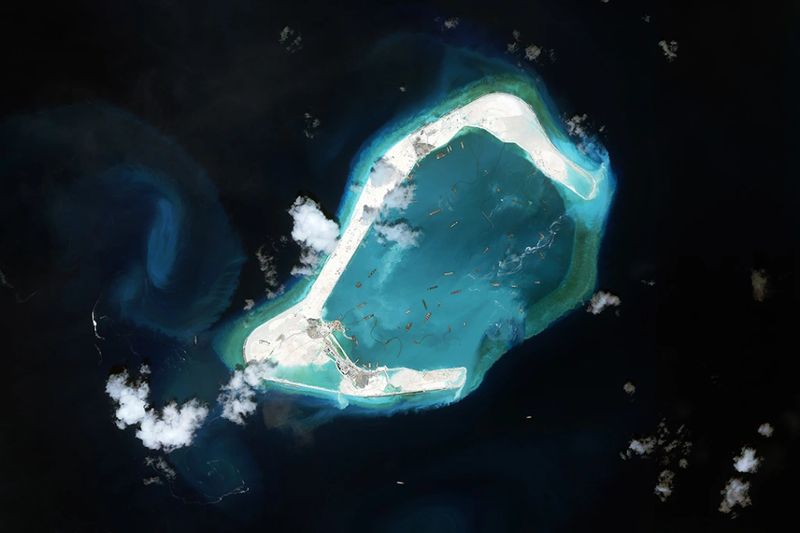
Myanmar’s seat at the leaders’ table remains what it has been since the 2021 coup: occupied below the level of leadership, by design. The junta’s leader remains barred from ASEAN summits, and Myanmar is represented in Manila by Director General Han Win Aung — a working-level presence that lets the bloc maintain a channel without extending recognition. The framework remains the Five-Point Consensus agreed in 2021: an end to violence, dialogue among all parties, humanitarian access, and an ASEAN envoy process that has produced access without settlement.
The Manila summit was never going to solve Myanmar, and its significance lies in what it refuses to do. Five years after the coup, with the civil war grinding on and the junta holding elections the bloc’s democracies do not recognise as credible, the path of least resistance would be normalisation by fatigue — the gradual readmission of Myanmar’s generals because excluding them has become tedious. ASEAN has not taken it. The empty chair is an unsatisfying policy. It is also, on the evidence of this week, still the policy.
The digital deal and the handover
Against the emergencies, the summit’s most durable product may be its least dramatic. The ASEAN Digital Economy Framework Agreement — DEFA — is expected to be signed in Manila: a region-wide framework for digital trade, data, payments and online commerce across a market of nearly 700 million people whose digital economy is among the fastest-growing on earth. DEFA will not lead the news bulletins against an energy crisis and a Trump arrival. It is nonetheless the kind of agreement summits exist to produce — the plumbing of a single regional market, negotiated in peacetime language, that compounds quietly for a decade.
Manila is also a handover. The Philippines passes the ASEAN chair to Singapore for 2027, closing a chair year defined by the energy emergency, the code negotiation and the region’s most delicate balancing act between Washington and Beijing. Singapore inherits all three files, plus the machinery of a summit calendar that now runs through the Shenzhen APEC meetings this week and into a year in which the US–China contest for Southeast Asia shows no sign of pausing.
Albanese signs a defence pact — and blesses dialogue
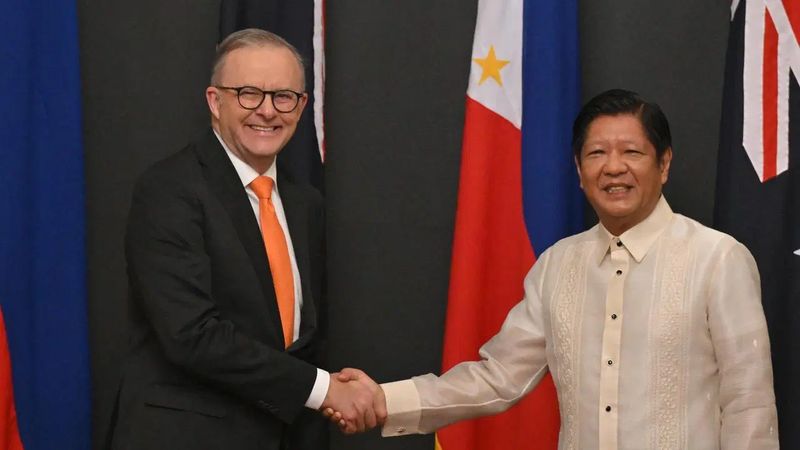
The summit’s corridors produced its hardest news on Sunday. Australian Prime Minister Anthony Albanese announced in Manila that Australia and the Philippines had signed a new Defence Cooperation Agreement — “which we’ve just witnessed the signing of,” he told a press conference, in a transcript published by the prime minister’s office. The pact, signed on the ASEAN sidelines, ramps up investment in drones and maritime surveillance to protect trade routes, and it lands in the 80th anniversary year of diplomatic relations between Canberra and Manila. Albanese visited the supply ship HMAS Stalwart in the Port of Manila, confirmed the largest-ever Australian contribution to Exercise Balikatan in 2026, and is due to hold a bilateral meeting with President Marcos on Monday.
Albanese was also asked about the week’s other summit — Thursday’s meeting in Shenzhen between Trump, Xi Jinping and Vladimir Putin — and his answer was a study in careful endorsement. “We think that dialogue is a good thing, and we await the outcome of that dialogue. It’s obviously quite significant,” he said. He wants de-escalation; he would engage Putin forthrightly if they were in the same room; and he did not rule out an APEC group photograph including Putin if host China wishes one. Two precisions matter. The Shenzhen trilateral, on the White House’s November 13 account, has a nuclear and arms-control focus, and Ukraine is not on its agenda — it is not a Ukraine peace summit. The European anxiety running alongside it — voiced by Germany’s Chancellor Merz and France’s President Macron, whose leaders met Friday, against forcing concessions or an unjust peace on Ukraine, and by President Zelenskyy, who likened Shenzhen to Yalta in 1945 and warned of a carve-up — concerns the separate Witkoff–Kushner Ukraine track, not the Shenzhen table itself. Albanese endorsed dialogue, not any terms, and he has no meeting scheduled with Putin. In a week of suitors, Australia’s was the most complete performance: a defence pact for Manila, reassurance for the alliance, and a blessing for a meeting of three presidents that pointedly excludes everyone else in the region.
An apology across the haze
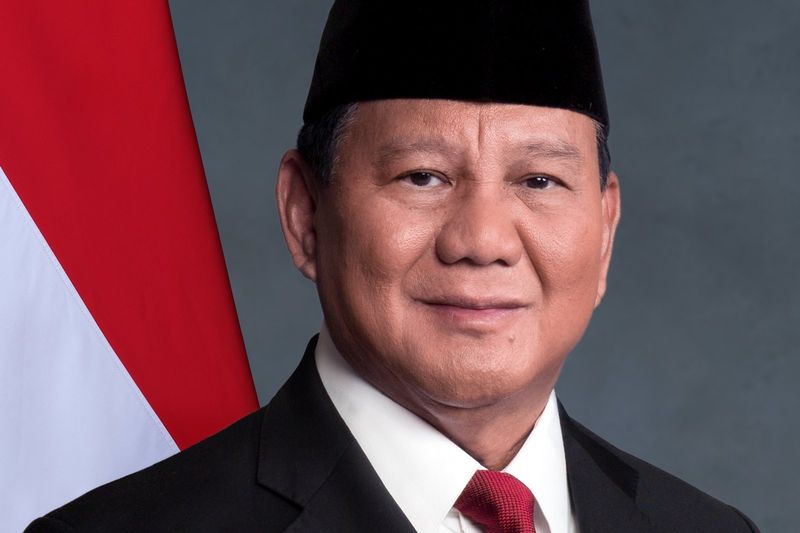
The summit’s most human moment came from its largest member. Indonesian President Prabowo Subianto apologised to Singapore and Malaysia on behalf of his government for any impact forest fires in Indonesia may have had on their people, according to a statement from Indonesia’s presidential palace reported by Reuters. The wording deserves to be carried exactly: an apology for any impact the fires may have had — not an admission of liability for specific health or economic harm. Prabowo said his government has taken, and will continue to take, firm action against companies linked to the blazes, and is preparing a new body to strengthen forest-fire prevention.
The context is severe. Indonesia is battling its most intense wildfires in eleven years, concentrated on Sumatra, Borneo and Papua, and the transboundary haze they generate has closed schools and poisoned air across the Strait of Malacca this season. Philippine Foreign Minister Theresa Lazaro described Indonesia’s intervention as “very candid,” and leaders used the moment to encourage ASEAN members to prioritise ratification of the ASEAN Coordinating Center on Transboundary Haze Pollution Control — the mechanism meant to convert apologies like this one into prevention. Track the fires themselves on Signal Post News’ wildfires tracker. An apology at a leaders’ summit does not clear a single hectare. But ASEAN runs on such moments: a grievance aired by the aggrieved, acknowledged by the responsible, and converted — slowly, imperfectly — into machinery.
Why this matters
ASEAN summits are easy to dismiss as choreography, and Manila supplies the counter-argument in a single agenda. In one building, in three days, the bloc is attempting crisis energy cooperation under a declared national emergency; holding a maritime negotiation together at seventy percent; maintaining a five-year exclusion of a member’s junta without breaking the bloc; signing a digital-economy framework for 700 million people; absorbing a new Australian defence pact with its most exposed claimant state; and extracting a public apology from its largest member over the region’s worst fires in eleven years — all before the American president arrives to ask for its allegiance, a day after China’s premier has asked for the same thing in the language of trade. That is not choreography. That is a region practising statecraft under pressure, with the pressure arriving from every direction at once.
The week’s deeper question is whether the balancing survives its own success. ASEAN’s method — centrality, consensus, the refusal to choose — works while both Washington and Beijing prefer courting the bloc to coercing it. An energy crisis tests the method’s economics; Shenzhen tests its symbolism, since three presidents discussing the world’s order without a Southeast Asian in the room is precisely the future ASEAN exists to prevent. Manila’s answer, so far, is to be too busy, too organised and too collectively valuable to be bypassed. It is a good answer. The week will show whether it is a sufficient one.
What happens next
Monday is the bloc’s last day on its own: partner talks, the Albanese–Marcos bilateral, and the closing leaders’ business, with Brazil’s President Lula attending the summit’s orbit, Canada’s Prime Minister Carney delivering a speech, India’s Prime Minister Modi attending and Russia’s Foreign Minister Lavrov participating in the week’s diplomacy. China’s Premier Li Qiang made Beijing’s case to the bloc on Monday — a trillion-dollar argument for free trade, delivered a day before the American arrival, and covered in full in our companion report.
Tuesday is Trump’s: the special summit with ASEAN leaders, the bilateral with Marcos, and the first Quad meeting in two years, bringing the United States together with Japan, Australia and India in the format widely read as the counterweight to Beijing. Then the caravan moves to Shenzhen for APEC and Thursday’s trilateral. Manila’s three days will be judged by a simple standard: whether ASEAN leaves its own summit with its energy mechanism alive, its code negotiation intact, its digital agreement signed and its centrality unchallenged — having been courted by everyone and captured by no one.
Related reading: Li Qiang Courts ASEAN in Manila With an ‘Extraordinary’ Trade Pitch — a Day Before Trump Arrives · White House Confirms First-Ever Trump–Xi–Putin Meeting in Shenzhen on November 19 · ASEAN Envoy Meets Myanmar Minister in Naypyitaw as Civil War Aid Push Meets a Closed Door on Aung San Suu Kyi
Sources
AJP, November 15, 2026 — the 49th ASEAN Summit opening in Manila, hosted by President Ferdinand Marcos Jr., with the energy crisis, South China Sea and Myanmar on the agenda and Trump scheduled for the final day. TBS News explainer, November 15, 2026 — the November 15–17 dates, the eleven members including Timor-Leste, the Philippines’ declared national energy emergency, Trump’s November 17 special summit and Marcos bilateral, and the attendance of Lula, Carney, Modi and Lavrov. AsiaToday, November 14, 2026 — the PICC Pasay venue, at least nineteen leaders, the theme “Navigating Our Future, Together,” the chair handover to Singapore for 2027, the expected DEFA signing, the code of conduct at roughly 70 percent progress (Philippine DFA) and Myanmar’s representation by Director General Han Win Aung. Prime Minister of Australia, official transcript, press conference, Manila, November 15, 2026 — the Defence Cooperation Agreement signing, the 80th anniversary of diplomatic relations, the largest-ever Australian Balikatan contribution for 2026, the Monday Marcos bilateral, and the remarks on the Shenzhen dialogue. The Guardian, November 15, 2026, and AP reporting — the pact’s drone and maritime-surveillance investment, the HMAS Stalwart visit, and the European and Ukrainian reactions to Shenzhen. Reuters, November 15, 2026, reporting the Indonesian presidential palace statement — President Prabowo’s apology to Singapore and Malaysia, firm action against companies linked to the blazes, the planned fire-prevention body, Foreign Minister Lazaro’s “very candid” assessment, the haze-centre ratification push, and Indonesia’s most intense wildfires in eleven years. Photographs are file photos credited in their captions; no pooled photograph of the opening session was available at publication.