A Shahed punched through a third-floor facade while lessons were under way. The shelter worked; the warhead did not. That narrow margin kept a school-day strike from becoming a mass-casualty event.
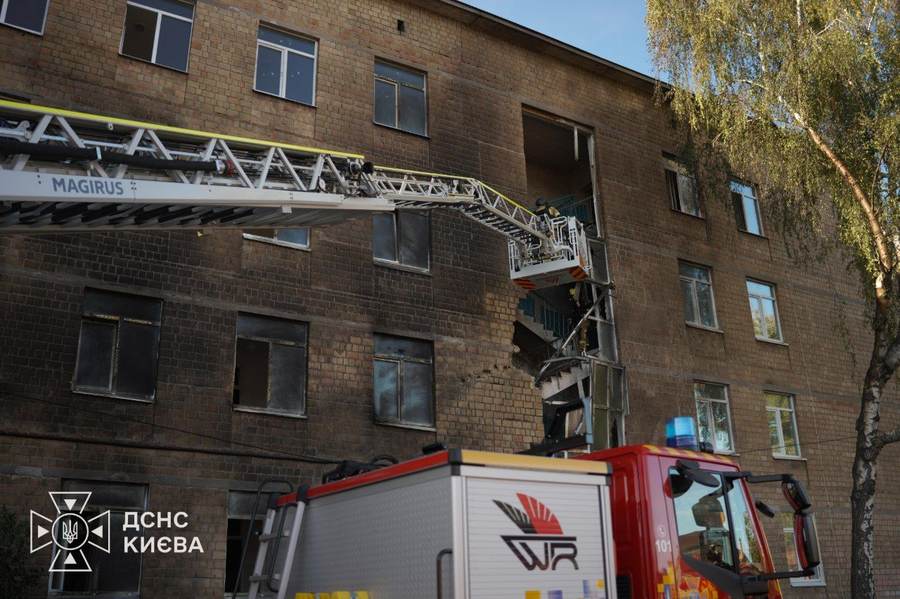
Russian drone hits Kyiv school: that was the blunt reality in the capital's Solomianskyi district on Thursday, October 1, when a Shahed struck during the school day as more than 100 pupils and about 60 staff waited in the bomb shelter. No one was injured. Kyiv Mayor Vitalii Klitschko said the drone's warhead failed to explode — the decisive fact separating a damaged building from a potential mass-casualty scene.
The aircraft tore a large hole through the third-floor brick facade, left a black burn mark, smashed windows and started a fire. Kyiv City Police supplied the shelter count, according to The Gaze; the physical damage and Klitschko's account were also reported by the Australian Associated Press and its Oldham Times syndication.
Zelenskyy's school attack statement
President Volodymyr Zelenskyy posted scene photographs on X and wrote, as quoted by AAP: “First responders and all necessary emergency services are working at the site in Kyiv, where a Russian ‘shahed’ struck an ordinary school. Fortunately, the children and teachers were in the shelter during the air raid alert, so no one was injured...”
The ellipsis matters: that is the published portion of the post, not a reconstruction of what followed. It also fixes the central sequence. The alarm came first, the school moved its people below ground, and the strike came while they were there. The shelter was not background infrastructure; it was the active reason the casualty count stayed at zero.
The overnight wave behind the Kyiv school drone attack
The strike was part of a broader cycle. From September 30 into October 1, Russia launched 107 drones of several types from Orel, Millerovo, Bryansk, Shatalovo, Russian-held Donetsk and Crimea, according to the Ukrainian Air Force and General Staff figures compiled by AJ News. Ukraine said 87 were suppressed or neutralised. Hits were recorded at 11 locations and falling debris at four more.
The mix was as important as the volume: 63 of the 107 were described as jet-powered. Zelenskyy has said Ukraine is intercepting only just over half of the newer jet drones, a far lower share than for older propeller-driven Shaheds. Kyiv is therefore facing two problems at once — saturation by numbers and compression of reaction time by speed.
The same day's damage extended well beyond one classroom block. Kyiv regional head Tymur Tkachenko said 42 facilities across six districts were damaged and six residents were injured, according to The Gaze. In Odesa, a Russian strike hit a business centre, damaged two buildings and injured one person, city officials said; Reuters reported the Kyiv and Odesa attacks. Our earlier report follows the October 1 overnight wave in Kyiv and Odesa.
Why this matters
A school struck in mid-session with roughly 160 people below it is a near-miss that exposes the design and the danger of a sustained air campaign. The shelter, alert system and staff discipline all worked. Yet the unexploded warhead was chance, not protection. Had it detonated after entering the building, the same event would be discussed not as damage to a facade but as one of the war's defining civilian disasters.
Schools occupy a particular place in the pressure campaign. They are not only buildings; they are the machinery of ordinary life. Every Kyiv schoolchildren shelter drone strike consumes lesson time, scatters families, diverts teachers into emergency management and makes attendance itself a calculation. That is how an air campaign can erode resilience even when casualty lists remain mercifully short.
Moscow says it targets military and military-linked infrastructure and has denied deliberately attacking civilians. Ukrainian officials, independent monitors and critics point to documented damage to homes, schools, hospitals, power systems and commercial buildings as evidence that the effects are much wider than Russia's stated target set. The legal and factual judgment on any individual strike requires evidence about aim and weapon performance; the cumulative civilian pattern does not disappear while that inquiry proceeds.
Jet-powered drones change the interception math
Russia's newest escalation is technical but its consequences are human. Serhii Beskrestnov, an adviser to Zelenskyy on defence technology, told AAP that Russia used a new jet-powered drone on Wednesday for the first time, fitted with a warhead designed to sever high-voltage pylons. Speed shortens the window for mobile teams and other lower-cost defences. If expensive surface-to-air missiles must replace cheap guns and interceptors, every incoming drone also becomes an attempt to drain Ukraine's scarce defensive magazine.
That is the strategic bargain Russia seeks: morale erosion in cities, forced dispersal of air-defence units, and depletion of Patriot interceptors needed for ballistic threats. US-made Patriots have been in short supply since the Iran war began, AAP reported, while producing them in Ukraine could take years. Kyiv is racing to field interceptors fast enough for jet drones, but the race is running during combat, not before it.
For Ukraine, the risk is broader than a lower interception percentage. It is continuity — whether schools can remain open, whether repairs can keep pace, whether families can plan a week without reorganising it around sirens. Maryna Lystopad, a 35-year-old Kyiv resident interviewed by AP, described the accumulating strain: “It's really horrible. I can't take it anymore... I'm constantly anxious. I can't relax.” Her account is not a military metric, but it measures the objective an attritional air campaign is built to pursue.
Russia's winter energy campaign in Ukraine
September 30 brought the biggest Russian attack on Ukraine's power grid since spring 2025, officials told AAP. The Institute for the Study of War called that barrage “the beginning of Russia's strike campaign aimed at degrading Ukraine's energy security ahead of winter ... and forcing Ukraine to capitulate.” No energy-infrastructure hits were reported on Thursday, but the absence of one day's grid damage is not evidence the campaign has paused.
The numbers show why officials expect colder weather to bring escalation: 107 drones in the latest overnight wave, 63 of them jet-powered; 87 reported neutralised; 11 impact locations; 42 damaged facilities across six Kyiv-region districts. The September grid barrage was the largest in roughly 18 months. These are not isolated tactical incidents so much as overlapping attempts to strain electricity, air defence, emergency response and public confidence.
The ground war, meanwhile, has seen no major shift since 2025. That relative stasis gives both sides an incentive to look above and behind the front. Ukraine has sent long-range drones against manufacturing plants deep inside Russia and has targeted drone launch infrastructure. Zelenskyy said Ukrainian forces struck a storage-and-launch site in Russia's Oryol region; our earlier coverage examined Ukraine's strike on the Oryol drone base. On the ground, Kyiv is also trying to regain initiative around Lyman through Operation Vivaldi in Donetsk.
What happens next
Winter now has three plausible tracks. In the first, Russia sustains large mixed waves and enough weapons leak through to force rolling outages, while Ukraine rations Patriots for ballistic missiles. In the second, cheaper Ukrainian interceptors scale quickly enough to restore the economics of defence against jet drones, allowing high-end systems to stay focused on the hardest targets. In the third — the most dangerous — Russia combines grid attacks with repeated strikes on schools, housing and commerce, turning infrastructure damage and civilian exhaustion into one pressure strategy.
The Solomianskyi school is therefore both a specific crime scene to be investigated and a warning about the months ahead. Its shelter plan saved lives. Its facade shows what still got through. Its unexploded warhead supplied the luck. Ukraine can build procedures, interceptors and hardened rooms; it cannot plan a winter around every warhead failing.
Sources
- Australian Associated Press — “Russia hits Kyiv school in relentless aerial campaign” (October 1, 2026)
- The Gaze — “Russian Drone Hits Kyiv School as Students Shelter Inside” (October 1, 2026)
- Oldham Times / PA syndication — “Russian drone hits Kyiv school as Moscow presses aerial campaign in Ukraine” (October 1, 2026)
- AJ News — “Ukraine regional recap for October 1”
- Reuters — “Russian air strikes injure two in Ukraine's Kyiv, Odesa, officials say” (October 1, 2026)