Russian strike Kyiv September 30
Ballistic missiles and drones slammed into the Ukrainian capital and its suburbs just before dawn, continuing Moscow's relentless nightly campaign against civilian areas — hours after Zelenskyy revealed that over 100 drones had been fired the day before.
What happened
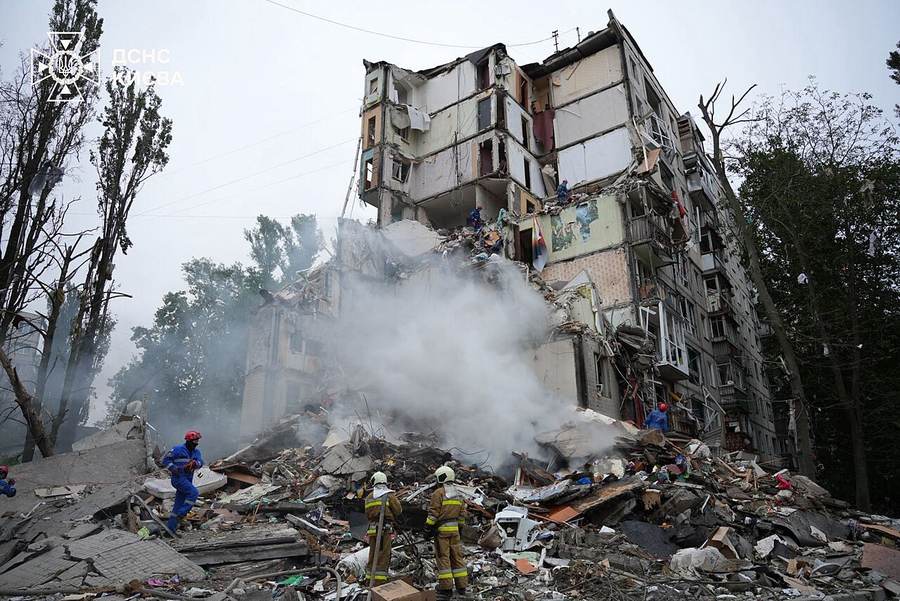
Shortly before 3 a.m. local time on Wednesday, September 30, more than a dozen explosions shook Kyiv as Russia launched a combined ballistic-missile and drone barrage at the capital and the surrounding region. Air-defense systems fired across the city while Ukraine's Air Force warned of incoming ballistic missiles. More blasts were heard around 3:40 a.m., according to reports from the scene.
The deadliest blow fell on Vyshhorod, a suburb just north of the capital, where a Russian missile and drone strike destroyed a house. Rescue teams pulled three people from the rubble and recovered the body of a child, regional governor Tymur Tkachenko said on Telegram. Three other people were injured in the Kyiv region, with damage to infrastructure, homes, warehouses, and cars across Vyshhorod, Bucha, and Obukhiv districts.
Inside the capital itself, fires broke out in private houses, a store, and a warehouse, leaving two people injured, Kyiv Mayor Vitali Klitschko said on Telegram. A Reuters witness heard the explosions firsthand. In the Sviatoshynskyi district, roughly a dozen homes were damaged; in Podilskyi, a non-residential building and a warehouse caught fire; in Bucha, three homes, eleven vehicles, and two warehouses were hit.
A note on the casualty figures: Reuters' latest tally, based on the statements of the Kyiv mayor and the regional governor, reports one child killed and five people injured. Earlier Ukrainian media reports put the toll higher — as many as three dead — as rescue operations continued through the morning. The numbers were still being reconciled when this article was published, and readers should treat the casualty count as evolving.
Russia's Defense Ministry claimed the overnight operation struck a communications center and energy facilities in Kyiv, as well as port facilities in Izmail on the Danube. That claim is a belligerent's account and could not be independently verified. Moscow has consistently denied deliberately targeting civilians, though Ukrainian officials accuse it of systematic strikes on residential areas and civilian infrastructure.
Why this matters
This strike is significant less for its immediate toll — tragic as every civilian death is — than for what it reveals about the phase the war has entered. Three things stand out.
First, the geography of fear is expanding. The killing happened not in the capital's center but in Vyshhorod's residential streets, and the damage spread across Bucha — a name that still carries the weight of the 2022 occupation — and Obukhiv. Russia is no longer just probing Kyiv's air defenses; it is methodically widening the radius of terror to the suburbs, the places families fled to for relative safety. When the suburbs stop feeling safe, the psychological pressure multiplies far beyond the physical damage.
Second, the timing exposes Ukraine's air-defense math problem. Just hours before the strike, President Volodymyr Zelenskyy said in his nightly address that Russia had launched more than 100 drones during the day on Tuesday alone — 29 of them jet-powered, of which 18 were shot down. Jet-propelled drones are faster and harder to intercept than the older Shaheds, and they cost a fraction of the interceptor missiles used to kill them. Every night like this one burns through Ukraine's finite stockpiles while Russia, with Iranian-design drones now mass-produced at home, replenishes far more cheaply. A war of attrition favors the side that can afford the interceptors.
Third, the strike fits a deliberate campaign pattern, not random violence. Kyiv has now been hit almost every night for over a week: Monday's brazen daytime jet-drone strike on the National Academy of Sciences killed one person and wounded 19; a September 25 strike killed four, including a 14-year-old boy; a September 29 ballistic-missile attack struck the capital the evening before this raid. The tempo is the message. Moscow appears to be testing whether it can normalize nightly bombardment of the capital — making air-raid exhaustion itself a weapon.
Background: a week of escalating strikes on the capital
The September 30 raid did not come out of nowhere. Russia has been intensifying its aerial campaign against Kyiv and other cities since August, with the pace and boldness of strikes increasing noticeably in the last ten days.
On Monday, September 28, a Russian jet-powered drone smashed into the historic National Academy of Sciences building in central Kyiv in broad daylight — an attack the academy's president called "terrorism," noting the institution had no military connection. One person was killed and 19 wounded as staff fled through windows. That same day, strikes hit Dnipro, Kharkiv, Zaporizhzhia, and Odesa.
Three days earlier, on September 25, a drone hit an apartment building and an office parking lot in Kyiv, killing four people including a 14-year-old boy and injuring 14. And on the evening of September 29 — just hours before this latest raid — ballistic missiles struck the capital again.
Ukraine has not been passive in this exchange. Its forces have struck Russian oil and defense infrastructure deep inside Russia and targeted military logistics, while Russia has broadened its target set to consumer logistics, data centers, and businesses — what Kyiv calls an effort to cripple the economy and force concessions. The nightly duel of long-range strikes has become the war's most visible front, even as ground fighting grinds on in the east.
Who gains, who pays — and what the critics say
Russia's calculation appears to be that sustained bombardment will break civilian morale and strain Ukraine's defenses to the breaking point, particularly as winter approaches and the energy grid becomes the real prize. Hitting communications and energy infrastructure — Moscow's stated target set — would serve that strategy directly. Critics of the Kremlin's approach, including Western analysts, argue the opposite effect is more likely: terror bombing has historically hardened rather than broken civilian populations, and each strike on a suburb like Vyshhorod gives Kyiv fresh evidence to present to Western partners when requesting air-defense systems.
Ukraine's position is the harder one. Every interception costs more than the drone it kills, and Zelenskyy is openly preparing "new talks, including on air defense and further support" — diplomatic language for an urgent resupply problem. The upside for Kyiv: the relentless tempo of attacks keeps the war's cost visible to Western publics and gives Ukraine's diplomacy a nightly argument. The downside is measured in interceptor inventories, and those are not infinite.
The civilian toll is where the ledger is unambiguous. A child pulled dead from rubble in Vyshhorod, families fleeing homes in Sviatoshynskyi, warehouse workers in Podilskyi — these are the people paying for the strategic logic on both sides. Ukraine's supporters will frame this as proof Russia wages war on civilians; Russia's defenders will point to the claimed communications and energy targets. The physical evidence — destroyed houses, not military installations, in the documented damage — speaks for itself.
The numbers in context
Zoom out, and the September 30 strike looks less like an isolated outrage than a data point on a steepening curve. Consider the sequence: September 25 (4 killed, 14 injured), September 28 (1 killed, 19 injured in the Academy strike alone, plus strikes across four other cities), September 29 (evening ballistic strike), September 30 (child killed, 5 injured). That is four significant strikes on or around the capital in five days — a tempo not seen since the heaviest bombardment phases of the war.
The drone numbers tell their own story. Zelenskyy's figure of 100+ drones in a single day, with 29 jet-powered, suggests Russia is scaling production of its faster, harder-to-intercept munitions. On the September 28 strike, he noted that 90 of 120 drones fired were jet-propelled, with only a 57 percent interception rate. If those ratios hold as jet-drone production ramps up, Ukraine's air defenses face a mathematical problem that no amount of resolve can solve — only more, and different, interceptors.
The economic dimension runs in parallel: on September 29, the United States announced sanctions on 13 individuals and entities tied to Iranian weapons procurement for Russia — including MG-Flot, whose vessels transport weapons for Russia's Defense Ministry, and aircraft manufacturer Yakovlev. Washington is trying to constrict the supply chain feeding these nightly barrages. Whether sanctions can move faster than drone factories is an open question.
What happens next
Three scenarios are worth watching. The most likely: the nightly campaign continues and intensifies through autumn, with energy infrastructure as the real target once temperatures drop. Russia's pattern — August escalation, September tempo increase — points toward a winter grid campaign designed to freeze Ukraine into concessions. The diplomatic track: Zelenskyy's promised "new talks on air defense" will test whether Western partners can deliver interceptors and systems faster than Russia can build drones — the decisive variable of the coming months. European defense ministers are already discussing whether the EU needs its own NATO-style emergency mechanism against what they call hybrid attacks. The wildcard: Ukraine's deep strikes into Russia — oil refineries, defense plants, logistics — could force Moscow to divert air defenses homeward, easing pressure on Kyiv. Each side is now trying to make the other's rear areas unlivable; the question is whose economy and whose morale cracks first.
For the residents of Vyshhorod, Bucha, and Kyiv's western districts, the strategic analysis is secondary. They will spend tonight the way they spent last night: listening for the air-raid sirens, counting the explosions, and hoping the interceptors hold. The war's fourth winter is coming, and both sides are shaping the battlefield for it — one missile at a time.
Related coverage
Sources
- Reuters — "Russian air strikes kill one, injure five in and around Kyiv, officials say" (September 30, 2026)
- Kyiv Post — "Russian Attack Kills 3, Including Child, Near Kyiv as Capital Faces Ballistic Missile Threat" (September 30, 2026)
- AnewZ — "Ukraine war latest: Child killed in Russian strike on Kyiv" (September 30, 2026)
- EA WorldView — "Ukraine War, Day 1,679: Civilians Killed, Injured by Russian Attacks On and Near Kyiv" (September 30, 2026)