Europe joins Ukraine US talks
Europe joins Ukraine US talksZelenskyy European allies join talksUkraine US talks Friday SaturdayUkraine air defence shortageUmerov Budanov US meetingZelenskyy 70 killed Russian strikesUkraine mirrored Russian data centre attacksYandex data centre drone strikeUkraine peace talks 2026Merz Kyiv visit Zelenskyy
KYIV — Europe joins Ukraine US talks this weekend — at least, that is the outcome Volodymyr Zelenskyy said on Thursday he expects, as his negotiators fly to the United States for two days of meetings with a single overriding item on their brief: air defence. More than 70 people have been killed in Russian strikes over the past two days, the Ukrainian president told reporters in Kyiv, and his team will argue in Washington that shielding Ukraine's cities is the precondition for any serious diplomacy.
The announcement, reported by Reuters, adds a third chair to a table that has so far been set for two. Ukraine's negotiators are due to meet US officials on Friday and Saturday as part of the American-led effort to settle a war now grinding through its fifth year — and Zelenskyy said plainly that he expects Kyiv's European partners to join the talks in the coming days. In his nightly video address on Thursday, he went further, saying Ukraine was counting on its European allies to take part, CNN reported.
It is a significant widening of the diplomatic frame. For months the negotiating geometry has oscillated between a US-Russia bilateral channel — envoy Steve Witkoff shuttling to Moscow, Russian envoy Kirill Dmitriev visiting Washington — and a US-Ukraine bilateral one. Zelenskyy is now insisting the format become trilateral, and he is doing it at the exact moment when Russia's aerial campaign has made air defence the most urgent currency Kyiv holds.
Why this matters
Europe joins Ukraine US talks at the moment Kyiv needs leverage most
Diplomatic formats are not decoration; they decide who gets to set the agenda and who gets blamed when nothing happens. A US-Ukraine bilateral lets Washington present Kyiv with terms. A US-Russia bilateral lets Moscow do the same in reverse. A trilateral that includes Europe — the bloc paying for much of Ukraine's survival — changes the arithmetic: it becomes much harder to press Ukraine into territorial concessions when the Europeans, who would have to underwrite and enforce any settlement, are in the room.
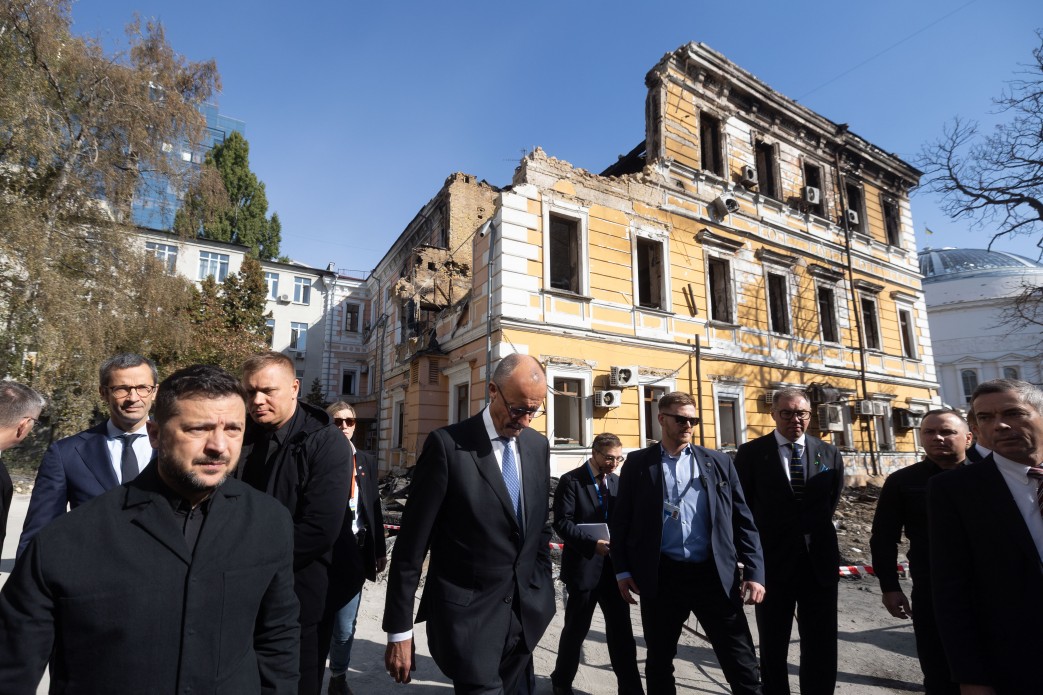
The timing is deliberate. Zelenskyy made the announcement in Kyiv on the same day German Chancellor Friedrich Merz was in the capital, visiting a memorial to slain service personnel and the scene of a Russian strike on the National Academy of Sciences. The choreography tells its own story: European leaders are being shown the cost of the war in person, then invited into the room where its end might be negotiated.
There is also a harder-edged calculation. Zelenskyy used his visit to the devastated town of Pryluky this week to accuse Washington of mixed signals — negotiating future economic projects with Moscow, he said, while describing diplomacy as stalled. Pulling Europe into the talks is a way of anchoring the process to partners who have no interest in a settlement that rewards aggression, and of making it politically costlier for the US to cut a quick deal over Kyiv's head.
What Zelenskyy actually announced in Kyiv
The Ukraine US talks Friday and the air defence agenda
The mechanics, as reported by Reuters and CNN: Ukrainian negotiators travel to the United States for meetings on Friday and Saturday. A source familiar with the planning told CNN that US envoy Steve Witkoff and Jared Kushner — President Donald Trump's son-in-law and a central figure in the administration's deal-making — would meet with senior Ukrainian officials Rustem Umerov and Kyrylo Budanov. Zelenskyy confirmed in his nightly address that the talks would run two days and that air defence would be raised directly.
That last point is the substance beneath the format. Ukraine is not going to Washington primarily to discuss maps; it is going to ask for the means to survive the winter. "Protection against all of this is the number one priority for me and Ukraine," Zelenskyy said, in remarks reported by Reuters — and the "all of this" is Russia's near-constant bombardment of Ukrainian cities.
"More than 70" dead in two days — the number behind the urgency
The figure Zelenskyy cited — more than 70 killed in strikes over the past two days — is what turns this from process story into emergency. Put it in context: a Russian glide bomb struck a crowded bus stop in Kramatorsk on Thursday, killing at least 33 people in what CNN called the deadliest single attack of the year. A day earlier, a Russian ballistic missile demolished a five-storey apartment block in Pryluky, killing around 20 people including several children. Two more died in Kyiv, others in Oleksandriia and the Poltava region.
Compare that two-day toll with the recent past: a mass Russian missile attack on Kyiv in July killed 33 people across the capital; an August drone strike on an ammunition depot near the capital killed 38. The past 48 hours have matched or exceeded either of those events — compressed into two days. Russia has been launching near-daily mass aerial attacks, taking advantage of what CNN described as Ukraine's critical shortage of interceptors. Moscow, for its part, denies deliberately targeting civilians and says its strikes hit military and military-industrial targets — a claim Ukrainian officials and Western reporting have repeatedly disputed given the pattern of residential buildings, bus stops and energy infrastructure being hit.
The mirror doctrine: Ukraine answers Russia's data centre campaign
The Yandex data centre strike and what "mirror-like fashion" means
Buried in Zelenskyy's briefing was a second, equally telling announcement: Ukraine has been deliberately "mirroring" Russian attacks on data centres. "We always respond in mirror-like fashion," he told reporters. "You all know, they have been hitting and continue to hit our data centres. We are responding. I can't share all the details."
The reference was to the Ukrainian drone strike on a data centre operated by Yandex, the Russian technology giant — an attack we covered as the first major Ukrainian strike on a Russian data hub. Yandex confirmed on Thursday that it could not yet determine whether the damaged equipment could be restored, according to Reuters.
Why does this matter for the talks? Because it signals that Kyiv is not arriving in Washington empty-handed. The "mirror" doctrine is Ukraine's way of demonstrating escalation leverage: every Russian strike on Ukrainian infrastructure invites a symmetrical Ukrainian answer against Russian infrastructure — refineries, terminals, tankers and now data centres. It is the logic of deterrence by punishment, and Zelenskyy is advertising it publicly precisely so that American and European negotiators understand what the alternative to a settlement looks like: a long-range strike campaign that neither side fully controls.
Who benefits, who loses and what critics will watch
Kyiv gains a bigger table; Moscow faces a harder room
Kyiv is the clearest near-term beneficiary. A trilateral format gives Zelenskyy what bilateral US-Ukraine talks could not: European witnesses to any American pressure for concessions, and a direct channel to the capitals that fund Ukraine's war effort. Making air defence the headline demand also reframes the talks from "what will Ukraine give up" to "what does Ukraine need" — a far stronger negotiating posture.
Europe gains the seat it has long demanded — but the seat comes with exposure. Being inside the talks means sharing ownership of the outcome, including if the talks fail. Some European capitals have been wary of deeper entanglement, and Moscow will certainly portray European participation as proof that the continent's leaders are parties to the conflict rather than mediators. The Kremlin has already warned foreign embassies to leave Kyiv for their own safety; Reuters reports that neither Germany nor any other major nation plans to do so — a quiet but pointed rejection of Russian intimidation.
Washington gets a more complex negotiation to manage, which cuts both ways for the Trump administration. A united Western front strengthens Trump's hand with Moscow — it is harder for the Kremlin to play the US against Europe when all three are in the same room. But it also constrains Trump's freedom to strike a quick bilateral bargain with Putin, the kind of leader-to-leader deal he has historically preferred.
Moscow loses the bilateral channel it has cultivated. Russia's consistent preference has been to negotiate over Ukraine's head — directly with Washington — and to demand that Kyiv cede the Donbas as the price of peace. A trilateral format with air defence on the agenda is the opposite of that script. Expect Russian officials to dismiss the European role as illegitimate, even as Russian forces intensify the very strikes that make air defence urgent.
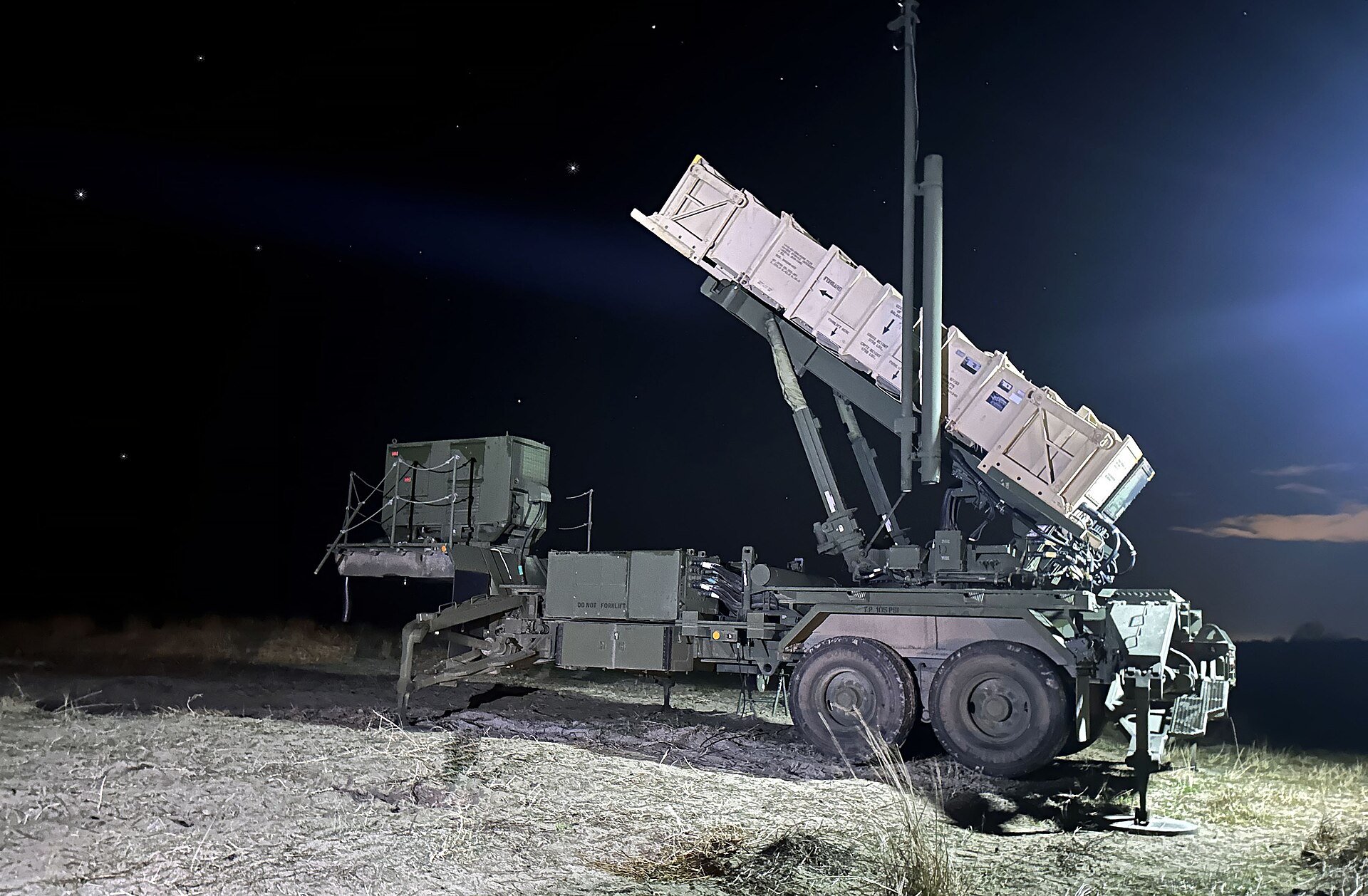
The critics' case deserves a hearing too. Previous rounds of talks have produced communiques more reliably than ceasefires, and air-defence pledges have a poor record of arriving on time — Trump's much-discussed licence for Ukraine to produce Patriot systems domestically would, by most expert accounts, take years to turn into hardware. There is a real risk that this weekend produces a format and a photo opportunity while the missiles keep falling. The test is not whether Europe joins the talks, but whether anyone leaves Washington with interceptor commitments that change the arithmetic of the coming winter.
The numbers: interceptors, ballistic missiles and a winter deadline
Ukraine air defence shortage in hard figures
The data behind Zelenskyy's urgency is stark. More than 70 dead in two days. Around 70 missiles — many of them ballistic — fired at Ukraine in a single massive attack earlier this week, hitting Kyiv and twelve regions. Ukraine's General Staff reported 202 combat engagements in a single day, with 85 Russian air strikes, 278 guided aerial bombs and nearly 10,000 kamikaze drones employed in 24 hours. Those are Ukrainian military figures and should be read as such, but the direction is undisputed: the aerial campaign is intensifying as winter approaches.
The specific bottleneck is ballistic missiles. Patriot batteries are the only systems in Ukraine's arsenal capable of intercepting them, and interceptors are, by Kyiv's own admission, critically short. Russia knows it: the shift toward ballistic strikes on cities and energy infrastructure is a deliberate exploitation of that gap. Every week without resupply is a week in which Ukrainian cities are, in Zelenskyy's own framing, wide open to attack — and with summer's warmth ending, Ukrainians are bracing for what Reuters describes as perhaps the toughest winter of the war, with Russia expected to target electricity, heat and water as it has in previous years.
This is the deeper significance of putting air defence at the top of the talks agenda. It is not just a shopping list; it is Kyiv's theory of how wars end. Zelenskyy's argument — made explicitly at Pryluky this week — is that only when Russia's aerial campaign stops paying dividends will Moscow negotiate seriously. "Stop feeding them deals; impose sanctions on their weapons," he urged Washington. Air defence, in this telling, is not charity. It is leverage.
What happens next
Three scenarios after the Friday and Saturday meetings
Scenario one: the hardware scenario. The talks produce concrete air-defence commitments — interceptor resupply, accelerated Patriot support, European co-production agreements — and a formal agreement that European representatives join the next round. This would be the best outcome for Kyiv and would validate Zelenskyy's trilateral gambit. Watch for specific numbers and delivery timelines; vague pledges do not count.
Scenario two: the process scenario. Europe is formally brought into the format, a joint statement is issued, and further meetings are scheduled — but the air-defence commitments stay general. This keeps diplomacy alive without changing the battlefield, and it is arguably the most likely outcome given how these rounds have gone before. The risk: Moscow reads process without hardware as weakness and escalates further.
Scenario three: the winter-war scenario. The talks stall on the familiar rocks — territory, sequencing, enforcement — and Russia intensifies strikes on Ukraine's energy grid as temperatures fall. In that case Zelenskyy's "mirror" doctrine becomes the story: Ukrainian long-range strikes on Russian refineries, terminals and infrastructure accelerate, and the war's economic dimension deepens for both sides.
Whichever scenario unfolds, one thing is already clear: the era of the US and Russia negotiating Ukraine's fate in a room Kyiv is not in — and Europe merely watches — is being actively contested. Zelenskyy has put his counter-proposal on the table. The next 48 hours will show whether anyone picks it up.
Sources and verification
The announcement, quotations and casualty figures are attributed to Zelenskyy's Thursday briefing as reported by Reuters; the nightly-address confirmation, the Witkoff-Kushner meeting details and the July/August casualty comparisons are attributed to CNN's reporting. The Merz visit details and the "number one priority" quotation are attributed to Reuters. No European attendee list is stated because the cited reporting did not provide one.
- Reuters, October 8, 2026 — Zelenskyy's announcement that European partners are expected to join US talks, the air-defence agenda, the "more than 70" killed figure, and the "mirror-like fashion" data centre remarks.
- CNN, October 8, 2026 — Zelenskyy's nightly address counting on European allies to join, Umerov and Budanov raising air defences, the planned Witkoff-Kushner meeting, and context on the interceptor shortage.
- Reuters, October 8, 2026 — analysis of Ukraine's air-defence gap, Merz's Kyiv visit, embassy decisions, and the coming winter.