Italy Iraq troop withdrawal
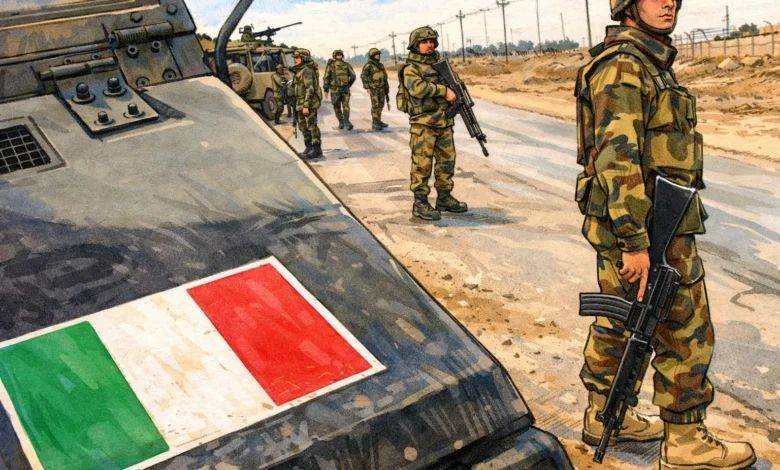
ROME — The Italy Iraq troop withdrawal was completed on Tuesday, September 29, ending a 12-year military presence that began when Islamic State seized Mosul and Western governments rushed back into a country they had hoped was moving beyond foreign deployments. Italy’s defence ministry said its last troops had left after serving in the U.S.-led Operation Inherent Resolve and NATO Mission Iraq, the alliance’s non-combat advisory and capacity-building effort.
Most Italian personnel had already been recalled by March 2026, after an overnight air strike targeted a military base in the Kurdistan region around Erbil. The final departure came one day before the September 30 deadline that Italian and NATO forces had agreed with local authorities. Defence Minister Guido Crosetto described the move as a transition toward greater Iraqi responsibility for the country’s own security.
The exit is not absolute. Two Italian Carabinieri officers will remain under the European Union’s EUAM Iraq mission, which operates with Baghdad’s approval. Their presence is small by design and politically distinct from the military formations that have now gone: an advisory thread left intact after the uniformed mission has closed.
A 12-year mission, from Mosul to Erbil
Italy entered the anti-ISIS coalition in 2014 after the group captured Mosul and threatened the Iraqi state. Operation Inherent Resolve Italy was one component of the broader U.S.-led effort to help Iraqi and Kurdish forces recover territory, rebuild units and deny Islamic State the sanctuary it had carved out across Iraq and Syria.
From 2016, the protection of the Mosul Dam became Italy’s signature contribution. The deployment put Italian troops around a piece of infrastructure whose failure would have carried grave consequences downstream. That assignment also illustrated Rome’s preferred profile: a meaningful but bounded role, tied to the protection of a specific strategic asset rather than an open-ended claim to direct Iraq’s politics.
NATO Mission Iraq followed in 2018 as a non-combat training and capacity-building mission. The distinction mattered. By then, the argument for foreign engagement had shifted from recapturing cities to making Iraqi institutions more capable of holding them. Advisers could help with planning, professional education and security-sector reform; they could not substitute indefinitely for Iraqi command, legitimacy or political cohesion.
The March 2026 Erbil base airstrike accelerated the final phase. Rome recalled most of its people after the overnight attack, turning what had been a planned drawdown into a sharper test of whether the remaining presence was worth the exposure. Tuesday’s completion formalizes the answer: the security benefit no longer justified keeping Italy’s military contingent in place.
Why this matters
The withdrawal matters less for the number of soldiers leaving on the final day than for what their departure says about the architecture surrounding Iraq. Italy was not the central military power in the country, but it was a durable European participant. When a mission that lasted 12 years ends, the message travels farther than the convoy: Baghdad is being told that international support will increasingly come through diplomacy, equipment, intelligence and civilian advice rather than foreign formations stationed on Iraqi soil.
It also arrives alongside the broader end of the coalition era. Signal Post News has reported on how U.S. forces are leaving Iraq after a 23-year military history. Italy’s withdrawal is narrower, but the two exits reinforce the same strategic direction: foreign partners are handing the operational burden back to Iraqi institutions at a moment when the Islamic State no longer controls territory but has not disappeared as a security risk.
This is the hard edge of Iraq security in 2026. A country can recover its sovereignty in one register while losing an external backstop in another. The absence of foreign troops gives Iraqi leaders a cleaner claim to national control. It also removes partners who provided expertise, reassurance and, particularly in the Kurdistan region, a visible Western commitment.
Who benefits, who carries the risk
Baghdad gains the sovereignty argument
The Iraqi government is the clearest political beneficiary. Every departing contingent strengthens its case that the state has moved beyond the emergency conditions of 2014. Crosetto’s formulation — greater Iraqi responsibility — offers Baghdad recognition without pretending that the security problem is solved. Responsibility is both a compliment and a transfer of liability.
Supporters of the Italy Iraq withdrawal can reasonably argue that a mission without an end date becomes a dependency, and that foreign forces can complicate as much as they deter when regional tensions turn bases into targets. The Erbil strike made that calculation concrete. Reducing a foreign military footprint also lowers the number of installations that hostile actors can use to pressure Baghdad or attack its partnerships indirectly.
Rome closes a mission without closing the relationship
For Italy, the exit offers a controlled end to a long deployment. Rome can point to the anti-ISIS campaign, the years of Mosul Dam protection and the NATO training role as a coherent record, then shift toward a lighter relationship. The two Carabinieri in EUAM Iraq are important not because two officers can alter the balance of power, but because they show that disengagement from a military mission need not become disengagement from Iraq.
That distinction also gives Italian policy room to evolve. Bilateral ties can continue through diplomacy, trade, training and civilian security-sector work without the political and force-protection costs of a deployed contingent. In European terms, it is a move from expeditionary presence to institutional partnership.
Kurdistan loses a visible Western partner
The Kurdistan Regional Government faces the most immediate symbolic loss. Erbil hosted Western forces and benefited from the reassurance that came with them. The March strike demonstrated the danger of that presence, but its removal also leaves fewer outside actors physically invested in the region’s security. Kurdish leaders will now have to rely more heavily on their own forces, arrangements with Baghdad and less visible forms of Western cooperation.
Critics of the withdrawal will focus here, and on Islamic State remnants. Advisory missions do not fight wars, but they connect institutions, share habits and keep attention fixed on threats that can otherwise fall below the political horizon. If militant networks regain room to organize, the argument that the mission ended because the job was finished will age badly. The more defensible case is narrower: Iraqi forces are now judged capable of leading, not guaranteed never to be tested.
The timeline in four numbers
2014. Italy joined the coalition after Islamic State seized Mosul, beginning the 12-year mission that ended Tuesday.
2016. Italian troops took on protection of the Mosul Dam, the best-known operational chapter of Rome’s presence in Iraq.
March 2026. Italy recalled most of its contingent after the overnight Erbil base airstrike, leaving the final withdrawal to complete a process already largely carried out.
September 29–30. Italy finished its pullout on September 29, one day before the agreed deadline for Italian and NATO forces to leave the area. Two Carabinieri remain under EUAM Iraq, outside the withdrawn military mission.
The sequence shows why the last day should not be mistaken for a sudden retreat. Most of the operational change happened months earlier. September 29 is the legal and political full stop: the point at which a reduced footprint became a completed military withdrawal.
What happens next
The first test belongs to Iraqi forces. They must show that the transfer of responsibility is more than a change in flags: maintaining pressure on Islamic State remnants, protecting strategic sites and coordinating between federal and Kurdish security structures without the routine presence of Italian or NATO personnel.
The second test belongs to NATO Mission Iraq. Italy’s exit is part of a wider drawdown arranged with local authorities, and the September 30 deadline closes the area’s current chapter. What follows will reveal whether the alliance can preserve useful relationships through remote support and bilateral channels, or whether institutional knowledge dissipates when the deployment ends.
The third test is political. Iraq is navigating pressure from multiple directions, visible in issues ranging from the foreign-troop departure to its decision to suspend Iranian flights at four airports. Sovereignty is not merely the removal of outsiders; it is the capacity to make difficult choices and enforce them consistently.
Italy, meanwhile, will have to prove that its bilateral relationship with Iraq can outlast the mission that sustained it. Rome’s broader European agenda — including the energy and regulatory diplomacy reflected in Italy’s push on EU energy costs — gives it reasons to remain engaged in a region central to trade and energy security. Military withdrawal narrows the means; it does not erase the interests.
The verdict
Italy’s Iraq mission ends without triumphalism and without the fiction that two remaining advisers amount to a military foothold. The record is substantial: coalition service after Mosul fell, protection of the dam from 2016, participation in NATO’s training mission from 2018 and a managed drawdown after the Erbil attack changed the risk calculation.
What comes next is the part no departure ceremony can settle. If Iraqi institutions contain the threats foreign forces once helped them fight, September 29 will look like a mature transfer of responsibility. If coordination fractures or Islamic State remnants exploit the thinner international presence, it will look premature. For now, the clearest fact is also the most consequential: after 12 years, Italy has left the military stage, and Iraq owns more of what happens on it.
Sources
- Reuters, citing the Italian defence ministry statement: Italy completes troop withdrawal from Iraq
- EU Advisory Mission Iraq: Official mission overview and Iraqi-partner mandate