WAR / SUDAN / DIPLOMACY
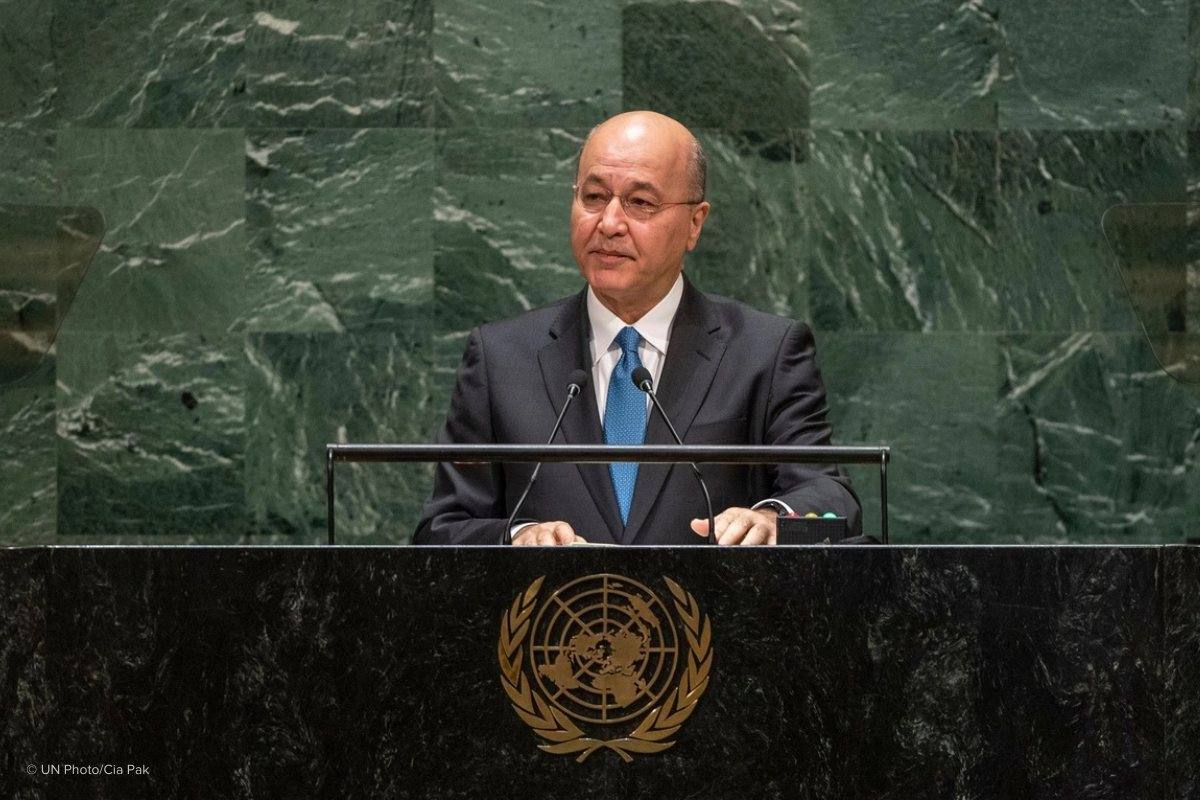
On Friday, the United Nations' new refugee chief looked the Security Council in the eye and told its 15 members what humanitarians usually say only after the cameras leave: they cannot fix this. Barham Salih — Iraq's former president, elected UN High Commissioner for Refugees last December — used his first address to the Council to demand a humanitarian truce in Sudan, declaring there is “no military solution” to a war that has driven 12 million people from their homes, the largest displacement crisis on earth. His UN refugee chief Sudan truce appeal landed on the sidelines of the General Assembly's annual gathering of world leaders, in the chamber whose Charter job is maintaining international peace and security.
His message, in essence: the Council has “a unique responsibility to help make peace possible” — use it. “For the millions of people forced from their homes – and the millions more who should never have to flee – I urge you to use that responsibility,” he said, in remarks reported by the Associated Press.
Why this matters
A first speech by a new High Commissioner is always a statement of priorities — and the Barham Salih UN Security Council speech chose to focus on the wars the world has learned to look past. He did not open with Ukraine or Gaza, the conflicts that dominate headlines. He opened with Sudan. That is a deliberate editorial choice by a man who understands how attention works: Sudan's war has produced more displaced people than any other conflict on the planet, yet it commands a fraction of the diplomatic energy spent on crises with better camera angles. By naming it first, in the Council chamber, Salih was doing what refugee chiefs do at their best — spending scarce moral capital where the cameras aren't.
There is a harder edge, too. “Humanitarians deal every day with the consequences of conflict, but they can't create peace.” That is not rhetoric; it is a jurisdictional claim. Under the UN Charter, peacemaking belongs to the Security Council. Salih — himself a former refugee who became a president — was telling the Council that the division of labor has broken down: his agency is being asked to manage the consequences of wars the Council has failed to stop, with budgets that were inadequate before Sudan and Yemen escalated again.
The numbers behind the warning: 117 million forcibly displaced
Salih's headline figure: more than 117 million forcibly displaced worldwide, with displacement outpacing solutions as conflicts grow more prolonged. He warned against a future in which the displaced spend generations in exile instead of returning home. His country-by-country ledger: Sudan — 12 million displaced inside and outside the country, the world's largest displacement crisis (“As long as this war continues, people will continue to flee”); Yemen — renewed fighting has driven more than 130,000 people from their homes since the beginning of September, with the UN putting the figure at more than 138,000 since early August, including 70,000 children, the highest new displacement since the 2022 truce; Congo — “generations have now lived through cycles of conflict and violence,” now compounded by an escalating Ebola crisis; Ukraine — millions displaced internally and millions more across borders; Western Sahara — generations of refugees in camps near Tindouf, Algeria, “facing uncertainty and limited prospects while awaiting a political solution.”
On Yemen, the texture behind the totals is grim: UNICEF reports 71,000 children forced from their homes in just three weeks and projects 2.2 million children under five acutely malnourished this year, more than half a million severely. More than 3,000 people have fled by boat across the Red Sea to Djibouti and Somalia — a figure the UN expects to triple as calmer seas arrive. The UNHCR Level 1 emergency Yemen declaration also covers Djibouti and Somalia, and planners project another 100,000 people could flee within three months. Its Yemen response plan was less than 20% funded before this surge. The Congo Ebola displacement crisis and the long uncertainty surrounding the Western Sahara refugee camps near Tindouf show why Salih warned that flight can cross generations.
Sudan: the crisis the cameras forgot
A war with no military solution
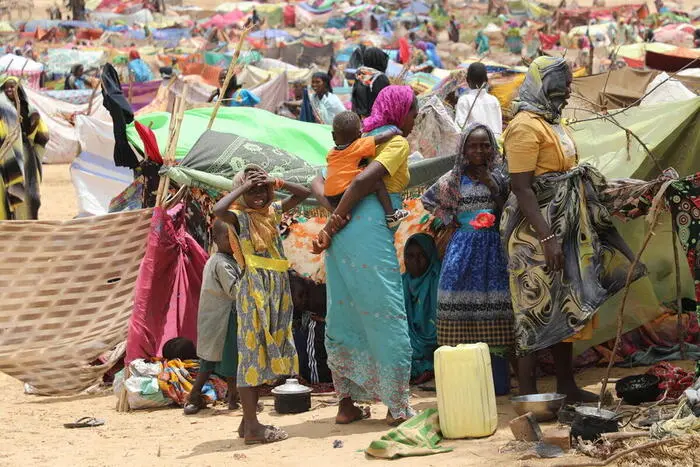
Salih's “no military solution” line is the analytical core of the speech — and the evidence for it is the displacement curve itself, which rises no matter which side claims battlefield momentum. The Sudan displacement crisis of 12 million people has already regionalized its costs: neighboring Chad is absorbing a 20-fold surge of Sudanese refugees, and Egypt and South Sudan are receiving flows of their own. Read our report on the surge of Sudanese refugees reaching Chad.
The regional spillover is already here
Every month the war continues, the question quietly shifts from “when will Sudan's displaced go home” to “which neighboring state breaks first under the caseload.” That is the generational-displacement pipeline Salih warned about — and Chad's camps are its intake valve.
Yemen's new emergency — and what it signals
The Yemen displacement UNHCR emergency is the other half of Salih's warning, and it carries a maritime shadow: the same Red Sea corridor now receiving refugee boats is the shipping lane the world is leaning on harder as disruptions persist in the Strait of Hormuz. Salih also used the speech to demand the immediate, unconditional release of detained UN and humanitarian personnel — a reminder that in Yemen, even the aid system itself is under detention. Read our earlier reporting on UNHCR's warning over new Yemen displacement and UNICEF's child-malnutrition alert.
The uncomfortable arithmetic of generational displacement
Salih's phrase — displacement “crossing generations” — deserves unpacking, because the precedents are not encouraging. Western Sahara's camps are half a century old. Congo's cycles have outlasted childhoods. The mechanism is always the same: a prolonged war, a response plan funded at a fifth of need, and host countries — Chad, Djibouti — left to absorb what the system cannot. Djibouti has already said it cannot meet the needs of those fleeing Yemen alone. When the money runs at 20% and the war runs at 100%, triage is not a choice; it is arithmetic. And triage is how temporary camps become permanent cities.
What happens next
Three things to watch. First, a Sudan humanitarian truce call remains unlikely to deliver results without real Council pressure — and the Council, as the AP's reporting notes, is divided. Read the speech as an attempt to create permission for diplomacy, not as a prediction of it. Second, Yemen: calmer seas in the coming weeks will likely multiply Red Sea crossings even as malnutrition climbs where fighting has cut access to treatment centers. Third, funding: with response plans under 20% funded, the system will ration — and rationing decides, silently, which crises become generational.
The bottom line
Salih's first speech reframes the refugee question from charity to politics: 117 million displaced is not primarily a humanitarian failure but a peacemaking failure. The Council holds the “unique responsibility.” The open question — the one Salih left hanging in the chamber — is whether anyone there was listening.
Sources
- Associated Press (Edith M. Lederer), Sept. 25, 2026 — “UN refugee chief urges action from Security Council so displacement no longer crosses generations”
- United Nations, Sept. 25, 2026 — Daily press briefing (Yemen displacement figures)
- Reuters, Sept. 25, 2026 — “Child malnutrition rises in Yemen as fighting intensifies, says UNICEF”
- Reuters, Sept. 22, 2026 — “More Yemenis expected to flee from upsurge in fighting, UN says”
- UNHCR / USA for UNHCR — “Grandi welcomes election of Barham Salih as UN High Commissioner for Refugees”