Yemen child malnutrition crisis 2026
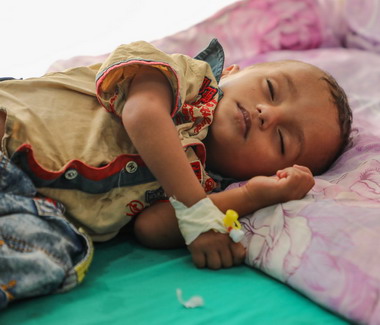
The numbers out of Yemen this week are the kind that stop a briefing room cold. Speaking from Aden via video link to reporters in Geneva on Friday, September 25, 2026, UNICEF's Country Representative in Yemen, Akhil Iyer, reported a "very visible increase in acute malnutrition among children" — the clinical term for what is happening to Yemen's youngest as the country's war sharply escalates. More than a quarter of the nearly 2,900 children screened in recent weeks by UNICEF mobile nutrition teams were acutely malnourished, 200 of them in the severe category. It is the latest, bleakest data point in the Yemen child malnutrition crisis 2026 — and it is getting worse by the day.
What UNICEF found
UNICEF Yemen malnutrition report: more than a quarter of screened children acutely malnourished
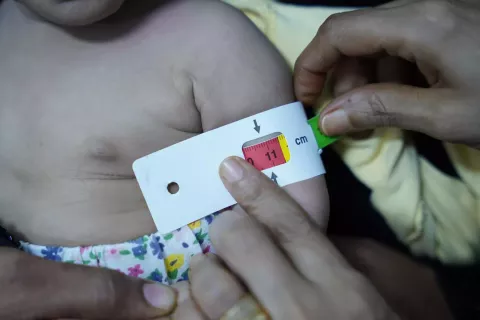
The screening is not a national census. Iyer's teams could only reach "accessible areas," and that caveat matters, because it means the picture is almost certainly worse where the fighting is heaviest. Of the roughly 2,900 children screened, over a quarter were acutely malnourished, with 200 in the severe category — the worst, life-threatening form. Severe acute malnutrition leaves a child eleven times more likely to die than a healthy peer, UNICEF has long warned, and even those who survive can face lifelong damage to cognitive development. Reuters reported the figures on September 25, 2026.
Yemen war child displacement 2026: 71,000 children displaced in three weeks
The hunger data cannot be separated from the displacement data. In the past three weeks, around 71,000 children have been forced from their homes, UNICEF said — part of a broader displacement wave of more than 133,000 people, with some fleeing across the Red Sea to Africa. The UN migration agency's Displacement Tracking Matrix puts the verified total at over 120,000 displaced since the current escalation began in June, concentrated in Taiz and Lahj — and IOM notes that figure only captures movements it can track, not a comprehensive national total. Displacement and malnutrition feed each other: every time a family is uprooted, its ability to feed its children collapses a little further. That pattern also frames UNHCR's warning about further Yemen displacement. Reuters reported UNICEF's three-week figure; IOM figures were cited in the September 2026 “Yemen Cannot Wait” humanitarian coalition brief.
Yemen malnutrition screening results 2026: 2.2 million children projected acutely malnourished
Step back to the full frame: UNICEF projects 2.2 million children under five will be acutely malnourished in Yemen this year, with more than half a million in the severe category. The September 2026 humanitarian coalition briefing, drawing on UN food-security data, puts the same 2.2 million figure alongside 1.3 million pregnant and breastfeeding women who are acutely malnourished, and 18.3 million people who are acutely food insecure — in a country where 22.3 million people need humanitarian assistance and protection.
Why this matters
Yemen famine warning 2026: malnutrition is war's early-warning system
Battlefield casualty counts make headlines; malnutrition numbers are the war's ledger in slow motion. A child does not become acutely malnourished overnight — it takes weeks of insufficient food, unsafe water and untreated illness. That means the screening results UNICEF reported on September 25 are not a snapshot of this week's fighting. They are the accumulated damage of months of economic collapse, closed clinics and empty markets, now accelerating as the shooting war returns. When a quarter of the children aid workers can reach are visibly wasting, the system feeding them has already failed.
Severe acute malnutrition Yemen treatment: the gap is widening, not closing
Only 59.3 percent of Yemen's health facilities are fully functional, according to the humanitarian coalition's September assessment; WHO figures cited at a UN briefing put the share at 60 percent, with just 6 percent providing a full package of trauma care. Around 30,000 children experience severe acute malnutrition with complications every year, and some therapeutic feeding centres are operating at roughly 120 percent of bed capacity. UNICEF's mobile teams — the same teams producing this screening data — are among the last delivery channels still functioning. Funding cuts and operational constraints are scaling them back just as need spikes.
UNICEF Geneva briefing Yemen September: the world is in the same room
The warning landed during UN General Assembly high-level week in New York — the annual moment when donor pledges are made and ignored. Yemen's 2026 humanitarian response plan seeks $2.16 billion to reach 12 million people; the coalition brief describes it as severely underfunded. Malnutrition is a solvable problem — therapeutic food works, and it is cheap by the standards of war — but only if the money and the access arrive. Right now, neither is.
Background: how we got here
Yemen Taiz Houthi offensive displacement: a truce that held — until September
Yemen's civil war, between the Saudi-backed Yemeni government forces and the Iran-backed Houthis, has run since 2014. A 2022 truce largely froze the front lines for four years — not peace, but a pause that allowed markets to function and aid to flow. That pause is now over. On September 3, the Houthis launched an offensive across Taiz and Hodeida provinces, capturing the Red Sea port city of Mocha and pushing south along the coast, while fighting flared around Taiz. Reuters described the war as having "sharply escalated." In August, the UN special envoy had already warned that Yemen faced a greater risk of renewed large-scale conflict than at any point since the April 2022 truce. The military escalation is detailed further in the UN's warning on Yemen civilian casualties.
Yemen children acute malnutrition 2026: a decade of hunger, in numbers
Yemen's malnutrition crisis did not begin in September 2026 — it deepened into it. In February 2021, four UN agencies warned that nearly 2.3 million children under five were projected to suffer acute malnutrition that year, 400,000 of them severe. In March 2025, UNICEF's then-representative Peter Hawkins told the same Geneva briefing room that 527,000 children were suffering severe acute malnutrition and pleaded for $157 million in additional funding. Today's figure — more than half a million severe cases projected for 2026 — means the crisis has essentially held at its worst level for years, and is now climbing again on the back of renewed war. The historical figures come from a UNICEF March 2025 Geneva Palais briefing note and WHO's Yemen reporting on the 2021 projection.
An economy that can no longer feed its people
The World Bank estimates Yemen's real GDP contracted 1.5 percent in 2025 and projects a further 0.5 percent contraction in 2026; government revenue has fallen to 5.6 percent of GDP. Weak revenues mean unpaid salaries for health workers and teachers; disrupted finance means rising food prices; and Yemen imports the essentials it lives on, so every disruption to Red Sea and Gulf shipping — including the Strait of Hormuz crisis unfolding in parallel — lands directly on the price of bread. Climate shocks, water scarcity and flooding compound the same vulnerability.
Multiple angles — who loses, what critics say, what is disputed
The losers are not in doubt
Children, displaced families, and women-headed households in the flight zones bear the greatest cost. UNICEF reports 26 health facilities disrupted and 243 schools closed or offering limited classes since the escalation, affecting some 137,000 students; at least nine children have been killed, twelve injured and three missing since early September, adding to more than 11,500 children killed or wounded since the conflict began in 2015. Families are being displaced for the second or third time — some now attempting the perilous crossing of the Bab el-Mandeb Strait to Djibouti.
The access argument — all sides under pressure
The humanitarian community's criticism is aimed at every party with power over access. The coalition brief notes that since June 2024, dozens of national staff from the UN, international NGOs and diplomatic missions have been arbitrarily detained by the de facto authorities in Sanaa, with UN premises occupied. It calls on all parties and authorities to ensure full, safe and sustained humanitarian access and to release detained personnel immediately. Both the Houthis and the Saudi-backed government frame their actions as defensive; the 80 countries that demanded the reopening of the Strait of Hormuz at the UN this week condemned the Houthis' decision to resume the Yemen conflict. Reporting on Saudi airstrikes and civilian deaths in Yemen documents the other side of the escalation. The food, however, does not check anyone's politics before it fails to arrive.
What the numbers cannot tell us
The 2,900-child screening covers only accessible areas — the true national rate is unknown, and the most dangerous front-line zones are precisely where screening cannot happen. The IPC's latest partial analysis covers government-controlled areas only; for the north, the most recent projection ran September 2025 to February 2026 — a different period, not directly comparable. Displacement figures are floors, not ceilings: IOM's matrix captures only tracked movements. The direction of every bias points the same way — toward undercounting.
What happens next
Yemen IPC food insecurity projections: the winter clock
The window between a malnutrition warning and famine conditions is measured in months. The IPC's June–September 2026 analysis already projected 5.4 million people in Crisis or worse in government-held areas, with 1.6 million in Emergency. If the fighting around Taiz and the Red Sea coast continues through the autumn, the next IPC update is likely to be worse.
Three scenarios
First, de-escalation: UN diplomacy produces a renewed truce and humanitarian corridors, mobile teams scale up, the $2.16 billion appeal gets funded. Second, frozen conflict: the fighting neither escalates nor stops, and malnutrition grinds upward through the winter as funding stays short. Third, full escalation: the coastal advance and coalition airstrikes intensify, ports and roads close, and the 2018 near-famine repeats with fewer aid workers left to stop it.
What to watch
The funding announcements out of New York this week, specifically whether the $2.16 billion plan moves. Whether UNICEF's mobile screening expands or contracts in October. The IPC's next analysis for the north. And Taiz: the city's front lines have decided Yemen's humanitarian fate before, and they are deciding it again.
Sources
- Reuters — “Child malnutrition rises in Yemen as fighting intensifies, says UNICEF” (September 25, 2026)
- “Yemen Cannot Wait” humanitarian coalition brief
- UNICEF Middle East and North Africa — Malnutrition
- WHO Regional Office for the Eastern Mediterranean — Acute malnutrition in Yemen
- UNICEF — Geneva Palais briefing note on children in Yemen after 10 years of conflict (March 2025)