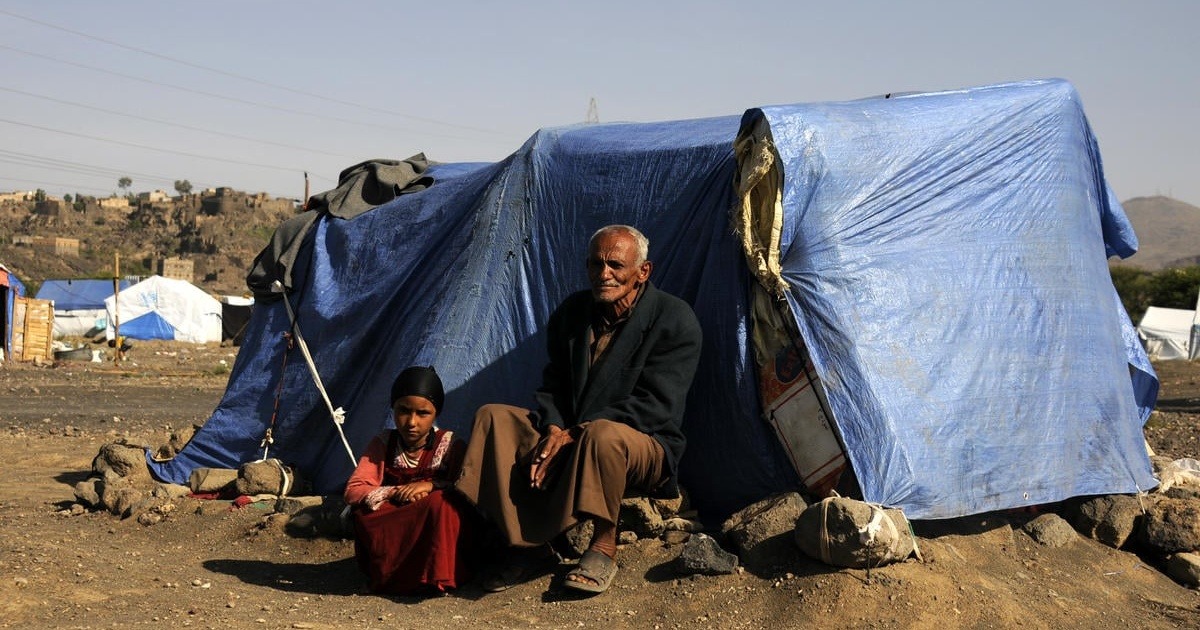
GENEVA — The UN Refugee Agency warned on September 22 that intensifying fighting in Yemen has driven more than 130,000 people from their homes since the beginning of the month and could force another 100,000 to flee within three months. The projection turns a rapid emergency into a test of whether humanitarian agencies can scale up while access narrows and funding remains far below what they say is required.
“Fighting in Yemen is expanding across multiple front lines, triggering a rapidly growing displacement crisis and driving more than 130,000 people to flee their homes since the beginning of September,” UNHCR spokesperson Babar Baloch said at a Geneva press briefing. He added: “Intensifying fighting in Yemen could drive more mass displacement, with growing numbers of people expected to flee, both within Yemen and to Djibouti, Somalia, and other countries.”
UNHCR’s planning estimate indicates that an additional 100,000 people could be displaced over the next three months if the fighting continues. It is a projection rather than a confirmed future total, but it is built around front lines that the agency says are still widening. The distinction matters: the warning describes a preventable outcome, not an unavoidable one.
Taiz is the center of the displacement
Taiz accounts for more than 60% of the displacement reported since September began, according to Baloch and UNHCR’s briefing notes. Many families remain trapped within the governorate rather than reaching safer areas because fighting, blocked roads and shortages of transport and fuel limit movement. That means the headline total does not fully describe the risk: some people facing the greatest danger may be unable to leave at all.
Displacement has also been reported from Al Jawf, Marib and Al Hodeidah governorates. UNHCR cites that spread as evidence of a multi-front conflict rather than a single localized battle. More than 90,000 of the newly displaced have reached Aden, Lahj, Abyan, Al Dhale’e and Marib, where existing displacement sites are already congested. New arrivals need shelter, food, clean water, health care and protection, putting additional pressure on fragile local services.
At least 110 civilian casualties have been reported, including 28 deaths, UNHCR said, while warning that both casualty and displacement figures may rise. Those numbers should be read as reported minimums, not a complete accounting: insecurity, damaged roads, movement restrictions and telecommunications disruptions can delay information as well as relief.
A sea route runs in reverse
More than 3,000 people have crossed by boat from Yemen to Djibouti, while hundreds more have landed in Somaliland and Puntland, UNHCR said. The agency and its partners are planning for more than 10,000 arrivals in Djibouti in the coming months. Sea conditions are expected to improve by mid-October, potentially making further crossings possible even as they remain dangerous.
The direction of travel is a striking reversal. Yemen hosts about 65,000 refugees and asylum seekers, mainly from Somalia and Ethiopia, according to UNHCR. For years, people fleeing the Horn of Africa crossed the Gulf of Aden toward Yemen. The renewed fighting is now sending Yemeni citizens back across the same water, toward countries and territories with their own limited reception capacity.
Djibouti’s small size makes the change consequential even when the absolute numbers look lower than internal displacement. A rise from 3,000 arrivals to more than 10,000 would more than triple the current caseload. Reception centers would need registration capacity, shelter, water, protection services and transport at the same time Yemen’s internal response is competing for money and staff.
The relief effort is funded at a fraction of need
UNHCR’s Yemen operation was only 18% funded in 2026 before the latest surge, with $34 million received against $194 million required. The agency now says an additional $25 million is urgently needed to meet the immediate needs of about 231,000 people. Humanitarian agencies are therefore being asked to expand while most of the original plan remains unfunded.
The $25 million appeal works out to roughly $108 per person. That is not a full cost of recovery; it is an average measure of the limited immediate package UNHCR is trying to mobilize across cash assistance, shelter and protection. The contrast is the central operational problem: displacement has accelerated in days, while donor financing has not.
UNHCR says it has declared a Level 1 emergency for Yemen, Djibouti and Somalia, released emergency cash assistance to 200 displaced families and planned immediate support for 1,000. It is also dispatching 3,000 packages of core relief items from Dubai. Those steps show activity, but their scale remains small beside more than 130,000 new displacements and a planning total that could approach 230,000.
How the war reached this point
Yemen’s civil war began in 2014 between Houthi forces and the internationally recognized government. The Houthi movement, which Reuters and the Associated Press describe as Iran-backed, advanced down the western coast this month toward the Bab el-Mandeb Strait. Residents cited by AP said Houthi fighters seized stretches of the Red Sea coast and entered the strategic port city of Mokha.
Reuters reported, citing five Yemeni military sources, that Houthi fighters were pushing to seize the Kahboub Mountains in Taiz and Lahij provinces. Control of the highlands could help cut the Red Sea coast off from territory held by Saudi-backed Yemeni government forces. The Houthis say Saudi Arabia has launched hundreds of airstrikes on their positions in recent days; that figure is the movement’s account.
The New York Times reported that the Trump administration prepared strikes against the Houthis on Sunday before President Donald Trump called them off at the last minute. Reuters said it could not immediately verify that report, and U.S. Central Command did not respond to its request for comment. The episode nevertheless illustrates how the local offensive sits inside a broader regional confrontation involving Red Sea shipping, Saudi security and U.S. military choices.
Why this matters
The first measure is pace. More than 130,000 people displaced in about three weeks equals roughly 5,900 people a day. Cross-crisis comparisons are imperfect because reporting systems and access differ, but that rate places Yemen’s September emergency among the year’s fastest-moving displacement shocks. The speed makes shelter and registration harder: sites can fill before aid inventories, funding decisions and access negotiations catch up.
The second is accumulation. More than 5.2 million people were already internally displaced before the escalation, and more than 22 million people were estimated to need humanitarian assistance in a country of roughly 40 million. Adding the 130,000 newly displaced and UNHCR’s projected 100,000 would push the total toward 5.43 million. The projection would not create a new crisis so much as deepen an existing one on a national scale.
The third is regional spillover. Boat crossings could strain Djibouti and place more people on hazardous routes toward Somaliland and Puntland. The fourth is economic and diplomatic: fighting near Bab el-Mandeb overlaps with threats to Red Sea shipping, a corridor central to global energy and trade. Even when attacks do not hit commercial vessels, insecurity can raise insurance costs, lengthen routes and complicate efforts to separate the Yemen front from the wider Middle East conflict.
Who bears the cost — and what aid officials criticize
Yemeni civilians bear the immediate losses, particularly families in Taiz who cannot reach safer areas. Host communities in Aden, Lahj, Abyan and Al Dhale’e absorb arrivals while their own water, health and housing systems remain fragile. Aid agencies must expand services on less than one-fifth of the budget requested before the latest fighting, and Djibouti faces a growing reception burden across the sea.
Aid officials’ criticism centers on two constraints. The first is the donor shortfall: money is not arriving at the speed or scale of new needs. The second is access. UNHCR says active front lines, insecurity, movement restrictions, telecommunications failures and damage to roads and Al Mokha port are slowing assistance. Funding cannot solve a blocked road, and access cannot replace food or shelter; the response needs both.
Regional stability is also exposed. A battle for the highlands could redraw access to the coast, while additional Saudi strikes or direct U.S. action could widen the theater. Those outcomes are not certain, and claims by combatants require scrutiny. But the movement of civilians is already evidence that military pressure is reaching beyond front-line units.
What the numbers imply
The before-and-after comparisons show the pressure clearly. A pre-escalation displaced population above 5.2 million moves to about 5.33 million after September’s 130,000, then toward 5.43 million if another 100,000 flee. Djibouti’s more than 3,000 arrivals could exceed 10,000 once calmer October seas make crossings easier. Against those growth rates, an 18%-funded Yemen operation and an immediate appeal averaging about $108 per intended recipient leave little margin for delay.
These calculations do not predict where people will move or guarantee UNHCR’s planning scenario. They indicate scale. A percentage that sounds incremental—another 100,000 against 5.2 million—still means tens of thousands of families needing transport, shelter, documents, health care and protection, often after losing income and community support.
What happens next: three projections
Scenario one: a pause or negotiated de-escalation. Saudi–Houthi channels or UN mediation could produce a humanitarian pause that slows displacement and opens roads. Past truces have reduced violence but proved fragile, so any pause would need practical access commitments and monitoring rather than a political announcement alone.
Scenario two: continued fighting. A battle for the Kahboub Mountains and surrounding highlands would likely push displacement toward UNHCR’s planning total of roughly 230,000 since the escalation began and could raise reported casualties. Host sites in southern governorates would face the fastest increase in immediate needs.
Scenario three: a mid-October rise in sea crossings. If fighting continues as waters become calmer, departures to Djibouti could accelerate toward the 10,000-plus level for which UNHCR and partners are planning. That would test a reception effort still seeking funds while increasing the number of people exposed to maritime risks.
The figures UNHCR released on September 22 are a warning as much as a count. Whether the next 100,000 people flee depends on fighting that is still expanding, on whether routes out of Taiz remain blocked, and on whether diplomacy and relief funding move faster than the front lines.
Sources
- Reuters, September 22, 2026: UNHCR displacement warning, three-month projection, Red Sea crossings and funding context
- UN News, September 22, 2026: humanitarian impact and regional displacement
- UNHCR briefing notes, September 22, 2026: figures, locations, access constraints, response measures and funding
- UNifeed: video of Babar Baloch’s Geneva briefing
- Reuters, September 21, 2026: Houthi highland push, Saudi strikes and the unverified report on planned U.S. strikes
Reporting note: Casualty figures are attributed to UNHCR. Combat claims and the report about planned U.S. strikes are attributed to their sources and are not presented as independently verified. Per-day, per-person and before-and-after figures are Signal Post News calculations from the cited UNHCR data.