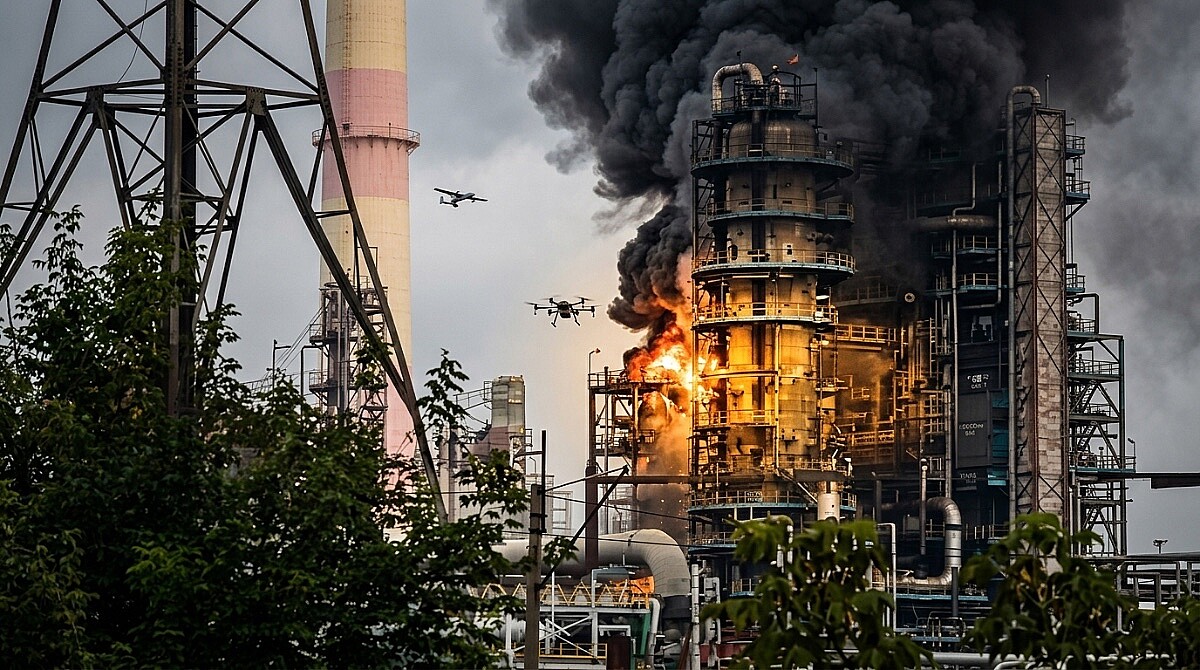
Ukraine’s military said on Tuesday, September 22, that it had struck an oil refinery in Ufa, the capital of Russia’s Bashkortostan region, during an operation the previous morning. Reuters reported the Ukrainian statement alongside a separate claim of a strike on the Kuibyshev refinery in Russia’s Samara region. This report concerns the Ufa operation only; the Samara attack and its disputed refinery footage are covered separately.
Early reporting from Ufa described a drone alert across Bashkortostan and temporary restrictions at Ufa International Airport. Shelter reported at 9:18 a.m. local publication time on September 21 that arrivals and departures had stopped and that preliminary information pointed to Bashneft refining facilities. A Kyiv Post report republished by EuropeSays cited Russian monitoring channels for the regional alert and Petro Andriushchenko, head of Ukraine’s Center for the Study of Occupation, for the preliminary Bashneft attribution.
Those reports established an air-security incident and a claimed target; they did not establish physical damage. Russian officials had not published a site-specific damage assessment at the reporting cutoff, and no independently verified satellite analysis or throughput data was available. Signal Post News is therefore not publishing a damage total or a casualty figure for the September 21 Ufa event.
What is confirmed—and what remains unverified
- Confirmed by Ukraine’s military: Ukraine says it hit a refinery in Ufa and also carried out a separate strike on Kuibyshev in Samara region.
- Reported in local and monitoring accounts: a drone alert covered Bashkortostan, a no-fly zone was imposed, and Ufa Airport temporarily stopped accepting and dispatching flights.
- Preliminary target attribution: Ukrainian-linked sources identified the Bashneft complex. Public reporting did not establish which processing unit, tank farm or pipeline was affected.
- Not independently verified: the number of drones involved, the number that reached the industrial area, the type or duration of any fire, and any loss of refining capacity.
- No casualty figure: this report publishes no death or injury total for the September 21 Ufa event because no sufficiently verified figure was available by the cutoff.
The distinction between a strike claim and a production outage is central to understanding the refinery campaign. A drone can trigger airspace restrictions or a visible fire without disabling crude processing. Conversely, damage to a primary distillation unit can halt downstream production even when the external fire appears limited. The strategic effect can be measured only after the affected equipment and operating status are known.
Why Ufa matters
Ufa is not a single refinery. It is a large, connected refining centre built around three Rosneft-owned Bashneft plants: Bashneft-UNPZ, Bashneft-Novoil and Bashneft-Ufaneftekhim. Public reporting puts their combined annual capacity above 23 million metric tons of crude. The cluster produces gasoline, diesel, aviation kerosene, lubricants and other petroleum products.
If that annual capacity were spread evenly through a year, it would average more than 63,000 metric tons of crude processing per day. That arithmetic is a scale indicator, not a measure of output lost on September 21. A shutdown at one unit would affect only part of the cluster; a hit on shared power, storage or transfer infrastructure could have broader consequences. Without a confirmed unit and operating report, the headline capacity cannot be treated as lost capacity.
Distance gives the operation strategic significance even before damage is known. Ufa lies more than 1,300 kilometres from Ukraine by Reuters’ description and about 1,600 kilometres from the border in Shelter and Kyiv Post reporting. The different figures likely reflect different reference points or routes; both place the city far beyond the immediate battlefield. Reaching it forces Russia to consider air defense, detection and industrial protection across a much larger rear area.
The deeper thesis is narrower than “distance equals success.” Ufa matters because repeat access to a remote, high-capacity refining cluster can impose persistent defensive and maintenance costs. Whether it materially tightens fuel supply depends on verified outages, repair times and the ability of other plants to compensate.
A repeat target, not a first incursion
The September 21 claim follows a series of attacks on energy infrastructure in Bashkortostan and Ufa. Reuters’ August 11 chronology said Ukrainian forces struck a Ufa refinery on July 1 for the second time and later hit an oil-pumping station in Bashkortostan on July 8. The same Reuters roundup listed shutdowns or processing suspensions at several other Russian refineries, including Volgograd, Saratov, Ryazan, Perm, Tyumen, Syzran and NORSI.
Defense Magazine reported another strike at Bashneft-UNPZ on August 19, citing geolocation analysis that pointed to the AVT-6 primary-processing unit. Regional head Radiy Khabirov acknowledged a drone attack and fire at that time, while the full damage remained unclear. The photograph above comes from that earlier incident and is labeled accordingly; it is not evidence about Monday’s strike.
One day before the latest Ufa operation, drones hit the Moscow refinery. Reuters reported that both of that plant’s primary crude-distillation units caught fire and that repairs could take several weeks. The Moscow facility processed 11.6 million tons of crude in 2024, roughly half the stated annual capacity of the three-plant Ufa cluster. That comparison explains why verified Ufa damage would matter, but it does not prove that the two events produced comparable outages.
The national refining campaign, by the numbers
- Ufa cluster capacity
- More than 23 million metric tons a year across three Bashneft plants
- Distance
- More than 1,300 km from Ukraine in Reuters’ account; about 1,600 km in local reporting
- Strike tempo
- About one Russian refinery hit every three days in January–August, according to The Times citing IEA data
- Ukraine’s assessment
- More than 45% of Russia’s designed refining capacity idle after recent strikes
The four numbers answer different questions. Capacity describes the size of infrastructure at risk. Distance describes the reach and defensive burden. Strike tempo describes pressure over time. The 45% figure is Ukraine’s General Staff assessment, relayed by Defense Express; it has not been independently established and may combine full and partial, short and longer outages. It should not be read as proof that almost half of Russia’s fuel supply has disappeared.
The Times reported, citing International Energy Agency data, that Russian refinery output had fallen to its lowest level in more than 20 years, with diesel production down nearly 30% and petrol output down about 20% over the previous year. Those are system-wide estimates shaped by repeated attacks, repairs, sanctions, maintenance, logistics and operating choices. They cannot be assigned to Ufa, and they do not show that Monday’s strike caused an additional decline.
A Meduza analysis relayed by Defense Express earlier in the campaign said eight of Russia’s ten largest refineries had been struck, that only Omsk and Angarsk remained untouched, and that some regions were reporting shortages amid the fastest gasoline-price growth in roughly two decades. That snapshot is now historically qualified: Reuters’ August 11 chronology says Omsk was struck on July 6. The discrepancy illustrates how quickly a map of “untouched” facilities can become obsolete and why dated claims should not be converted into current totals.
Trump, Zelenskyy and the diesel argument
The Ufa claim arrived as refinery strikes moved to the centre of U.S.–Ukraine diplomacy. The Times reported that a senior Ukrainian official described President Donald Trump’s message in a private call with President Volodymyr Zelenskyy as “diesel, diesel … diesel.” Another Ukrainian official said Trump argued that the strikes were contributing to higher prices and global shortages. The White House did not publish a transcript confirming those words.
Trump wrote on September 21 that “Russia has unfortunately lost control of its Diesel Oil Industry” because of the war and said many refineries were at least temporarily out of commission. His statement was a political claim, not an independently audited capacity estimate. It nevertheless shows why the refinery campaign now affects negotiations beyond the battlefield: a Ukrainian operation designed to raise Russia’s costs can also tighten internationally traded fuel markets.
Zelenskyy’s position is reciprocal rather than unilateral. He has said Ukraine would take steps toward de-escalation if Russia stopped attacks on Ukraine’s energy sector, critical infrastructure and food exports. Secretary of State Marco Rubio publicly supported the idea of an “energy infrastructure ceasefire.” No completed agreement had been announced at the cutoff.
The Ufa strike should not be framed as Zelenskyy “defying” or “ignoring” Trump. The public record establishes pressure from Washington, Ukraine’s conditional offer and continued operations; it does not establish a binding order, a formal ceasefire or the decision chain for this mission. Those distinctions matter in reporting on alliance disagreements and military command.
Who gains, who loses and what critics argue
Ukraine gains potential leverage if the campaign forces Russia to move air defenses away from other priorities, spend on repairs and operate refineries less efficiently. Repeated reach into Ufa can matter even when an individual strike causes limited damage, because protection and inspection costs recur. The gain is smaller if plants resume quickly or public claims outrun verifiable evidence.
Russia, Rosneft and fuel users carry the direct economic risk. A confirmed outage would reduce flexibility inside a system already managing disruptions. Households, transport operators, agriculture and industry can face higher prices or tighter regional supply. Russia can offset some losses by redirecting stocks, reducing exports, prioritizing users or increasing runs elsewhere, but each adjustment transfers cost.
Importing economies can lose through diesel prices. Crude oil and diesel are related but distinct markets: refineries turn crude into transport fuels, and a shortage of processing capacity can lift diesel prices even when crude supply remains available. That explains Washington’s concern. It does not by itself prove that Ukrainian strikes are the dominant cause of global diesel pressure; war in the Middle East, shipping disruptions, sanctions, maintenance and inventory levels also affect the market.
Critics of the campaign warn of civilian harm, environmental damage, escalation and price shocks. Supporters argue that refineries provide fuel and revenue supporting Russia’s war and that asking Ukraine to stop without reciprocal protection for its power system would remove leverage. International humanitarian law still requires distinction, proportionality and feasible precautions. The military relevance of industrial infrastructure does not erase risks to workers, nearby residents or the environment, and each attack must be assessed on its own facts.
What happens next
- No meaningful outage. Russia reports that debris or a limited strike caused little damage, airport restrictions end, and the cluster continues operating. In this scenario, the main effect is the demonstrated reach and the cost of defending Ufa.
- A localized unit shutdown. Industry sources or satellite imagery identify damage at one crude-distillation or secondary-processing unit. Output falls at one plant while the other Ufa refineries and Russia’s wider network compensate. Repair time, not the visual size of a fire, becomes the key measure.
- A wider cluster disruption. Damage to power, shared transfer systems, storage or multiple units reduces throughput across more than one plant. This would have greater diesel and gasoline implications, but no evidence available at the cutoff established such an outcome.
- A reciprocal energy arrangement. Trump, Zelenskyy and Russia move from public positions to defined terms covering refineries, power plants, ports and food-export infrastructure. Any agreement would need a timeline, target definitions and a way to investigate alleged violations.
- Continued escalation. If no arrangement emerges, Ukraine may keep testing deeper targets while Russia continues attacks on Ukraine’s energy and industrial systems. The campaign’s strategic result would then be measured in verified throughput, repair delays, export changes and domestic shortages—not strike announcements alone.
The next reliable evidence will be a named-site statement from Russian authorities or Rosneft, independently reviewed satellite imagery, industry-source confirmation of a shutdown, changes in product sales or flows, and any formal language after the Trump–Zelenskyy meeting. Until those indicators appear, the defensible conclusion is limited: Ukraine says it reached the Bashneft refining centre in Ufa again; the physical and economic effect of the September 21 strike remained unverified.
Sources
- Reuters via Sowetan: Ukrainian military claim of strikes on Ufa and Kuibyshev, September 22, 2026
- Kyiv Post report republished by EuropeSays: Bashkortostan alert, preliminary target attribution, airport restrictions and Ufa refinery-cluster context
- Shelter: September 21 Ufa alert, airport restrictions, distance and combined Bashneft capacity
- Reuters: Moscow refinery outage, damaged primary units, repair estimate and 2024 throughput
- Reuters: dated chronology of Ufa, Bashkortostan and other refinery attacks through August 11
- The Times: Trump–Zelenskyy call reporting, IEA figures and reciprocal-ceasefire diplomacy
- Defense Express: Ukraine’s General Staff assessment that more than 45% of designed refining capacity was idle
- Defense Express relaying Meduza: earlier campaign analysis and regional fuel-price context
- Defense Magazine: August 19 Bashneft-UNPZ strike context and photograph provenance
Reporting cutoff: September 22, 2026 at 9:30 AM PDT. The Ukrainian strike claim, preliminary target reporting and national capacity estimate remain attributed. Russian officials had not published a site-specific damage assessment, and Signal Post News had not independently verified damage, operational losses or a casualty figure for the September 21 Ufa event. This is a fixed reporting snapshot and does not update automatically.