Krasnodar oil depot drone strike
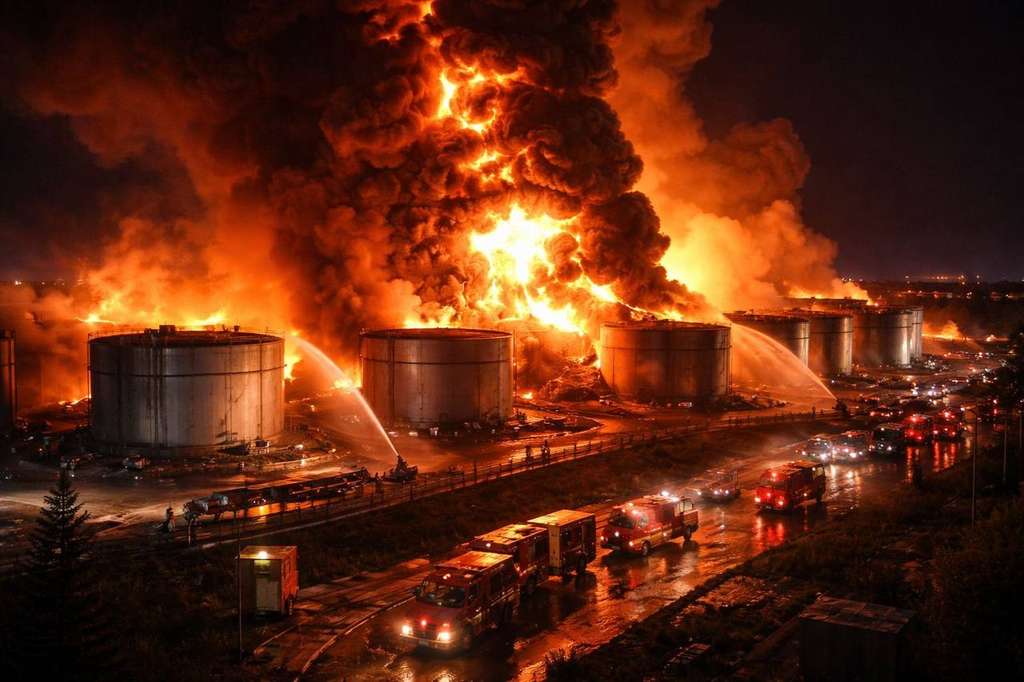
Krasnodar oil depot drone strike — Ukrainian drones struck the Edelweiss-95 oil depot in Russia's Krasnodar Krai during the night of September 28, 2026, igniting a fire on the facility's premises, according to Russia's independent ASTRA news agency and Al Jazeera's reporting on the incident. Residents of the stanitsa of Novotitarovskaya reported drones flying overhead and numerous explosions in the area of the railway, and ASTRA's OSINT analysis of eyewitness videos geolocated the fire to the depot itself. The Ukrainian Telegram monitoring channel Exilenova+ published footage of the large fire and identified the facility as the Pavlovskaya oil depot.
No injuries have been reported so far, and there is currently no official information about the scale of the fire or the extent of damage to the depot. The strike is the latest in a run of Ukrainian attacks on Russian fuel infrastructure that has intensified sharply in recent weeks, hitting refineries, depots and ports from Krasnodar to Bashkortostan.
Why this matters
Fuel is the connective tissue of a mechanized war. Every tank, truck, helicopter and generator in Russia's war effort runs on diesel and gasoline, and the revenues from refined products help fund the war itself. Ukraine's drone campaign against oil infrastructure is designed to attack both at once: deprive the military of fuel at the margin and choke the revenue stream that pays for the invasion. A wholesale depot like Edelweiss-95 may look like a civilian commercial facility — and in legal terms it is one — but in a war economy it is a node in the logistics network that keeps the front supplied.
The strike also matters because of what it signals about reach. Novotitarovskaya sits deep inside Krasnodar Krai, hundreds of kilometres from Ukrainian-held territory. That Ukrainian drones can reliably find and hit fuel infrastructure there — repeatedly, in recent days — tells Moscow that no rear-area fuel node is safe, and forces Russia to spread scarce air defences across an enormous geography. Every battery guarding a depot is a battery not guarding a headquarters or an airfield. That dispersal is itself a Ukrainian objective.
What happened at the depot
The sequence, as reconstructed from local reports and open-source analysis, is straightforward. During the night of September 28, residents of Novotitarovskaya heard drones overhead, followed by numerous explosions in the area of the railway. Video of a large fire began circulating on Ukrainian monitoring channels; Exilenova+ identified the burning facility as the Pavlovskaya oil depot. ASTRA then applied geolocation to the eyewitness footage and concluded the fire was on the premises of the depot owned by the Krasnodar-based company Edelweiss-95.
What remains unknown is significant. Russian officials have not publicly confirmed the strike on this specific facility, and there is no official account of how many tanks burned, how much fuel was lost, or how long the depot will be out of service. That information vacuum is typical of these strikes: Moscow rarely volunteers damage assessments of successful Ukrainian hits, and independent verification from the ground is limited. The facts that can be stated with confidence are the fire itself, its location, and the drone attack that preceded it — all corroborated by independent chains of reporting.
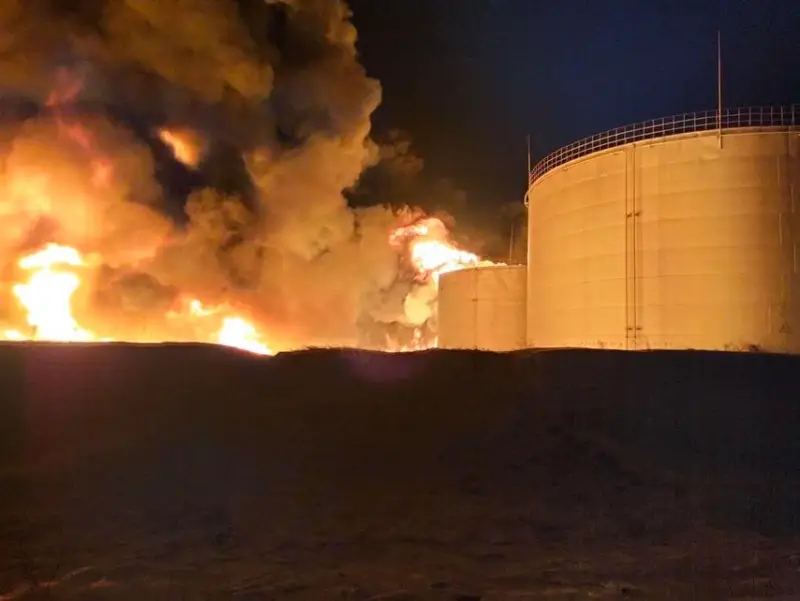
Edelweiss-95: the company behind the tanks
Edelweiss-95 is not a household name, but its profile explains why it was targeted. The Krasnodar-based company specialises in the wholesale supply of diesel fuel and AI-92, AI-95 and AI-100 gasoline, with a stated storage capacity of 4,500 cubic metres — modest by refinery standards, but significant as a regional distribution node. It operates its own railway branch for receiving and shipping fuel, buys petroleum products directly from major Russian refineries, and says it has operated in the fuel market for about 30 years.
The railway branch is the telling detail. Rail is how fuel moves in bulk across Russia's south, and a depot with its own siding is a transfer point between the refinery system and the trucks and trains that carry fuel toward military consumers. Striking distribution nodes rather than only refineries is a way to attack the system's connective tissue: refineries can be repaired, but a logistics network under constant threat operates slower, costlier and with larger safety margins — all of which tax the war effort.
A campaign, not an incident
The Pavlovskaya fire cannot be understood in isolation. Two nights earlier, Ukrainian drones struck the Ilsky oil refinery — also in Krasnodar Krai, about 500 kilometres from Ukrainian-controlled territory — in an attack Ukraine's General Staff publicly confirmed as an exercise of self-defence under Article 51 of the UN Charter. President Volodymyr Zelenskyy posted images of that fire, and the Ukrainian drone manufacturer Fire Point said three main refining units and a tank farm had been hit, reportedly suspending operations at a refinery that processes some 6.6 million tonnes of crude a year and had already been attacked at least 16 times since the full-scale invasion began.
A day later, drones hit the Afipsky refinery and Port Kavkaz on the Kerch Strait, injuring three people at the port, according to local authorities. Earlier in the week, Ukrainian strikes reached refineries in Ufa, roughly 1,400 kilometres from Ukraine's borders, and the Kuibyshev refinery in Samara. The tempo is the story: Ukraine is no longer conducting occasional symbolic strikes on Russian energy but a sustained interdiction campaign across the depth of Russia's fuel system.
Moscow's response has combined air-defence claims — the defence ministry routinely reports dozens of drones intercepted overnight — with retaliatory strikes on Ukrainian energy and industrial targets. Russia's defence ministry said it bombed a Kyivstar data centre in Kyiv and an Omega Telecom facility, claiming both served the Ukrainian army. The exchange has settled into a grim rhythm: Ukraine burns Russian fuel infrastructure; Russia burns Ukrainian infrastructure in return; civilians on both sides absorb the costs.
Who gains, who pays
For Ukraine, the arithmetic of the drone campaign is compelling. Long-range drones are cheap relative to the damage they inflict and the defences they force Russia to deploy. Each successful strike on a depot or refinery is a double hit — physical damage plus the economic drag of a fuel system operating under threat — and it demonstrates to Western partners that Kyiv retains the initiative even as US-led talks to end the war have failed to produce a breakthrough. The political risk is that strikes on fuel infrastructure invite pressure from allies worried about global energy markets: Ukraine's UNN news agency reported on September 28 that US President Donald Trump had asked Zelenskyy to “slow down” strikes on Russian refineries over fears of a global fuel crisis — a claim reported by a single news chain and not confirmed by Zelenskyy's office, and treated here as unverified.
For Russia, the fires are an embarrassment that compounds. The Kremlin's official line — debris from intercepted drones, no significant damage — grows harder to sustain as geolocated footage of burning depots accumulates. The material cost is real but manageable for an economy of Russia's size; the strategic cost is the dispersal of air defences and the signal to the Russian public that the war's consequences are arriving at home. Foreign Minister Sergey Lavrov told the UN General Assembly on Saturday that Moscow intends to continue its military campaign “to the end” — a posture that leaves little room for the kind of reciprocal energy truce Zelenskyy has floated.
For civilians, the ledger is the bleakest. No injuries were reported at Pavlovskaya, but fuel infrastructure sits amid populated areas, and the campaign's logic — degrade the enemy's fuel system — inevitably raises prices and risks for ordinary people. Ukraine knows this from the receiving end: Russia's own strikes on Ukrainian energy have repeatedly left cities dark and cold. The drone war on fuel is, by design, a war on the systems civilians depend on.
What happens next
Three paths branch from the smoke over Novotitarovskaya. The first is sustained tempo: Ukraine keeps hitting depots and refineries faster than Russia can repair and defend them, gradually degrading the fuel logistics of the southern military districts. The pattern of the last ten days — Ilsky, Afipsky, Port Kavkaz, Ufa, Samara, now Pavlovskaya — points this way, and Ukraine's domestic drone production gives it the means to sustain it.
The second is adaptation: Russia hardens fuel sites, thickens air defences around energy infrastructure, and accepts the cost of defending the rear. Moscow has already begun fortifying power plants with concrete after retaliatory Ukrainian strikes; depots and refineries are the logical next step. Adaptation cannot prevent every strike, but it can raise the cost of each one and limit the damage when drones get through.
The third is diplomacy, and it looks the thinnest. Lavrov's “to the end” declaration, the failure of US-led talks to produce a breakthrough, and a UN assessment highlighting the growing civilian toll all point away from negotiation. Zelenskyy's reciprocal energy-truce offer — stop hitting our energy if you stop hitting yours — remains on the table, but neither side has shown willingness to take the first step. Until one does, the depots will keep burning.
Sources
- ASTRA via UNN (EuropeSays): In Russia's Krasnodar Krai, the “Edelweiss-95” oil depot caught fire after a drone attack — the overnight September 28 fire; Novotitarovskaya residents' reports of drones and explosions near the railway; ASTRA's geolocation of eyewitness footage to the depot's premises; company profile (wholesale diesel and AI-92/95/100, 4,500 m³ capacity, own railway branch, ~30 years in market); no official information on the scale of the fire or damage.
- Al Jazeera (via EuropeSays): Russian strikes kill eight, injure dozens across Ukraine — “Ukrainian drones struck an oil depot in Russia's Krasnodar region on Monday”; Exilenova+ published footage of a large fire and identified the facility as the Pavlovskaya oil depot; no injuries reported so far; Ukraine's intensified targeting of Russian oil infrastructure in recent weeks.
- Informat.ro: Ukrainian drones caused a fire at one of Russia's largest refineries — the September 26 Ilsky refinery strike; Ukraine's General Staff confirmation and Article 51 framing; Zelenskyy's images; Fire Point's account of three main refining units and a tank farm hit; 6.6 million tonnes annual capacity; at least 16 attacks since the invasion began, per ASTRA.
- Reuters via InfoMarine: Ukrainian drones strike oil refinery, port in Russia's Krasnodar region — the September 27 Afipsky refinery fire and Port Kavkaz strike; three injured at the port; damage to a service vessel and pier complex; Russian defence ministry's account of 87 drones downed overnight.
This article is based on reporting by Russia's independent ASTRA news agency as carried by UNN, and Al Jazeera's wire reporting, with additional context from Informat.ro and Reuters. The strike has not been independently verified by Signal Post News. No injuries were reported in the initial accounts, and Russian officials have not publicly confirmed the strike on this facility or the extent of the damage. The report that US President Donald Trump asked President Zelenskyy to slow strikes on Russian refineries is attributed to a single UNN news chain dated September 28 and has not been confirmed by Zelenskyy's office. Claims by either side about intercepting the other's drones could not be independently verified.