UK Ukraine AI drone swarm partnership
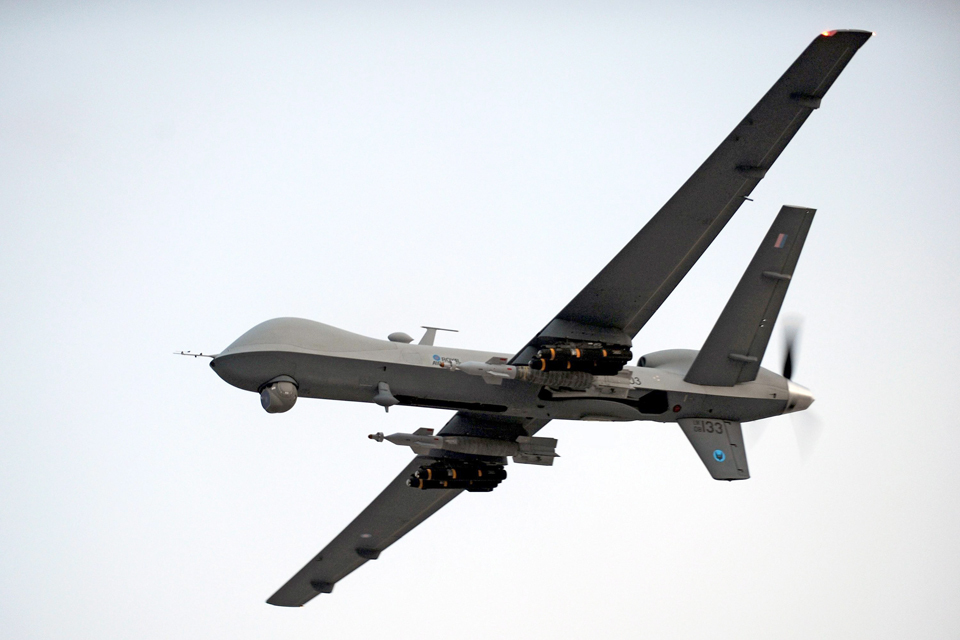
Britain is inviting as many as 12 UK companies to train artificial-intelligence models on Ukraine's Avengers AI Labs battlefield database, an unusually direct attempt to convert wartime sensor records into software for collaborative drone operations. The collection contains daylight and thermal imagery, video and sensor information covering more than six million object detections.
The stated ambition is broader than improving a single aircraft. The competition seeks models for autonomous target recognition, distributed decision-making, adaptive mission execution and collaborative sensing—functions that could allow groups of uncrewed systems to share work even when radio links are unreliable or satellite navigation is unavailable.
Why the data matters more than the airframe
Modern AI systems depend on relevant, labeled examples. Commercial imagery can teach a model to recognize vehicles or structures in clean conditions; battlefield footage includes camouflage, smoke, partial views, heat signatures, electronic interference and damaged equipment. Ukraine's database therefore offers something difficult to reproduce in a laboratory: repeated observations from an active, rapidly changing war.
That does not guarantee a reliable model. Six million detections are not automatically six million high-quality training examples. Performance will depend on labeling accuracy, class balance, sensor calibration and whether the data represent the environments in which a future system is deployed. A model that works on Ukrainian terrain may require substantial testing elsewhere.
What “swarming” could mean in practice
A swarm need not imply a fully independent mass attack. It can describe aircraft dividing surveillance areas, passing detections to one another, selecting which platform maintains a track or rerouting when one unit loses communications. Distributed decision-making can make a group more resilient because no single link or navigation source carries the whole mission.
The official announcement says operations will have “appropriate human involvement.” That is an important boundary, and it means the program should not be described as removing people from lethal decisions. Yet the phrase does not answer every operational question: which actions require authorization, how quickly a person can intervene, what logs are retained and who is accountable when a model misidentifies an object.
The unresolved governance questions
Selected firms will gain access to sensitive wartime material with commercial and military value. The public documents set out the competition and intended use cases, but important implementation details remain: licensing rights for models trained on Ukrainian data, export-control treatment, safeguards against unauthorized reuse, audit standards and ownership of improvements.
Those issues affect both trust and procurement. Ukraine has an interest in preventing a uniquely valuable dataset from becoming a one-way transfer. British companies need clear rights if they are to invest. Defence customers need evidence that outputs can be traced and tested rather than treated as opaque scores.
The competition calendar
The competition launched on September 25. An industry briefing is scheduled for October 7, submissions close at 11:59 p.m. BST on October 22, and review is planned for October 23 through October 30. Applicants are due to be notified by November 6. That short timetable signals a rapid selection exercise, not the fielding date of an operational swarm.
The likely winners are firms with existing perception, autonomy and edge-computing systems that can demonstrate secure handling and realistic testing. Ukraine gains potential tools and a route into British defence development. The risk is that urgency compresses scrutiny or produces impressive demonstrations that do not survive electronic warfare, weather and adversarial deception.
What happens next
Watch the technical briefing for details on data access, evaluation benchmarks and the meaning of human involvement. Then watch whether selected models are tested against held-back battlefield data rather than the material used for training. Independent red-teaming, logs that support post-mission review and clear authorization rules will determine whether the program creates dependable capability or merely a fast procurement narrative.
The strategic significance is clear: Britain is treating Ukraine not only as a recipient of equipment but as a source of combat-tested data and design knowledge. The unresolved question is how that value—and the responsibility attached to automated military decisions—will be shared.
Related reporting: Ukraine's long-range drone campaign · the human cost of drone warfare in Kyiv · Europe's latest Ukraine military-aid release
Reporting basis: Fixed September 25, 2026 snapshot. The official material states that operations will include appropriate human involvement; public documents do not yet resolve every authorization, licensing, export-control or accountability detail.