Trump Monday announcement
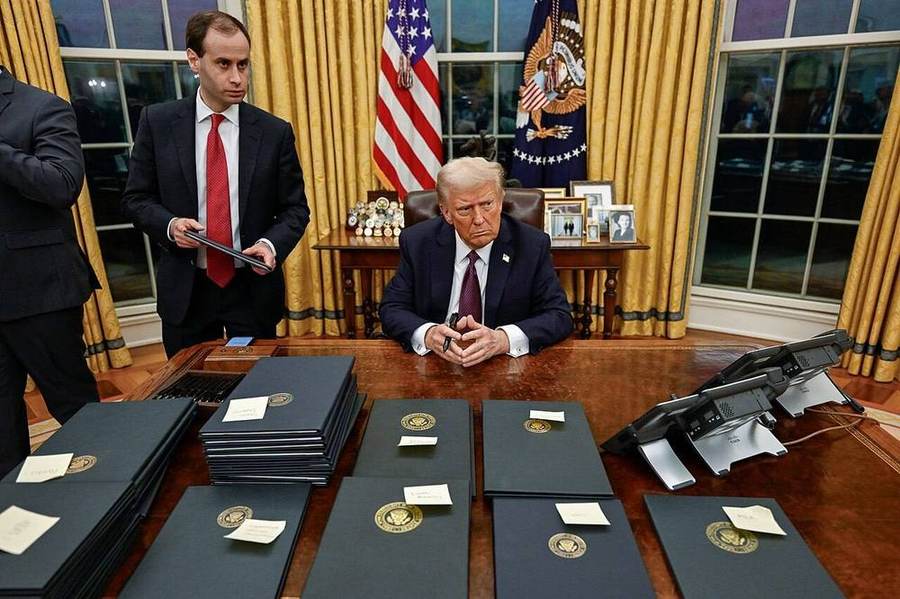
The Trump Monday announcement comes straight from the White House's official daily guidance: at 2:00 p.m. Eastern Time on Monday, September 28, 2026, President Donald Trump will “make an Announcement” from the Oval Office, with the White House press pool present. Ninety minutes later, at 3:30 p.m. ET, he will sit for a print interview behind closed doors. What he plans to say is unknown — the schedule offers no subject, no briefing paper and no advance text — and that single blank line set off a weekend of speculation across Washington, Silicon Valley and the markets. The timing is 11 a.m. PT and 7 p.m. BST.
What the official schedule says
The White House pool's daily guidance for Monday lists a day that begins quietly and becomes public only in the afternoon. All times below are Eastern Daylight Time:
- 8:00 a.m. — executive time.
- 11:00 a.m. — policy meeting, closed press.
- 12:30 p.m. — policy meeting, closed press.
- 1:00 p.m. — policy meeting, closed press.
- 2:00 p.m. — the president makes an announcement in the Oval Office, with the White House press pool present.
- 3:30 p.m. — print interview in the Oval Office, closed press.
The sequence is the most important confirmed fact. Three private policy sessions lead directly into the public event; an interview follows. The guidance does not identify the policy under discussion, the interviewer or any document that will accompany the announcement.
Why this matters
A scheduled but undisclosed presidential announcement is itself a communications choice. Most policy rollouts are pre-framed: agencies brief stakeholders, officials seed a fact sheet, and friendly surrogates arrive on television with the same talking points. Here, the White House disclosed the stage and the clock but withheld the subject. That guarantees reporters, political rivals and traders will be watching while limiting the risk that the central message leaks early.
The 2 p.m. ET slot falls squarely inside the U.S. trading day. If the announcement touches tariffs, energy, technology controls or a major corporate partnership, markets can react before the closing bell. That does not prove the topic is economic, but it raises the practical stakes of every word and every omitted detail.
The print interview at 3:30 p.m. is the rarer tell. Pool coverage can capture the announcement and immediate questions, but a longer print conversation gives the White House another chance to establish context, answer objections and shape next-day headlines. Placing that interview immediately after the public event suggests the administration wants more than a televised soundbite; it appears to want a durable narrative in long-form coverage.
The clues pointing to AI
The most concrete public clue came Sunday evening, when Trump dined with Anthropic chief executive Dario Amodei. Asked by a reporter about the “big announcement,” Trump pointed toward artificial intelligence: “We're meeting with Anthropic as you know on Tuesday that's going to be big,” according to a transcript reported by Newsweek. The wording leaves room for two separate events — Monday's announcement and Tuesday's meeting — so it is a clue, not confirmation.
The broader policy context makes the clue consequential. After Chinese President Xi Jinping's Washington visit, the United States and China launched a bilateral AI dialogue, with another round expected in November. Reuters reported on September 26 that the two governments also agreed to more favorable tariff treatment for $30 billion in non-sensitive goods moving in each direction. An AI announcement could therefore sit at the intersection of industrial policy, export controls and the administration's China strategy rather than being only a corporate meeting.
Trump also used last week's United Nations General Assembly to reject global efforts to control AI development and urged government writers to say “super-intelligence” rather than “artificial intelligence.” He has said the United States is roughly a year and a half ahead of China in AI. Those statements frame the technology as a contest for national advantage, not simply a regulatory file.
The Amodei relationship adds another layer. Trump previously called the Anthropic leader a “treasonous traitor” during a dispute over AI policy. A White House dinner therefore signals at least a willingness to reopen the channel. If Monday produces an executive order, infrastructure package or public-private partnership, the meeting may mark a substantive thaw; if it does not, it still shows that the administration is talking directly with a company at the center of the AI safety debate.
The other theory: energy and trade
Other reporting has pushed speculation toward energy. Some accounts have focused on possible diesel export restrictions as global fuel markets remain under pressure, with diesel reportedly trading near record levels around $6.52 per gallon in some measures cited over the weekend. No restriction appears in the official schedule, and no White House document has confirmed one. The number and the policy theory should therefore be treated as reported speculation, not as a preview of the president's decision.
Trade is a related possibility. Agricultural shipments to China are expected to feature in administration announcements this week, and the recent U.S.–China understanding gives the White House an incentive to present a concrete commercial result. Yet there is no official evidence tying those shipments to the 2 p.m. event. Energy and trade remain plausible because of the calendar and current policy pressures, not because the guidance names them.
What it is probably not
Online posts have labeled the event an “emergency” and spun theories about resignation. The official document does neither. It lists a standard presidential announcement with routine pool access, followed by a scheduled interview. There is no emergency designation, no unusual continuity-of-government language and no evidence in the published guidance for resignation claims.
That distinction matters because uncertainty attracts narratives that outrun the source material. A blank subject line is evidence that the topic was withheld; it is not evidence of a constitutional crisis. Until the president speaks, the responsible description is a scheduled Oval Office announcement with an undisclosed subject.
What happens next
The announcement begins at 2 p.m. ET with the White House press pool present, so major networks and live-news services are expected to carry it. The 3:30 p.m. print interview is closed press; the first account will come from the participating outlet or later pool readouts rather than a live camera.
Three broad scenarios fit the available clues. The first is an AI initiative — potentially an executive order, procurement decision or partnership announcement. The second is an energy or trade measure, possibly linked to fuel supply or Chinese purchases. The third is something that public speculation has missed entirely. The absence of advance text means none can yet be ranked as fact.
The foreign-policy setting also matters. Signal Post News is tracking Iran and UNGA diplomacy in our live coverage, while last week's Trump UNGA speech placed Iran at the center of U.S. pressure and the Trump–Zelenskyy meeting tested an energy-ceasefire proposal. Any surprise national-security announcement would land against that unsettled backdrop.
This article will be updated as the president's remarks and the interview details become available.
How to watch
The White House website is expected to carry the 2 p.m. ET Oval Office announcement, with major broadcast and cable networks also providing live coverage. For viewers outside the Eastern time zone, the start is 11 a.m. Pacific and 7 p.m. British Summer Time. Because the later print interview is closed press, do not expect a separate livestream at 3:30 p.m.
Sources
- White House pool daily guidance — the official Monday schedule and press-access designations.
- Newsweek, “Donald Trump To Make Mystery Announcement Today: What We Know” — Trump's Sunday remarks and the Anthropic clue.
- The Sun timing explainer — announcement timing and public speculation.
- The Blast — the online guessing game surrounding the undisclosed subject.
Reporting basis: The confirmed schedule comes from official White House daily guidance. Proposed subjects are clearly identified as clues, reported speculation or possible scenarios.