Health / Explained — The Shamonda Schmallenberg bluetongue difference confuses even farmers: all three arrive by midge, all three emptied milk tanks in Europe — but they are different viruses, with different dangers, different death tolls and very different rulebooks.
The Shamonda Schmallenberg bluetongue difference matters this week because all three viruses now share one stage. Shamonda's arrival in European herds in the summer of 2026 — followed by the first confirmed human infection, near Lyon — put it in daily conversation with Schmallenberg, the livestock virus that shocked Europe in 2011, and bluetongue, the sheep disease that has invaded the continent repeatedly since 2006. Farmers watching a feverish cow and a falling milk yield cannot tell them apart at the gate; the symptoms overlap because the delivery system is identical — Culicoides biting midges. But under the microscope they are distinct creatures with distinct records. This comparison sets out what actually separates them: their families, their histories, what they do to animals, what they mean for people, what they cost, and why one of them is regulated to the hilt while another is barely regulated at all. The news anchor for the series is our report, France confirms the first human Shamonda virus case.
Track it live: Live outbreak tracker — disease outbreaks worldwide
The comparison at a glance
| Shamonda | Schmallenberg | Bluetongue | |
|---|---|---|---|
| Virus family | Orthobunyavirus, Simbu serogroup | Orthobunyavirus, Simbu serogroup | Orbivirus — a different family entirely |
| First identified | Nigeria, 1965 (cattle blood) | Germany, 2011 (dairy cattle) | Known for over a century in Africa; named for the swollen, blue-tinged tongue of sick sheep |
| Main hosts | Cattle; also sheep, goats, horses, alpacas | Cattle, sheep, goats | Sheep most severely; cattle as reservoir; also goats, deer |
| Adult disease | Fever, diarrhoea, milk drop; usually recovers | Fever, milk drop of up to 50 percent; usually recovers | Can be severe and fatal, especially in sheep |
| Worst damage | Abortions, malformed fetuses; milk losses up to 75 percent in the worst herds studied | Waves of malformed lambs and calves across Europe in 2011–13 | Mass sheep deaths — more than 1.8 million died in the 2006–08 European epidemic — plus trade restrictions |
| Human infection | One confirmed case (France, 2026); causation of death under investigation | None — a dedicated study found no evidence of zoonotic transmission | None — does not affect people |
| Vaccine | None available | Prototypes developed; none with full marketing authorisation in the FLI's account | Yes — vaccines exist and were deployed at scale |
| EU legal status | Not classified under the Animal Health Law; no official surveillance or control | Not notifiable in the same way; monitored through veterinary networks | Notifiable disease with movement controls and restriction zones |
Bluetongue: the old invader, and the benchmark of damage
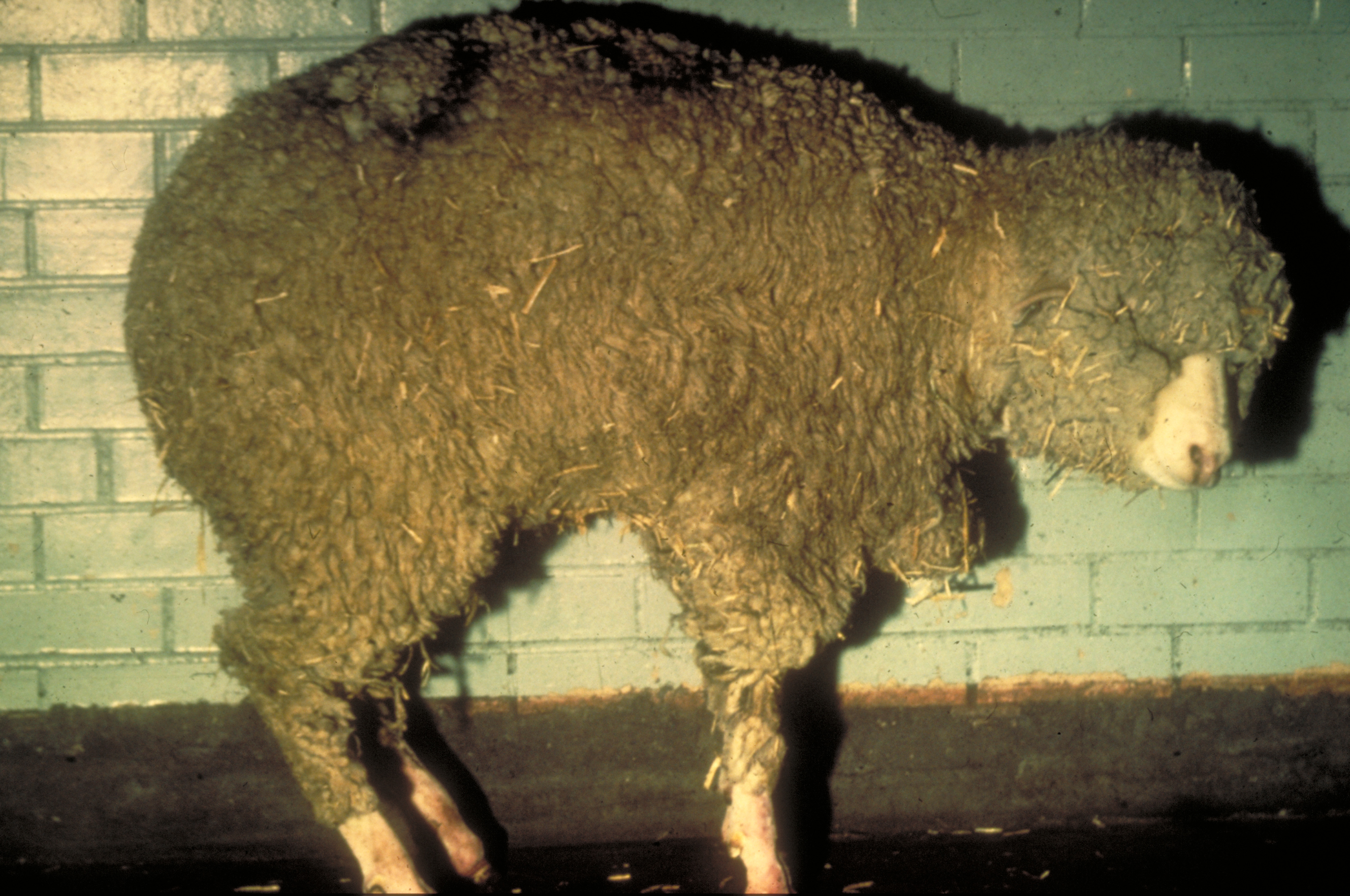
Bluetongue virus is not a bunyavirus at all — it is an orbivirus, double-stranded RNA where the others carry segmented single strands, and it has been marching out of Africa for a century. Its signature is in its name: in sheep, the disease can produce fever, drooling, and dramatic swelling of the lips, face and tongue, which can turn blue-purple. Sheep die of it in large numbers; cattle usually suffer less but act as the great reservoir, carrying virus that midges redistribute to sheep. There are up to 27 serotypes, each requiring its own immunity — an animal recovered from one is defenceless against another — which is why bluetongue keeps returning in new costumes: serotype 8 in 2006, and a major risk warning for serotype 3 (BTV-3) in the Netherlands from 2024, per the UK's National Animal Disease Information Service.
The 2006 BTV-8 epidemic is the reference disaster for all European midge viruses. The virus appeared in the Netherlands in August 2006, six degrees of latitude further north than bluetongue had ever been recorded, spread through Belgium, Germany, France and Luxembourg, overwintered, and reached eastern England in 2007 — most likely in midges blown across the Channel. More than 1.8 million sheep died across Europe, and unusually, the northern outbreak killed cattle too. Control meant the full statutory machinery: movement bans, a 20-kilometre restriction zone with controls extending to 150 kilometres, insecticide campaigns that the literature records as failing to halt dispersal — and in the end, mass vaccination, which is what finally drove BTV-8 back. Bluetongue is the proof of concept for everything in this article: wind-borne spread, overwintering, the inadequacy of spraying, and the decisive role of a vaccine when one exists.
Schmallenberg: the 2011 shock, and Shamonda's closest famous relative
Schmallenberg virus was unknown to science until the summer of 2011, when dairy cows around the German town of Schmallenberg and across the Dutch border developed fever, lost appetite and produced up to 50 percent less milk, as the Veterinary Research review of the epidemic records. Germany's Friedrich-Loeffler-Institut identified a new orthobunyavirus by November. It spread across western and central Europe within months, riding the obsoletus-complex midges that every northern farm hosts. Then, the following lambing and calving seasons delivered the second act: thousands of lambs and calves born with arthrogryposis (joints fixed in bent positions), hydranencephaly (brain tissue replaced by fluid), twisted spines and necks — the congenital syndrome that Simbu serogroup viruses, Akabane above all, were already known for in Asia and Australia. Cattle carry Schmallenberg in the blood for only two to six days, so the malformation wave was the fossil record of an infection wave months earlier.
Two facts about Schmallenberg matter most for the Shamonda comparison. The first is genetic: when researchers sequenced it, its three genome segments told a story of mixing — the M segment closest to Sathuperi virus, the S and L segments closest to Shamonda, per the European Food Safety Authority's profile; later work by the FLI places Schmallenberg within the Sathuperi virus species. Either way, the virus that cost European farming so dearly is knitted together from the same genetic cloth as Shamonda — a standing demonstration that the Simbu group's segmented genomes trade parts. The second is zoological: Schmallenberg never infected a human. When it emerged amid genuine public anxiety, German researchers tested exposed people and published the result under a title that says it all — "Lack of Evidence for Zoonotic Transmission of Schmallenberg Virus". Europe's most explosive Simbu virus, in fifteen years of intense contact between farmers, vets and infected herds, produced zero human cases. That is the single strongest precedent for calm about Shamonda — and the single strongest reason the French case, which breaks the pattern, commands scientific attention.
Shamonda: the quiet cousin steps forward
Against those two, Shamonda is the understudy who waited sixty years. Isolated from Nigerian cattle blood in 1965, detected since in midges in Japan and in livestock in South Africa, it caused the family's standard repertoire — brief fever and milk loss in adults, reproductive catastrophe in the pregnant — without ever generating a European season or a human case. Its 2026 transformation has two parts: geography and company. Geography: genomic testing caught it in southern Germany, Switzerland and eastern France in late July, and France's surveillance bulletin now lists at least twelve European countries and territories, with two distinct variants in circulation (SHAV-EU1 and SHAV-EU2, in WOAH's designation). Company: it arrived in herds already hosting bluetongue, epizootic haemorrhagic disease and endemic Schmallenberg, where its clinical signature is nearly impossible to separate without a laboratory — one reason its true prevalence this summer is certainly undercounted. And then, in October, the Lyon patient: one confirmed human infection, in a severely immunocompromised man, whose death's relationship to the virus remains formally under investigation. Shamonda's biography is told in full in What is Shamonda virus?, and its spread mechanics in How does Shamonda virus spread?
The shared machinery — and the one difference that decides policy
Strip the three viruses down and the machinery is one machine: a Culicoides midge, a viraemic ruminant, warm weather, and wind. All three incubate inside the insect before they can transmit; all three exploit the impossibility of sealing a pasture; all three overwinter or re-enter with a reliability that has made "this year's incursion" a permanent genre of European veterinary news. Even their clinical silhouettes rhyme — fever and milk loss in the cow at the gate — because they are all, at first contact, systemic infections of ruminants doing ruminant things.
The differences that matter are downstream: severity in adults (bluetongue kills; the bunyaviruses mostly sicken), teratogenicity (the Simbu pair specialise in it; bluetongue can also cause fetal losses but built its reputation on adult death), vaccines (routine for bluetongue; prototypes but no authorised product for Schmallenberg, per the FLI; nothing at all for Shamonda), and law. That last difference may be the most consequential of all. Bluetongue is a notifiable disease: suspicion triggers official action, zones, movement controls, compensation frameworks, vaccination campaigns. Shamonda is not classified under the EU Animal Health Law — Reuters noted the fact in its report on the human case — and is not regulated internationally either, per veterinary briefings; there is no obligation even to report it, which is why those briefings warn of significant underreporting across the affected countries. Europe's newest midge virus is, legally, close to invisible, at the very moment it has demonstrated the one ability — infecting a person — that its regulated and unregulated cousins have never shown. The human-risk question that follows is taken up in Is Shamonda virus dangerous to humans?
Why this matters
Comparisons are how societies price risk, and Europe has been pricing these three viruses with three inconsistent rulers. Bluetongue gets statues and zones because it arrived first and killed conspicuously; Schmallenberg gets research programmes because its debut was a scientific ambush; Shamonda gets bulletins because, until this month, it had the good manners to devastate quietly and abroad. The viruses themselves do not respect the hierarchy. They share vectors, trade genome segments, exploit the same warming seasons — European farmers in 2026 faced all of them simultaneously, alongside the kind of multi-front animal-disease pressure visible in the livestock emergency in Siberia. A rational system would classify by capability — teratogenic, wind-borne, vaccine-less, now with a documented human infection — rather than by order of arrival. Whether the EU moves Shamonda inside its Animal Health Law list is the concrete decision this comparison points to; it would switch on reporting duties, surveillance funding and vaccine incentives in one stroke. Until then, the honest summary for any reader is: same midges, same pastures, three different threats — one regulated like a plague, one watched like a mystery, and one, until last week, barely watched at all.
Sources
EFSA, Schmallenberg disease fact sheet / disease profile — EFSA; Friedrich-Loeffler-Institut, "Schmallenberg Virus" — fli.de; Doceul et al., "Epidemiology, molecular virology and diagnostics of Schmallenberg virus, an emerging orthobunyavirus in Europe", Veterinary Research — biomedcentral.com; Ducom-Galéa et al. / Ducom et al., "Lack of Evidence for Zoonotic Transmission of Schmallenberg Virus" (Emerging Infectious Diseases); National Animal Disease Information Service, "Bluetongue in Sheep" — nadis.org.uk; New Scientist, "Bluetongue, leapfrog and global warming" — newscientist.com; World Organisation for Animal Health, "Shamonda virus: what do we know about its effects on animals?" (Oct 2026) — woah.org; British Agriculture Bureau, "Novel Shamonda-like orthobunyavirus in Ireland" (2026) — britishagriculturebureau.co.uk; Reuters (Oct 22, 2026).