The Russia tear gas Ukraine investigation — a Ukrainian-led inquiry carried out with assistance from the Organisation for the Prohibition of Chemical Weapons, the OPCW — has concluded that Russian forces used a drone to drop a tear-gas canister on Ukrainian troops. It is the first time an investigation has linked the Russian military itself to the wartime use of a riot-control agent in Ukraine. The report was released on Tuesday and circulated to the OPCW’s 193 member states ahead of the chemical-weapons watchdog’s annual meeting, which begins next week. Its focus is deliberately narrow: a single incident in September 2024, when Russian forces attacked a Ukrainian military post in central Ukraine, and a video posted on a pro-Russian Telegram channel that investigators say shows a tear-gas grenade dropped from a drone. The substance at issue, CS gas, is not a lethal chemical weapon — but its use as a method of warfare is banned under the Chemical Weapons Convention, to which Russia is a party. Russia had no immediate comment on the report. It has denied using chemical weapons in the past, and it alleges that Ukraine has used banned substances. What follows is what the investigation found, what the OPCW has and has not said, where the evidence is strong and where it is contestable, and what the report sets in motion.
Track it live: Ukraine war map · Wars tracker
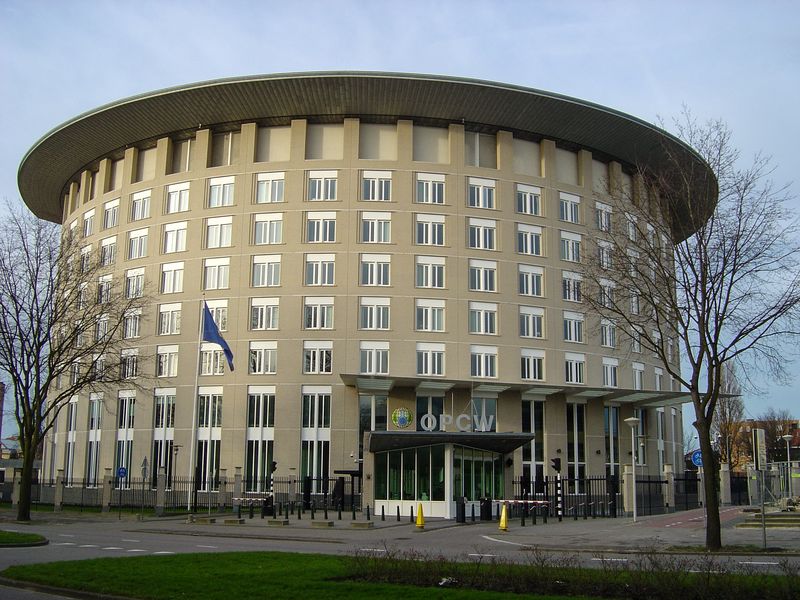
THE HAGUE, November 17, 2026 — The investigation, led by Ukraine with OPCW assistance, concludes that a tear-gas canister dropped from a drone onto Ukrainian troops in September 2024 was a Russian act — not merely that a banned-in-warfare substance was present on the battlefield, which the OPCW itself confirmed in 2024, but that Russian forces were the ones who used it. That distinction, between presence and attribution, is the whole significance of Tuesday’s release. The OPCW, as a matter of its usual practice, identifies substances; it typically does not say who used them. The attribution to the Russian military in this report is the investigation’s own conclusion, reached with the watchdog’s technical assistance, and it is the first time the Russian military has been linked in this way to the use of a riot-control agent as a weapon in Ukraine. The report’s circulation to all 193 OPCW member states, days before the organisation’s annual meeting, ensures that the conclusion will be debated in the one forum where the Chemical Weapons Convention’s members sit together — with Russia in the room.
What happened
The report released on Tuesday is the product of an investigation led by Ukraine and conducted with OPCW assistance. Its central finding concerns one engagement: in September 2024, Russian forces attacked a Ukrainian military post in central Ukraine, and, according to the investigation, a drone dropped a tear-gas canister on the Ukrainian troops holding it. The key piece of evidence the investigators rely on is a video that appeared on a pro-Russian Telegram channel and that, in their assessment, shows a tear-gas grenade being dropped from a drone. Around that core, the report builds the chain the investigators say connects the canister, the drone and the Russian forces who attacked the post.
Ukraine’s broader allegation is much larger than the single case the report examines. Kyiv alleges that Russian forces have regularly used tear gas to flush Ukrainian troops out of buildings and trenches — positions that become untenable the moment a choking agent fills them, leaving soldiers to choose between the gas and exposure to fire outside. Ukraine puts the scale at about 14,000 similar incidents over nearly five years of war, with troops needing medical attention in some 3,000 of them. Those figures are Ukraine’s, and they are reported here as Kyiv’s allegations: the investigation released on Tuesday examined and attributed one incident, not fourteen thousand. The relationship between the one proven case and the alleged pattern is the central analytical question the report raises, and it is taken up in the sections below.
The September 2024 incident and the Telegram video
The investigators’ choice of focus is itself informative. Rather than attempt a survey of thousands of alleged incidents — most of them fleeting, many of them recorded only in unit logs and medical reports from the front — the investigation concentrated on a single attack on a military post in central Ukraine in September 2024, and on the evidence trail that attack left behind. At the centre of that trail is the video: footage posted to a pro-Russian Telegram channel which, investigators say, shows a tear-gas grenade being dropped from a drone onto the position. Evidence published by the side accused of the act carries a particular forensic weight when it can be authenticated — it was not produced by the accuser — and a particular set of vulnerabilities, because its provenance, editing and context must all survive hostile scrutiny. Both aspects matter, and the skeptics’ case, set out below, begins with this video.
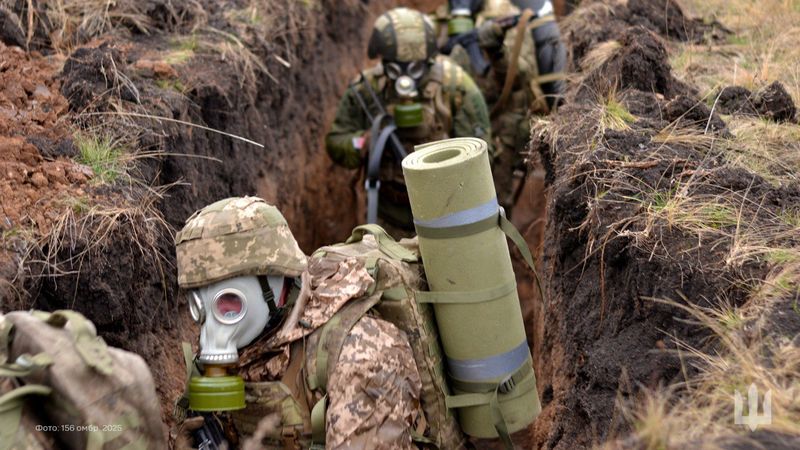
The tactical picture the incident fits is consistent with what Ukrainian troops have described throughout the war. A riot-control agent delivered into a trench or a building does not need to kill to be effective: CS gas causes intense burning of the eyes and airways, disorientation and panic, and a soldier driven coughing and half-blind from cover is a soldier exposed. Delivered by drone, the canister can be placed with a precision that earlier generations of grenades, thrown or fired, could not match — directly into a dugout entrance or through a broken roof. That is the use Ukraine alleges has been repeated thousands of times. It is also the use the Convention prohibits, which is where the law comes in.
The substance: CS gas and the legal line
Precision about the substance is essential, because the phrase “chemical weapons” summons images — nerve agents, chlorine barrel bombs, the dead of Halabja and Ghouta — that do not describe CS gas. CS is a riot-control agent: the active compound in the tear gas that police forces around the world use for crowd control. It is designed to incapacitate temporarily, not to kill, and Tuesday’s report does not allege a lethal chemical attack. Any account that blurs that distinction overstates the finding.
But the legal line does not run between lethal and non-lethal. It runs between policing and war. The Chemical Weapons Convention, the 1993 treaty that bans chemical weapons and created the OPCW to police the ban, expressly prohibits the use of riot-control agents “as a method of warfare” — while leaving their use for domestic law enforcement lawful. The same canister that a police officer may legally fire into a riot becomes a treaty violation the moment a soldier drops it on an enemy position in battle. Russia is a party to the Convention. The allegation against it is therefore precise and, if sustained, serious: not that Russia possesses tear gas, which is unremarkable, but that its forces used a riot-control agent as a method of warfare, which it has treaty-bound itself not to do. The investigation’s conclusion is that in September 2024, in central Ukraine, that is what happened.
What the OPCW did — and did not — say in 2024
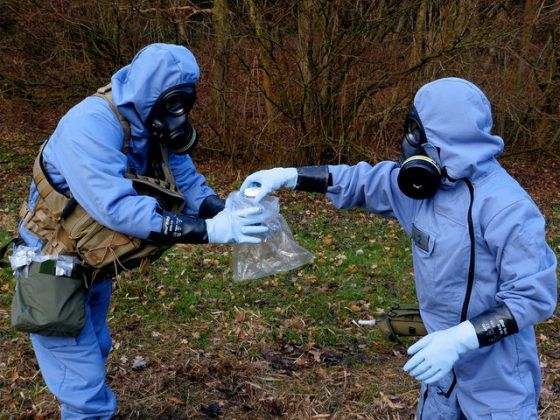
Tuesday’s report does not arrive in a vacuum. In 2024, the OPCW confirmed that CS gas had been found at several locations in Ukraine. That confirmation established the presence of the substance on the battlefield — a scientific finding, reached through the watchdog’s laboratory network and sampling procedures. What it did not establish, and what the OPCW as an institution typically does not attempt, is attribution: the organisation’s technical work identifies what was used, and its reports ordinarily stop short of naming who used it. That restraint is structural. The OPCW is a verification body serving 193 member states, including the states its findings may embarrass, and its authority rests on being a laboratory, not a prosecutor.
The investigation released on Tuesday steps into exactly that gap — and readers should be clear about whose step it is. The inquiry was led by Ukraine, one of the parties to the war, with OPCW assistance. The conclusion that Russian forces carried out the September 2024 drop is the investigation’s conclusion. It is the first time an investigation has made that link to the Russian military, and its novelty is precisely its attribution. But attribution by an interested party, even one working with the watchdog’s assistance and methods, carries a different evidentiary status from attribution by the watchdog itself, and the report’s reception at next week’s annual meeting will turn in large part on how member states weigh that difference. The honest summary is threefold: the substance’s presence in Ukraine is OPCW-confirmed; the September 2024 incident is documented by the investigation around a specific video and a specific attack; and the assignment of that incident to Russian forces is the investigation’s finding, now placed before the 193 states to judge.
Why this matters
The report matters first because of the norm it tests. The prohibition on using riot-control agents in warfare exists to hold a line that history shows is easier to cross in increments than in leaps: the battlefield use of chemicals in the First World War began with tear gases before it reached chlorine, phosgene and mustard. The Convention’s drafters wrote the riot-control ban into the treaty precisely to seal the first step of that slope. A finding that a major power’s forces used CS gas as a method of warfare — delivered by drone, as a routine tactical tool, if Ukraine’s wider allegations are credited — describes the seal being broken not in a single desperate act but as practice. Norms against chemical use have held for a century less because violations are impossible than because they are named, evidenced and priced. Tuesday’s report is an act of naming, with evidence attached.
It matters second because of timing and forum. The report was circulated to all 193 OPCW member states ahead of the organisation’s annual meeting beginning next week, which converts a bilateral accusation into a multilateral agenda item. Russia will face the finding in a room where it must either contest the evidence, contest the investigation’s legitimacy, or ignore both at reputational cost — and where states that have sat out the war’s arguments over territory and arms supplies will be asked to take a position on a treaty most of them have signed. The audience for the report is therefore not only Moscow. It is the large bloc of member states whose votes and statements will decide whether the finding becomes a collective judgement or remains a Ukrainian one.
It matters third for the war itself. The allegation at the report’s centre is not about a strategic weapon but about the daily texture of the fighting — the same fighting whose wider course, from the Ramstein meeting on air defence for Ukraine to Ukraine’s seven-stage operation against the Crimean Bridge, this newsroom has covered as a war increasingly fought by drones at every level. If gas dropped from a drone is part of that texture, then protective equipment, medical preparation and the law all have to reckon with it as routine rather than aberration. And the human ledger runs in parallel: the United Nations has documented the war’s civilian toll month by month, most recently in the UN report on October’s civilian casualties — a reminder that the categories of harm in this war, to soldiers in trenches and to civilians in apartment blocks, accumulate together.
The numbers in context
Two numbers dominate Ukraine’s wider claim: about 14,000 similar incidents in nearly five years, and troops needing medical attention in about 3,000 of them. Both are Kyiv’s figures, attributed here to Ukraine, and neither was the subject of Tuesday’s investigation, which examined one incident in depth. Read carefully, the numbers describe a claim about pattern, not a catalogue of proof. A count of 14,000 incidents over nearly five years works out to an average of several alleged uses a day across a front hundreds of kilometres long — a tempo consistent with a tactical habit rather than a series of exceptional orders, which is exactly the characterisation Kyiv intends. The 3,000 medical cases, roughly one incident in five on Ukraine’s own arithmetic, describe mostly temporary effects: CS exposure is usually treated and survived, which is consistent with the substance’s nature and does not make the alleged use lawful, incidental or minor to the soldiers coughing in the trenches.
The analytical point is the distance between the two evidentiary objects. For one incident, there is now an investigation, a video, an identified substance with a prior OPCW confirmation behind it, and a named conclusion. For the other 13,999 alleged incidents, there is Ukraine’s aggregate claim. The report’s strategic function is to bridge that distance: to establish a template case thoroughly enough that the pattern claim inherits some of its credibility. Whether it succeeds depends on whether independent reviewers — member states’ own experts, and the OPCW’s processes at the annual meeting — find the template case as solid as its authors present it. That is a question about evidence, and it leads directly to the skeptics.
Multiple angles, including the skeptics
The case for the finding rests on convergence. The substance is not in serious dispute: the OPCW confirmed CS gas at several locations in Ukraine in 2024, so the question was never whether riot-control agent was present in the war, but whose it was and how it arrived. For the September 2024 incident, the investigation offers a specific attack, a specific delivery method and a video that circulated on a pro-Russian channel — evidence whose origin on the accused side’s own information ecosystem makes it harder to dismiss as fabrication by the accuser. Add the tactical logic — gas is the obvious tool for the trench-clearing problem both armies face, and Ukrainian accounts of its use have been consistent for years — and the finding fits a pattern that many front-line reports had already sketched.
The skeptics’ case deserves to be stated at full strength, because the annual meeting will hear it. First, scope: the investigation attributed a single incident. One drone, one canister, one post, in September 2024. Generalising from it to a Russian practice, let alone to 14,000 incidents, is an inference the report itself does not complete. Second, evidence: the key exhibit is a video from a Telegram channel. Telegram footage in this war has been mislabelled, recycled and staged by all sides; an investigation resting on it must show authentication — metadata, geolocation, chain of custody — rigorous enough to survive a hostile technical review, and outside experts have not yet had the chance to conduct one in public. Third, authorship: the investigation was led by Ukraine, a belligerent with an obvious interest in the conclusion, albeit with OPCW assistance. The watchdog’s assistance lends method; it does not transfer the OPCW’s institutional neutrality to the conclusion, and the OPCW has not itself attributed the use. A state asked to condemn Russia on this basis is being asked to trust Kyiv’s inquiry, and some will decline for reasons of precedent as much as politics: today’s accepted method is available for tomorrow’s contested case.
Russia’s position, for balance, is this: Moscow had no immediate comment on Tuesday’s report. It has denied using chemical weapons in the past, and it alleges that Ukraine has itself used banned substances. Neither the denial nor the counter-allegation was substantiated in the material released with the report, and both are recorded here as positions, not findings. But they forecast the shape of next week’s argument: expect Moscow to attack the investigation’s provenance, to demand OPCW-grade attribution rather than a party-led inquiry, and to table its own allegations in reply.
From the member states’ side, finally, the angle least visible from the battlefield: many of the 193 governments receiving this report are neither Russia’s allies nor Ukraine’s, and their concern is the Convention itself. A treaty regime that cannot respond when a riot-control agent is used in war invites the next escalation; a regime that attributes on the word of a belligerent-led inquiry invites a different corrosion. The report puts that dilemma, cleanly and uncomfortably, on the annual meeting’s table.
What happens next
The immediate next step is fixed: the OPCW’s annual meeting begins next week, with the report already in every delegation’s hands. Watch, in order, for the OPCW’s own framing of its assistance role — how explicitly the organisation associates itself with, or distances itself from, the attribution; for Russia’s first substantive response, which had not come by Tuesday evening; and for whether any group of member states converts the report into a formal agenda fight — a vote, a decision text, or a call for a dedicated OPCW attribution mechanism for Ukraine of the kind that has been debated, and resisted, before.
Three scenarios cover the plausible range. In the first, the template holds: technical reviewers find the September 2024 evidence sound, a broad coalition of states endorses the conclusion at the meeting, and the report becomes the foundation for consequences — coordinated sanctions designations tied to chemical-weapons use, export-control tightening, and a standing attribution process that can examine further incidents from the alleged 14,000. In the second, the meeting splits along the war’s existing lines: Western states condemn, Russia and its partners reject the inquiry’s legitimacy, the majority in the middle calls for an OPCW-led attribution mechanism without endorsing this report’s conclusion — an outcome that would paradoxically advance the institutional question while leaving the September 2024 finding in limbo. In the third, the report is absorbed and neutralised: procedural argument consumes the meeting, no text is adopted, and the finding joins the long shelf of documented allegations whose consequences never arrived — the outcome that would do the norm itself the deepest damage, because it would teach that the first step of the chemical slope can be taken, evidenced and priced at nothing.
Which scenario obtains will be decided less by the video from a Telegram channel than by the less visible work of the next days: whether Ukraine and its partners share the investigation’s underlying evidence widely enough for independent experts to test it, and whether the states in the middle judge that the Convention’s credibility is better served by acting on a party-led inquiry or by insisting on the watchdog’s own. The report has done the first part of accountability’s work — it has made a specific, checkable claim, about a specific incident, in front of all 193 states. Next week will show what the second part is worth.
Sources
Sources: Associated Press, The Hague, November 17, 2026, via The Reflector (reflector.com) — the Ukrainian-led investigation with OPCW assistance, its conclusion that Russian forces used a drone to drop a tear-gas canister, the September 2024 incident in central Ukraine, the pro-Russian Telegram channel video, the circulation of the report to the OPCW’s 193 member states ahead of the annual meeting, the OPCW’s 2024 confirmation that CS gas had been found at several locations in Ukraine, and Ukraine’s figures of about 14,000 similar incidents and 3,000 cases needing medical attention, attributed to Ukraine; Meduza, November 17, 2026 (meduza.io) — independent report of the same investigation. Russia had no immediate comment on the report; its past denials of chemical-weapons use and its allegations that Ukraine used banned substances are recorded as its positions. Photographs are file photos and do not depict the September 2024 incident or the events of November 2026.