The Ukraine civilian casualties October 2026 figures, published Tuesday by the UN Human Rights Monitoring Mission in Ukraine (HRMMU), describe a war that is not winding down but speeding up. At least 372 civilians were killed and 1,981 injured in a single month — the deadliest October since Russia’s full-scale invasion began, and 95% more deaths than in October 2025. Worse, the mission’s running tally for January through October — 2,957 killed and 17,218 injured — means the first ten months of 2026 have already killed more Ukrainian civilians than the whole of 2025. Danielle Bell, who heads the mission, used the release to plead with the world not to “become numb to the deadly toll the war exacts on Ukraine’s civilians.” The numbers suggest numbness is not the risk. The risk is that the curve itself has become the story nobody can look away from — and it is still rising.
Track it live: Wars tracker · Ukraine war map
KYIV, November 17, 2026 — Every monthly report from the UN’s monitors in Ukraine carries the same quiet caveat: these are the deaths and injuries the mission could individually verify, and the real toll is certainly higher. Read October’s report with that caveat in mind and it becomes harder, not easier, to absorb. Three hundred and seventy-two verified dead. One thousand nine hundred and eighty-one verified injured. A month that killed civilians at nearly double the rate of the same month a year earlier — 183 killed and 1,021 injured in October 2025 — in a war now approaching its fifth winter. Since February 2022, HRMMU has verified 17,994 civilians killed and 57,854 injured in Ukraine; UN News, rounding the same ledger, puts it at almost 18,000 dead and almost 58,000 injured. Those are floors, not totals. The ceiling is unknown, and October moved the floor sharply upward.
The October numbers in context
The single most important comparison in Tuesday’s release is not month against month. It is the year against itself. From January to October 2026, HRMMU verified 2,957 civilians killed and 17,218 injured — 63% higher than the same ten months of 2025, and more than twice the toll of the same period in 2024. A war in its fifth year is supposed, by the grim logic of attrition, to find some equilibrium: front lines harden, populations evacuate the most exposed places, air defences learn. Instead, each successive year of this war has been deadlier for the people who live nowhere near a trench. The fact that ten months of 2026 out-killed twelve months of 2025 is the cleanest possible statement of the trend, and it demolishes any remaining version of the argument that the civilian war is stabilising.
October’s 95% year-on-year jump — 372 dead against 183 — sits on top of that trend rather than replacing it. One bad month can be an artefact of one bad strike. A ten-month curve rising 63% on the year before, and doubling the year before that, is a structure. It reflects choices: about which weapons to build and buy, about which targets to prioritise as the cold approaches, and about how much civilian risk is acceptable in pursuit of them. HRMMU’s job is to count, not to assign motive. But a count that rises this steadily, for this long, is itself evidence about the character of the campaign producing it.
A verified minimum, not a census
It is worth pausing on what these numbers are. HRMMU verifies casualties case by case, to a standard designed to survive legal scrutiny: names, places, circumstances, corroboration. Deaths in occupied territory, deaths in places monitors cannot reach, deaths recorded only in a local register the mission cannot cross-check — many never enter the count at all, or enter it months late. When the mission says “at least 372,” the words “at least” are doing heavy work. The true October toll is higher by an amount no one can presently measure. Every figure in this article should be read that way: as the documented minimum of a larger, darker number.
What is killing people now
The weapon mix in October tells the second story. Long-range weapons — missiles and drones fired from far beyond the front — remain the leading cause of civilian harm, accounting for more than half of those killed and injured, according to HRMMU. That is the familiar pattern of this war’s rear-area campaign: the danger no longer stops at the line of contact, and a flat in Kharkiv, Kyiv or Zaporizhzhia is a front-line position on the nights the waves come in. It is also why the air-defence arithmetic we detailed in our report on the Ramstein air-defence pledges by Britain and Germany matters so directly to a casualty report: every interceptor delivered, or not delivered, shows up eventually in this ledger.
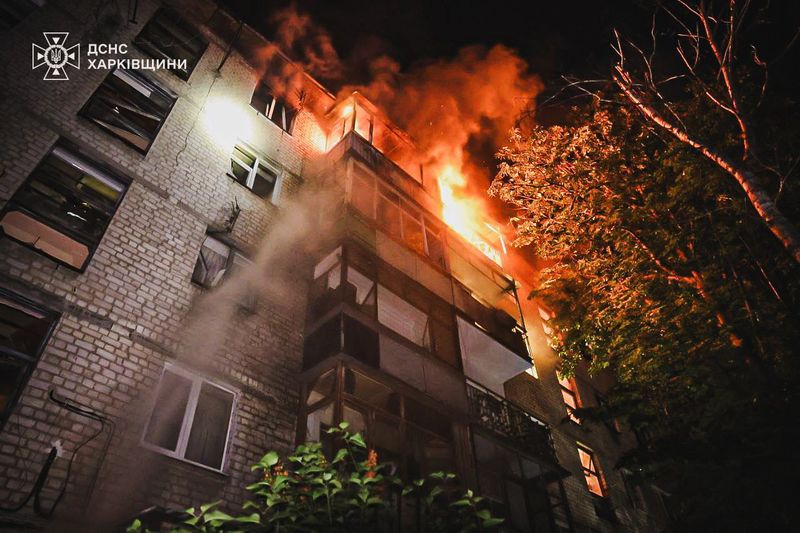
The sharpest change is in the glide bomb column. Civilian deaths from aerial glide bombs doubled compared with September, HRMMU reported — 92 killed and 331 injured in October alone — and glide bombs accounted for 18% of all October casualties. Short-range drones, the kind flown by operators within a few kilometres of their targets, caused another 19%. Together, those two categories describe the war’s drift toward cheap precision. A glide bomb is an old Soviet-era bomb fitted with wings and a guidance kit: inexpensive, plentiful, launched from aircraft that never enter Ukrainian air-defence range, and accurate enough to be aimed at a specific building. It cannot be jammed as easily as a drone and it arrives with the explosive weight of the bomb it was built from. When deaths from such a weapon double in a month, it means the weapon is being used more, closer to where people live — and the front-line cities within its reach, Kharkiv above all, are absorbing the difference.
The winter-energy campaign
October is when this war’s calendar turns, and HRMMU’s report records the turn. Russian forces intensified attacks on Ukraine’s energy infrastructure during the month, ahead of a fifth winter at war. The strikes damaged electricity and heating systems, disrupted water supplies in some cities, and forced nationwide rolling outages — the now-familiar choreography in which generation and substations are hit faster than repair crews can restore them, and the burden is distributed across the country in scheduled darkness. Energy attacks occupy a particular place in the civilian ledger because their casualties are not only the people killed at the point of impact. A heating plant destroyed in October is a January emergency room, a frozen pipe, an elderly person alone in an unheated flat. The monthly casualty count captures the blast; it cannot capture the cold, which is one more reason the verified figures understate the harm.
The mission also recorded the other direction of the energy war: Ukrainian forces attacked electricity infrastructure in Russian-occupied territory. That fact belongs in any honest account of October, and HRMMU includes its verified portion of it below. The asymmetry, though, is in scale and in verification. The campaign against Ukraine’s grid in October was nationwide and sustained; the verified toll from Ukrainian strikes on energy infrastructure in occupied areas, as the next section sets out, was 12 killed and 18 injured. Both facts are in the UN’s report. They are not the same size, and reporting them as if they were would be its own kind of distortion.
The other side of the line
HRMMU’s mandate covers all civilians in this war, and its October report includes figures provided by Russian authorities for areas outside Ukraine’s control. According to those authorities, Ukrainian attacks in October killed at least 90 people and injured 306 in Russian-occupied Ukrainian territory, and killed 59 and injured 402 inside Russia. Those numbers are reported here because the UN reported them — and they are flagged, exactly as the mission flagged them, as figures HRMMU could not independently verify. They should be held at precisely that weight: claims by a party to the conflict, recorded by the UN, unverified by the UN.
What the mission could verify on that side of the line is narrower and specific: at least 12 civilians killed and 18 injured in occupied areas as a result of Ukrainian attacks on electricity infrastructure. That verified subset is the only figure in this section that carries HRMMU’s evidentiary standard, and the gap between it and the Russian-authority totals is itself information — about access, about the impossibility of independent monitoring in occupied territory, and about why every number in this war arrives with a provenance attached. Signal Post News applies the same rule in both directions: a figure is worth what its verification is worth, whoever issues it.
November is not slowing down
If October’s report has a forward edge, it is that November has already produced incidents that will sit at the top of next month’s ledger. On November 2, bombs struck school premises in Komyshuvakha, including an underground shelter where civilians had gathered to receive aid. On November 16, Ukrainian authorities reported that 72 people were killed and four remain missing; HRMMU says it is still verifying the incident but has confirmed that dozens of those killed were civilians. The full account of the search’s end and the final toll is in our Komyshuvakha report — and the attribution matters: the 72 figure is Ukrainian authorities’, the UN’s confirmation so far is of dozens of civilian dead, and the verification continues. A school shelter, an aid distribution, seventy-two dead if the authorities’ count holds: it is the single deadliest incident of its kind in months, and it happened two days into the month that follows the deadliest October of the war.
Then, on Monday, November 16, a drone struck a humanitarian vehicle near Kramatorsk as it evacuated civilians with limited mobility, according to the UN Secretary-General’s spokesperson. The driver was seriously injured, one evacuee suffered minor injuries, and others sustained hearing damage. The UN humanitarian coordinator’s office, OCHA, renewed its call for civilians and aid workers to be protected. Consider the two November incidents together: people sheltering where aid was given out, and people being carried out of danger by aid workers, hit within a fortnight of each other. Whatever the intent in each case — and intent is for investigators, not monthly reports — the practical effect is to make the humanitarian space itself more dangerous, which is how civilian tolls compound: not only in the strike, but in the rescues and distributions that become harder to run afterward. For the regional pattern of what drones are doing to civilian life across this war’s wider arc, see also our report on the UN’s Sudan drone findings, where the same technology accounts for three-quarters of verified civilian deaths.
Why this matters
The timing of this report is not incidental to its meaning. It lands two days before the November 19 trilateral in Shenzhen, where the leaders of the United States, China and Russia meet with Ukraine’s future on the table, and it lands while the diplomatic track is, by every public account, stalled on the same questions it has been stalled on all autumn: territory, guarantees, and who moves first. Into that stall, HRMMU has placed a simple, brutal fact: the cost of the stall is not static. It is compounding at 63% a year. Every month of negotiating deadlock is not a month of frozen conflict; at October’s rate it is roughly 372 verified dead and nearly 2,000 verified injured, plus the unverifiable remainder. Diplomats price delay in leverage. This report prices it in people.
It also cuts into the negotiating positions themselves. A casualty curve accelerating this sharply is evidence, for Kyiv and its partners, that the pressure campaign against Ukrainian cities is intensifying rather than being traded away — which strengthens the argument that any settlement without enforceable air defence and security guarantees merely pauses the ledger. For Moscow, the same curve is a demonstration of reach: proof that it can raise the cost of resistance through a fifth winter. And for the capitals supplying interceptors, October’s weapon mix is a procurement document: glide bombs doubling and long-range weapons causing most of the harm is a precise description of what Ukraine’s air defence must be built to stop, and of what happens to civilians in the months before it is.
Finally, there is the archive. HRMMU’s case-by-case verification exists, in large part, so that these deaths are documented to a standard that outlives the war — usable by prosecutors, commissions and historians. The 17,994 names behind the cumulative figure are not a statistic in the mission’s files; they are case files. When Danielle Bell warns against numbness, she is speaking as the custodian of that archive as much as as a humanitarian official: the world’s attention is a resource her mission cannot manufacture, and without it, both the aid and the accountability her numbers are meant to drive become harder to sustain. Numbness, in her framing, is not a feeling. It is a policy outcome — the one in which a deadlier October than any before it is received as background noise.
What happens next
The near-term markers are grimly predictable. November’s verified toll, including Komyshuvakha and Kramatorsk, will be published in mid-December, and nothing in the first half of the month suggests the curve will bend downward on its own. The winter-energy campaign will be tested against the coldest weeks of the year, when damage to heating and power does its worst work and when repair windows shrink. The Shenzhen trilateral on November 19 will show whether the casualty acceleration enters the diplomacy at all — whether a report like this one is an input into the talks or merely a commentary on their absence. And the air-defence deliveries pledged this month will either arrive at a rate that changes the interception arithmetic, or October will read, in retrospect, less like a peak than like a step on a staircase.
Three scenarios cover the range. In the first, the diplomacy moves and the strike tempo falls with it; November becomes the last month of the old pattern, and HRMMU’s December report is the first to bend. In the second, the talks stall and the winter campaign runs its course; the ten-month record of 2026 becomes a twelve-month record by a wide margin, and 2027 begins with the same curve intact. In the third — the one October’s glide-bomb column warns about — the weapon mix keeps cheapening and widening, the front-line cities absorb more of the war than the capital’s grid does, and the monthly reports keep setting records nobody wants. The UN’s monitors will count whichever future arrives, name by verified name. The question their head put to the world on Tuesday is whether anyone is still reading the count as if it were news. On the evidence of October, it is the most important news there is.
Sources
Sources: UN Human Rights Monitoring Mission in Ukraine (HRMMU), “Protection of Civilians in Armed Conflict — October 2026,” November 17, 2026 (ukraine.ohchr.org); UN Human Rights in Ukraine, “In Ukraine, Civilians Die at Alarming Rates Amid Intensifying Attacks, UN Human Rights Officials Say,” November 17, 2026 (ukraine.ohchr.org); UN News, November 17, 2026 (news.un.org). All casualty figures are HRMMU verified minimums unless expressly attributed otherwise in the text; figures provided by Russian authorities are reported as unverified, as HRMMU states; the Komyshuvakha toll of 72 killed and 4 missing is as reported by Ukrainian authorities on November 16, 2026, with HRMMU verification ongoing. Photographs are file photos via Wikimedia Commons and do not depict the events of October or November 2026.