Track it live: Ukraine war map — live tracker
SALAVAT, Russia, November 17, 2026 — The strike reached one of the largest industrial sites in Russia, at a distance that depends on whose measurement you take — and the two measurements in circulation are attributed separately here, not merged. The independent Russian outlet Astra, whose reporting Euromaidan Press also carried, placed the complex nearly 1,300 kilometres from the front line. Ukraine’s General Staff, via Reuters, put the plant at about 1,500 kilometres from the Ukrainian border, and said Ukrainian forces struck it overnight, with explosions heard and a fire breaking out. “Salavat is no ordinary plant,” the General Staff said. “It is one of Russia’s largest oil refining and petrochemical complexes, capable of processing about 10 million tonnes of oil a year.”
Against that account stands the official one from Bashkortostan itself. The republic’s State Committee for Emergency Situations said Ukrainian drones attacked industrial areas in Ufa and Salavat, and that air defences, industrial security teams and mobile fire groups shot down more than 50 drones. All plants were operating as normal, the committee said, and no critical damage was reported — a position the Associated Press also carried, reporting that Bashkortostan’s authorities described a “massive” drone attack on industrial zones in Ufa and Salavat as repelled, with all plants working as usual. Between those two poles — Kyiv’s fire and Ufa’s all-clear — sits the eyewitness record, and it does not settle the question.
What the eyewitness record does and does not show
Astra geolocated eyewitness video to the Gazprom Neftekhim Salavat complex, and monitoring channels reported multiple fires on the site, with a glow reportedly visible from Sterlitamak, roughly 17 kilometres away, according to Euromaidan Press and UNITED24 Media reporting. That reporting is evidence that something burned at or near the complex — geolocation ties the imagery to the plant — but it is not verified proof of what was damaged, how badly, or for how long, and Signal Post News does not present it as such. A refinery at night can burn brightly from a single unit, a storage fire or a debris blaze; none of those possibilities can be separated from the others on eyewitness video alone, and no independent assessment of production impact exists for the November 17 strike.
This is the recurring structure of the refinery war’s information problem, and Salavat is now its clearest example. The attacker announces a hit and a fire. The defender announces a repelled attack and normal operations. The middle evidence — geolocated flame — is real but mute about the only question that matters economically, which is whether throughput stopped, and for how long. Readers should hold all three layers separately, because each side’s incentive is known: Kyiv benefits from demonstrating reach; the republic benefits from demonstrating control; and neither benefit requires the underlying claim about damage to be true.
A record night, in both directions
Salavat was one target in the largest drone night of the war so far — by Moscow’s own count. Russia’s Defence Ministry claimed on Tuesday that its air defences had downed a record 1,441 Ukrainian drones overnight, across more than twenty regions, surpassing the record of 1,336 set only the night before, on Monday. Russian interception claims are claims, and they are carried here as such; but even discounted, the trajectory they describe — two consecutive daily records — matches the observable fact of a Ukrainian long-range campaign expanding in volume. The same night, Ukraine’s operation against the Crimean Bridge reached its conclusion, confirmed by President Volodymyr Zelenskyy and covered by Signal Post News in our report on the seven-stage Crimean Bridge operation and in our report on the second strike that suspended traffic on the bridge. Read together, the night’s targets describe a single strategy executed at two ranges: sever the logistics artery to Crimea, and tax the refining base that fuels the whole war economy.
The economics of saturation sit underneath the record numbers. A long-range drone is cheap next to the interceptor fired at it, and a wave counted in four figures forces a defender to spend missiles, radar time and crew endurance across an enormous map — from the Moscow region to the Volga and beyond — in a single night. Every battery positioned to defend a refinery in Bashkortostan is a battery not positioned somewhere else; every night of 1,400 claimed tracks is a night the air-defence system cannot stand down. Ukraine does not need every drone to arrive. It needs enough to arrive, often enough, at targets whose repair bills compound.
The plant, and why it keeps being targeted
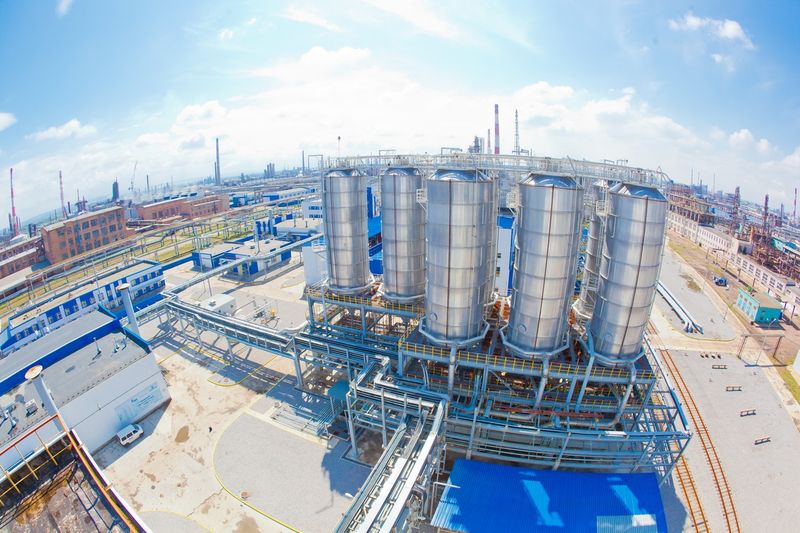
Gazprom Neftekhim Salavat, founded in 1948, is not a standalone refinery but an integrated complex: an oil refinery, a gas-chemical plant and the Monomer petrochemical plant on one site, capable of processing up to about 10 million tonnes of crude oil and gas condensate a year. Its product slate — gasoline, diesel, jet fuel and kerosene, fuel oil, polyethylene and other petrochemicals — reaches both the civilian economy of the Volga-Urals region and, as Kyiv emphasises, the fuel supply of the Russian military. A complex of that integration is also a complex of interdependencies: damage to one unit can idle others, and a site that refines, cracks and polymerises in one fence line concentrates value in a way a dispersed industry would not.
It is also, on the monitoring count, a repeat target. Euromaidan Press, citing the monitoring channel Exilenova+, counted the November 17 attack as the fourth strike on the Salavat complex since July — a count attributed here to that channel. Ukraine’s General Staff had previously confirmed a strike on the same complex on October 8 that caused a fire near its refinery. The repeat pattern is the strategy in miniature: a plant is hit, repaired under wartime pressure, and hit again, so that the defender pays the repair bill repeatedly while never regaining confidence that the site is safe. Each return visit is also cheaper for the attacker than the first, because the route, the defences and the gaps in them have already been mapped.

One node in a deep-strike geography
Salavat is not an isolated pin on the map. It belongs to a target geography that Ukraine has been building strike by strike across Russia’s industrial east — the same pattern Signal Post News traced in October, when attacks reached refining and energy sites around Astrakhan in the south, Omsk in Siberia and Ukhta in the Komi Republic, each of them hundreds or thousands of kilometres from the front. The logic of that list is the logic of Salavat: Russia’s refining and petrochemical base was sited, in the Soviet period and after, for access to crude, rivers, rail and labour — never for exposure to an enemy’s air campaign, because no such campaign was imagined reaching the Volga, let alone Siberia. Ukraine’s long-range drones have converted that inherited geography into a liability. Every major complex is now a fixed, flammable, high-value target whose coordinates are public and whose defences must be supplied from the same finite pool that protects the front, the capital and the leadership.
The repair cycle is where the campaign compounds. A refinery unit damaged in July and repaired by September has consumed scarce components — compressors, heat exchangers, control systems — many of them historically imported and now sanctioned, slow to substitute and slower to deliver. A second strike on the same unit does not merely repeat the damage; it consumes the repair itself, and the spares stockpiled against a single incident. That is why the monitoring count of strikes on a single plant — four since July, on the Exilenova+ tally — is a more meaningful measure of this campaign than any single night’s fire. Kyiv is not only burning equipment; it is taxing the maintenance system that keeps Russia’s fuel economy whole, and it is doing so at a tempo the maintenance system was not built to sustain. Whether November 17 added materially to that tax is precisely what the disputed damage accounts leave open — but the strike’s place in the sequence is not in dispute, and the sequence is the strategy.
Why this matters
Distance is the headline fact, and it deserves to be read slowly. Whether the plant sits roughly 1,300 kilometres from the front line, as Astra and Euromaidan Press put it, or about 1,500 kilometres from the border, as the General Staff put it via Reuters, Salavat is deeper inside Russia than almost any target Ukraine struck in the war’s first years. A strike at that range announces that Russia’s refining geography — built in the Soviet era on the assumption that the industrial rear was sanctuary — no longer has a safe depth. Refineries cannot be moved. Their defence must therefore be spread across every site that matters, which is to say across a map too large to cover densely, against an attacker who chooses the time and the target.
The second reason is cumulative rather than spectacular. Ukraine’s refinery campaign works, when it works, by accumulation: repeated strikes on the same complexes, repair cycles interrupted, spare parts and specialist crews consumed, insurance and logistics costs rising, and regional fuel markets tightening when a major plant stumbles. A single disputed night at Salavat changes none of that arithmetic by itself — which is exactly why the damage dispute matters less than the pattern. If the complex was barely scratched, the campaign’s cost to Kyiv was a night’s drones; if a unit is down, the cost to Moscow is measured in weeks. The asymmetry is the point, and it persists regardless of which account of November 17 proves closer to the truth.
The data, in context
The night’s numbers, each with its source attached: 1,441 Ukrainian drones claimed downed by Russia’s Defence Ministry, a second consecutive daily record after Monday’s 1,336. More than 50 drones claimed downed over Bashkortostan by the republic’s emergency committee, which reported no critical damage and normal operations at all plants. A complex capacity of about 10 million tonnes a year, per the General Staff and Euromaidan Press. A fourth strike on the plant since July, per the Exilenova+ count carried by Euromaidan Press. A glow reportedly visible from Sterlitamak, about 17 kilometres away, per monitoring-channel reporting. And zero casualties reported by any source checked — a figure this article states plainly because inventing or implying casualties in either direction would be a fabrication.
Set against Russia’s total refining system, one 10-million-tonne complex is a single-digit share of national throughput — significant locally, absorbable nationally, and dangerous mainly in combination with the campaign’s other targets. That is the honest scale of a Salavat strike: not a knockout, but a recurring tax on the same industrial node, levied from a distance that was supposed to make it impossible.
What happens next
The near-term evidence will come from the plant itself: satellite imagery of the complex, any change in regional fuel pricing or availability in Bashkortostan and neighbouring regions, and whether Russian or Ukrainian sources revise their accounts as imagery circulates. Kyiv’s pattern suggests the target list will be revisited — Salavat has now been struck repeatedly since July, and the campaign’s logic rewards returning to repaired sites. Moscow’s problem is structural and will not be solved by one night’s interceptions: the air-defence spread across Salavat, Astrakhan, Omsk, Ukhta and the rest of the deep-industrial map is thin by geometry, and two consecutive record drone nights say the pressure on it is rising, not easing.
For now, the verified core of November 17 is narrow and should stay narrow: Ukrainian drones struck the Salavat complex overnight; Ukraine’s General Staff reported explosions and a fire; Bashkortostan’s authorities reported a repelled attack, more than 50 drones downed and no critical damage; Astra geolocated eyewitness video to the plant; and no independent confirmation of damage or production impact — and no casualties — have been reported. Everything beyond that is claim, and this article has labelled it as such.
Reporting based on the Associated Press and Reuters (Nov. 17, 2026), Euromaidan Press and UNITED24 Media (Nov. 17, 2026), Meduza’s report of the Bashkortostan emergency committee statement, and Astra’s geolocation reporting as carried by those outlets. Damage accounts conflict and are attributed throughout; no damage or production impact is independently confirmed.
Sources
Sources: Associated Press (Nov. 17, 2026); Reuters (Nov. 17, 2026); Euromaidan Press / UNITED24 Media (Nov. 17, 2026); Meduza (Nov. 17, 2026); Astra, via Euromaidan Press (Nov. 17, 2026).