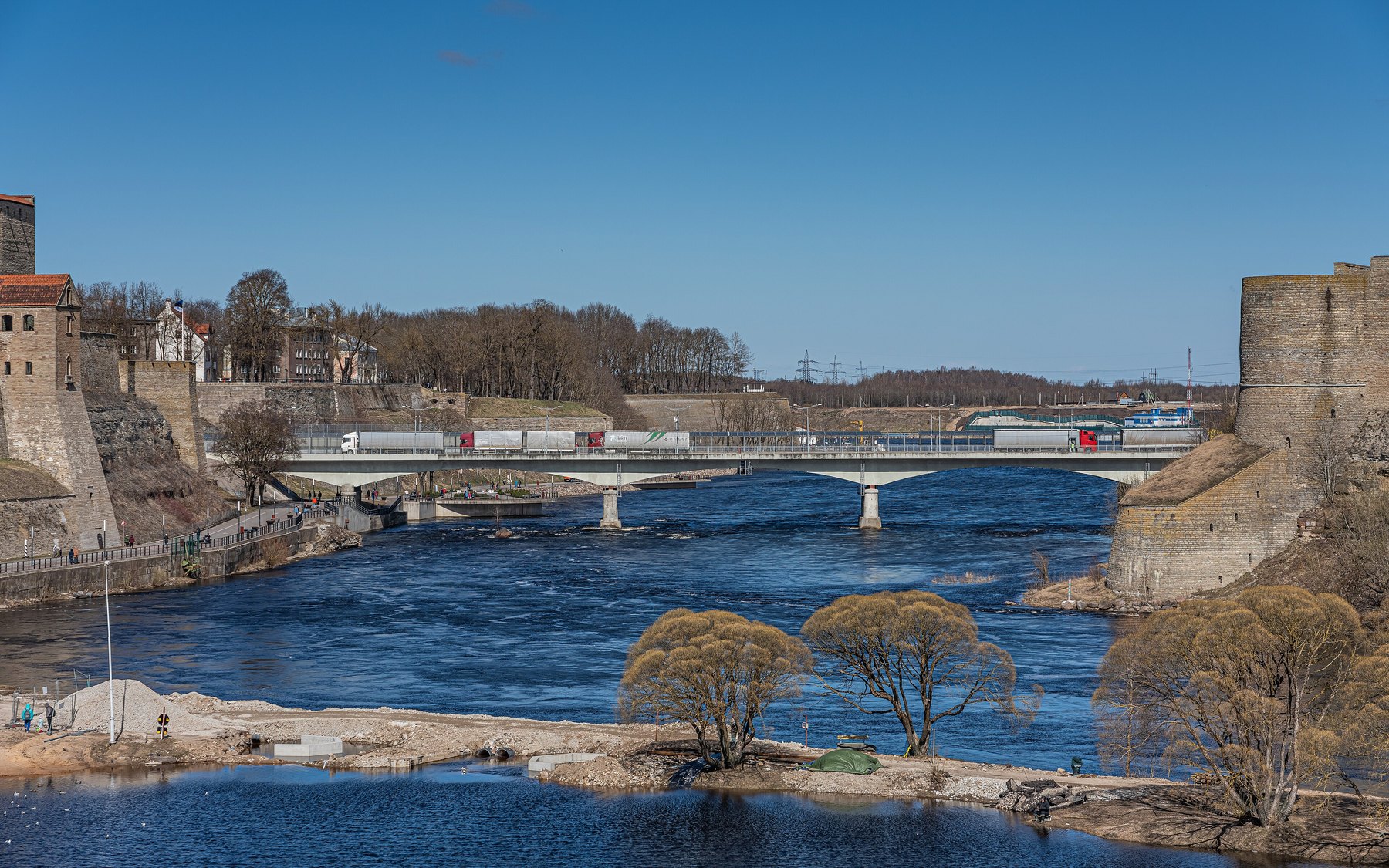
The Russia Estonia border curfew is limited in time and geography, but it sits in one of Europe’s most sensitive places. A notice attributed to Russia’s Federal Security Service, or FSB, says special controls run from September 16 through September 26 in the Kingisepp and Slantsy districts of Leningrad region, directly across the frontier from Estonia. The measures include a nighttime movement ban outside populated areas within a five-kilometre border strip, limits on hunting and firearms, and shoreline and small-boat restrictions on part of the Narva River.
Estonia’s Interior Ministry said the situation on its eastern border remained calm and that authorities were monitoring events. Estonian border officials also said Russia has used comparable temporary measures around exercises or prevention operations before and did not treat this order, by itself, as evidence of an immediate military threat. Those facts are essential. So is the strategic setting: Narva is where the European Union and NATO meet Russia at a river crossing overlooked by two fortresses, after four years of war in Ukraine and repeated warnings about sabotage, drones and other pressure below the threshold of open conflict.
The measured conclusion is not that an attack is imminent. It is that a short administrative order can have several uses at once: enforcing border rules, rehearsing security procedures, constraining civilian movement and signalling control. On a frontier where routine activity is read through a military lens, ambiguity itself has strategic value.
What the FSB Narva border restrictions actually say
The notice reproduced by the Kingisepp municipal administration says operations are intended to prevent border and migration violations and protect aquatic biological resources. It cites Paragraph 10, Part 2, Article 30 of Russian Federation Law No. 4730-1 of April 1, 1993, “On the State Border of the Russian Federation.” That law is the post-Soviet legal framework for guarding Russia’s state boundary; the cited provision is presented as authority for temporary restrictions in border territory to protect the frontier and public safety.
The stated measures are specific:
- People may not enter the shoreline zone and small watercraft may not operate on the specified Narva River stretch between the Bolshaya Cheremukha and Kriusha rivers.
- Hunting and movement with firearms are barred in the Slantsy border zone and in a five-kilometre strip in Kingisepp.
- At night, people and vehicles may not move outside populated areas within a five-kilometre strip along the border in both districts.
That is narrower than a general curfew. It does not, on the published wording, order residents to remain inside their homes across whole towns. It regulates movement outside populated places in the border strip and adds activity-specific bans. Calling it a “border curfew” is useful shorthand, but the operational details matter.
Why 5 km, 11 calendar days and two districts matter
Five kilometres is deep enough to create a controlled belt beyond the immediate fence or riverbank. It reduces casual nighttime traffic, makes unusual movement easier to identify and gives border units a cleaner operating picture. It is not, by itself, evidence of troop concentration.
Eleven calendar days is the inclusive span from September 16 through September 26. That fixed endpoint makes the order testable: it either expires on schedule, is extended, or is replaced by a different regime. The window also overlaps the political afterglow of Russia’s State Duma election, making it reasonable to ask why tightening persists as the vote ends. The order itself does not answer that question.
Two districts widen the significance beyond a single bridge. Kingisepp contains Ivangorod, directly opposite Narva, while Slantsy extends the controlled area southward along the Estonian frontier. In practical terms, the measure covers more than an urban crossing: it reaches river, forest and rural approaches where patrol, hunting and small-craft movements can be difficult to distinguish at night.
Kingisepp and Slantsy districts: local order, NATO consequence
The immediate order is Russian and applies on Russian territory. The strategic audience is broader because Narva sits on NATO’s eastern boundary. Every change in patrol patterns, river access or civilian movement is observed by Estonian authorities and allies, even when the change is lawful and temporary.
Post-election timing magnifies the signal. During an election period, internal security measures can serve domestic control and border enforcement. After voting, the same measures can be interpreted abroad as preparation for exercises, a check on outbound movement or a demonstration that security services retain freedom to tighten the frontier quickly. None of those interpretations is confirmed by the notice. The value for analysts lies in comparing what Russia says, what units actually do, and whether the September 26 end date holds.
Narva River boat restrictions tighten a visible seam
The Narva River boat restrictions affect a boundary that is both geographic and political. The river separates Narva from Ivangorod and forms part of the EU and NATO frontier. Barring small craft and shoreline access can reduce smuggling, accidental crossings and interference with patrol operations. It can also keep civilians away from activity authorities do not want observed.
That dual-use logic is why Estonia’s calm public response is important. Tallinn has not described the order as proof of attack preparation. Its position—monitoring closely without declaring an emergency—reduces the risk that speculation outruns evidence while preserving readiness.
Estonia Russia border tensions, 2022–2026
The order lands after a four-year escalation arc. Russia’s full-scale invasion of Ukraine in February 2022 transformed Baltic defense planning. Finland joined NATO in 2023, extending the alliance’s direct land frontier with Russia. Finland then closed its eastern land crossings, saying Russia was facilitating irregular migration; the Finland Russia border closure has remained a major regional precedent for treating migration flows as a security instrument as well as a humanitarian and border-management issue.
Estonia, Latvia and Lithuania have increased fortifications, civil-defense planning and allied deployments. At Narva, episodes involving border markers and crossings have reinforced the sense that even small physical changes can carry political meaning. At the same time, routine enforcement, fishing rules and exercises have not disappeared. The analytical challenge is to distinguish familiar border-control practice from a change in intent.
In 2026, that challenge has sharpened. European officials have warned about a rise in Russian-linked hybrid activity; Moscow denies many such accusations. A suspected Russian drone entered Lithuanian airspace, according to reporting cited by The War Zone. Reported Russian drone-and-missile strikes close to Ukraine’s borders with Poland and Moldova have also raised concern about spillover and misidentification, while Lithuanian officials have warned about the possibility of staged or false-flag-style drone incidents. Those warnings are assessments, not proof that a specific operation is planned at Narva.
Baltic hybrid threats and the Leipzig/Halle warning
The wider Baltic hybrid threats debate includes sabotage, cyber operations, GPS disruption, disinformation, migration pressure and deniable drone activity. The concern is cumulative: an isolated event may be ambiguous, but repeated disruptions force governments to spend resources, harden infrastructure and explain uncertainty to the public.
German authorities blamed Russia after a drone carrying roughly 1.3 pounds of explosives was found near a Ukrainian-operated An-124 cargo aircraft at Leipzig/Halle airport on August 4–5, according to The War Zone’s account. That allegation is serious, but it is a German attribution reported by a secondary source; it does not establish a connection to the Narva restrictions. Its relevance is contextual: Baltic and European officials are assessing border changes against a backdrop of alleged covert action far from conventional front lines.
This is also why analysis should not turn every border notice into a prelude to invasion. A hypothetical limited-incursion scenario around Narva has been explored by the Institute for the Study of War, but that exercise is a scenario, not evidence that Moscow has selected or ordered such an operation.
Russia mobilization fears Estonia—but evidence is absent
Speculation: commentators have suggested the restrictions could be connected to a post-election mobilization measure or an attempt to slow military-age men leaving Russia. No mobilization order tied to these districts has been published, and no verified evidence establishes that the September restrictions were designed for that purpose. The fact that Finland’s land border is closed and Estonia’s crossings are heavily controlled may make the region relevant to exit-route calculations, but relevance is not causation.
Readers should therefore separate three things: the confirmed FSB order; the plausible operational uses of a controlled border belt; and the unproven theory that mobilization is imminent. Only the first is established.
NATO Baltic security: who benefits, who loses
Russia’s border services benefit from fewer civilians, hunters and boats in the area. That simplifies surveillance and gives the state more control over movement. The Kremlin may also benefit from strategic ambiguity if NATO governments must devote attention to interpreting a low-cost measure.
Estonia and NATO gain information if they can observe how quickly Russia imposes, enforces and lifts the controls. The episode can test monitoring and communication without requiring a military response. But the alliance loses if every ambiguous move triggers public panic or if complacency causes a real change to be missed.
Border communities lose most immediately. Residents, hunters, fishers and small-boat users bear the direct limits. Families and businesses already affected by reduced cross-border traffic face another reminder that normal movement can be narrowed quickly. Russia also risks reinforcing the Baltic case for more NATO presence and harder infrastructure—the opposite of any goal to reduce allied activity near its frontier.
Three scenarios through and after September 26
1. Restrictions expire quietly. This is the least escalatory outcome and the one most consistent with a temporary enforcement operation. The order ends after September 26, patrol patterns normalize, and Estonia records no unusual incident. The episode still provides a data point about Russian border-control capacity.
2. Restrictions are extended. An extension without a clear explanation would raise the political cost of the measure and justify closer scrutiny of deployments, outbound traffic and activity on the river. It would not prove mobilization or attack planning, but it would weaken the “short routine operation” interpretation.
3. Miscalculation or an incident escalates tensions. A drone crossing, boat encounter, firearm incident or misunderstood patrol movement could produce competing narratives before facts are established. The principal danger is not necessarily a planned assault; it is rapid escalation from an ambiguous event in a place where both sides are already primed to expect hostile intent.
What to watch next
Four indicators matter: whether the controls end on September 26; whether Russian authorities announce exercises or additional security measures; whether Estonia reports unusual personnel, vehicle or river activity; and whether border crossings or communications are changed. Statements should be judged alongside observable behavior.
For the diplomatic backdrop, see Signal Post News coverage of Estonia’s warning that Putin is buying time, the Trump–Zelensky energy-ceasefire discussion, and the new Graham sanctions law.
Sources and limits
This analysis draws on the Russian notice as reproduced by Elentir/Contando Estrelas, Estonian border officials’ comments relayed in Inbox.lv, and broader security reporting by The War Zone. The official notice explains what is restricted and Russia’s stated rationale; it does not disclose operational intelligence. Claims about covert activity, mobilization or hostile intent remain attributed and unconfirmed unless separately established.
Topics: Russia Estonia border curfew · FSB Narva border restrictions · Kingisepp Slantsy districts · Russia mobilization fears Estonia · NATO Baltic security · Narva River boat restrictions · Estonia Russia border tensions · Baltic hybrid threats · Finland Russia border closure