Sports · Football · Portugal
The Cristiano Ronaldo Jr Portugal debut lasted about twenty minutes, with the match already won, in a shirt numbered 18 rather than 7 — and it was still the most watched under-17 substitution of the year. Seven days after Cristiano Ronaldo closed a 23-year international career with 146 goals, his 16-year-old son came off the bench for Portugal’s under-17s against Andorra, and very nearly scored.
OEIRAS, November 15, 2026 — Generational handovers in football are usually metaphors. This one had a date, a venue and a teamsheet. On Thursday, November 12, at the Cidade do Futebol, Portugal’s national training centre in Oeiras on the outskirts of Lisbon, Cristiano Ronaldo Jr — “Cristianinho,” 16 years old, a forward in Al Nassr’s academy — came off the bench in the 73rd minute to make his Portugal under-17 debut in a 4–0 win over Andorra in qualifying for the 2027 UEFA Under-17 European Championship, Reuters and ESPN reported. Portugal were already four goals up when he entered. He played the final twenty minutes or so, wore the No. 18 shirt, and in the 88th minute sent a header narrowly wide that would have made it five. That is the whole event. Everything else — and there is a great deal of everything else — is what the event means, because of whose son he is.
The timing is the first thing to hold on to, because it is almost too neat for fiction. Coach Filipe Ramos named the boy in his 23-player squad on November 2. Three days later, on November 5, his father retired from international football, ending the career this site covered in Cristiano Ronaldo’s farewell to Portugal: 146 goals in 234 caps, per ESPN, the largest international scoring record the men’s game has ever produced. A week after that, the son walked onto a pitch in Portugal red for the first time at under-17 level, watched — Reuters reported — by senior internationals Vitinha, Ruben Neves, Goncalo Ramos and Joao Felix, who were at the complex ahead of their own training session. The old team, in other words, stood and watched the new name arrive. Portuguese football could not have staged the photograph better if it had tried, and some part of it surely knew that.
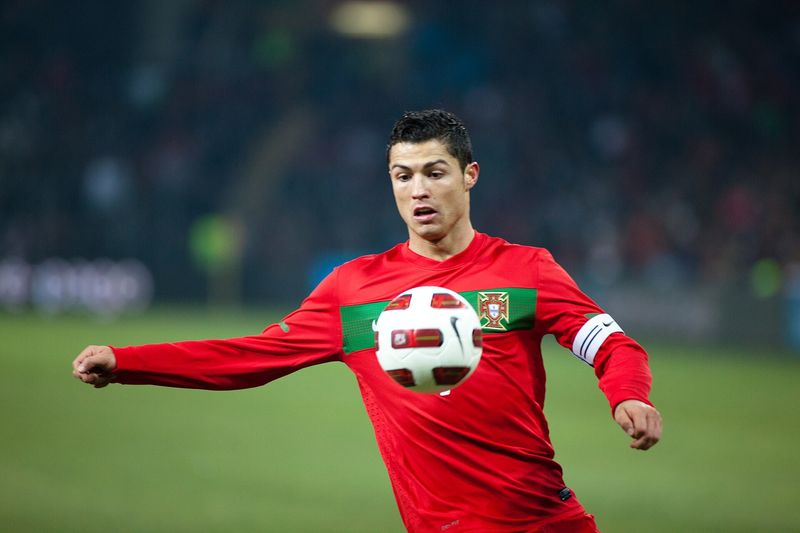
What actually happened in the twenty minutes
The match itself was a procession, and the debut must be reported inside that fact rather than instead of it. Portugal’s goals came from a brace by Sporting CP’s Diego Farinha, a penalty by Santos FC’s Kauã Miranda, and a 60th-minute goal by Braga’s Rafael Cabral. By the time Ronaldo Jr entered in the 73rd minute, the qualifier was decided, the tempo was that of a training exercise, and the coaching purpose of his introduction was development minutes, not rescue. This matters for the honest assessment in both directions. Sceptics will note, correctly, that twenty minutes at 4–0 against Andorra is the softest possible landing international youth football offers. Believers will note, also correctly, that this is exactly how federations blood 16-year-olds in every country, famous or not: late, safe, and in games already won. The debut was normal. Only the surname was not.
Two details from the cameo have travelled furthest, and both reward a second look. The first is the shirt: No. 18, not No. 7. Whether by his choice, the staff’s or simple squad numbering, the effect is the same — a small, visible refusal of the costume. His father, as the Spanish newspaper AS pointed out in coverage carried by GOAL, wore the No. 7 for Portugal at the same age; the son began in 18, and AS’s verdict, via GOAL, was that nothing in the boy’s style of play simply copies his father either. The second detail is the header. In the 88th minute he got across his marker and put an effort narrowly wide — the kind of near-miss that, for any other debutant, would be a footnote, and for this one became the clip. A goal would have been a headline in forty countries. The width of a post is the entire distance between a nice story and a global one, and learning to live inside that arithmetic, at sixteen, is the real curriculum he has enrolled in.
The pathway: Juventus, Manchester United, Al Nassr
Strip the name away and the résumé is that of a serious academy prospect, assembled along a route that mirrors his father’s club career with almost eerie fidelity: Juventus, then Manchester United, then Al Nassr, following the family’s moves. He debuted for Portugal’s under-15s in 2025, progressed through the under-16s, and arrived at this camp with 13 appearances across the two age groups and five goals, per Nogomania and DailySports reporting. Those are respectable, unspectacular numbers — the numbers of a player inside a strong national pathway, not above it. Portugal produces elite forwards the way other countries produce weather; the under-17 group he has joined contains players from Sporting’s academy, one of Europe’s finest, and from Santos and Braga. Nothing about his selection requires conspiracy to explain, and nothing about it guarantees anything at all. Youth internationals at sixteen fail to become senior internationals at a rate that should sober any headline writer: the base rate is the story’s silent co-author.
There is a shadow across the pathway, and it should be handled with care and attribution. Portuguese media reports, carried by DailySports, suggested unhappiness from the senior Ronaldo in October over his son’s earlier omission from under-16 and under-17 selection. That is reported here as what it is: attributed reporting about a father’s feelings, not an established fact about federation decision-making, and not evidence that the November call-up was anything other than a coach’s judgement. But its existence points at the structural awkwardness that will follow this player for years. Every selection will be read twice — once as football, once as favour — and every omission will be read twice too. The federation cannot win the argument; it can only keep making defensible decisions and let the minutes accumulate into a record that speaks for itself.
The surname: door-opener and measuring stick
What the name gives him
It would be naive to pretend the name is only a burden. It has given a 16-year-old academy forward coaching attention, federation familiarity, commercial interest and a global audience for his first twenty minutes of under-17 football — an audience no other player in that squad will ever command. Doors open. Scouts attend games they would otherwise skip. When he plays well, the world hears about it within the hour. In a sport where thousands of equally talented teenagers vanish for want of a single well-timed look from the right person, the guarantee of being looked at is a genuine, compounding advantage.
What the name costs him
The measuring stick, though, is not “good young forward.” It is 146 international goals. Every performance will be graded against the most productive international career in history, by an audience most of whom will see only clips. A normal development dip at seventeen will be content. A normal benching will be a narrative. And the comparison is rigged in a specific way: his father was not, at sixteen, the finished monument he later became, but memory edits the father’s youth into destiny and demands the son match the monument immediately. The healthiest sentence in the week’s coverage was AS’s: that the boy’s game does not copy his father’s. A player who is permitted to become something else has a chance. A player conscripted into being a tribute act does not.
Who benefits, and who carries the cost
Portugal’s federation benefits either way: if he develops, it has a player; if he merely persists, it has a story that keeps its youth programme in the world’s shop window for a decade. Al Nassr’s academy benefits from the association. The media — this site included, and honesty requires the admission — benefits from a debut that twenty minutes of football would never otherwise have justified covering at this length. The cost is carried almost entirely by one person: a sixteen-year-old who did not choose his surname, his audience or the week his father happened to retire. The adults around him, family and federation alike, owe him the one thing fame makes scarce: unremarkable room to be ordinary while he finds out whether he is more.
What happens next
The group continues at the Cidade do Futebol: Bulgaria were played on Saturday, November 14, and Serbia follow on Tuesday, November 17, with the top two in the group advancing. One caution belongs in the record: a single-source report (DailySports) said Portugal drew Bulgaria 1–1 with Ronaldo Jr an unused substitute; that detail is single-sourced and is flagged here as unverified rather than woven into the narrative. If it proves accurate, it is itself the healthiest possible sign — evidence that Filipe Ramos is managing a squad, not a storyline, and that the boy will be picked the way his teammates are picked. What would count as genuine progress from here is unglamorous and specific: minutes in games still undecided, starts earned across a season, goals at under-17 level against the group’s stronger sides, and selection that survives the move to under-18 and under-19 football, where the pathway narrows brutally. What would count as hype is everything else — the clips, the comparisons, the countdown clocks to a senior debut that is, at the very earliest, years away. On November 12, a talented boy played twenty minutes for his country and nearly scored. His father’s career is finished; the record books have it. The son’s file, properly, contains one page. Let it fill at football’s pace, not the internet’s.
Sources
Reuters, November 15, 2026 — “Ronaldo Jr takes next Portugal step as dad exits international scene” (https://www.reuters.com/sports/soccer/ronaldo-jr-takes-next-portugal-step-dad-exits-international-scene-2026-11-15/): the November 12 debut against Andorra at the Cidade do Futebol, the senior internationals watching, and the family context. ESPN, November 13, 2026 — “Cristiano Ronaldo Jr. makes Portugal U17 debut one week after dad’s retirement” (https://www.espn.ph/football/story/_/id/50463201/cristiano-ronaldo-jr-makes-portugal-u17-debut-one-week-dad-retirement): the 73rd-minute entry, the 4–0 scoreline and scorers (Farinha brace, Miranda penalty, Cabral), the father’s November 5 retirement and his 146 goals in 234 caps. GiveMeSport and Nogomania, via GOAL/AS: the 88th-minute header narrowly wide, the No. 18 shirt, AS’s assessment that his style does not copy his father’s, and the under-15/under-16 record of 13 appearances and five goals (also via DailySports). DailySports, single source and flagged as unverified in the text: the reported Bulgaria 1–1 draw on November 14 with Ronaldo Jr unused, and the attributed Portuguese-media reporting of the senior Ronaldo’s October unhappiness over earlier omissions. The scoreline is 4–0 and the entry minute the 73rd, per Reuters and ESPN; one aggregator’s 4–1 headline contradicted its own text and was not used. Photographs are file photos via Wikimedia Commons; none depicts the November 12 match.