Netanyahu UNGA speech 2026
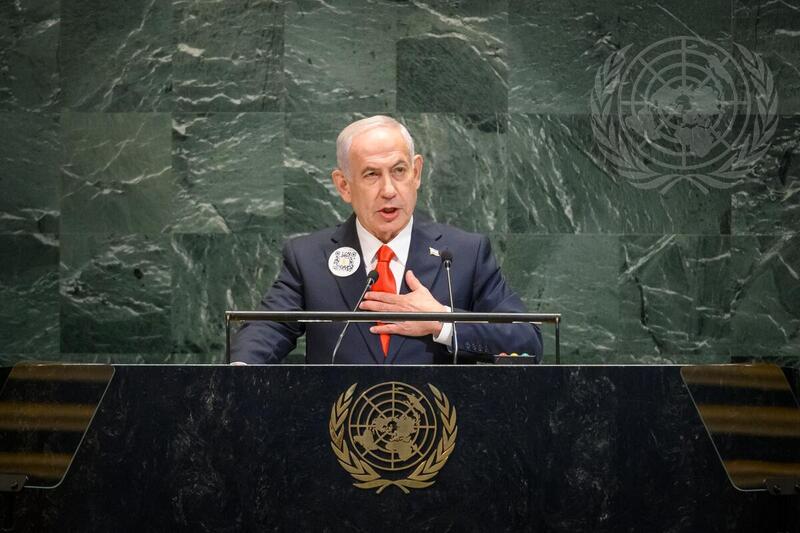
NEW YORK — The Netanyahu UNGA speech 2026 was never designed as a plea for consensus. It became a demonstration of political separation: cheers and boos in the chamber, scores of delegates filing out as Israel's prime minister approached the rostrum, and Benjamin Netanyahu answering a visibly thinned audience by calling the departing diplomats “moral cowards.” Then he offered a phrase likely to travel far beyond Turtle Bay, describing the decision to strike Iran as “one of the easiest decisions I've ever had to make.”
The speech compressed three audiences into one event. Netanyahu addressed foreign governments that increasingly reject Israel's conduct in Gaza; Israeli voters who will choose a new Knesset on October 27; and adversaries in Tehran and across the region who parse every sentence for deterrent intent. His seven-hour New York visit, already narrowed by security concerns and demonstrations, therefore functioned less like a conventional diplomatic stop than a tightly controlled campaign rally with the United Nations as its backdrop.
That distinction matters. A General Assembly address can be a statement of national policy, a piece of wartime signaling and a domestic political advertisement at the same time. Netanyahu used all three registers. The result was forceful but not conciliatory, memorable but not obviously capable of closing the widening gap between Israel and a large share of the diplomatic community.
A walkout turns absence into the dominant image
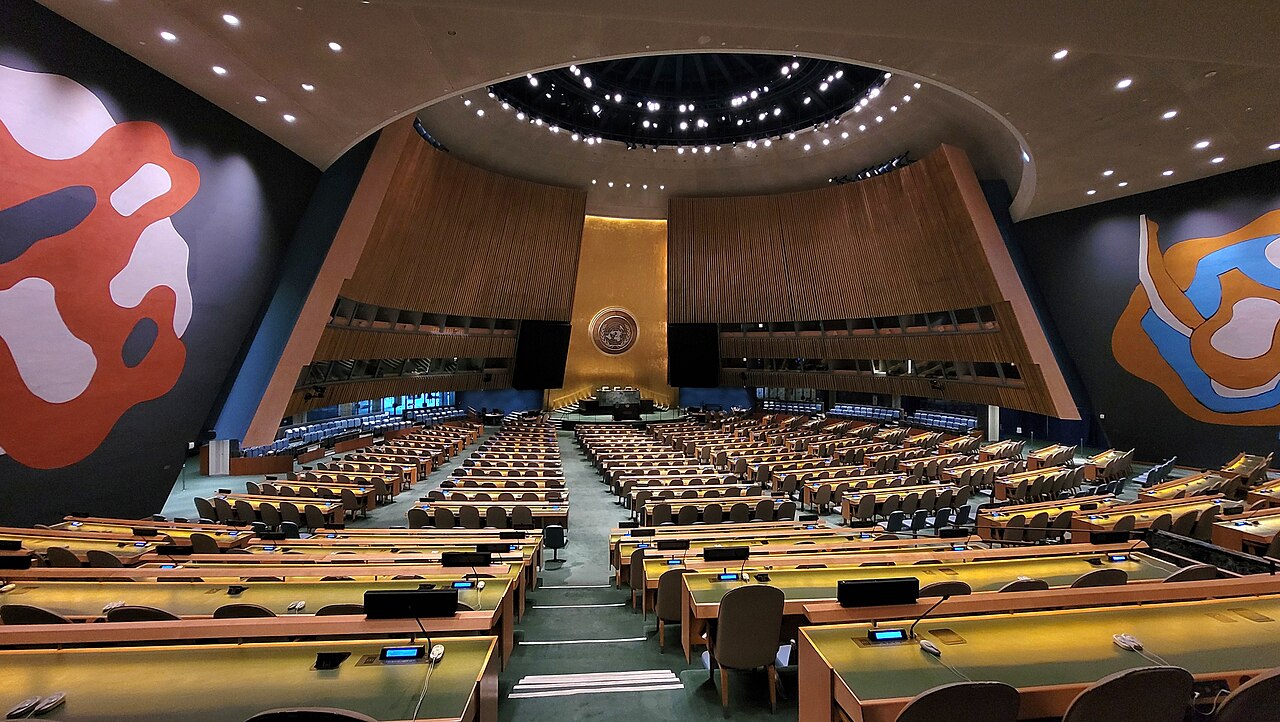
According to Associated Press reporting, cheers, boos and a mass walkout greeted Netanyahu as he reached the rostrum. Scores of delegates left, and a majority of seats were empty. The Palestinian Mission had urged delegations to walk out, transforming a normally procedural act — deciding whether to remain in the hall — into a coordinated political message.
Netanyahu's response was immediate. “If there are any other moral cowards who have not yet left the hall, please do so now,” he said. The line was calibrated for more than the people who heard it in person. It allowed him to recast diplomatic isolation as evidence of resolve: if critics departed, in this telling, that did not weaken Israel's case; it revealed their unwillingness to face it.
This is one of Netanyahu's most durable rhetorical moves. He often treats international condemnation not as a constraint to be managed but as a contrast that sharpens his preferred image at home — the leader who will stand alone when others will not. Yet a walkout also carries a cost that rhetoric cannot erase. Diplomacy depends on keeping audiences in the room long enough to hear an argument, test a proposal and negotiate over its consequences. The more the image of empty seats defines the day, the less the speech operates as persuasion.
The walkout should not be mistaken for unanimity. Some delegations stayed; applause and supportive reactions were also audible. Nor does leaving the chamber settle any of the legal, military or humanitarian disputes around the Gaza war. It does, however, provide a rough measure of the political atmosphere. Netanyahu arrived determined to argue that Israel's use of force had redrawn the strategic map. Many delegates chose to make Israel's isolation the visual story instead.
Why the Iran line carried the most strategic weight
Netanyahu's description of striking Iran as “one of the easiest decisions I've ever had to make” was the speech's clearest strategic declaration. It reduced a decision with vast military, economic and regional consequences to a test of leadership. That may have been the point: to project certainty in a domain usually crowded with caveats.
But “easy” can describe the political choice without describing the aftermath. An attack on Iran carries risks for missile escalation, proxy attacks, shipping through the Strait of Hormuz, oil prices and the durability of any ceasefire. It can degrade capabilities while also hardening political resistance. It can reassure allies who fear Iran's weapons programs while alarming governments that fear a wider regional war. The operational question — what was struck and with what effect — is only one part of the strategic ledger.
The timing also intersected with an active diplomatic track. U.S. and Iranian officials have been linked to indirect, mediator-driven contacts around sanctions, frozen assets and maritime security. Our analysis of the U.S.-Iran shuttle talks around UNGA found a bargaining environment in which public threats and private messages can move in opposite directions. Netanyahu's line raised the political price of any future concession by defining decisive force as uncomplicated and hesitation as weakness.
That framing serves a domestic purpose, too. Elections reward clarity more readily than they reward ambiguity. A prime minister asking voters to evaluate wartime leadership has an incentive to compress uncertainty into a simple claim: Israel faced an intolerable threat; he made the call; the call was correct. The harder questions — whether the gains are durable, how escalation is contained and what diplomatic off-ramp remains — do not disappear because the decision was rhetorically easy.
A seven-hour visit built for control, not courtship
The trip's compressed schedule shaped the speech before Netanyahu said a word. His New York stay was cut to roughly seven hours amid demonstrations, legal rhetoric and unusual security pressures. The shortened itinerary eliminated the leisurely choreography of summit diplomacy: the motorcades, private meetings and carefully staged images that normally make a leader's UN week look expansive.
Instead, the visit concentrated attention on the rostrum. Our earlier report on why Netanyahu shortened his UN trip examined how the tight schedule reflected the collision between international exposure and domestic urgency. It also showed the limits of treating a trip to New York as routine while an International Criminal Court warrant remains part of the political backdrop, even though the United States is not a party to the court.
New York politics heightened that tension. Democratic mayoral figure Zohran Mamdani had made Netanyahu's presence a point of confrontation, while legal experts noted that city officials do not control federal foreign policy or possess a free-standing power to execute an international warrant. Netanyahu answered that political challenge before leaving Israel, and the clash became part of the visit's prewritten drama. Our separate analysis of the Netanyahu-Mamdani “shame on you” exchange explains why both men benefited from escalating a dispute neither city law nor a UN speech could resolve.
A pre-speech report citing i24 News said Netanyahu's office also signaled that he would refer to the injury of Neriya Leiter, the son of Israel's ambassador to Washington. The detail underscored the personal register his advisers wanted to bring to a speech otherwise dominated by strategy. In wartime politics, individual stories are not incidental: they connect battlefield decisions to family sacrifice and translate policy into moral claim.
Abbas on video, and two competing claims to permanence
Palestinian Authority President Mahmoud Abbas appeared by prerecorded video after the United States denied him a visa for a second consecutive year, according to AP reporting. “We will not leave our homeland. We will not accept displacement,” Abbas said. The contrast with Netanyahu's physical presence was stark: one leader at the lectern under intense protection, another confined to a screen by the host country's entry decision.
Both messages rested on permanence. Netanyahu argued that Israel would act, including against Iran, to secure its future. Abbas insisted Palestinians would not be displaced from theirs. These positions are not mirror images — the parties do not possess equal power, and their institutions operate under very different constraints — but they reveal why diplomatic formulas collapse when they are not backed by a credible political process. Each side believes time can be used to strengthen facts on the ground. Each fears that delay will make the other's preferred outcome irreversible.
The visa denial also complicates the United Nations' claim to be a universal diplomatic forum. The U.S. retains broad authority over entry, and Washington's relationship with the Palestinian leadership is politically fraught. Still, when a central participant in the conflict can appear only on video, the institutional imbalance becomes visible. The General Assembly can amplify the message, but it cannot create the access or leverage required to turn it into negotiations.
Hamas's signal and the missing architecture of peace
Hamas said it was ready to move forward on a Gaza peace agreement, according to the same AP report. That statement is important but insufficient on its own. Readiness has to be translated into terms: the status and release of hostages, the sequencing of withdrawals, guarantees against renewed combat, governance in Gaza, security arrangements, aid access and a mechanism for enforcement.
The phrase “peace agreement” can conceal sharp differences about whether the objective is a temporary ceasefire, a permanent end to the war or a wider political settlement. Israel may view disarmament and the removal of Hamas from power as prerequisites; Hamas may treat Israeli withdrawal and durable guarantees as essential. Mediators can bridge wording for a time, but ambiguity becomes dangerous when implementation begins.
Netanyahu offered no sign that the walkout had altered his underlying terms. His posture was deterrent, not transactional. That does not mean negotiations are impossible. Governments often negotiate most intensely when public rhetoric is at its hardest. It does mean any breakthrough will likely come through private channels rather than from the General Assembly floor.
The reconstruction gap is the material test
A senior European Union official said only a small amount of the funding needed for Gaza's reconstruction had been collected, AP reported. This may be the day's most consequential fact because it exposes the gap between diplomatic language and executable policy. A ceasefire can stop immediate destruction; it cannot by itself rebuild homes, schools, hospitals, water systems or an economy.
Donors face a rational dilemma. They are reluctant to commit billions without knowing who will govern Gaza, how materials will be monitored, whether reconstruction will be destroyed in another round of war or whether aid will reach civilians. Yet waiting for a fully settled political order prolongs desperation and makes any future governing arrangement harder to sustain. Security depends partly on reconstruction, while reconstruction depends on security.
That circular problem is where slogans fail. Netanyahu can argue that military pressure removed threats. His critics can argue that the humanitarian cost is intolerable. Both arguments eventually meet the same administrative questions: who clears rubble, who controls crossings, who pays contractors, who verifies dual-use materials and who provides policing. Without answers, a “day after” remains a phrase rather than a plan.
Outside the UN, protest becomes the counter-speech
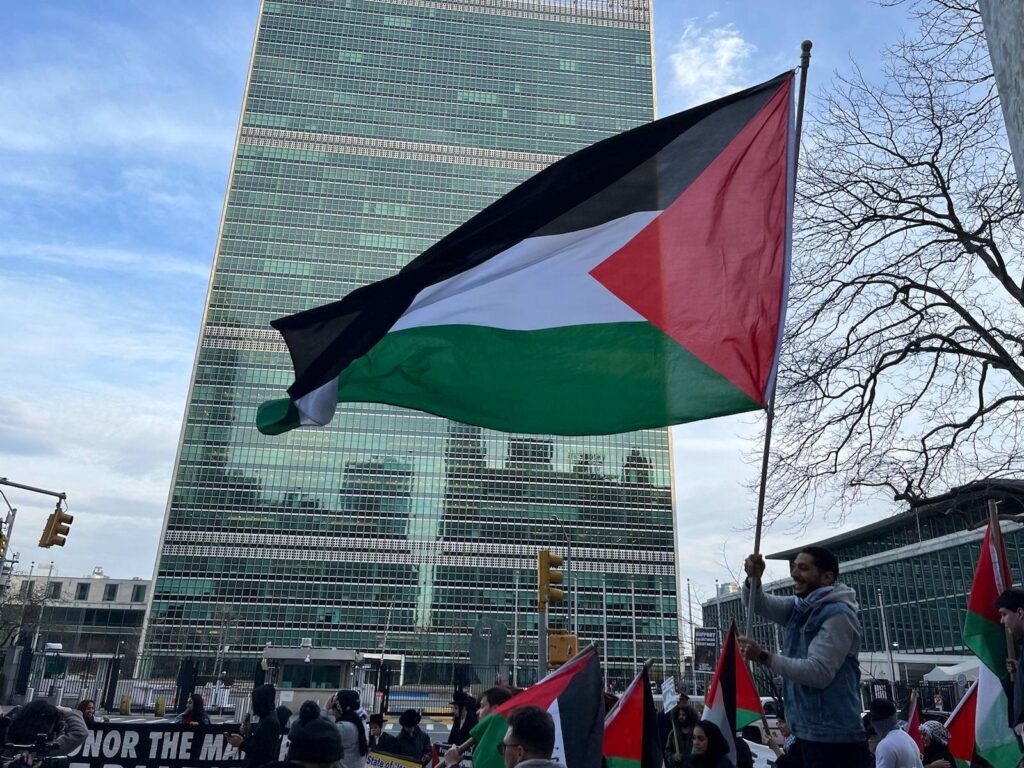
Hundreds of Jewish, Palestinian, Iranian and Lebanese New Yorkers joined a Jewish Voice for Peace protest near the United Nations, according to 710 WOR's summary of Guardian reporting. Demonstrators used the slogans “Let Gaza live” and “Fund people not bombs.” Their presence made the geography of the day unusually compressed: formal diplomacy inside, street politics outside, each side speaking about legitimacy and accountability.
The report said actor Susan Sarandon was detained and attributed the detention of former U.S. Army intelligence analyst Chelsea Manning to the Guardian. Those details should be handled with care because arrest, detention and release can carry different legal meanings, and early crowd reports often change. The clearest conclusion is that police action became part of the story, raising the visibility of a demonstration already built around a visiting world leader.
Protest at the UN does not constitute a vote, and celebrity participation does not settle policy. But the coalition itself matters. Jewish-led groups opposing the Israeli government's conduct complicate attempts to cast all criticism as hostility to Israel or Jewish people. Palestinian, Iranian and Lebanese participants bring distinct histories and political positions that should not be collapsed into a single bloc. What unified them for the afternoon was opposition to Netanyahu and to continued military action.
The prime minister's defenders will see the demonstrations as another reason to reject outside pressure. His opponents will see them as evidence that the diplomatic walkout had a civic counterpart. Both readings reinforce polarization. The harder task is to determine whether public pressure changes a government's options or merely strengthens the leader's claim to be besieged.
The speech was also an October 27 campaign event
Israel's election was 33 days away. Newsmax reported a Channel 13 poll showing Netanyahu's bloc at 54 seats and the opposition at 52, while a Kan poll put the blocs at 52 and 51 respectively. Neither result reaches the 61 seats required for a Knesset majority. Polls are snapshots, not forecasts, and bloc arithmetic can shift with turnout, thresholds and coalition bargaining. Still, the numbers explain the speech's political urgency.
Netanyahu did not need to win over most UN delegates to gain at home. He needed to reinforce three propositions: that Israel remains under threat, that he is uniquely willing to act and that international criticism validates rather than discredits his approach. Calling the Iran strike easy served the second proposition. Calling walkout participants moral cowards served the third. Framing the speech as a surprise served the first by creating anticipation around what only the incumbent could reveal.
This is why the half-empty hall may not be a purely negative image for his campaign. Opposition abroad can become authority at home when a leader tells voters that foreign elites misunderstand the country's danger. The risk is that political theater obscures strategic evaluation. Voters need more than proof that a decision was difficult or easy; they need evidence that it improved security at an acceptable cost and left the country with sustainable alliances.
The polls also counsel against declaring a winner. A bloc in the low-to-mid 50s is competitive, but it is not a government. Smaller parties, turnout and post-election negotiations may decide the result. Netanyahu's UN appearance gave him a powerful visual asset. It did not give him 61 seats.
Who gains from the confrontation?
Netanyahu gains a vivid campaign clip: hostile delegates leave, he stays, and he defines their departure on his terms. Opposition leaders gain evidence for their argument that his policies have damaged Israel's diplomatic standing. Iran gains material for portraying Israel as isolated, even as the speech reminds Tehran of Israel's willingness to use force. Palestinian leaders gain a symbolic display of international anger but still lack a negotiated path from solidarity to sovereignty.
The United States occupies the most difficult position. It protects a close ally, controls access to the UN host country and tries to prevent regional escalation while pursuing indirect contacts with Iran. Visa policy toward Abbas, the legal limits surrounding the ICC and the practical need for U.S. mediation all point in different directions. Washington can shape the room more than any other outside power, but it cannot guarantee that the parties will use the room to compromise.
What happens next
Four tests will show whether the speech was more than an election-season performance. First, watch the indirect U.S.-Iran channel: does Netanyahu's language narrow the possible terms, or does it provide Washington leverage by demonstrating the alternative? Second, look for a detailed Gaza framework that specifies hostages, withdrawal, governance and enforcement rather than repeating general commitments to peace.
Third, follow reconstruction pledges. The amount collected, the identity of the governing authority and the mechanism for delivering materials will reveal whether international concern is becoming policy. Fourth, track Israeli polling beyond the immediate news cycle. Rally effects can be intense and short. If Netanyahu's bloc remains below 61, the decisive contest may be over coalition credibility rather than the applause line of any single speech.
The UN address succeeded on Netanyahu's own terms if the objective was defiance. He dominated the day's images, placed Iran at the center of his record and forced critics to respond to his words. It was less successful if the objective was diplomatic repair. A hall emptied by protest is not a coalition, and a description of a past strike is not a plan for the next negotiation.
The most revealing feature of the day, then, was not the volume of the boos or cheers. It was the narrowing of political space. Delegates walked out. Abbas appeared remotely. Protesters were detained outside. Reconstruction money remained scarce. Netanyahu spoke with certainty, but the region's central problems — war termination, Palestinian governance, Iranian deterrence and Israeli political legitimacy — remained unresolved. The election may reward certainty. History will measure whether the strategy behind it worked.
Sources
- Associated Press reporting via The Daily Reflector
- 710 WOR summary of Guardian reporting on protests and detentions
- Newsmax reporting on speech timing, election date and Israeli polling
- News18 / CNBC-TV18 live coverage of the Netanyahu-Mamdani dispute
- Indian Economic Observer report citing i24 News on the speech preview