War · Middle East
A Kuwaiti court sentenced three men to death on Monday over an alleged plot to assassinate the interior minister in collaboration with Iran and Lebanese Hezbollah. On Wednesday, Iran’s embassy in Kuwait denied that any Iranian citizen took part — and Kuwait answered by summoning Tehran’s ambassador and handing him a formal protest note. The plot remains an allegation advanced by prosecutors, the sentences are not final and can be appealed, and Iran denies any involvement.

Track it live: Middle East tracker — follow the war, the diplomacy around it and the Gulf’s internal-security cases as they develop.
KUWAIT CITY — Kuwait’s Foreign Ministry summoned Iran’s ambassador on Wednesday and handed him a protest note, two days after a Kuwaiti criminal court sentenced three men to death over an alleged plot to assassinate the country’s First Deputy Prime Minister and Interior Minister, Sheikh Fahad Al-Yousef Al-Sabah. The sequence is the story: a verdict on Monday, a categorical denial from Iran’s embassy in Kuwait on Wednesday, and — within hours — a formal summons that turned a criminal case into an open diplomatic clash between two Gulf neighbours in the middle of a regional war.
The ministry said the ambassador — named as Muhamad Tutunyi in EFE reporting — was handed a note describing the Iranian embassy’s statement as “a blatant intervention in the internal affairs of Kuwait and a diminution of its sovereignty and independence of its judicial authority, in clear violation of international laws and norms.” Kuwait urged Iran to comply with international law and the Charter of the United Nations, and restated its firm condemnation of any intervention in the rulings of its national courts. What began as a state-security trial had become, by Wednesday afternoon, a dispute about whether a foreign embassy may publicly dispute a Kuwaiti court’s verdict at all.
What the court decided
On Monday, October 26, Kuwait’s Criminal Court, sitting in its State Security and Terrorism circuit, sentenced three men to death and eight others to five years in prison. The panel was chaired by Judge Nasser Al-Bader, according to Middle East Monitor’s court report and local media, sitting alongside judges Omar Al-Mulaifi, Abdullah Al-Faleh and Salem Al-Zayed. The three men sentenced to death are Hussein Abdullah Al-Maatouq, a religious scholar and secretary-general of the National Islamic Alliance; Hassan Abdulhadi Hajieh; and Abdulreza Haidar Dehqani, an Iranian citizen.
The charges, as set out by the prosecution, allege that the defendants collaborated with Iran and with Lebanese Hezbollah, committed espionage on behalf of Iran, plotted to assassinate Sheikh Fahad Al-Yousef, harmed Kuwait’s national interests, joined a banned organisation and sought explosives. Those are allegations the court accepted at trial; they are not findings that any Iranian state body has publicly been shown evidence for, and Tehran denies them. One detail, reported by AFP citing two judicial sources, gives the case an unusual history: one of the defendants had previously been convicted of terrorism in 2016, received an Emiri pardon, and was re-arrested in April. The sentences handed down on Monday are not final. Under Kuwaiti procedure they can be appealed, and none of the three death sentences can be treated as settled until the appeals process has run.
Iran’s denial — and Kuwait’s protest note
Iran’s embassy in Kuwait moved first on Wednesday, issuing a statement that categorically denied that an Iranian citizen had participated in any assassination plot or in any act threatening Kuwait’s security. The embassy said the individual in question has not been in Kuwait for ten years, described the reports as fallacious, and said such accusations run contrary to the principle of good neighbourliness. Read closely, the statement made two distinct claims: a factual one, about where one named defendant has been for a decade, and a political one, about how neighbours ought to speak of each other in wartime.

Kuwait’s answer was not a rebuttal of the embassy’s facts but a challenge to its right to make them. The Foreign Ministry summoned Ambassador Tutunyi, handed him the protest note, and framed the statement itself as the offence: a foreign mission publicly disputing the verdict of a Kuwaiti court was, in Kuwait’s telling, an intervention in its internal affairs and an affront to the independence of its judiciary, in violation of international law and norms. The ministry urged Iran to comply with international law and the UN Charter. Notably, Kuwait did not withdraw its own ambassador, expel Iranian diplomats or downgrade relations on Wednesday — the protest note is a serious but deliberately bounded instrument, the strongest formal complaint a foreign ministry can lodge while keeping the relationship intact.
Why this matters
The case matters because it opens a second, quieter front of the Middle East war: the internal-security front, fought in courtrooms and counter-intelligence files rather than with missiles. Since the war began, Gulf states have detained dozens of people suspected of belonging to Iran-linked cells, AFP reported, during a period of repeated Iranian strikes on the region. Kuwait’s verdict is the most severe judicial outcome of that campaign so far — three death sentences in a single case, aimed, prosecutors say, at the minister who runs the country’s internal security. A state that believes its interior minister was targeted by a foreign-directed cell is a state whose threat perception has changed, whatever the appeals court eventually decides.
It is also running in parallel with the week’s diplomacy, and the contrast is the analytical point. The same days that produced Kuwait’s death sentences and protest note also produced Qatari mediators handing Tehran a new draft deal to end the war, with guarantors and a seven-day timeline of confidence-building steps. One Gulf capital is negotiating with Iran; another is summoning its ambassador over a plot Tehran denies. Both are responses to the same war, and they are not obviously compatible: every escalation on the internal-security front raises the political cost, for mediators, of asking Gulf publics to accept a negotiated settlement with the state their courts are accusing. United States intelligence has been describing the same alleged pattern from the other side — as we reported in our coverage of US warnings that Iranian assassination plots against American officials had reached advanced stages, which accompanied the pullback of US diplomats from Gulf embassies. Kuwait’s case is a national prosecution, not an American claim, but it lands in a region already primed to read it as one more entry in a single ledger.
Context and background
Kuwait has been here before, and the precedent shapes how Monday’s verdict is being read at home. In 2015, Kuwaiti authorities announced the discovery of the so-called Abdali cell, a network accused of links to Iran and Hezbollah and of stockpiling weapons; in 2016, Kuwait’s Court of Appeal upheld a death sentence against one of the defendants in that case. The Abdali case shadowed Kuwait-Iran relations for years afterwards, and it is the template against which Kuwaiti officials and commentators instinctively measure any new Iran-linked security case. The 2026 case is legally distinct — different defendants, different alleged plot, a different target at the top of the state — but politically it will be processed through the memory of 2015.
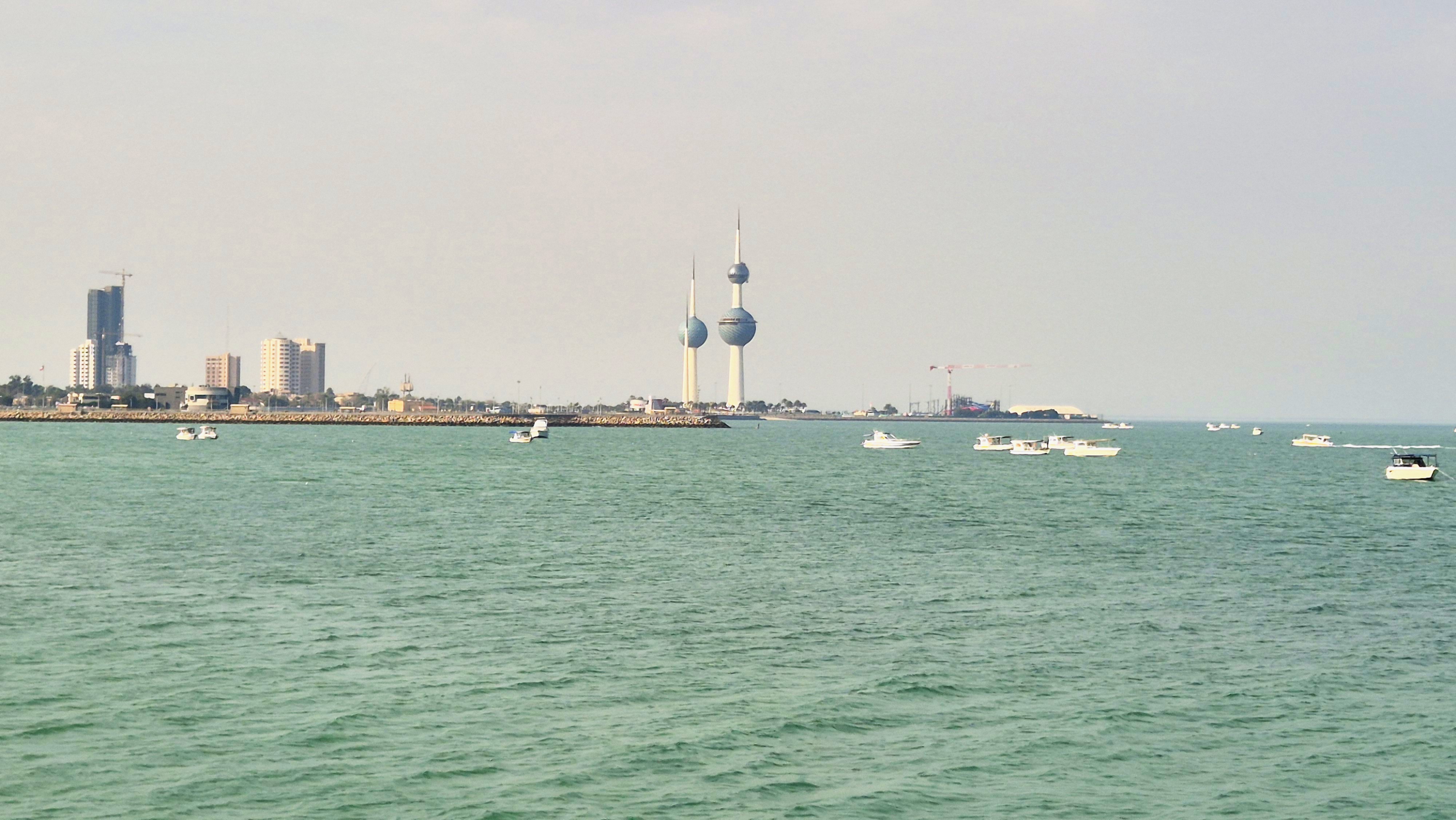
The wartime context widens the frame further. AFP’s reporting on the verdict placed it in a regional pattern: since the Middle East war began, Gulf governments have detained dozens of people suspected of Iran-linked cells while their countries absorbed repeated Iranian strikes. Kuwait is not the only state running such cases, and its courts are not the only ones under pressure to show that the home front is being defended. Also this week, a different Gulf answer to the same insecurity was on display in Oman’s call for the Gulf states, Iraq and Iran to sign a non-aggression pact — an attempt to build security by agreement rather than by prosecution. Kuwait’s summons and Oman’s proposal are opposite instruments pointed at the same fear.
Two readings of the same verdict
Kuwait’s reading is about sovereignty, and it was stated in the protest note’s own language. A Kuwaiti court heard a Kuwaiti case; its verdict belongs to Kuwait’s judicial authority; a foreign embassy that publicly disputes the verdict diminishes that authority and intervenes in internal affairs. On this reading, the summons was not really about whether Dehqani was in Kuwait ten years ago — it was about who gets to pronounce on a Kuwaiti judgment. The note’s appeal to the UN Charter and international law is chosen to make that procedural claim carry universal weight: non-intervention is a principle every state in the region invokes when it suits it.
Tehran’s reading, set out by its embassy, is about neighbourliness and about the character of the accusations themselves. Iran denies that any Iranian citizen participated in a plot against Kuwait’s security, offers a specific factual counter-claim — that the man has not set foot in Kuwait for ten years — and frames recurring reports of Iranian interference as fallacious and contrary to good neighbourliness between two states that share a maritime border and a long, mostly managed history. On this reading, it is Kuwait’s case, amplified in wartime, that breaches the norms of the relationship. Critics of the prosecution, including voices concerned about communal cohesion in a country with a significant Shia minority, add a third note of caution: that wartime espionage cases against defendants drawn largely from one community carry sectarian sensitivities, and that the fairness and transparency of the appeals process will matter for domestic trust as much as for foreign relations. That concern is a warning about perception, attributed here to critics; it is not evidence about the verdict itself.
The disciplined way to hold the story is to separate its layers. Established: a Kuwaiti court sentenced three named men to death and eight others to five years on Monday; the sentences are appealable; Iran’s embassy denied involvement on Wednesday; Kuwait summoned Iran’s ambassador the same day and protested in the quoted terms. Alleged: that the defendants collaborated with Iran and Hezbollah, spied for Iran and plotted to kill Sheikh Fahad Al-Yousef — the prosecution’s case, accepted by the trial court and now subject to appeal. Denied: any Iranian role, denied categorically by Tehran’s embassy. A reader who keeps those three layers apart has the whole story; a reader who merges them has someone else’s argument.
What the numbers imply
The arithmetic of the case is compact and revealing. Eleven defendants stood at the centre of it: three sentenced to death — just over a quarter of the dock — and eight sentenced to five years each, a total of forty years of prison terms distributed across the wider group. The state, in other words, drew a sharp line inside its own case: a small leadership group it says directed the alleged plot, marked for the ultimate penalty, and a larger ring assigned supporting roles and punished heavily but finitely. One of the three condemned men is an Iranian citizen, which is why a domestic verdict acquired a diplomatic dimension at all; one had a prior 2016 terrorism conviction and an Emiri pardon behind him before his re-arrest in April, a biographical fact that prosecutors will inevitably read as recidivism and defence lawyers as prejudice. And the diplomatic numbers are as telling as the judicial ones: roughly forty-eight hours separated verdict from summons, and the trigger for the summons was not the sentence but a statement — Kuwait moved when Tehran spoke, not when its own court did.
What happens next
The legal track now runs upward. The three death sentences are not final; the defendants can appeal, and Kuwaiti capital cases in state-security matters proceed through appellate review before any sentence is settled — the Abdali precedent, in which an appeal court ruled on a death sentence in 2016, shows both that appeals in such cases are real proceedings and that they do not automatically soften outcomes. Defence filings, the appeal court’s handling of the espionage and collaboration findings, and any eventual question of clemency will determine whether Monday’s sentences stand. Until then, describing the three men as condemned is accurate; describing their fate as decided is not.
The diplomatic track has two visible paths. Containment would look like this week ending where it stands: a protest note delivered, positions stated for the record, embassies open, and the dispute absorbed into the managed friction that has characterised Kuwait-Iran relations since Abdali — sharp words, no rupture. Escalation would announce itself through instruments Kuwait pointedly did not use on Wednesday: expulsions, a reduction of Iran’s diplomatic presence, a recalled ambassador, or a coordinated Gulf statement echoing Kuwait’s protest. Oman’s non-aggression proposal, circulating in the same week, offers a third possibility in embryo — that the Gulf states eventually decide the internal-security front, like the military one, needs a framework rather than a sequence of bilateral crises. Which path the Kuwait case takes will be signalled first not by the courts but by Tehran’s foreign ministry: whether it answers the protest note in kind, lets the embassy statement stand as its last word, or opens a channel to contain the case before the appeals begin. The verdict was Monday’s news. The relationship it has strained is the longer story, and it is still being written.
Sources: Agence France-Presse (October 2026) report of the verdict, citing two judicial sources, on the three death sentences, the charges, the defendant previously convicted in 2016, pardoned and re-arrested in April, and the wartime pattern of Gulf detentions of suspected Iran-linked cell members; Middle East Monitor (October 27, 2026) court report on the State Security and Terrorism circuit panel chaired by Judge Nasser Al-Bader and the prosecution’s allegations; EFE via Demócrata (October 28, 2026) on the summoning of Ambassador Muhamad Tutunyi, the text of Kuwait’s protest note and Iran’s embassy denial. The assassination plot is an allegation advanced by Kuwaiti prosecutors; the death sentences are not final and can be appealed; Iran denies any involvement.