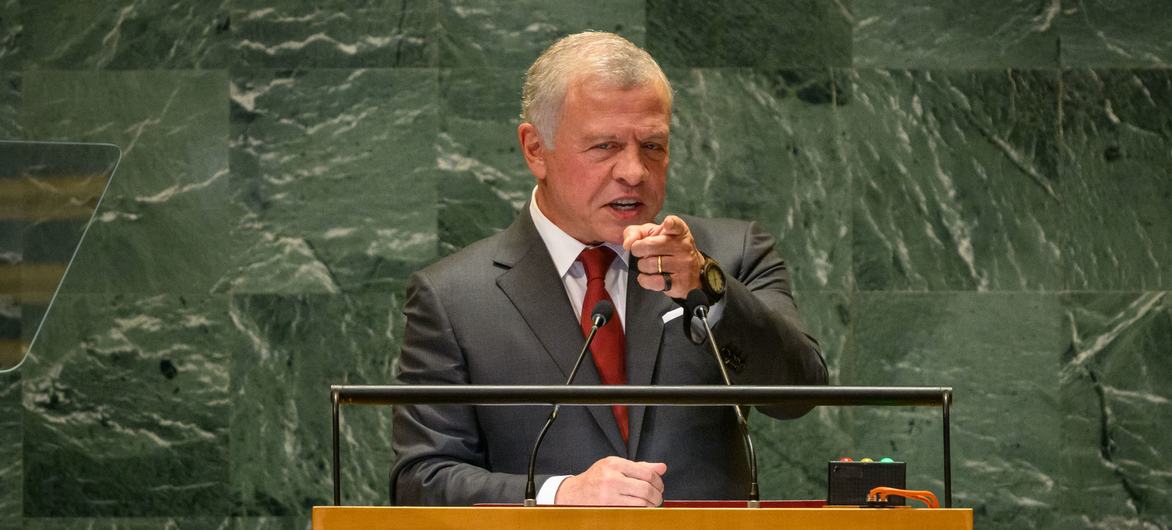
King Abdullah UNGA speech Gaza was not framed as a new negotiating proposal. It was an argument that decades of crisis management have allowed territorial and humanitarian conditions to harden while diplomatic attention moved elsewhere. Speaking in New York on September 22, Jordan’s King Abdullah II accused Israel’s government of changing the reality in Gaza and the West Bank and warned that Israeli actions in southern Syria threatened Jordanian interests. Turkish President Recep Tayyip Erdoğan followed a parallel line, using sharper language and calling for more pressure on Israel.
The two leaders spoke one day after eight Muslim-majority states, including Jordan and Türkiye, endorsed a Phase Two road map for Gaza. That sequence gave their addresses a diplomatic context: the speeches were designed not only to condemn, but also to build political weight behind a proposed transition from ceasefire management to withdrawal, stabilization, interim administration and reconstruction.
The central uncertainty is enforcement. Abdullah listed sanctions, asset freezes, embargoes and diplomatic isolation as available tools. Erdoğan urged governments to increase pressure and recognize a Palestinian state. Neither speech established which states would take those steps, on what timetable, or how they would respond if Israel rejected them. The gap between declared principle and coordinated action is the main measure by which these addresses should be judged.
What Abdullah said—and what remains an allegation
Abdullah began from the politics of attention. “For decades, I have stood before this Assembly and warned of the dangers of leaving the Palestinian-Israeli conflict unresolved,” he said, arguing that the international community had chosen to manage the conflict instead of confronting it. He described repeated Israeli measures as having shifted from temporary responses into durable policy.
On Gaza, Abdullah said that “in the first 300 days of the so-called ceasefire, at least 300 Palestinian children were killed.” That is the king’s figure and characterization; Signal Post News has not independently reconstructed the cases behind the count. He also accused Israel’s government of “squeezing Palestinians into barely a third of Gaza” while continuing attacks, damaging civilian infrastructure and refusing to withdraw.
His sharpest legal accusation concerned the West Bank. Abdullah said demolitions, land appropriation, checkpoints and settler attacks formed part of a policy compelling Palestinians to leave. “And there is a name for that: forced displacement. And that is a war crime,” he said. Those are Abdullah’s allegations and legal characterization, not an adjudicated finding presented here as fact.
The king rejected treating Gaza and the West Bank as separate crises, calling them “two fronts of the same Israeli strategy.” In his formulation, destruction in Gaza and what he called West Bank de facto annexation had the same strategic effect: making a viable Palestinian state impossible. The speech therefore linked immediate casualties and access restrictions to a longer contest over territory, sovereignty and the possibility of a two-state outcome.
Israel expansionist appetite Syria warning
Abdullah then widened the argument beyond the Palestinian territories. “This Israeli government’s expansionist appetite is now a regional threat,” he said, naming Syria as the warning the international community was failing to see. He cited repeated incursions, territorial expansion and changes around water resources, and said any threat to Jordan’s northern border or water security would be treated as a threat to national security.
The Israel expansionist appetite Syria warning matters because it recasts Israel’s military activity in Syria from a bilateral security dispute into a question for neighboring Jordan. Israel says its operations in Syria are intended to prevent hostile forces and weapons from threatening its territory. Abdullah argued that the pattern was instead producing new facts on the ground and testing how far Israel could act without international consequences. Those competing explanations cannot be collapsed into a single settled account.
Erdogan UNGA Gaza speech 2026
The Erdogan UNGA Gaza speech 2026 reinforced the same diplomatic pressure while using more inflammatory terms. Erdoğan accused Israel of possessing a “genocidal mindset that can never get enough of killing,” according to the Washington Examiner. He said that “in Gaza alone, over the past three years, we have lost 74,000 of our brothers and sisters,” and described those deaths as the result of what Türkiye regarded as Israeli state terror. Israel’s delegation walked out during the speech, the newspaper reported.
Erdoğan’s 74,000 figure was somewhat higher than the “more than 73,000” Palestinian death toll Reuters reported from Gaza health authorities in a separate account. Neither number distinguishes civilians from combatants in the total cited here, and the one-thousand difference may reflect reporting time, source updates or counting methodology. Gaza health authorities do not separate fighters and civilians in their headline total; Israel has disputed casualty presentations and says Hamas operates among civilians.
Erdoğan also criticized the withholding of Palestinian Authority President Mahmoud Abbas’s visa, called on more governments to recognize Palestine and appealed to the Trump administration’s Gaza plan. His address aligned Türkiye with Abdullah’s demand for consequences while preserving room to work with Washington’s diplomatic framework.
Israel disputes the framing
Israel disputes the central framing used by both leaders. Israeli officials say the war is directed at Hamas and other armed groups, not Palestinians as a people; they argue that Hamas embeds military infrastructure in civilian areas and that Israeli warnings and evacuation orders are intended to reduce harm. Israel rejects accusations of genocide and forced displacement and maintains that security controls in Gaza, the West Bank and along the Syrian frontier respond to attacks and military threats.
Those defenses do not settle the legal or factual disputes. Civilian casualties, restrictions on movement, settlement growth and the destruction of homes remain documented subjects of international scrutiny. But neutrality requires separating evidence from attribution: Abdullah and Erdoğan made accusations; Israel rejects them; courts and other competent bodies, not political speeches alone, determine criminal responsibility.
Why this matters for Jordan
Jordan’s interest is not abstract. The country absorbed large numbers of Palestinians after the 1948 and 1967 wars, hosts the largest registered Palestinian-refugee population served by UNRWA, and has a large population of Palestinian origin. The Washington Examiner described roughly half of Jordanians as ethnically Palestinian, an estimate that is politically sensitive and not established by a current national census.
That demographic and historical connection makes any prospect of mass displacement from the West Bank or Gaza a domestic security question for Amman. Jordan has repeatedly rejected proposals that could move Palestinians permanently across its borders, while supporting aid, Palestinian political rights and a negotiated state. Abdullah’s forced displacement war crime language therefore served both an international legal argument and a warning that Jordan will not accept demographic transfer as a regional solution.
Jerusalem adds another direct responsibility. Abdullah reaffirmed the Hashemite Custodianship and the historic and legal status quo at Muslim and Christian holy sites. Jordan’s role at Al-Aqsa Mosque/Haram al-Sharif is embedded in its peace relationship with Israel and its standing in the Arab and Muslim worlds. Any change at the sites can quickly affect public order, bilateral ties and wider regional diplomacy.
Abdullah’s historical UNGA warnings
The 2026 address belongs to a long line of Abdullah speeches warning that an unresolved Palestinian-Israeli conflict will not remain geographically contained. Over successive General Assembly appearances, he has tied the issue to regional stability, the credibility of international law, the protection of Jerusalem’s holy sites and Jordan’s own security. His message this year was that repetition without enforcement has allowed conditions to worsen.
He reached back to the 2002 Arab Peace Initiative, which he said offered Israel normalization with 57 Arab and Muslim states, including Iran and Iraq at the time, in exchange for peace and Palestinian statehood. The historical point is significant even though the initiative is often described more narrowly as an Arab League proposal: the offer’s strategic logic was regional normalization in return for withdrawal and a negotiated Palestinian state. More than two decades later, the central bargain remains unrealized.
The contrast Abdullah drew was between available diplomatic architecture and absent political execution. His case was not that no plan exists, but that plans and resolutions repeatedly fail to alter incentives. That history also explains why the least dramatic of the forward scenarios may be the most likely.
Eight nations Gaza comprehensive plan Phase Two
On September 21, the foreign ministers of eight Muslim-majority countries endorsed a road map intended to move Gaza beyond the first phase of President Trump’s Comprehensive Plan. The eight nations Gaza comprehensive plan Phase Two framework called for completing existing commitments and advancing Israeli withdrawal, an International Stabilization Force, a transitional administration and reconstruction under the proposed Board of Peace architecture.
The speeches gave that document political urgency but did not resolve its hardest questions. A stabilization force requires a mandate, contributors and rules of engagement. Interim governance requires Palestinian legitimacy as well as external support. Reconstruction requires access, security and financing. The Trump Board of Peace Gaza plan may provide an umbrella, but it cannot substitute for consent among the parties or a workable division of authority.
Israel’s security concerns, Hamas’s future, the Palestinian Authority’s role and the sequence of withdrawal remain unresolved. Those are not drafting details. They determine whether Phase Two is an executable transition or another framework whose language outruns its coalition.
Numbers in context
- 300 children / 300 days
- Abdullah’s stated count for the first 300 days of what he called the “so-called ceasefire”; not independently reconstructed here.
- 74,000
- Erdoğan’s Gaza death-toll figure; about 1,000 above the 73,000-plus figure Reuters separately attributed to Gaza health authorities.
- “Barely a third of Gaza”
- Abdullah’s description of the area into which he said Palestinians were being compressed; a political characterization, not an independently mapped measurement in this report.
- 57 states
- The Arab and Muslim states Abdullah said were covered by the 2002 peace offer, including Iran and Iraq at the time.
These numbers operate differently. The death tolls are cumulative claims that change with reporting and methodology. “Barely a third” is a spatial description requiring a defined date and map to verify. The 57-state reference is diplomatic history. Placing them in one speech creates moral force, but responsible reporting must preserve the category and source of each figure.
Who benefits—and who loses
Jordan gains diplomatic clarity but assumes political risk. Abdullah reinforced Amman’s role as a defender of Palestinian rights, Jerusalem’s status quo and regional stability. If other states do not act, however, Jordan is left carrying border, refugee and domestic pressures without the leverage implied by the speech.
Türkiye gains leadership visibility. Erdoğan’s language appeals to audiences demanding a harder response to Israel and supports Ankara’s claim to regional influence. The cost is that maximal rhetoric can narrow room for mediation if Israeli officials view Türkiye as a partisan rather than an intermediary.
Palestinians gain attention, not yet changed conditions. The speeches elevate civilian harm, territorial fragmentation and statehood at the UNGA 81st General Debate speeches. They do not themselves reopen crossings, remove checkpoints, halt settlement activity or establish a government for postwar Gaza.
Israel faces greater diplomatic pressure. The convergence of two influential regional leaders, the eight-state road map and broader recognition efforts raises reputational and policy costs. Israel also retains decisive military power and support from key partners, giving it room to resist measures it considers unsafe or politically unacceptable.
Washington’s plan gains endorsement and scrutiny. Both speeches acknowledged President Trump’s peace effort while arguing that implementation was inadequate. That allows the administration to claim regional buy-in, but it also makes the United States the principal outside actor against which stalled enforcement will be measured.
Three scenarios from here
Scenario 1 — The speeches unlock coordinated leverage. Jordan, Türkiye and the other road-map states align sanctions, diplomatic conditions, reconstruction finance and security commitments. Washington uses that coalition to negotiate concrete Phase Two benchmarks. This is the most consequential outcome, but it requires agreement on tools the speeches did not specify.
Scenario 2 — Limited implementation proceeds. Humanitarian access, reconstruction planning or security talks improve while the central disputes over withdrawal, Hamas, Palestinian governance and the West Bank remain unresolved. This would produce measurable gains without the political settlement Abdullah demanded.
Scenario 3 — The speeches fade without enforcement. This is the highest-probability scenario given precedent. Governments praise the addresses, repeat support for international law and return to divided national policies. Israel continues to set operational facts, Palestinian institutions remain fragmented, and Phase Two stays aspirational. Abdullah’s own historical argument—that repeated warnings have not been converted into sustained action—is the strongest evidence for this outcome.
The next evidence will be practical: whether states announce specific diplomatic or economic measures; whether the eight-nation group publishes a timeline and assignments; whether Israel and Palestinian actors accept any part of the transition; and whether Washington attaches consequences to missed commitments. Without those steps, the September 22 addresses will matter as a record of regional consensus, not as a turning point.
Related Signal Post News coverage
- Eight nations endorse a Gaza Comprehensive Plan road map for Phase Two
- Katz Gaza City evacuation ultimatum adds a new escalation threshold
- Trump’s UNGA address sets out the U.S. regional position
Sources
- Jordan News Agency (Petra): official full text of King Abdullah II’s 81st UNGA address
- Washington Examiner: reporting on Abdullah’s and Erdoğan’s speeches, the Israeli delegation walkout and Jordanian context
- Eastleigh Voice: listed report on Abdullah’s regional warning (the publisher URL was serving unrelated copy when checked and was not used for factual support)
- Reuters: 73,000-plus Gaza death-toll comparison attributed to Gaza health authorities
- Israeli statement at the United Nations: Israel’s stated position on civilian harm, Hamas and genocide allegations
- Global Issues / UN Photo: source page for the September 2024 file photograph
Reporting cutoff: September 23, 2026 at 12:01 AM PDT. Direct accusations and contested legal descriptions are attributed to the speakers or governments making them. The Eastleigh Voice URL was retained for source transparency but did not supply factual claims because the publisher page returned unrelated text when checked. This is a fixed reporting snapshot and does not update automatically.