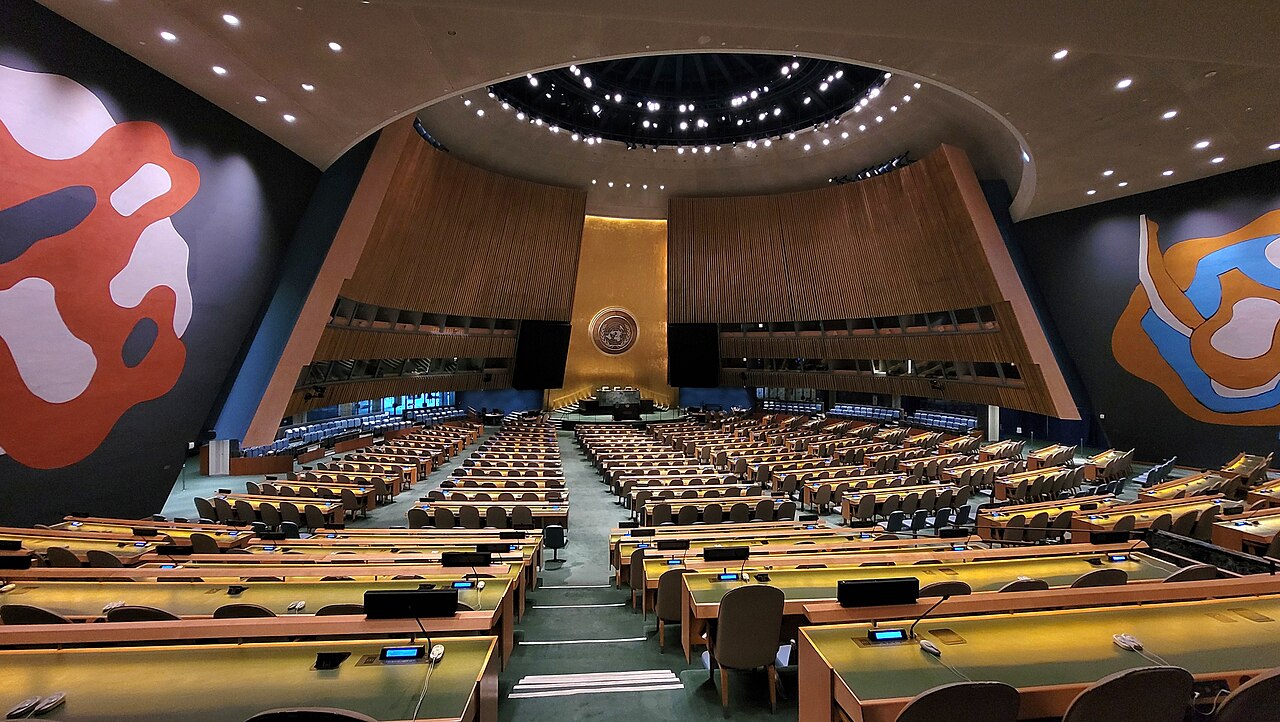
A unified demand at the United Nations
The foreign ministers of Egypt, Qatar, Jordan, the United Arab Emirates, Indonesia, Pakistan, Türkiye and Saudi Arabia met in New York on September 21 on the margins of the 81st United Nations General Assembly. In a joint statement released September 22, the eight governments demanded that Israel immediately fulfil the outstanding commitments in Phase One of the Gaza Comprehensive Plan and formally endorsed a Road Map for the plan’s second phase.
The immediate test, the ministers said, is whether the ceasefire produces material change for civilians. Their statement called for the “immediate, safe and unhindered delivery of humanitarian assistance and Early Recovery supplies,” the rehabilitation of critical infrastructure, and respect for the “imperative of preserving the ceasefire and ending all violations.” Those are not presented as optional confidence-building measures. In the bloc’s formulation, they are unfinished obligations that must precede a credible move into the next phase.
The Road Map turns Phase Two into an operational sequence
The ministers described the Road Map as an “integral part” of the Comprehensive Plan. They said Phase Two should move through linked steps: decommissioning alongside full Israeli withdrawal, deployment of an International Stabilization Force, or ISF, assumption of responsibilities across Gaza by the National Committee for the Administration of Gaza, known as the NCAG, and the launch of Early Recovery and Reconstruction.
That sequencing is the statement’s most consequential feature. “Phase Two” is no longer only a diplomatic destination. The Road Map identifies institutions, security arrangements and an order of operations. If accepted, the ISF and NCAG would become the bridge between a ceasefire and a functioning postwar administration. If any link fails—withdrawal, security deployment, administrative transfer or reconstruction—the rest of the sequence becomes harder to execute.
The eight ministers called on all parties to meet their commitments “in good faith and without delay.” The wording applies beyond Israel, even though the statement places its sharpest immediate demand on the Israeli government. It also creates a public standard against which mediators, Palestinian actors and the proposed international mechanisms can be judged.
Territory, displacement and the political end state
The statement categorically rejected the expulsion or forced displacement of Palestinians and any attempt to alter the territorial or demographic character of the Occupied Palestinian Territory. The ministers also deplored settlement expansion, land confiscation, home demolitions, settler violence and forced displacement. These are the ministers’ allegations and policy positions; the statement’s language should not be read as an independent adjudication of every underlying incident.
They said Gaza must remain an integral part of Palestinian territory and called for the reunification of Gaza with the West Bank, including East Jerusalem. The political destination, in their account, is a credible and irreversible path to Palestinian self-determination and an independent state with East Jerusalem as its capital through a two-state solution.
This matters because the plan is being framed as more than a security transition. The bloc is tying reconstruction and governance to a territorial and diplomatic settlement. That broadens the coalition supporting the Road Map, but it also raises the cost of ambiguity: a temporary security arrangement without a political horizon would not satisfy the conditions the ministers set out.
An endorsement of Trump’s framework—with public conditions
The ministers commended President Donald J. Trump’s leadership, stressed what they called the indispensable role of the United States and asked for sustained, active U.S. engagement. They also expressed readiness to work with Washington, the Board of Peace, the Palestinian Authority and other relevant parties.
The statement is therefore not a rejection of an American-backed framework. It is an attempt to bind that framework to specific obligations and a timetable of practical steps. The eight governments are endorsing Trump’s Comprehensive Plan while publicly defining what implementation must mean: aid access, infrastructure repair and ceasefire compliance in Phase One, followed by withdrawal, stabilization, Palestinian administration and reconstruction in Phase Two.
That combination gives the statement unusual diplomatic weight. The group spans Arab states directly involved in mediation and regional security, as well as major Muslim-majority countries from South and Southeast Asia. Their alignment creates a wider political constituency for the plan while making it harder to treat the Road Map as a narrow bilateral initiative.
How the process reached this point
The Gaza Comprehensive Plan was endorsed through United Nations Security Council Resolution 2803. Its institutional architecture includes the Board of Peace and the proposed transition mechanisms named in the Road Map. Endorsement, however, did not guarantee execution. The dispute shifted from whether a plan existed to whether the parties would carry out the first phase and permit the second to begin.
In August 2026, the same eight countries issued a joint statement condemning what they described as Israel’s unwillingness to proceed with the plan. The September statement escalates that pressure in two ways. First, it uses immediate obligation language rather than only condemning delay. Second, it formally embraces the Road Map as the vehicle for Phase Two and lists the mechanisms that should follow. The movement from criticism to sequencing is politically significant: it turns dissatisfaction into a testable implementation agenda.
Chatham House’s analysis describes a stalled first phase and cites an Office for the Coordination of Humanitarian Affairs estimate that 58% of Gaza’s population faces severe deficiencies in shelter or access to essentials. The same analysis says the UAE committed $100 million to training Gaza police, while Israel barred recruits from training in Cairo. Those details show why governance and security provisions cannot be separated from humanitarian recovery. Institutions cannot take over effectively if personnel cannot be trained, infrastructure remains unusable or civilians lack basic necessities.
What the 58% figure implies
A population-level measure of 58% means the problem is not confined to isolated districts or a small residual caseload. It indicates that more than half the population is facing severe gaps in shelter or essentials, according to the OCHA estimate cited by Chatham House. That scale changes the meaning of diplomatic delay. Each week without reliable access, repairs and early-recovery supplies compounds health, displacement and administrative pressures.
The number also helps explain the sharper language compared with August. The bloc is no longer simply asking whether the Comprehensive Plan will proceed. It is warning that Phase One remains materially incomplete while the costs of waiting are borne primarily by civilians. The Road Map’s credibility will depend less on declarations than on measurable flows of aid, restored services, access for reconstruction teams and a verified reduction in ceasefire violations.
Who gains leverage—and who bears the risk
The eight states gain leverage by acting together. Egypt and Qatar bring mediation roles; Jordan, the UAE and Saudi Arabia bring regional political and financial weight; Türkiye, Pakistan and Indonesia widen the coalition beyond the Arab world. Collectively, they can support implementation, withhold political cover or press Washington to enforce the framework it helped advance.
The Board of Peace and NCAG mechanism also gain from the statement because the ministers have publicly named them as parts of the transition rather than abstract future bodies. The United States gains a coalition willing to work inside its framework. Israel could gain a defined route from ceasefire management toward an international security and governance arrangement, but only if it accepts the stated conditions and sequencing.
If the process stalls, Gaza’s civilians face the clearest losses: delayed aid, unrepaired systems, prolonged displacement and uncertainty over administration. The eight governments also risk their credibility if they endorse institutions they cannot help activate. Washington risks seeing a plan associated with its leadership become a container for unresolved disputes rather than an instrument of change.
The unanswered Israeli position
Israel had not publicly responded to the September 22 joint statement in the source reports available for this article. That absence matters because the Road Map’s first steps require Israeli decisions on access, infrastructure, ceasefire conduct and withdrawal. It would be premature to treat the ministers’ preferred sequence as agreed policy.
Israel has argued in the broader conflict that its security requirements must be met and that armed threats cannot be allowed to reconstitute. The ministers’ statement tries to answer that concern through decommissioning and an ISF, but the cited reports do not establish whether the Israeli government accepts those mechanisms, their mandate or their timing. The design questions—who contributes forces, who commands them, how decommissioning is verified and how the NCAG relates to the Palestinian Authority—remain decisive even when the political headline is unity.
Three paths from here
Implementation: Israel fulfils the remaining Phase One commitments, humanitarian and early-recovery access expands, infrastructure rehabilitation advances, and the parties agree on benchmarks for withdrawal. The ISF deploys under an accepted mandate, the NCAG assumes responsibility across Gaza and reconstruction begins. This is the Road Map’s intended sequence, but it requires coordination among actors that do not yet share every definition of security or authority.
Managed stalemate: The ceasefire broadly holds, but disputes over access, decommissioning, withdrawal or the composition of the ISF prevent Phase Two. In that scenario, the eight-country bloc would have to decide whether to increase diplomatic pressure, contribute more resources or accept a prolonged interim arrangement. The longer the pause, the more the Comprehensive Plan’s credibility erodes.
Breakdown: Renewed ceasefire violations trigger retaliation, restrict aid and push the Road Map out of reach. The ministers’ warning about ending all violations is aimed at preventing that spiral. A breakdown would weaken the Board of Peace and NCAG before either could establish authority and would leave reconstruction contingent on a new round of negotiations.
Why this matters
The significance of the September statement lies in its dual message. Eight governments with different regional interests have rallied behind a U.S.-backed plan while insisting that its credibility depends on immediate Israeli compliance and a defined political transition. That is more than rhetorical solidarity. It is an attempt to convert a ceasefire framework into an accountable sequence of humanitarian, security, administrative and political steps.
The next evidence will be operational: aid entering safely and consistently, critical infrastructure being restored, violations declining, and public agreements on withdrawal, the ISF and NCAG. If those measures appear, the Road Map could become the formal vehicle for Phase Two. If they do not, the statement will stand as a record of widening diplomatic consensus without the power to move conditions on the ground.
Sources: NAM News Network: joint statement and Phase One demands; Islamabad Post / DNA: statement details and Phase Two Road Map; Tezkhabar / APP: ministerial meeting and political provisions; Chatham House: plan background, humanitarian conditions and implementation obstacles. Facts and figures are a fixed September 22, 2026 reporting snapshot and do not update live.