Israeli tanks have rolled onto Gaza’s main north–south road, west of the Yellow Line, in the ceasefire’s most serious ground test in months. Three people were killed, the army says it was targeting Hamas infrastructure, and the Board of Peace warned the same day that a ceasefire delivering nothing visible “cannot be sustained indefinitely.”
Track it live: Israel/Gaza war map · Live wars tracker
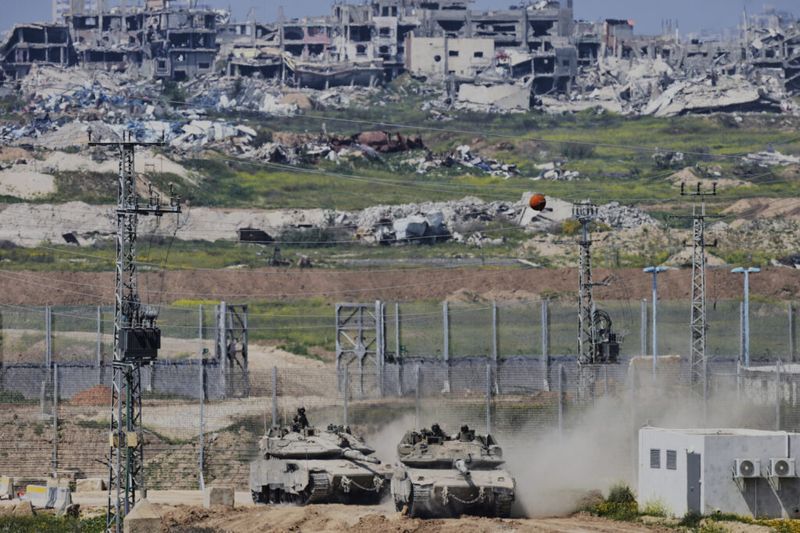
CAIRO, November 18, 2026 — Israeli tanks advanced in an area of the central Gaza Strip on Wednesday, witnesses said, and some of them rolled onto the main Salahudeen Road — a ground thrust west of the Yellow Line that Palestinian medics said was accompanied by airstrikes killing three people, according to Reuters. An Israeli airstrike near the army raid killed one person, Palestinian medics said. Separate Israeli airstrikes earlier in the day killed two other people, in Deir al-Balah and in Gaza City, medics said. The Israeli military said its forces were targeting Hamas infrastructure outside the areas Israel controls in the enclave. The advance put Israeli armour on Gaza’s main north–south artery, on the Palestinian side of the ceasefire line, more than a year after the October 2025 truce halted major fighting — and on the same day the Board of Peace warned the UN Security Council that the ceasefire is at risk of collapse, in findings set out in our report on the Board of Peace ceasefire collapse warning.
What witnesses, medics and the military each said
Witnesses said Israeli tanks advanced in an area of the central Gaza Strip on Wednesday, and that some tanks rolled onto the main Salahudeen Road, west of the Yellow Line that marks the boundary of the two-thirds of the Gaza Strip still under Israeli control despite a ceasefire that has lasted more than a year, Reuters reported. The Israeli military said its forces were targeting Hamas infrastructure outside the areas Israel controls in the enclave.
Palestinian medics gave the day’s toll. An Israeli airstrike near the army raid killed one person, medics said, according to Reuters. Separate Israeli airstrikes earlier in the day killed two other people, in Deir al-Balah in the central Gaza Strip and in Gaza City, medics said. Reporting by Gaza Herald and SANA the same day added names and places to the medics’ account: one of those killed in central Gaza was named as Fadi Nahid Ismail, 35, killed near the Deir al-Balah police station, and a second person was killed in a vehicle strike in the Sheikh Ajlin neighbourhood, west of Gaza City. Those identifications are Palestinian- and SANA-reported details; they are attributed here as reported and have not been independently confirmed.
An Israeli military spokesperson said the military was carrying out an operation targeting “Hamas infrastructure” west of the Yellow Line in central Gaza, and that it had struck a militant in southern Gaza earlier on Wednesday; the spokesperson had no immediate comment on the other strikes, Reuters reported. In its own operation announcement, the Israeli army said Salah al-Din Road would be closed to traffic in Blocks 660, 661 and 666 during the operation — a closure notice that, whatever its duration, asserts Israeli control over movement on the strip’s main road.
Wednesday’s killings follow a pattern of strikes carried out during the truce rather than a single rupture of it, including Israeli drone strikes that killed two people in Gaza earlier this month. What distinguishes Wednesday is not the airstrikes but the armour: a ground advance, onto the main road, across the line.

What is the Yellow Line?
The Yellow Line was the first-phase redeployment line of the October 2025 ceasefire: the boundary to which Israeli forces pulled back when the truce took effect, and the line beyond which the agreement’s later phases were supposed to move them further. Early ceasefire maps put Israeli deployment at about 53 percent of Gaza. Reuters now describes two-thirds of the Gaza Strip as still under Israeli control, and the Board of Peace report says Gaza’s more than two million people live confined to around a third of the territory, mostly in tents and damaged buildings. Salahudeen Road — also rendered Salah al-Din Road — is Gaza’s main north–south artery, running the length of the strip. Tanks on that road, west of the Yellow Line, are therefore not patrolling the Israeli side of the boundary the ceasefire drew; they are operating beyond it, on the road the whole territory depends on.
Why this matters
Analysis: airstrikes during this ceasefire have become near-daily, and each is absorbed into the truce’s grim arithmetic. A ground move onto the main road west of the line is different in kind, and it is worth being precise about why. The Yellow Line is the ceasefire’s central physical fact: everything in the agreement — phased withdrawal, Hamas disarmament, reconstruction — is sequenced from where that line sits and whether it moves. Armour crossing it to operate on Gaza’s main artery tests whether the line is a temporary redeployment line, as the agreement describes, or a hardening boundary that Israel can advance at will. Wednesday’s operation came with a road-closure notice for three numbered blocks of Salah al-Din Road, which reads less like a raid’s footprint than an administrator’s.
The timing compounds the test. On the same day, the Board of Peace — the body overseeing the truce — delivered its second report to the UN Security Council, faulting both Israel and Hamas for failing to meet their commitments and warning that “the distance between what has been agreed and what is happening on the ground nonetheless remains the principal risk to the process.” And on the same day, Defence Minister Israel Katz said Israel would not withdraw from Gaza until Hamas was dismantled and Gaza was demilitarised, according to Reuters’ report on the board’s findings. A tank advance west of the line, an overseer’s collapse warning, and a no-withdrawal condition, all within one news cycle, are the ceasefire’s three moving parts moving at once — the ground shifting, the diplomacy stalling, and the gap between them widening.
Context: a ceasefire that halted the war but not the fighting
The October 2025 ceasefire halted major fighting, but it has not stopped attacks or secured Hamas’s disarmament, Reuters reported. Under the plan the Board of Peace oversees, Hamas would disarm, Israeli forces would withdraw in phases, a civilian transitional authority would govern Gaza, and reconstruction would begin. Thirteen months on, none of those steps has been completed, and the board’s November report describes a process whose agreed sequence has broken down at its first link.
The breakdown has a specific history. The board’s report says Hamas agreed in July to a Board roadmap under which it would surrender its weapons and transfer governance of Gaza to a civilian transitional authority — but that Israel rejected the roadmap, saying it will not withdraw until Hamas is dismantled. The board criticised Israel’s “absence of decisions” on establishing a civilian Palestinian police force, and said restrictions on supplies and equipment, together with funding shortfalls, have hindered preparations for winter flooding. It also said Hamas has been collecting taxes on goods entering Gaza, affecting the availability of basic commodities, and that Hamas militant activity and attacks on Israeli troops have continued. Wednesday’s tank advance is the ground-level expression of that stalemate: with the political sequence frozen, the military one keeps moving.
The toll, in context
The human numbers, each stated with its source, frame Wednesday’s operation. Gaza health authorities say at least 1,600 Palestinians have been killed since the ceasefire took effect in October 2025; the Israeli military says five Israeli soldiers have been killed in that period, Reuters reported. Across the war as a whole, Palestinian authorities say more than 74,000 people in Gaza have been killed in the campaign Israel launched after Hamas-led fighters killed about 1,200 people in southern Israel on October 7, 2023, Reuters reported. The territorial figures have moved in the same direction as the toll: from about 53 percent of Gaza under Israeli deployment on early ceasefire maps to the two-thirds Reuters now describes as under Israeli control. These tolls are reported by the parties and by authorities on each side; they have not been independently verified in full, and they are presented here as attributed figures, not as audited counts.
Angles: a security case, a derailment charge, and the people in between
Israel’s stated case is a security one. Israel says Hamas has recently been regrouping and rearming, and it has stepped up attacks against the group on that basis, Reuters reported; Wednesday’s operation was described by the military as targeting Hamas infrastructure. Defence Minister Israel Katz restated the government’s governing condition on Wednesday: Israel would not withdraw from Gaza until Hamas was dismantled and Gaza was demilitarised. In that telling, operations west of the Yellow Line are enforcement against a rearming adversary, not expansion.
Hamas’s stated case is the mirror image. Hamas has accused Israel of attempting to derail the US-brokered ceasefire, Reuters reported — a charge under which an advance onto the main road, in the same week as repeated lethal strikes, is evidence not of enforcement but of intent to collapse the truce on Israeli terms. The Board of Peace, in its report, declined to adopt either account wholesale: it faulted both parties, recording Israel’s rejected roadmap and absent police decisions alongside Hamas’s continued militant activity, attacks on Israeli troops and taxation of goods entering Gaza.
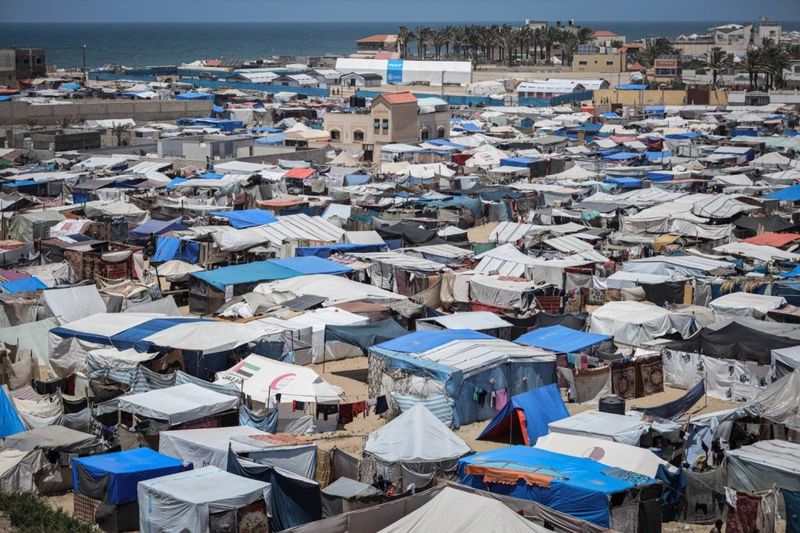
Civilians occupy the ground both arguments are about. Gaza’s more than two million people live confined to around a third of the territory, mostly in tents and damaged buildings, the board’s report says — and that third is the side of the line into which Wednesday’s tanks advanced. Those families are now facing winter rain and flooding in camps with too little shelter material and equipment, a danger set out in our report on Gaza’s winter floods and the WHO warning for displaced families. For them, the question the Yellow Line poses is not diplomatic: it is how much of Gaza remains theirs to live in, and whether the road that connects it stays open.
What happens next
Analysis and scenarios, not predictions: the immediate fixed point is the end of November, when the Board of Peace presents its report to the UN Security Council in New York. That presentation now takes place against a live ground operation that embodies the report’s central complaint, and against Defence Minister Katz’s restated condition — no withdrawal until Hamas is dismantled — which the board’s roadmap sequencing cannot accommodate. Three scenarios cover the plausible range. In the first, Wednesday’s advance is a limited raid that pulls back: the tanks return east of the Yellow Line, the road reopens, and the operation is recorded as enforcement within a strained but holding truce. In the second, the line is pushed further west: the closure of Salah al-Din Road in Blocks 660, 661 and 666 hardens into a standing boundary, the third of Gaza left to its population shrinks again, and the ceasefire survives as a partition rather than a process. In the third, the advance and the response to it escalate into the renewed wider fighting the board warned of — the collapse captured in its sentence that “a ceasefire that delivers nothing visible cannot be sustained indefinitely.” Which scenario unfolds depends on decisions in Jerusalem, in Gaza and in Washington over the coming days, and on whether the Security Council presentation produces pressure that thirteen months of stalemate have not.
Sources
Sources: Reuters, November 18, 2026 — “Israeli military begins new thrust in Gaza, kills three people” (reuters.com): witnesses’ account of tanks advancing in central Gaza and rolling onto the main Salahudeen Road west of the Yellow Line; the Israeli military’s statement that its forces were targeting Hamas infrastructure outside the areas Israel controls; Palestinian medics’ account of one person killed in an airstrike near the raid and two others killed in earlier strikes in Deir al-Balah and Gaza City; the military spokesperson’s statement on the operation targeting “Hamas infrastructure” west of the Yellow Line and the strike on a militant in southern Gaza; Israel’s position that Hamas has been regrouping and rearming; Hamas’s accusation that Israel is attempting to derail the US-brokered ceasefire; and the attributed tolls of at least 1,600 Palestinians and five Israeli soldiers killed since the October 2025 ceasefire, more than 74,000 people killed in Gaza across the war, and about 1,200 people killed in southern Israel on October 7, 2023. Reuters, November 18, 2026 — “Trump’s Board of Peace faults Israel and Hamas for failure to end Gaza war” (reuters.com): the board’s 12-page second report to the UN Security Council, seen by Reuters and to be presented in New York at the end of November; its faulting of both Israel and Hamas; the quotations “the principal risk to the process” and “a ceasefire that delivers nothing visible cannot be sustained indefinitely”; the July roadmap episode; the criticism of Israel’s “absence of decisions” on a civilian Palestinian police force and of restrictions and funding shortfalls hindering flood preparation; Hamas taxation of goods entering Gaza and continued militant activity; Gaza’s population confined to around a third of the territory; and Defence Minister Israel Katz’s statement that Israel would not withdraw until Hamas was dismantled and Gaza demilitarised. Gaza Herald and SANA, November 18, 2026: the naming of Fadi Nahid Ismail, 35, killed near the Deir al-Balah police station, and of a second person killed in a vehicle strike in the Sheikh Ajlin neighbourhood west of Gaza City, reported as Palestinian- and SANA-reported details. The Israeli army’s operation announcement: the closure of Salah al-Din Road to traffic in Blocks 660, 661 and 666 during the operation. Photographs: file photographs from the Associated Press (via Final Call and via Portside) and Christian World Service, credited in the captions; all three are file images and do not depict Wednesday’s operation.