War · Iran · Europe · United States
A member of the Iranian parliament’s National Security Committee has told Euronews, in an interview published November 4, that if the United States uses its bases in Europe — naming Italy and Germany — to attack Iran, “Iran’s missiles will be fired towards Europe.” The Revolutionary Guard, hardline newspapers, and a state-aligned newspaper’s published target map of American installations in nine European countries have echoed the warning all week. No strike has been ordered and none has happened; the threat is explicit, and it is conditional on an American attack launched from European soil. But it is the furthest Tehran has ever publicly drawn its retaliation map — and it lands on the desks of governments that assumed this war would stay in the Middle East.
Track it live: Live Global Trackers — Iran War
TEHRAN, November 6, 2026 — The sentence was not shouted at a rally or printed on a banner. It was delivered, evenly, to a European broadcaster. “If America uses its bases in Europe, including in Italy and Germany, Iran’s missiles will be fired towards Europe,” Ahmad Bakhshayesh Ardestani, a member of the Iranian parliament’s National Security Committee, told Euronews in an interview published on November 4. “In the two previous wars we did not do this, but this time we will not let Europe’s assistance to America for an attack on Iran go without consequence.” He said Iran would strike any base used against it, and would also target “the material and non-material assets of countries that assist America” — and he argued that European countries had, in Tehran’s view, already been at war with Iran in the previous phase by allowing their territory to be used.
The precision of the condition matters as much as the threat. Ardestani was not announcing an intention to attack Europe; he was publishing a price list. European bases are the infrastructure through which any large American air campaign against Iran would partly flow, and Tehran is declaring, in advance and on the record, that hosting that infrastructure would make the host a target. The message is designed to be read in Berlin, Rome and London at least as carefully as in Washington — and over the same days, the rest of Iran’s security establishment has repeated it in chorus: parliament, the Revolutionary Guard, the hardline press, and a map.
What Tehran actually said: the words, the statement, the map and the banner
Ardestani’s interview was the clearest statement, but not the only one. Fada Hossein Maleki, another member of the same committee, said Iran has prepared a new approach — a new scenario — for any renewed conflict, one designed to surprise the United States and Europe alike. The Islamic Revolutionary Guard Corps, in a statement issued Wednesday, November 4 — the anniversary of the 1979 seizure of the US embassy in Tehran, a date Iran marks every year with anti-American ceremony — promised an “immediate, effective response without geographical limits to every level and type of threat,” saying Supreme Leader Mojtaba Khamenei had ordered an update of its “target bank” to include the enemy’s tangible and intangible assets within range. The same anniversary week, IRGC-linked media circulated a dramatised video simulating strikes on American bases in Europe — propaganda, not operations, as Signal Post News reported at the time, but part of the same signalling campaign.
The press carried the argument further. Kayhan, the hardline newspaper whose managing editor is appointed by a representative of the Supreme Leader, wrote that Iran’s target range is no longer confined to US bases in the Middle East and could extend to “the heart of Europe.” Hamshahri, a state-aligned newspaper, published a target map of US installations in nine European countries — the United Kingdom, Germany, France, Italy, Greece, Romania, Albania, Portugal and Cyprus — annotated with distances. Former foreign minister Manouchehr Mottaki said a new war’s scope “could extend to European countries hosting US bases.” Outside the German embassy in Tehran, a banner quoted Mohsen Rezaei, secretary of the Supreme National Security Council: “Europe will pay the price for supporting Israel.” The Fars news agency reported that Iran had warned Germany its military assets in the region would be “legitimate defensive targets” if Berlin directly joined a confrontation — a claim Euronews noted it could not independently verify, and which Signal Post News likewise treats as unverified.
For the other side of the account: Euronews sought comment from the German embassy in Tehran and from Germany’s foreign ministry; both were unreachable at publication. No European government has endorsed Tehran’s characterisation of base-hosting as participation in war, and international lawyers generally treat hosting allied forces under long-standing agreements as a different legal category from conducting attacks — a distinction Tehran is deliberately collapsing. Analysts read the week’s chorus as coordinated deterrent messaging rather than an operational disclosure. Ellie Geranmayeh of the European Council on Foreign Relations noted that Iran has explicitly warned any country facilitating US attacks that it exposes itself to Iranian counterattacks, and that Tehran’s purpose is to spread a future war horizontally, raising its cost to everyone who might enable it.
Why this matters
Europe’s bases are not scenery — they are the war’s logistics
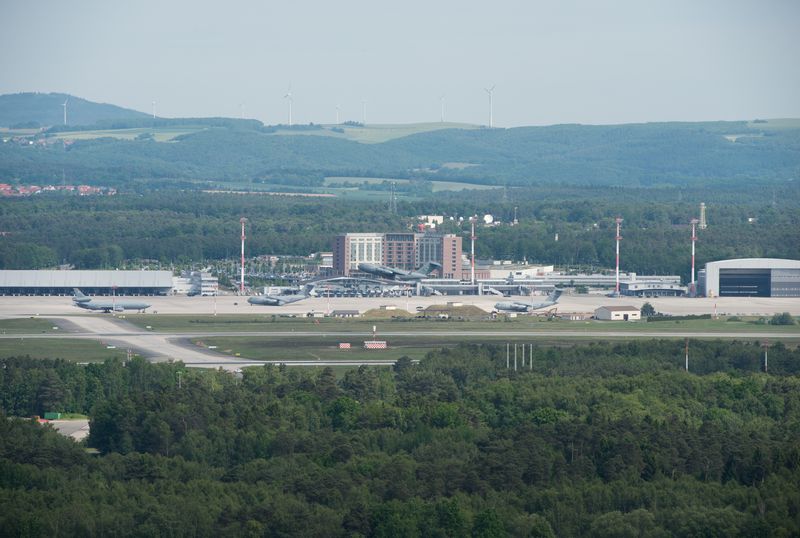
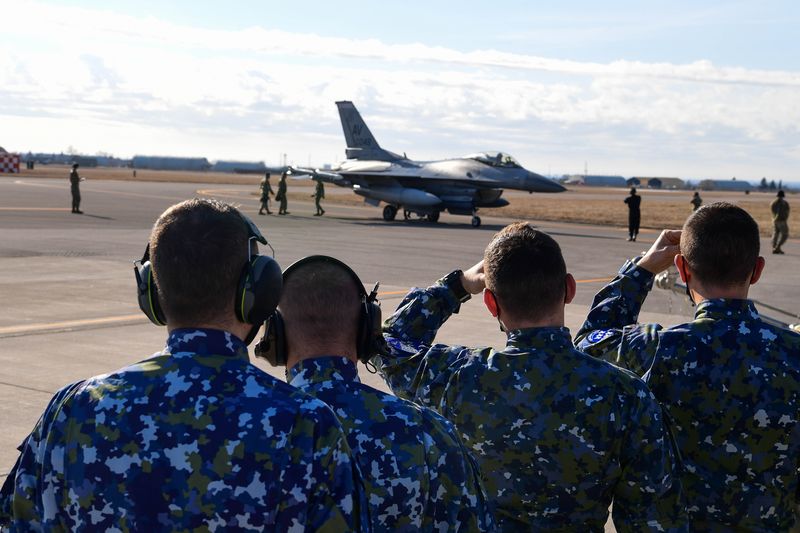
The American presence in Europe was built for a different war, but it is the load-bearing structure of any campaign in the Middle East. Ramstein in Germany is the largest US Air Force installation outside the United States: headquarters of US Air Forces in Europe, the hub through which American personnel and cargo flow toward the Middle East, a relay for theatre communications. Aviano in Italy hosts the 31st Fighter Wing’s F-16s, among the closest US combat aircraft to Iran on allied rather than American soil. Souda Bay, Rota, Lakenheath, Incirlik — the Hamshahri map’s nine countries are not random pins; they are the refuelling stops, tanker bridges and launch points that make sustained American airpower over Iran possible at scale. Tehran cannot reach the bombers’ home bases in the continental United States. It is telling the countries it might reach that their real estate is the next best target — and that the lease now carries a risk it did not carry last year.
The real audience may be European voters, not American generals
A threat does not have to be executable in full to work. Tehran’s message creates a domestic problem inside every host country: the moment American aircraft stage through Ramstein or Aviano for a strike on Iran, opposition parties and publics in Germany and Italy will ask whether their government has imported a war onto their own soil — and Tehran has supplied the headline in advance. That pressure is the actual payload of statements like Ardestani’s. It aims to make European governments hesitate, qualify, or quietly restrict the use of their bases before the first American takeoff, shrinking Washington’s options without Iran firing a shot. Khamenei’s publicised update of the IRGC’s “target bank” does the same work from the military side: a target bank is a planning artefact, and advertising its expansion costs Tehran nothing while forcing nine European defence ministries to spend money and attention on the possibility.
The capability question: can Iranian missiles actually reach Europe?
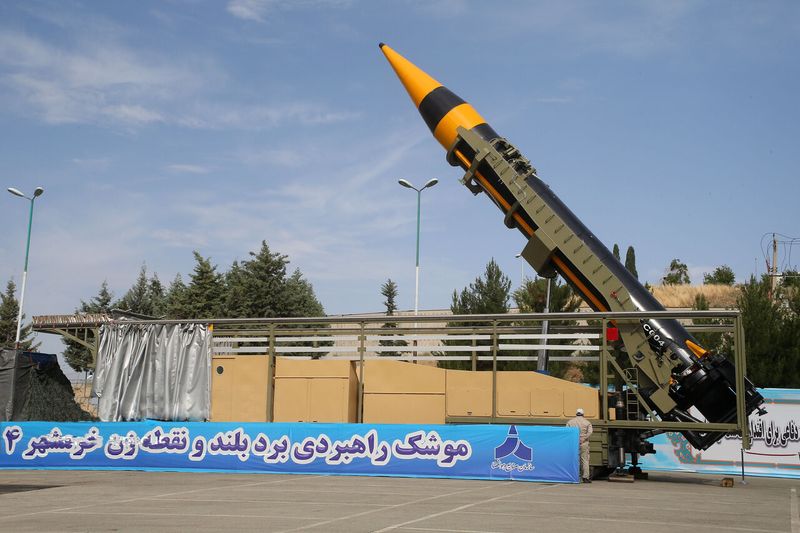
Here the numbers deserve cold treatment, because the gap between the threat and the declared arsenal is the most important fact in the story. Ramstein lies roughly 3,100 kilometres from Iran’s northwestern border; Aviano is farther, around 3,300 kilometres. Iran has for years publicly capped its ballistic missile ranges at about 2,000 kilometres — a limit officials describe as deliberate policy — and its longest-declared systems, including the Khorramshahr-4 (Kheibar) unveiled in 2023, are credited with ranges at or near that figure. On declared numbers, Tehran’s missiles cannot reach Germany or Italy. They can reach or approach the nearer pins on Hamshahri’s map: Cyprus and the British base areas there, Greece, and parts of the Balkans sit at or inside the outer edge of the 2,000-kilometre envelope from launch sites in western Iran.
Two claims complicate the arithmetic. In March, the British government said Iran had launched two missiles at Diego Garcia, the US-UK base in the Indian Ocean some 3,800 kilometres from Iran — a shot that, if accurately described, would imply a missile of roughly double the declared range. Iran denies the Diego Garcia account. Western analysts also note that range is a choice as much as a limit: the same missile flies farther with a lighter warhead, and a state with satellite launch vehicles holds much of the technology an intermediate-range missile requires. The honest summary is that Iran’s ability to strike central Europe today is unproven and doubted by many specialists, while its ability to threaten the Mediterranean’s eastern rim is not in serious doubt. A deterrent does not need to be believed in full to be effective — only believed in part, by nervous governments, on behalf of publics who will not be reading range tables.
Who gains, who pays
Tehran gains leverage at zero immediate cost. The statements cannot be disproven, and every hour European officials spend answering them is friction inserted between Washington and its hosts; if even one host attaches quiet conditions to base use in a future crisis, the campaign Tehran fears becomes slower, smaller, or dearer for the United States. European governments pay twice: in missile defence — the expensive arithmetic of Patriots and SAMP/T now argued over in nine capitals — and in political exposure, as the German-embassy banner signals Tehran intends to campaign on the issue publicly. Washington pays in freedom of action: infrastructure that made American power projection routine becomes a set of permissions to renegotiate under pressure. The clearest losers, were the rhetoric to harden into doctrine, would be the smaller hosts on the map’s near edge — Cyprus, Greece, Albania, Romania — closest to Iran’s proven range, with the thinnest defences. European publics, meanwhile, are learning that a distant war has been given a return address in their own postcode.
Background: two wars that stopped at the water’s edge
Tehran’s argument rests on a version of the last two rounds that European governments dispute but cannot ignore. In the previous phases of this confrontation, Iranian retaliation fell on American bases in Iraq and the Gulf, on Israel, and on shipping — while American and allied operations flowed through European infrastructure, visible in open-source flight tracking and acknowledged in allied statements. From Tehran’s podium, that makes Europe a participant enjoying immunity: the bases refuelled and relayed, but the return fire stopped at the Mediterranean’s eastern shore. Ardestani’s claim — that European countries had “already been at war with Iran” by hosting — is the foundation of the new threat: if hosting is belligerency, striking the host becomes, in Tehran’s telling, retaliation rather than aggression. European governments reject that framing; the law of armed conflict generally requires a state’s own direct participation in hostilities, not the treaty presence of allied forces, before its territory becomes a lawful target. The disagreement is genuine, unresolved, and now stated openly by both sides.
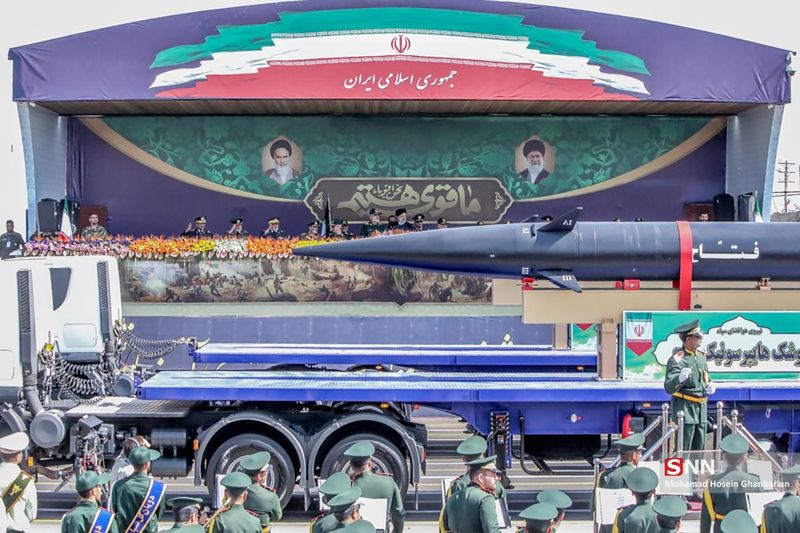
The timing is part of the message. The IRGC chose November 4 — the embassy-seizure anniversary, the most symbolically loaded date in the US-Iran calendar — to promise a response “without geographical limits,” and the remarks arrive as the region braces for possible renewed American strikes on Iran’s nuclear programme: Iraq, as Signal Post News reported this week, has activated nuclear emergency plans and radiation monitoring along its Iranian border in anticipation of exactly that scenario. The arc is symmetrical. Washington’s threatened target set has expanded — Natanz, Fordow, Pickaxe Mountain — and Tehran’s threatened response set is expanding to match: from the Gulf, to Israel, to the Strait of Hormuz, and now, on paper, to Europe. Each side is trying to make the other’s next step look more expensive than it did last month.
What happens next
Three scenarios cover most of the plausible futures. In the first, and most likely, the threat remains what it is today: stated doctrine with no triggering event. No American strike from European bases occurs, ministries file the statements as deterrent rhetoric, and the residue is bureaucratic — updated base-defence plans, air-defence batteries quietly repositioned, sharper parliamentary questions in Berlin and Rome. In the second, the United States does strike Iran, and the campaign’s geometry becomes the story: a package flown from the continental US, carriers and Gulf bases would test Tehran’s condition literally, while any visible use of Ramstein or Aviano would dare Tehran to make good on Ardestani’s sentence — and Tehran would face its own trap, choosing between its threat’s credibility and the certainty of NATO’s response to a strike on alliance soil. In the third, the pressure works in advance: European governments, publicly committed to the alliance and privately alarmed, attach conditions, demand consultation, or decline particular uses of their bases — the outcome Tehran’s messaging was built to buy, achieved without a missile leaving its launcher.
The tells are specific. Whether Berlin and Rome answer Euronews’ unanswered questions with public rejections of Tehran’s premise, or with silence. Whether missile-defence assets move toward the Mediterranean’s northern shore. Whether Iran flight-tests anything demonstrating range beyond its declared cap — the one act that would convert this week’s rhetoric into a capability argument. And whether “target bank” language recurs in operational channels or fades with the anniversary. For now, the verified facts are narrower than the headlines they will generate: named Iranian officials have said, on the record, that European bases used against Iran would bring Iranian missiles toward Europe; the IRGC says its target list now ignores geography; and the missiles Iran admits to owning cannot reach the two countries its spokesman named first. A threat can be real, conditional and beyond present capability all at once. This one is all three — and Europe must decide, before any American aircraft asks permission to take off, how much of it to believe.
Sources
Euronews, November 4, 2026 — interview with Ahmad Bakhshayesh Ardestani of the Iranian parliament’s National Security Committee; Fada Hossein Maleki, same committee, on a prepared new scenario; the IRGC’s November 4 statement promising a response “without geographical limits” and citing Supreme Leader Mojtaba Khamenei’s target-bank order; Kayhan on targets extending to “the heart of Europe”; Hamshahri’s target map (UK, Germany, France, Italy, Greece, Romania, Albania, Portugal, Cyprus); former foreign minister Manouchehr Mottaki; the German-embassy banner quoting SNSC secretary Mohsen Rezaei; Euronews noted the Fars-reported warning to Germany could not be independently verified, and that the German embassy in Tehran and Germany’s foreign ministry were unreachable for comment. ANSA and Adnkronos, November 2026 — Italian coverage of the threat to Aviano and US installations in Italy. National Security Journal and The Times, November 2026 — capability context, including the British government’s March statement on Iranian missiles toward Diego Garcia (approximately 3,800 km), which Iran denies, and the roughly 3,100 km from northwestern Iran to Ramstein. Analysis: Ellie Geranmayeh, European Council on Foreign Relations. Related Signal Post News coverage: Iraq activates nuclear emergency plans and Iran-border radiation monitoring; Iran and the Strait of Hormuz. Photos: Wikimedia Commons, as credited in the captions.