Houthi missile strike Aden: a ballistic missile hit the Saudi-led coalition's military operation room at the Badr Camp in Aden on Wednesday, the Houthis' military spokesman said, in the third attack in a week on the seat of Yemen's internationally recognised government — with a second strike the same day on Al Rayyan airport in Mukalla.
World / Smoke rose near Aden's airport on Wednesday as the Houthis claimed a precise hit on a coalition operations room — and, hundreds of kilometres east, a second strike on a coalition base at Mukalla's airport.
Track it live: Middle East tracker — live map and latest developments · Live wars tracker
What happened in Aden
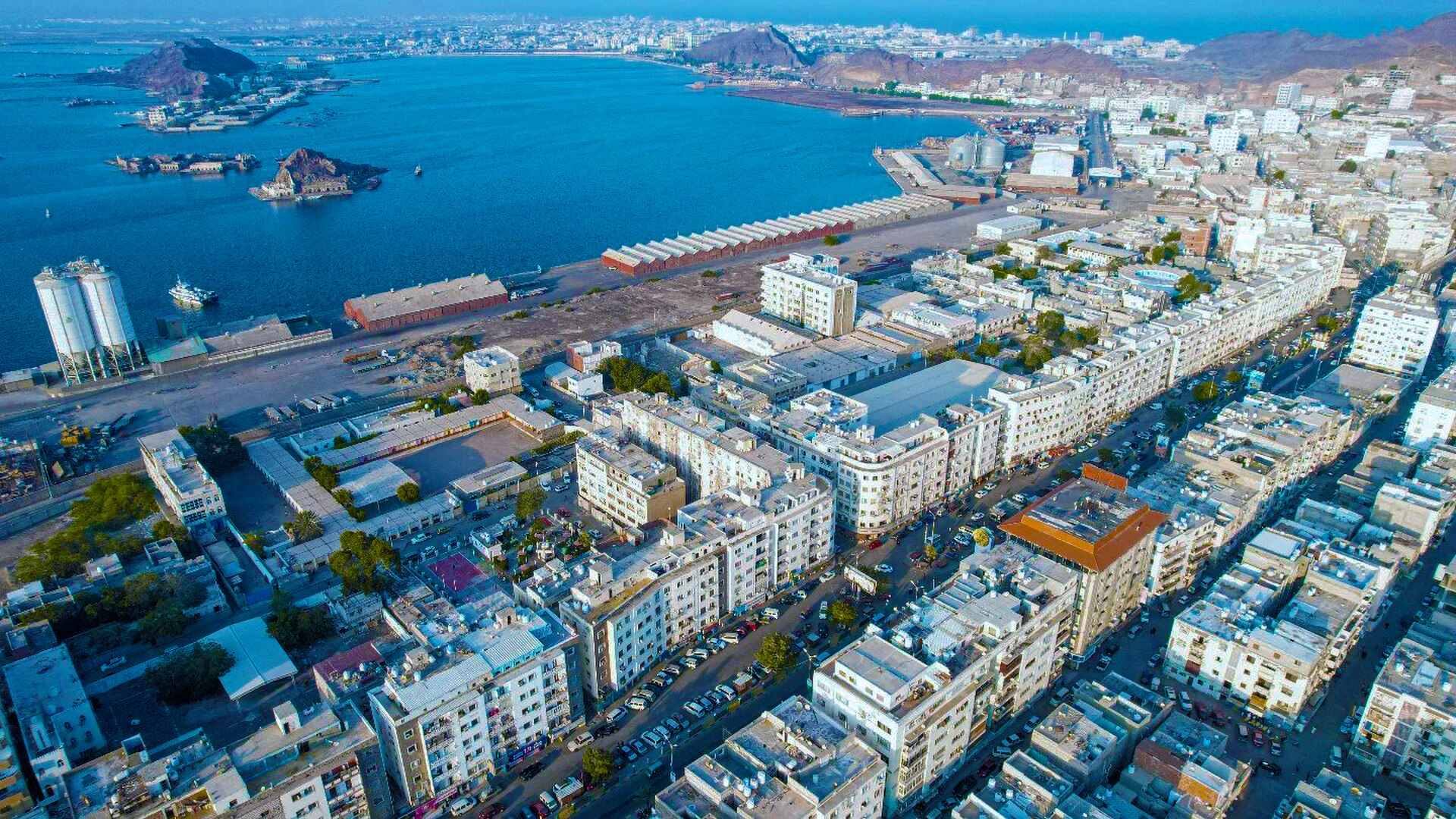
The first accounts of Wednesday's Aden strike were sensory before they were official: a powerful blast heard across the city and smoke rising near the international airport, reported by Al Jazeera's journalist in Aden and a police official there. That geography matters, and it needs to be stated carefully. The airport district of Aden is not only a civilian gateway; it sits beside military facilities used by the Saudi-led coalition that backs Yemen's internationally recognised government, which has its seat in Aden. The police official who spoke to AFP attributed the blast to a Houthi missile. Two further security sources in Aden told the agency the target was a coalition site near the airport. Those three Aden accounts — one named by role, all anonymous — describe where the explosion happened and who local officials believe fired it. They do not, on their own, describe what was hit.
For that, the available account is the Houthis' own. Yahya Saree, the group's military spokesman, said in a statement on Wednesday that Houthi forces had fired a ballistic missile at the coalition's "military operation room at the Badr Camp in Aden" and that "the strike was precise and direct." That is a claim by one of the parties to the war about its own operation, and it is reported here as exactly that: it has not been independently confirmed, and no coalition statement confirming or denying the Badr Camp account had been reported in the sources seen at publication. What can be said on the combined record is narrower and still significant: an explosion occurred near Aden airport on Wednesday; Aden security officials attributed it to a Houthi missile aimed at a coalition site; and the Houthis publicly claimed a ballistic-missile strike on a coalition operations room at Badr Camp, in terms specific enough to name the facility and the room inside it.
The second target: Al Rayyan airport, Mukalla
Wednesday's operation was not confined to Aden. In Mukalla, the Hadramout capital roughly 480 kilometres east of Aden along the Arabian Sea coast, two military officials told AFP that the Houthis used missiles and drones to target a military base housing Saudi-led coalition forces at Al Rayyan airport — spelled Riyan airport in Reuters' reporting. Saree's statement covered that strike too: he said the target was "military equipment transported by the Saudi enemy via military cargo planes to Al Rayyan airport." A Yemeni government military source and a local official separately told Reuters that the group had also attacked Riyan airport in Mukalla. As in Aden, no casualties or damage figures for the Mukalla strike were reported in the sources seen, and this report does not invent any.
The pairing of the two targets is itself part of the story. Aden and Mukalla are the two most important coastal cities of Yemen's south, both held by forces aligned with the internationally recognised government and its Saudi-led backers, and both served by airports that double as coalition logistics hubs. A strike package that reaches both on the same day is, whatever its physical effect, a demonstration of range and coordination: the Houthis are saying, in effect, that coalition facilities at either end of the southern coast are within reach on a single morning. Whether the strikes achieved the precise military effects Saree claimed is a different question, and on the evidence published so far it is unanswered.
The stated motive — an accusation, not an established fact
The Houthis framed Wednesday's strikes as a response to an alleged Saudi attack on fishermen. Middle East Eye reported that the strikes came after the Houthis accused Saudi Arabia of killing eight fishermen overnight; the Sanaa-based health ministry — the health authority run from the Houthi-held capital — said Saudi Arabia had targeted boats off al-Kadha in the Taiz governorate and called it a flagrant violation of international humanitarian law. Reports aligned with the Sanaa authorities — Press TV and Hodhod Yemen News, citing the health ministry and a local official — placed the boats off al-Kadha in the Dhubab district, near Bab el-Mandeb, and described two strikes on Tuesday: the first on an anchored fishing boat, the second on survivors escaping in another boat. Yemen's agriculture and fisheries ministry rejected the coalition's allegation that traditional boats were being used to smuggle weapons — an allegation coalition spokesman Turki al-Maliki had supported a day earlier by releasing footage of strikes on vessels he said were smuggling weapons. Press TV noted that the coalition had issued no statement on Tuesday's fishermen killings at the time of its report. That claim is carried here only as what it is: an accusation by the Houthi movement and its Sanaa health ministry, offered as their stated reason for the day's strikes. It is not independently confirmed, and no independent reporting verifying the deaths of eight fishermen off al-Kadha had been published in those sources. Readers should hold the two halves of Wednesday's story at different levels of confidence: the blasts in Aden and the reported attack in Mukalla rest on local officials, journalists on the ground and the Houthis' own public claim; the fishermen killings rest, so far, on the word of one side.
Not the first strike on this target — the third attack on Aden in a week
Wednesday's blast was not the first time this target set has been hit, and it should not be read as one. AFP framed Wednesday's attack as the third attack in a week on Aden. Only five days earlier, on October 16, Aden's airport area was attacked and a Houthi source said the intended target then was not the civilian airport but an adjacent military site at Badr Camp, described on that occasion as a command headquarters and weapons depot for Saudi-led forces — the same Badr Camp that Saree named again on Wednesday. Read our earlier coverage of the October 16 Aden airport attack and the Yanbu intercept for how that strike was reported at the time. The repetition is the point: the same camp, beside the same airport, claimed by the same spokesman, twice in six days. A single strike can be written off as a gesture; a second strike on the identical facility, inside a week that AFP counts as containing three attacks on the city, reads as a campaign against a specific node of the coalition's presence in the south — and as a test of whether anything about the site's defences changed after the first hit.
Wednesday also produced a contrast worth keeping separate rather than merging. Earlier the same day, the Saudi-led coalition said it had intercepted drones over Medina and Saudi Arabia's Eastern Province, inside the kingdom — and Saree denied launching any drones toward Saudi Arabia. Hours later, the same spokesman was claiming strikes inside Yemen, at Aden and Mukalla, in the group's own name. Those are two different claim sets about two different geographies: a denial regarding Saudi territory, and an open claim regarding coalition targets in Yemen. Reporting them together is accurate only if the distinction is kept: the Houthis on Wednesday simultaneously rejected one set of attacks attributed to them and advertised another.
Why this matters
A missile that lands near an airport in a government's seat, for the third time in a week, matters even before anyone counts damage — because of what it says about the war's trajectory. Yemen's Saudi–Houthi front had been comparatively quiet since the UN-brokered truce of 2022, which formally lapsed but largely held in practice along that axis even as other Yemeni conflicts continued. That relative calm has now ended in earnest. The renewed fighting of recent weeks — a missile attack on a government security training camp in Shabwa province on Monday and Tuesday that Reuters and AP reported killed 73 people, covered in our report on the Shabwa military camp attack — has been followed within days by strikes on the government's own capital and on the main coalition base in Hadramout. The sequence is an escalation ladder being climbed in public: a mass-casualty strike on a training camp, then repeated strikes on the capital's military infrastructure, then a two-city operation reaching the far east of the country.
There is a second layer. Both Wednesday targets sit beside civilian airports. Aden International and Al Rayyan are not abstractions to the people who use them: they are among the few functioning air links for a country where commercial aviation has been strangled by a decade of war, and Al Rayyan only resumed regular flights in recent years after long closures. Every strike near a runway — whatever military facility it is said to aim at — prices risk into those airports again, for airlines, insurers and passengers, and tightens the isolation of the south. The Houthi framing, offered through the Badr Camp and cargo-plane claims, is that their fire is aimed exclusively at the coalition's military infrastructure. The Aden government's implicit framing, through its security sources, is that a missile arriving beside a civilian airport is an attack on the city it governs. Both framings are present in the record; the physical fact underneath them — explosions near two airports on one morning — is not in dispute.

Background: a truce that faded, a south under pressure
To understand Wednesday, start with the map. Yemen's internationally recognised government, backed by the Saudi-led coalition, holds the south and east, including Aden and Hadramout. The Houthis hold Sanaa and much of the north-west, including the Red Sea coast. The 2022 truce between the Houthis and the Saudi-led side froze the biggest front of the war without settling it; for several years the Saudi–Houthi axis was the quietest part of a country that was never at peace. That arrangement has been unravelling through 2026, and the past week is its sharpest break yet: first the Shabwa camp attack with its toll of 73 reported by Reuters and AP, then Wednesday's paired strikes.
The pressure is not only military. Taiz, the governorate in whose waters the alleged fishermen killings were said to have occurred, remains under Houthi encirclement, and the United Nations said on October 20 that fighting had closed the Aden supply route into the city — the road on which hundreds of thousands of people depend, as our report on fighting cutting off aid to 800,000 people in Yemen sets out. That is the humanitarian ledger running underneath the missile exchange: every week the renewed war continues, the encircled city at its centre gets harder to feed, and the ports and airports being struck are the same infrastructure any relief effort would need.
Who gains, who loses
On their own account, the Houthis gain a demonstration: they reached the government's capital and its eastern stronghold on the same day, named their targets, and attached the operation to a grievance — the fishermen — framed in the language of international humanitarian law. Whether the strikes destroyed an operations room or military cargo is unverified; the publicity of the claim was achieved regardless. The coalition and the Aden government lose on the same ledger: a third attack in a week on the capital they are meant to defend invites an obvious question about air defence over Aden, and it arrives days after the Shabwa camp attack exposed a training facility to catastrophic loss. Saudi Arabia, for its part, faces a war it spent years trying to exit returning to its doorstep — Wednesday's drone interceptions over Medina and the Eastern Province, whatever their origin, underline that the kingdom's own airspace is again part of the daily story. Civilians in Aden, Mukalla and Taiz lose most concretely: they absorb the risk around the airports, the closure of the roads, and the possibility that a misjudged strike — by any side — turns a claimed military target into a mass-casualty event like Shabwa's.
What happens next
Three indicators will show where this goes. First, the coalition's answer: after Shabwa, and now after a third strike on Aden in a week, Riyadh and the Aden government must decide between retaliation against Houthi launch infrastructure — the path that historically widens this war — and a defensive crouch around the southern airports. Second, verification: if independent reporting confirms or refutes the fishermen claim off al-Kadha, the stated casus belli of Wednesday's operation becomes either a documented atrocity requiring a response of its own, or a pretext that collapses under scrutiny; until then it remains an accusation. Third, tempo. One strike is an incident; three attacks on Aden in a week, plus Shabwa, plus a same-day strike 480 kilometres away in Mukalla, is a rate of operations. If that rate holds, the question stops being whether the Saudi–Houthi calm of the truce years is over — Wednesday suggests it is — and becomes how far the renewed war spreads before any party looks for an exit. For continuing coverage, follow the Middle East tracker.
Sources
Reuters (October 21, 2026): Houthi-denial wire — a Yemeni government military source and a local official told Reuters the group also attacked Riyan airport in Mukalla; the same wire carried Saree's denial of drone launches toward Saudi Arabia. AFP (October 21, 2026, via the Pakistan TV live blog): a police official in Aden attributed the blast to a Houthi missile; two other Aden security sources said a coalition site near the airport was targeted; two military officials said missiles and drones targeted the coalition base at Al Rayyan airport, Mukalla; AFP framed the Aden strike as the third attack in a week on the city. Al Jazeera (October 21, 2026): a powerful blast heard in Aden and smoke rising near Aden International Airport, reported by its journalist on the ground and a police official. Middle East Eye (October 21, 2026): Saree's statement claiming the ballistic-missile strike on the coalition's military operation room at Badr Camp and the strike on military equipment at Al Rayyan airport, and reporting the Houthi accusation — via the Sanaa-based health ministry — that Saudi Arabia killed eight fishermen off al-Kadha, Taiz governorate. Casualty and damage figures for Wednesday's Aden and Mukalla strikes: none reported in these sources.