War · Middle East
On Monday the system that watches the Strait of Hormuz could say the words every shipping desk wants to hear: crew safe. On Tuesday, after the same disabled tanker was hit again at the same position off Khasab, it could say only that the crew are unaccounted for — UKMTO’s exact words — with a fire on board and the damage unknown.
OFF KHASAB, OMAN, November 17, 2026 — A Hormuz tanker struck twice in two days has left its crew unaccounted for, after a second strike on Tuesday set the already-disabled vessel ablaze seven nautical miles north of Khasab, Oman, the UK Maritime Trade Operations centre said. UKMTO first reported the tanker on Monday, disabled by an engine-room fire after an initial strike at the same position, with the crew at that time reported safe. In its Tuesday update, relaying information from a maritime security agency, UKMTO stated the position in full: “The crew are currently unaccounted for, and damage assessment is unknown at present.” No further information was immediately available. UKMTO urged vessels to transit the area with caution and to report suspicious activity, and said authorities are investigating. It named no vessel, no flag, no operator — and no attacker.
Track it live: Iran war tracker — https://signalpostnews.com/tracker/iran-war — carrier movements, Strait of Hormuz shipping and the wider U.S.–Iran confrontation as they develop; and the oil price forecast tracker — https://signalpostnews.com/tracker/oil-price-forecast — Brent, WTI and the market’s reading of the Hormuz risk.
What we know
- Monday, first strike: UKMTO received a third-party report of a tanker attacked about seven nautical miles (13 km) north of Khasab, on the Omani shore of the Strait of Hormuz. The vessel was disabled, a fire broke out in the engine room, and the crew were initially reported safe.
- Tuesday, second strike: in an update to the same advisory — UKMTO Warning 208-26 — UKMTO said it had received information from a maritime security agency that the tanker had sustained a second strike at the same position, which caused a fire on board. The crew are currently unaccounted for, and the damage assessment is unknown.
- What UKMTO did not say: the centre identified no vessel, flag or operator in either advisory, and said nothing about who carried out either strike. Authorities are investigating, and vessels have been urged to transit with caution and report suspicious activity.
- The crew’s status, stated exactly: unaccounted for. No outcome for the crew has been confirmed by UKMTO or by any other source in this reporting, and this article states none.
- The identity question: the Tuesday update amends the same warning number and the same position as Monday evening’s incident, which Monday reporting identified as the Panama-flagged LPG carrier Tara Gas — an identification carried with an official-confirmation caveat, set out in full below. Hull identity for the second strike is not confirmed.
Two strikes, one position
The sequence, as UKMTO’s advisories record it, is stark in its simplicity. On Monday, a tanker transiting the strait off Khasab was struck and disabled. The fire was in the engine room — the space whose loss takes away a ship’s propulsion and much of its power — and the first accounting, the one that matters most to the families ashore and to every other crew in the strait, was reassuring: the crew were reported safe. A disabled tanker with a safe crew is a salvage problem. It is serious, expensive and dangerous to navigation, but it sits within the range of outcomes the shipping industry knows how to handle: tugs are dispatched, a tow is rigged, the ship is taken somewhere she can be made safe and inspected.
On Tuesday, that accounting broke. The update to Warning 208-26 reported a second strike on the tanker, a fire on board, and a crew no longer accounted for. UKMTO’s wording deserves to be read as it was written, because in maritime reporting these formulations carry precise weight: “The crew are currently unaccounted for, and damage assessment is unknown at present.” Unaccounted for is not a euphemism, and it is not a conclusion. It is a statement about the state of knowledge: as of the update, the reporting chain that could confirm the crew safe on Monday could no longer confirm their whereabouts or condition on Tuesday. Everything beyond that sentence — every outcome readers may fear, and every outcome they may hope for — is, as of publication, unconfirmed.
Reuters, reporting the update on Tuesday, put the same facts in the same order: a tanker attacked for a second time north of Khasab, a fire on board, the extent of the damage unknown, and a crew unaccounted for after having initially been reported safe when the ship was first struck and disabled on Monday. Anadolu, in reporting carried by EuropeSays, traced the advisory chain the same way — a third-party report received by UKMTO on Monday, a vessel disabled with an engine-room fire and a crew reported safe, then the subsequent update recording the second strike. Two wire accounts and the primary advisory agree on the core of the story, and on nothing beyond it: no vessel name from UKMTO, no flag, no operator, no attribution, no damage assessment, no environmental assessment, and no confirmed outcome for the crew.
The name UKMTO has not given
Readers will encounter, in coverage of this incident, a ship’s name: Tara Gas. This article uses that name only inside the fencing that the reporting itself requires, and the fencing is this. UKMTO has not named the vessel in either the Monday advisory or the Tuesday update. What connects Tuesday’s update to Monday evening’s incident is documentary, not visual: the update amends the same UKMTO warning, 208-26, and gives the same position, seven nautical miles north of Khasab, as the incident reported on Monday evening. Position and warning continuity are facts of the advisory record.
Monday’s reporting went one step further. The maritime security firm Vanguard Tech identified the vessel disabled in Monday evening’s Khasab incident as the Panama-flagged LPG carrier Tara Gas, and India’s shipping minister, Sarbananda Sonowal, confirmed that her 25 crew — 24 of them Indian nationals — were safe after that first strike. That identification and that confirmation belong to Monday’s incident, and they were part of the verified wave this newsroom reported in Tankers Hit in the Strait of Hormuz as a Third U.S. Carrier Arrives. But Gulf Business, in its reporting of the identification, noted that the link between Tara Gas and either specific UKMTO advisory remained unconfirmed in official statements. That caveat travels with the name. It is therefore accurate to say that the tanker struck for a second time on Tuesday was struck at the same position, under the same warning number, as the ship Monday’s reporting identified as Tara Gas. It is not confirmed — by UKMTO or by any official statement in this reporting — that the twice-struck tanker is Tara Gas, and this article does not state it as fact.
The distinction is not pedantry, and Tuesday shows why. If the hull is confirmed in the coming hours or days, the accounting for a named crew of a named ship can proceed through an owner, a flag state and a government that has already spoken for them once. If it is not the same hull, then two ships have been struck at nearly the same position in two days, and the picture is different again. Precision about which of those is true has to wait for the institutions that can establish it. What can be said now is what the advisory record says, and it is said above.
Claims, counter-claims, and what is not established
Alongside UKMTO’s narrow update runs a far broader account, and the two must not be merged. The Islamic Revolutionary Guard Corps Navy has said that two vessels it described as “unauthorized” struck naval mines in the strait, triggering massive explosions and fires that left both ships immobilised — one of them a supertanker carrying more than two million barrels of crude, the other a liquefied gas carrier — and it claimed both vessels were sailing under the air cover of numerous U.S. fighter jets. That is a claim, reported here as a claim. It was unclear, in the reporting of it, whether the tanker in UKMTO’s advisories was one of the two vessels in the IRGC statement, and nothing in Tuesday’s verified reporting establishes that it was. The mine account, the air-cover account and any account of a sinking are not established facts of this incident, and none is stated as one here.
The same discipline applies to the claims moving fastest online. Assertions circulating on social media and in open-source channels about the weapon involved in the second strike — including claims of a drone or missile hit — are unconfirmed. UKMTO attributed neither strike to any actor or any weapon, and no verified imagery of the second strike has been released. Footage and stills purporting to show a burning tanker in the strait have circulated before in this crisis attached to incidents they did not depict; none is presented as verified in this article. The earlier pattern of unattributed fire reports in the strait, including the incident this newsroom covered in Ship Seen on Fire in the Strait of Hormuz as Iran Claims Three Tankers Hit Mines, is a reminder of how long the gap between a first alert and a verified account can run — and of why the gap should be reported as a gap.
Why a second strike on a disabled ship changes the risk
A ship lying disabled off Khasab is not merely a ship in trouble; she is a fixed point in one of the most closely watched waterways on earth, and everything that would normally happen next has a clock on it. Firefighting parties, salvage teams and tugs approach a burning tanker on timelines measured in hours, in daylight where possible, with the ship’s own crew — the people who know her valves, her boundaries and her cargo system — as the first and most important responders. A second strike collapses each of those assumptions at once. It interrupts whatever firefighting or abandonment sequence was under way, it endangers any rescue or salvage craft that had closed with the ship, and it converts the crew’s situation from a confirmed status into an open question at precisely the moment when reaching them becomes hardest.
For every other crew in the strait, the lesson travels instantly, and it does not need an official advisory to spread: a vessel that has survived a first hit can no longer assume that the incident is over. Masters plan transits around threat windows; a disabled ship has no transit left to plan. The practical consequences will show up first in the unglamorous machinery of the industry — in war-risk insurance pricing for Hormuz transits, in owners’ decisions about whether a damaged ship is towed out through the strait or held where she lies, in crewing agencies’ phones ringing in Manila, Mumbai and Odessa. The strait carries about a fifth of the world’s petroleum and liquefied natural gas shipments. Its cargoes can be rerouted, delayed or priced around. Its crews cannot be abstracted in the same way, and Tuesday’s advisory is, at bottom, about a specific group of seafarers whose status nobody in the reporting chain could confirm.
The wider board: carriers, a stalled memorandum, and a long count
Tuesday’s update landed in a theatre that was already at its most charged pitch of the autumn. Monday’s verified wave — the supertanker Al Dhannah hit in her steering gear room on Sunday, the tanker On Phoenix struck on Monday morning with her crew accounted for, and the Monday-evening Khasab incident itself — coincided with U.S. Central Command’s confirmation that a third U.S. carrier strike group, built around USS Theodore Roosevelt, has arrived in the region. That full account is Monday’s story, told in the companion report linked above, and it is not re-reported here as new. What Tuesday adds to it is a change in kind: the wave that produced damaged ships and accounted-for crews has now produced an accounting failure, and it has done so within sight of the largest concentration of American naval air power in the region during this confrontation.
The diplomatic frame is no steadier. Washington and Tehran signed a memorandum of understanding in June whose implementation stalled over freedom-of-navigation guarantees for Hormuz, and hostilities have periodically resumed since July. A second strike on a disabled merchant ship, whoever carried it out — and attribution, again, is not established — is the kind of event that tests such paper from both directions at once: it pressures Washington to demonstrate that its naval concentration can protect shipping, and it pressures every capital involved in the stalled implementation to decide whether the memorandum still describes a reachable outcome. The International Maritime Organization’s running count gives the backdrop its scale: 136 security incidents involving vessels in the Strait of Hormuz and the wider Middle East recorded between March 1 and November 11. Tuesday’s second strike is one more entry in that ledger, and the first in this wave in which the crew column cannot be filled in.
The market, and the number that has not moved
There is no verified Tuesday oil price in this reporting, and this article invents none. The last verified market figure in this newsroom’s coverage is Monday’s settlement: Brent crude closed $3.40 lower at $92.44 a barrel on Monday, falling on a day when three tankers were hit and a third carrier arrived — a verdict that priced diplomacy and comfortable supply above the weekend’s violence. Whether Tuesday’s news re-prices that judgement is a question the market will answer in its own time and on its own record. What can be said is what would move it: not the second strike alone, which the market has shown it can absorb, but the confirmations that have not yet arrived — the crew’s status, a damage and environmental assessment (none has been published), any change to UKMTO or Joint Maritime Information Center routing guidance, and any evidence that the pattern has shifted from striking ships under way to striking them again where they lie disabled.
What happens next
Three scenarios now branch from the same unanswered question, and they lead to very different weeks. In the first, the crew are located safe — taken off by a rescue craft, ashore in Oman, or sheltering in a part of their own ship that the reporting chain simply could not reach on Tuesday — and the incident closes as the most alarming near-miss of the wave: a warning, absorbed by insurers and routing desks, about what a second strike means. In the second, the accounting ends without that reassurance, and the wave acquires the human fact it has so far not had in verified form; the diplomatic and military consequences of that outcome, with three carrier groups in the region and a stalled memorandum on the table, would not stay inside the shipping pages. In the third — the scenario the industry may find hardest to price — the ambiguity itself persists: no confirmation either way for days, a ship still burning or drifting off Khasab, and every master in the strait asked to sail past an unanswered question.
What is settled tonight is narrower, and it is enough. A tanker was disabled off Khasab on Monday and her crew were reported safe. She was struck again on Tuesday, at the same position, under the same UKMTO warning, and caught fire. Her crew are unaccounted for; the damage is unknown; no vessel has been named by the authority reporting the strikes; no attacker has been identified by it; and no outcome for the crew has been confirmed by anyone. Signal Post News will update this story when UKMTO, the vessel’s flag state or operator, or the authorities investigating say more — and not before the facts allow the sentence the whole strait is waiting to read.
Sources
- Reuters, November 17, 2026 — “Crew of tanker unaccounted after second attack north of Oman’s Khasab, UKMTO says”: the crew of a tanker passing through the Strait of Hormuz unaccounted for after the vessel was attacked for a second time seven nautical miles north of Khasab, Oman; the second strike caused a fire on board and the extent of the damage is unknown; UKMTO initially reported the crew safe after the tanker was first struck on Monday, despite the vessel being disabled after a fire broke out in the engine room; no further information was immediately available.
- Anadolu Agency via EuropeSays, November 17, 2026 (Mohammad Sio) — EuropeSays report of the UKMTO update: UKMTO first received a third-party report of a tanker attacked about seven nautical miles north of Khasab, disabling the vessel, with an engine-room fire and the crew initially reported safe; in a subsequent update, information from a maritime security agency that the tanker had sustained a second strike causing a fire on board, with UKMTO stating verbatim, “The crew are currently unaccounted for, and damage assessment is unknown at present”; UKMTO urged vessels to transit with caution and report suspicious activity, authorities are investigating, and UKMTO did not identify the tanker, its flag or operator, or say who was responsible; the same report carried the IRGC Navy’s mine claim as a claim, noting it was unclear whether the UKMTO tanker was one of the two vessels in that statement.
- UK Maritime Trade Operations (UKMTO), Warning 208-26, as relayed by DefconAlerts, November 17, 2026, 11:05 UTC — “Second tanker strike north of Khasab”: the Tuesday update amends UKMTO Warning 208-26, the same warning number as Monday’s Khasab incident (third-party report, tanker disabled, engine-room fire, crew reported safe at that time); Warning 207-26 was Monday’s separate outbound projectile strike.
- Gulf Business, November 2026 — “India identifies Tara Gas as tanker targeted in Strait of Hormuz”: Monday reporting’s identification of the vessel in Monday evening’s Khasab incident as the Panama-flagged LPG carrier Tara Gas (Vanguard Tech identification; India’s shipping minister Sarbananda Sonowal confirming 25 crew safe, 24 of them Indian nationals) — and the caveat that the link between Tara Gas and either specific UKMTO advisory remained unconfirmed in official statements. UKMTO has not named the vessel in either advisory.
- Signal Post News, related coverage: Tankers Hit in the Strait of Hormuz as a Third U.S. Carrier Arrives (Monday’s verified wave and the third carrier’s arrival — background to this story, not re-reported as new); Ship Seen on Fire in the Strait of Hormuz as Iran Claims Three Tankers Hit Mines. Market figure: Brent crude settled $3.40 lower at $92.44 a barrel on Monday, November 16, 2026, as compiled in this newsroom’s Monday coverage — the last verified settlement figure; no Tuesday price is stated in this article. IMO figure: 136 maritime security incidents recorded in and around the strait from March 1 to November 11, 2026.
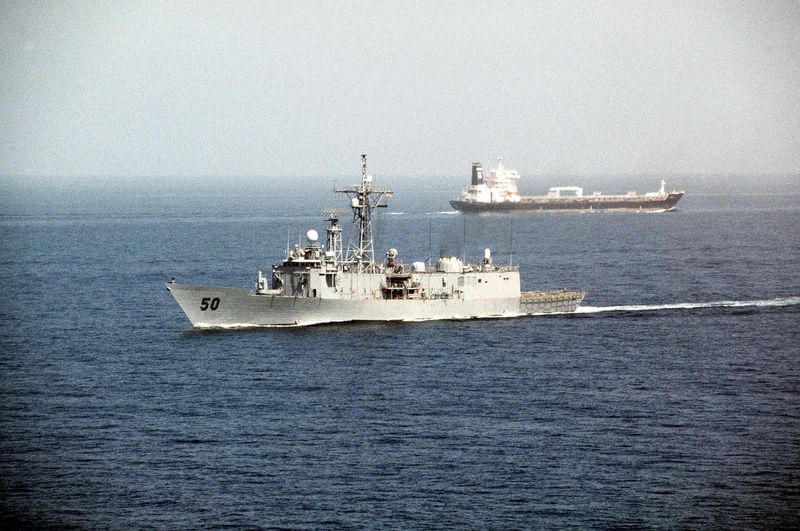
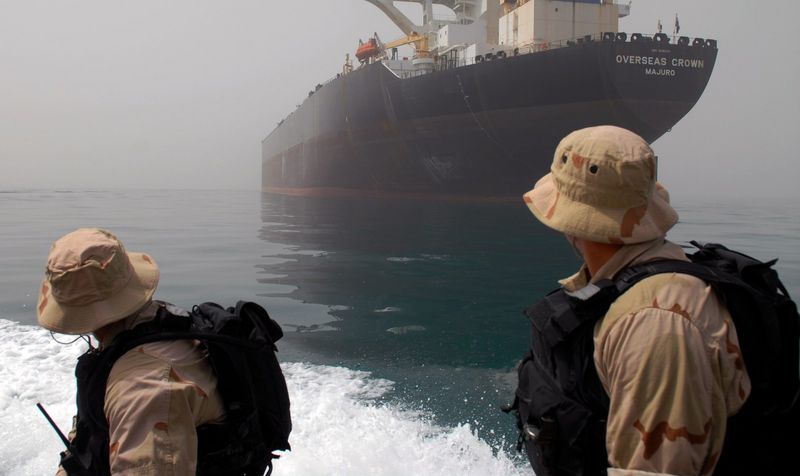
- Photos: the guided missile frigate USS Taylor (FFG-50) passing a tanker after transiting the Strait of Hormuz, U.S. Department of Defense photograph via Wikimedia Commons (public domain); U.S. Navy visit, board, search and seizure team members approaching the oil tanker Overseas Crown in the Persian Gulf, June 3, 2007, U.S. Navy photograph via Wikimedia Commons (public domain) — each credited in its caption. Both are file photographs; neither depicts the vessel struck off Khasab on November 16–17, 2026, whose identity UKMTO has not released, and no verified imagery of the second strike has been released.