World · France · Europe · Protests
A third weekend of living-cost protests meets the largest security deployment of the crisis so far: some 70,000 officers on the streets, a Paris march banished from the centre, two famous squares sealed overnight and curfews for minors — all of it falling on the one night of the year when half the crowd is wearing a mask.
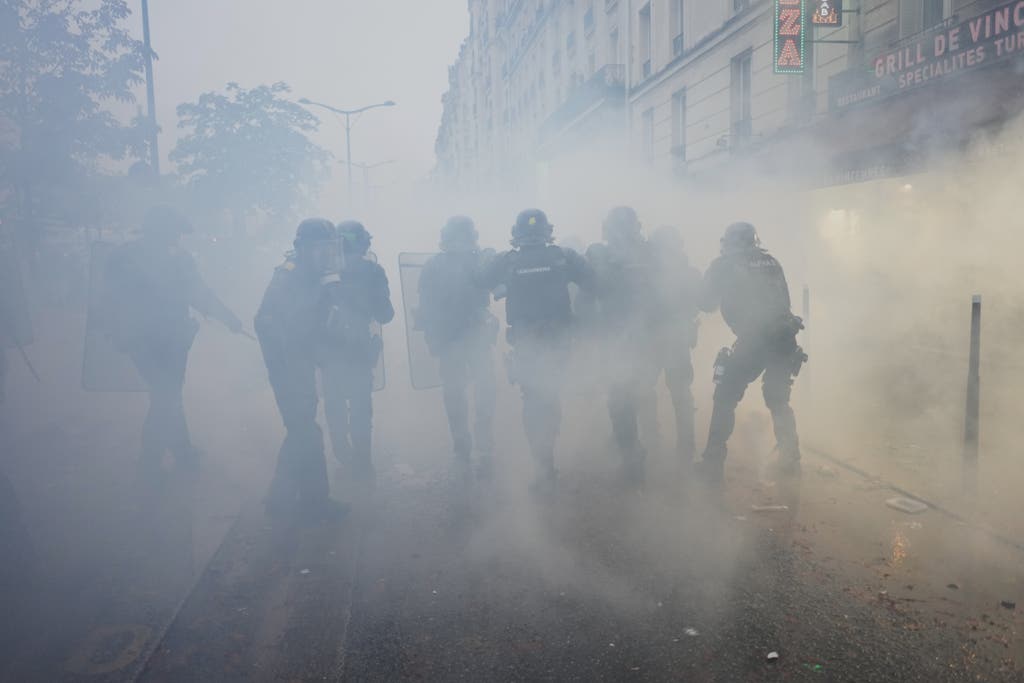
France protests in October 2026 reached their most heavily policed day yet on Saturday, as the government deployed about 70,000 police officers and gendarmes across the country for a third consecutive weekend of demonstrations over living costs, public services and education — a show of force timed, unavoidably, to Halloween. The interior ministry counted about 150 gatherings planned nationwide, according to Reuters, and the largest of them, in Paris, was not allowed anywhere near the streets where the previous two weekends turned violent.
Paris police banned the trade-union and Yellow Vest marches from the city centre altogether. The one authorised route in the capital runs along the outer boulevards, from Porte de Bagnolet in the east to Porte de Charenton in the south-east — a long, wide, easily sealed corridor about as far from the symbolic heart of the city as a Paris march can be while still being in Paris. On Saturday morning, France’s top administrative court, the Council of State, confirmed that the planned central march from Place de la République to the Bastille would be banned, rejecting a legal challenge brought by unions, Reuters reported in its updated account of the day.
Interior Minister Laurent Nuñez set the tone before a single placard was raised. He warned of a “very high risk” of unrest, especially after dark, promised an “extremely firm response” to any disorder, and said simply: “Everyone is on deck.” He also pointed to the calendar. Halloween masks, the minister noted, can be used to conceal identities, and face coverings can be banned in France wherever public order is judged to be at risk — a warning aimed as much at costume shops as at rioters.
The restrictions tighten further after nightfall. Police have barred entry to Place de la République and the Les Halles district — both scenes of rioting and looting on October 17 — from 11pm until 6am on Saturday and Sunday nights. Around the Champs-Élysées, unaccompanied minors face a 9pm curfew. The legal ground under that measure is contested: a Paris court ruled on Wednesday that an earlier curfew for minors was an unlawful restriction on movement and suspended it, the Associated Press reported. The US Embassy in Paris, meanwhile, advised travellers to avoid demonstration areas altogether.
Why this matters
Analysis: Saturday is not really about Saturday. It is about whether a minority government with almost no fiscal room, facing a protest movement it has already tried and failed to buy off with promises, can hold the line through a third weekend without either a televised disaster or a concession large enough to reset the crisis. Every element of the day’s choreography — the 70,000 officers, the exiled march route, the sealed squares, the curfews — is designed to prevent a repeat of October 17, when looters ransacked hundreds of shops on the capital’s grand boulevards. But each element also carries a cost the government will pay later, in courtrooms, in parliament and, ultimately, at the ballot box in April.
The movement France is confronting is broader than the ones it has faced before. It began in September with high-school students furious about dilapidated buildings, overcrowded classrooms and a university admissions system they regard as rigged. It was then joined by the trade unions, with their organisation and strike funds, and by a re-emergent Yellow Vest movement carrying the older, wider grievance about the cost of living. That coalition — teenagers, union members and the peri-urban working poor — is unusually hard to negotiate with, because it has no single leadership, no single demand and no single price. Promises to reform education and ease fuel costs, offered after the first weekend, have failed to calm it. Saturday will show whether force, or the credible threat of it, does any better.
France 70,000 police protests: the deployment in numbers
The scale of the France 70000 police protests operation deserves a moment of its own. Alongside the regular police and gendarmerie, the deployment includes specialist intervention units, drones, helicopters and dog units, backed by 26 armoured vehicles and 15 water cannon, according to LaPresse reporting of the French security plan. That is not crowd management in the ordinary French sense — and France manages crowds roughly. It is closer to the posture a state adopts when it expects, somewhere in the country, to lose control of a street and intends to take it back quickly. The government’s calculation is that visible overmatch deters the marginal rioter. The risk is that it also photographs badly, recruits for the movement, and leaves officers exhausted at the start of a month that may contain several more weekends like this one.
How France got here: budgets, schools and an old yellow ghost
The immediate trigger was money — or, more precisely, the absence of it. The protests gathered pace in late September as President Emmanuel Macron’s minority government opened talks on the 2027 budget with public debt approaching 120 percent of GDP and borrowing costs climbing. Every actor in French politics understands what those numbers mean: there is no large cheque available to end this crisis the way previous crises were ended, because the state’s room to borrow its way out has narrowed to something close to nothing.
The spark, though, was schools. Students walked out over buildings they describe as falling apart, classes too crowded to learn in, and an admissions lottery that decides futures on terms many families consider arbitrary. Signal Post News examined that tinderbox in its explainer on the France schools crisis and why students are striking. What turned a schools revolt into a national movement was the arrival of everyone else: unions scenting a weak government, and Yellow Vests recognising their own 2018 grievances — fuel, prices, dignity, distance from Paris — in a new generation’s anger. The France cost of living protests of 2026 are, in that sense, two movements sharing one street.
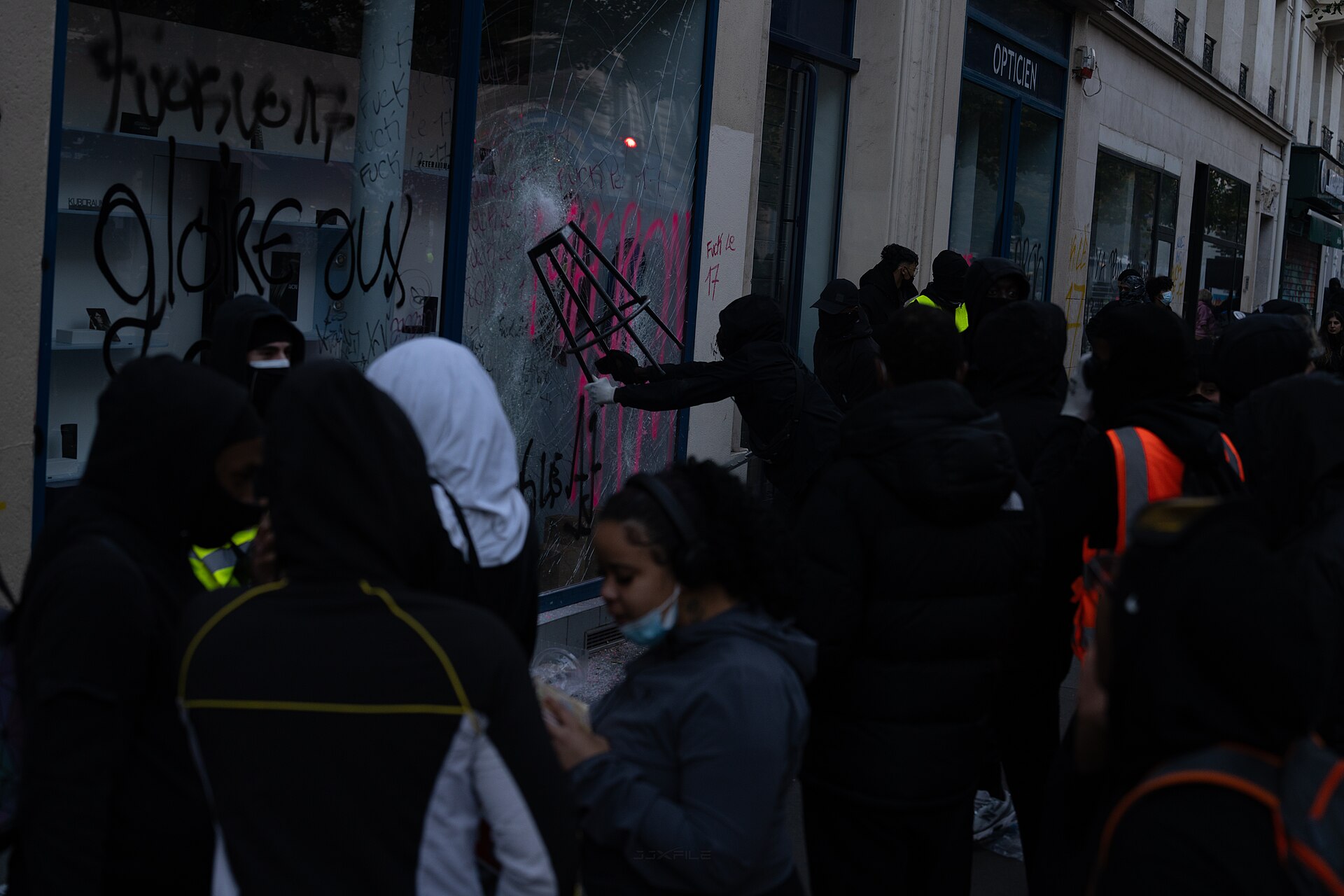
The numbers from the first two weekends explain the government’s nerves. On October 17, authorities counted about 550,000 marchers nationwide; the day’s peaceful majority was overshadowed by rioters who looted hundreds of shops, including Hermès, Louis Vuitton and Burberry outlets on Paris’s shopping boulevards. On October 24, about 410,000 people marched. That day was largely peaceful — and still produced more than 1,300 arrests, according to AP. A movement that can put half a million people on the street, twice, while its fringes loot luxury flagships, is not a news cycle. It is a governing condition.
It is also, crucially, young. In Nogent-sur-Marne, east of Paris, 15-year-old Aaron Berthier de Grandry was preparing to join his third consecutive weekend of protests — a schoolboy who has become, in a fortnight, a veteran. Reuters recorded what he said, and it is worth quoting in full because it captures the movement’s self-image better than any ministerial briefing: “When I was little, I was told young people were the future... if we, as the future of France, lack resources, that means France will end up collapsing.” Governments can out-poll, out-last or out-police many movements. One that speaks in the name of the country’s future — and means school buildings when it says so — is a harder argument to win.
The security gamble: protection, provocation and the price of a riot
The Paris protest march banned from the centre is the day’s most consequential decision, and its most debatable one. The official logic is straightforward: République and the Bastille corridor are where October 17 went wrong, wide ceremonial avenues flanked by exactly the shops that were looted. The Paris Bagnolet Charenton march route, by contrast, keeps demonstrators on the outer boulevards, away from the luxury retail streets and the seats of power. The Council of State’s decision on Saturday — upholding the ban against the unions’ challenge — gives that logic legal cover, at least for today.
The counter-argument, made by unions and civil-liberties lawyers, is that a march nobody can see is a right exercised in a soundproof room, and that pushing tens of thousands of angry people to the city’s edge does not abolish confrontation — it relocates it to neighbourhoods with fewer cameras and the same number of grievances. There is a harder version of the critique, too: that the ban teaches the movement’s moderate majority that lawful protest is futile, which is precisely the lesson its radical fringe wants taught. Both readings are honestly available before the fact. Which one Saturday validates will depend on decisions taken tonight by people in masks and people in helmets, in that order.
Laurent Nunez ‘very high risk’ warning and the 10,000-euro law
The Laurent Nunez very high risk warning sits atop a legal offensive that extends well beyond one weekend. The government is pushing a controversial law that would make rioters liable to pay up to 10,000 euros — about $11,000 — for damage caused not only by themselves but by groups they are deemed to be part of, Reuters reported. Ministers present it as elementary fairness: those who smash should pay. Rights groups and a number of lawyers respond that collective liability for damage caused by others risks punishing presence rather than conduct, and that its real target is the willingness of ordinary people to march at all. The curfew fight points the same way. When a Paris court suspends a minors’ curfew on Wednesday as an unlawful restriction on movement, and a version of it is back in force around the Champs-Élysées by Saturday, the argument is no longer only about public order. It is about how much liberty a frightened republic may lawfully subtract, and who checks the subtraction.
The economics: a shrinking economy meets an unaffordable argument
On Friday, the statistics office delivered the backdrop in a single line: France’s economy shrank in the third quarter. Signal Post News reported the figures and the returning recession risk in its coverage of France’s third-quarter contraction. Put the quarter’s numbers beside the autumn’s other numbers and the government’s trap becomes visible. Debt approaching 120 percent of GDP limits what it can concede. A shrinking economy limits what it can tax. And the protests themselves are now a line item: the Chamber of Commerce estimates that retailer losses from the unrest already exceed 1 billion euros — roughly $1.1 billion — while other estimates run to twice that once uninsured damage and lost revenue are counted, according to Reuters.
Analysis: weigh those figures honestly and an uncomfortable comparison emerges. A serious package on school repairs, class sizes and fuel costs would run to several billion euros the treasury does not obviously have — but the disorder is already consuming billions in damage, lost trade, overtime and deterrence, while corroding the business confidence a shrinking economy can least afford to lose. The government’s position is not that concessions are wrong; it is that they are unaffordable and would not work, because a movement this diffuse cannot sign a receipt. The movement’s answer is that a state which can find 70,000 officers for a Saturday can find money for classrooms — it is a question of what the republic chooses to fund. Neither side is lying about its half of the arithmetic. That is why the argument has lasted three weekends.
Not just France: the protest idea crosses borders
What began in French lycées is now travelling. In Germany, a youth initiative calling itself “Gen Z regelt” — roughly, “Gen Z will sort it” — urged protests in about 30 cities on Saturday for better education, healthcare and climate policy and a more affordable life, AP reported. More than 140,000 people had signed up online, and Berlin police expected about 10,000 demonstrators at the Brandenburg Gate. In Spain, Catalan police in Barcelona were placed on their highest alert after rioting there last Saturday led to about 130 arrests. Italian police were likewise on alert after clashes in Milan, Turin and Bologna.
Gen Z protests Europe: a shared script, local grievances
The Gen Z protests Europe is now watching share a script — school conditions, housing costs, a sense that the future has been quietly cancelled — but not a programme, and the distinction matters. Each country’s movement is powered by its own failures: France’s admissions system and debt-bound budget, Germany’s strained services, Spain’s and Italy’s youth unemployment. What travels is not ideology but repertoire: the walkout, the occupation, the Saturday rhythm, the livestreamed confrontation. For governments, that is in some ways worse than a coordinated movement. There is nobody to negotiate with in Berlin who can deliver Paris, and nobody in Paris who can deliver Turin. The contagion is of example, not organisation — and examples cannot be arrested.
What happens next
The honest opening to any forecast is that nobody — not the interior ministry, not the unions, not this newsroom — knows Saturday’s turnout, or whether the night stays peaceful, until nightfall itself. Halloween cuts both ways: it may thin the marches, as families stay home, or thicken the disorder, as costume and darkness grant anonymity to anyone seeking it. Two broad scenarios cover the plausible ground. In the first, containment works: respectable crowds march the outer boulevards, the sealed squares stay sealed, arrests are counted in dozens rather than thousands, and the government claims — with some justice — that firmness without catastrophe is possible. Momentum then becomes the story: movements that cannot win a spectacle often struggle to hold a third of their numbers by the fifth weekend.
In the second scenario, the night produces the images the deployment was built to prevent: a breached cordon, a burning flagship, a viral video of either police excess or rioter cruelty. At that point the argument changes subject — from budgets to competence — and the pressure on Macron protests in 2026 becomes a question about the survival of the government itself. Calls for labour strike action are already circulating for November 5, which would test whether the street movement can convert itself into the one weapon French governments have historically feared most: a weekday shutdown of the country, not a Saturday march around it.
Hovering over all of it is April. The unrest is, on current evidence, a gift to Marine Le Pen, whose far-right movement leads polling for the presidential election while the centrist heirs to Macron remain divided among themselves — a landscape Signal Post News mapped in its report on the poll putting Le Pen and Mélenchon into a runoff. Le Pen does not need to endorse the riots; she needs only to narrate them, as proof that the republic’s managers have lost the streets, the budget and the schools simultaneously. Every additional weekend of disorder is a campaign broadcast she did not have to buy. The government knows this, which is one more reason Saturday’s operation is sized less like crowd control than like a closing argument.
Conclusion
By the time Paris goes dark tonight, France will have staged one of the largest domestic security operations in its recent history to protect a right — peaceful protest — by narrowing where and how it may be exercised. That paradox is the story of the autumn. A debt-laden government, a school-born movement that has swallowed unions and Yellow Vests, a far-right opposition waiting to inherit the anger, and now copycat marches from Berlin to Barcelona: none of these elements was created by Halloween, and none will be resolved by it. What Saturday decides is narrower and still important — whether the state can pass one dangerous night without either a catastrophe or a humiliation, and whether a movement entering its third weekend still believes the street is where its future gets decided. The boulevards from Bagnolet to Charenton will give the first answer. The night will give the rest.
Sources
- Reuters — “France braces for fresh unrest as government vows tough response” (October 31, 2026, updated report): the 70,000 deployment, some 150 planned gatherings, Laurent Nuñez’s warnings, the Council of State ruling, the student quote, the economic estimates, the 10,000-euro liability law, the Le Pen polling context and the US Embassy advisory.
- Associated Press, via Hillingdon Times — “Police and gendarmes on alert as France prepares for another day of protests” (October 31, 2026): the République and Les Halles overnight closures, the Champs-Élysées minors’ curfew and the Paris court’s suspension of the earlier curfew, the October 17 and October 24 tolls, and the protest alerts in Germany, Barcelona and Italy.
- LaPresse / AFP reporting (October 31, 2026): the composition of the security operation, including specialist units, drones, helicopters, dog units, 26 armoured vehicles and 15 water cannon.
This article is based on Reuters and Associated Press reporting of October 31, 2026, and LaPresse/AFP reporting of the French security deployment. Quotations from Interior Minister Laurent Nuñez and from Aaron Berthier de Grandry are as published by Reuters. Figures for the October 17 and October 24 demonstrations are the authorities’ counts as reported by AP; retailer-loss figures are Chamber of Commerce and other estimates as reported by Reuters, and are identified as estimates in the text. Analysis is by Signal Post News. Turnout and the scale of any disorder on October 31 cannot be known until the day and night have run their course.