Track it live: Ukraine war map — live tracker
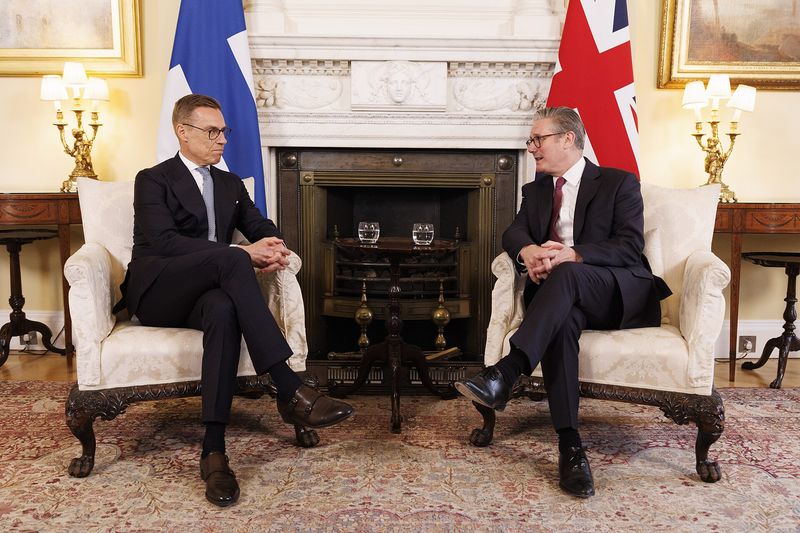
HELSINKI, November 17, 2026 — Europe direct talks with Putin: that is the demand now being made, in unusually blunt language, by one of the European leaders closest to the war. Finland’s President Alexander Stubb, in an interview with the Financial Times published on Tuesday, urged European leaders to engage directly with Russian President Vladimir Putin on ending the war in Ukraine — and called Europe’s long reliance on Washington to do that engaging “irresponsible.”
“We have outsourced European engagement with Russia for too long and I think that is irresponsible,” Stubb told the FT. “Now that we have a framework … I think European leaders should engage directly with Putin with the same message … (and) common speaking points.” He added: “It’s very important that we become agenda setters.” And he stated the premise underneath the whole argument: “We have to be realistic that there will be no deal without Putin’s agreement.”
Two cautions belong at the top of this story, because Stubb’s argument depends on them. First, his belief that Putin is ready to engage with Europe is Stubb’s assessment — not a Kremlin commitment. The Kremlin has not agreed to any European role in the talks: Kremlin aide Yuri Ushakov said on November 16 that expanding the negotiations has not been agreed, and no meeting between European leaders and Putin is scheduled. Second, Stubb is not proposing that Europe break with Ukraine or cut out Washington. He credited U.S. negotiators with reviving the stalled peace talks between Moscow and Kyiv. His formula is one common European message, delivered directly, inside the framework Europe has just built — an E5+EU negotiating team agreed in Dublin on November 13.
What Stubb said
The interview, as reported by the Financial Times and carried by the Kyiv Independent and The Independent on Tuesday, is a coherent argument in four parts. The diagnosis: Europe has outsourced its engagement with Russia — above all to the United States — for too long, and doing so is irresponsible. The opportunity: Europe now has a framework, the joint negotiating format agreed days earlier, which gives it something it previously lacked — a structure through which to speak. The prescription: European leaders should engage Putin directly, with the same message and common speaking points, rather than arriving as a chorus of national positions. And the purpose: to become agenda setters — to shape the terms of a settlement rather than react to terms negotiated by others.
Stubb also set out what direct talks should be about. He argued they should follow a common European position, and he listed the priorities: security guarantees for Ukraine, territory, postwar reconstruction, confidence-building measures, a ceasefire, and a future security framework. He cautioned, too, that future talks involving European, NATO, Ukrainian, Russian and U.S. officials could reach an impasse — a warning that his proposal is a route into a hard negotiation, not a shortcut around one.
And he paired his realism about Putin with a flat insistence about the war itself: Russia, he said, has not won the war in Ukraine and will not win it. That pairing is the story. Stubb is simultaneously arguing that no settlement is possible without the agreement of a man he says is losing, and that Europe must talk to that man directly precisely because the settlement will decide Europe’s security order. He framed the choice in historical terms, warning that Europe faces a decision between a return to the 1945 Yalta arrangements — a Europe divided into spheres of influence — and the principles of the 1975 Helsinki Accords: sovereignty and territorial integrity. As he presented it, Washington currently appeared closer to the Yalta approach — though he acknowledged its position could change. That framing is reported here as he presented it: a suggestion, hedged, about how the American position appears from Helsinki.
The framework Europe just built
Stubb’s phrase “now that we have a framework” refers to a specific, recent construction. On November 13 in Dublin, European leaders agreed to form a joint negotiating team — the E5+EU format. European Council President António Costa announced that representatives of the EU institutions plus Britain, France, Germany, Italy and Poland would take part in the next round of negotiations. On November 15, Commission President Ursula von der Leyen posted on X that Europe will “closely engage” in the negotiations through that format.
That framework is what converts Stubb’s interview from an opinion into a proposal. A single European leader calling Putin is a phone call; a leader speaking with the agreed message of five major capitals and the EU institutions is a negotiating position. Stubb’s argument is that the Dublin format has given Europe the second instrument, and that it would be irresponsible — his word — to build the instrument and then leave the actual engagement with Moscow to Washington. Signal Post News covered the Dublin agreement and the Kremlin’s stated condition for talks in our report on the E5+EU formation.
Moscow’s answer: not agreed
The counterweight to Stubb’s assessment arrived before his interview was published. Stubb said he believes Putin is “ready to engage with Europe.” The Kremlin’s position, stated by aide Yuri Ushakov on November 16, is that Moscow has not agreed to expand the negotiations: “For this to be agreed upon, a lot will need to be done, including, perhaps, another round, and perhaps more than one, of trilateral negotiations.” The next round, on the Kremlin’s account, remains planned as a trilateral — United States, Russia, Ukraine — with no date agreed. Kremlin spokesman Dmitry Peskov restated the position on November 17, saying the talks were never tied to a ceasefire.
There is one softer signal, and it should be weighed precisely. U.S. envoy Jared Kushner previously told reporters that Putin was ready “to give it a try” when asked about engagement with Europe, the Kyiv Independent reported. That is an American envoy’s characterization of Putin’s attitude. It is not a Kremlin statement, not an invitation, and not a commitment — and the distance between “ready to give it a try,” as relayed by Kushner, and Ushakov’s “not agreed” is exactly the distance Stubb’s proposal has to travel. No meeting is scheduled. Nothing has been accepted in Moscow.
Why Stubb, why now
Stubb does not make this argument as an outside commentator. On October 27, he and Norwegian Prime Minister Jonas Gahr Støre held a roughly 90-minute call with Putin — the first direct contact between European leaders and the Russian president in over a year — after coordinating with President Volodymyr Zelenskyy in advance. That call, covered by Signal Post News in our report on the Stubb–Støre call, is the practical foundation of Tuesday’s interview: Stubb has already done, once, the thing he is now urging Europe to do collectively. (His November 11 interview with the Frankfurter Allgemeine Zeitung concerned that October call and is a separate interview; its quotes are not part of this story.)
His standing matters too. Finland is one of Kyiv’s strongest allies — a frontline NATO state with a long border with Russia, backing Ukraine’s EU accession and its defence and financial needs. When the president of that country says Europe must talk to Putin, it cannot be filed as softness toward Moscow; it is an argument from within the hawkish camp about who holds the pen. And the timing is pointed. On Thursday, November 19, U.S. envoys Steve Witkoff and Jared Kushner are due in Berlin with Ukrainian and European officials — and on the same day, a Trump–Xi–Putin trilateral convenes in Shenzhen, a room in which neither Europe nor Ukraine sits. Stubb’s Yalta warning is not abstract. It is a description of a calendar.
Why this matters
The argument is, at bottom, about authorship. A settlement of the Ukraine war will distribute territory, guarantees, money and risk across a continent. If the terms are negotiated between Washington and Moscow — with Kyiv pressed to accept them and Europe presented with the bill and the consequences — then the postwar European order will have been written without Europeans, which is the outcome Stubb’s Yalta-versus-Helsinki framing is meant to conjure. His demand for direct engagement is a demand that Europe be a principal in the negotiation of its own security, speaking with one message through the E5+EU team it built for the purpose.
But the interview also exposes the weakness of the position, and Stubb’s critics — in European capitals and beyond — will not miss it. Direct European engagement is precisely what the Kremlin keeps declining to agree to. Ushakov’s formula — another trilateral round first, perhaps more than one — can be repeated indefinitely, which means the E5+EU team’s leverage is unproven: it is leverage only if Moscow eventually wants something Europe can give or withhold. Otherwise the framework risks becoming theatre — a negotiating team for a negotiation it is not in. That test, between agenda-setting and irrelevance, is what the next rounds will actually decide, and it is why Stubb’s call matters even if it fails: it forces every European capital to state whether it wants a seat at the table enough to ask for one, out loud, together.
The angles around the table are distinct. From Helsinki, the case is agenda-setting or irrelevance: build the common message and deliver it, or accept terms written elsewhere. From Kyiv — which has given no reported reaction to this interview, and none is invented here — the standing interest is European weight added to the negotiation without any track that trades Ukrainian territory over Ukrainian heads; Stubb’s coordination with Zelenskyy before the October call is the precedent he would point to. From Washington, the picture is double: Stubb credited U.S. negotiators with reviving the talks even as he suggested the American position currently leans toward a Yalta-style logic — praise and warning in the same interview, aimed at an ally he cannot afford to alienate. From Moscow, the answer so far is procedural refusal. And among European sceptics, the October 27 call itself drew coordination criticism at the time — a reminder that “one common European message” is an aspiration that European politics does not automatically supply.
The talks calendar, in context
The data points that frame Stubb’s intervention are dates and formats. The Abu Dhabi trilateral talks of November 10–11 produced no significant breakthrough. The Dublin agreement of November 13 created the E5+EU team: five capitals — London, Paris, Berlin, Rome and Warsaw — plus the EU institutions. November 19 brings two simultaneous events: Witkoff and Kushner in Berlin with Ukrainian and European officials, and the Trump–Xi–Putin trilateral in Shenzhen. The European Council meets on November 26–27, with Ukraine financing and the peace negotiations on the agenda. Against that, the format the Kremlin insists on — a U.S.–Russia–Ukraine trilateral — has no date agreed at all.
Read as a sequence, the calendar explains the urgency in Stubb’s language. The rooms where the war’s end is being discussed are multiplying, and Europe is in some of them only as a guest of the American process. His proposal is that the E5+EU team stop being a guest. Whether the Kremlin ever lets it through the door is the open question Ushakov’s statement poses — and the one the European Council, meeting nine days after the Shenzhen trilateral, will have to answer with something more concrete than a format.
What happens next
Three scenarios, stated as scenarios, cover the plausible paths. In the first, Europe is admitted to a later round of talks — the E5+EU team takes its seat, Stubb’s common message is delivered to Putin directly, and the negotiation becomes the five-sided process Stubb warned could reach an impasse but argued Europe must join anyway. In the second, the Kremlin holds the trilateral line: round follows round without Europe, and the E5+EU team is redirected to the tracks where Europe’s consent is indispensable regardless — security guarantees, reconstruction finance, sanctions — becoming a leverage track beside the talks rather than a party inside them. In the third, the Stubb method recurs without a framework decision: individual European leaders, coordinating with Kyiv, make direct calls of the October 27 kind, and “engagement” proceeds as a series of bilateral probes while the formal argument about Europe’s seat continues.
The near-term markers are fixed: Berlin and Shenzhen on November 19, and the European Council on November 26–27. What Stubb has done, nine days before that Council, is put the question in its sharpest form — not whether Europe supports Ukraine, which is settled, but whether Europe will insist on negotiating with the man whose agreement, on Stubb’s own blunt premise, any settlement requires. Related coverage: Zelenskyy, Witkoff and Kushner: the European talks and the strikes warning.
Reporting based on the Financial Times interview with President Alexander Stubb (Nov. 17, 2026), as reported by the Kyiv Independent and The Independent. Stubb’s assessment that Putin is ready to engage is his own; the Kremlin has not agreed to expand the talks, and no meeting is scheduled.
Sources
Sources: Financial Times, interview with Alexander Stubb (Nov. 17, 2026); Kyiv Independent, “Finland’s Stubb urges Europe to take Russia talks into its own hands” (Nov. 17, 2026); The Independent, Ukraine–Russia war live blog (Nov. 17, 2026).