Ethiopia Eritrea invasion 2026
ADDIS ABABA — The Ethiopia Eritrea invasion 2026 crisis crossed a decisive diplomatic line on Friday. In a letter to the United Nations Security Council shared with Reuters by a senior Ethiopian government official, Foreign Minister Gedion Timothewos said Eritrean forces, “including mechanized units,” had deployed as far as 60 kilometers, or 37 miles, inside northern Ethiopia.
“The all-out invasion of parts of northern Ethiopia by Eritrea is a matter of public record,” the letter said. Timothewos called the deployment a “blatant act of aggression that engages Ethiopia's inherent right to self-defence.” It was Ethiopia's first official statement about the reported incursion; earlier Ethiopian allegations had appeared through anonymous briefings.
That distinction is not bureaucratic. Governments complain about hostile activity constantly. A state that writes to the Security Council, identifies another state's forces, describes mechanized depth and expressly invokes self-defence is assembling the public record that could later be used to justify military action. The allegation has not been independently proved: Reuters said it could not verify witness accounts of Eritrean troops, and Eritrea denies that it is invading.
Why this matters: a legal tripwire for open war
The Ethiopia self-defence Eritrea language changes the stakes
Under Article 51 of the UN Charter, states retain an inherent right of individual or collective self-defence if an armed attack occurs. Timothewos's formulation does not automatically settle whether an armed attack occurred, who initiated it or what response would be proportionate. It does something politically consequential: it tells council members that Addis Ababa is no longer treating the alleged incursion as a deniable border problem.
The Gedion Timothewos UN letter is therefore both a warning and a piece of legal positioning. Ethiopia is inviting diplomats to see any coming response as defence against an external force, not simply another front in the Tigray war 2026. If the Security Council fails to secure a withdrawal or even establish facts, Ethiopian officials can argue that they notified the international system before acting.
This is the tripwire. Once the dispute is framed at the UN as aggression between sovereign states, each drone strike, convoy movement or artillery exchange carries a greater risk of becoming evidence in a case for wider war. The council letter does not make war inevitable. It makes escalation easier to explain at home and abroad.

From the 2018 handshake to the 2026 rupture
The alliance that ended isolation never resolved the border
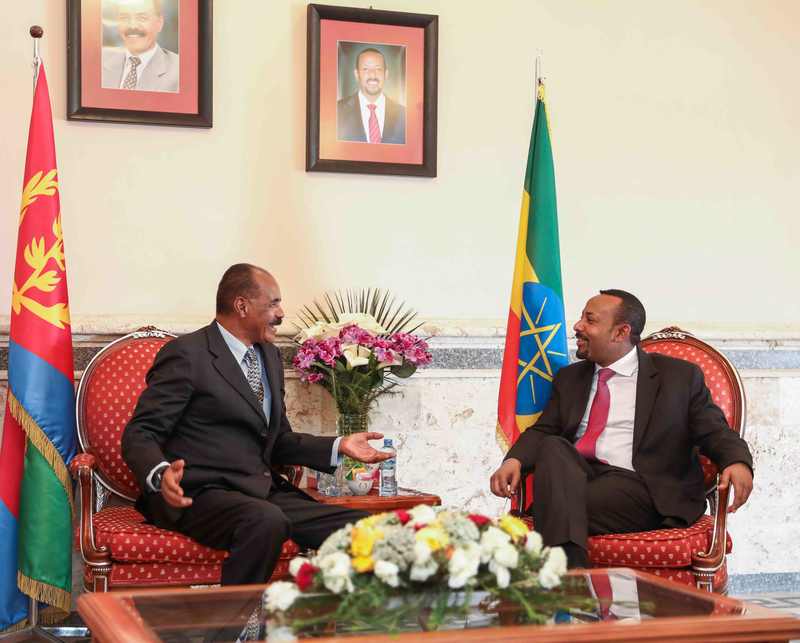
The photograph above captures why this moment is so jarring. In 2018, Prime Minister Abiy Ahmed and President Isaias Afwerki restored relations after two decades of hostility. The reconciliation helped Abiy win the Nobel Peace Prize and suggested that the Horn of Africa had stepped away from the legacy of the 1998–2000 border war, which killed tens of thousands.
Yet the rapprochement was built as much on shared enemies as on a durable settlement. Eritrea and Ethiopia fought on the same side against the Tigray People's Liberation Front in the 2020–2022 Tigray war. Eritrean forces were accused of grave abuses during that conflict. When Ethiopia's federal government and the TPLF signed the Pretoria peace agreement in 2022, Eritrea was excluded. The alliance that had transformed the battlefield had no formal seat in the arrangement meant to end the war.
Relations then soured over Ethiopia's stated desire for sovereign access to the Red Sea. Eritrea interprets that ambition as a threat to its territory and sovereignty. Addis Ababa says maritime access is an economic and strategic necessity for Africa's second-most populous country. What one side presents as national survival, the other hears as revisionism.
The diplomatic break came around October 1–2. Ethiopia closed its embassy in Asmara and expelled 10 Eritrean diplomats as persona non grata; Eritrea reciprocated. By then, the political guardrails had already been removed. An embassy closure does not start a war, but it eliminates channels that can stop a misunderstood convoy or strike from becoming one.
The fuse: September 23 fighting and Eritrean troops in Adigrat
Reported sightings pushed the crisis beyond the frontier
Fighting has spread since September 23 between Ethiopia's military and a rebel alliance that includes the TPLF, with combat reported across Tigray, Amhara and Afar. This is not a clean two-state battlefield. It is an interstate confrontation layered over a renewed Ethiopian civil conflict, which makes attribution harder and escalation more tempting.
On October 7, witnesses told Reuters that Eritrean soldiers had driven through Adigrat, roughly 25 kilometers inside Ethiopia. Reuters said it could not independently verify those accounts. Eritrean Information Minister Yemane Gebremeskel did not respond to Reuters's request for comment on Friday; on Wednesday, he said incursion reports were part of an Ethiopian plan to justify a war of aggression.
Conflict monitor ACLED said Ethiopian drone strikes hit Eritrean vehicles near Adigrat on October 7 and 8 as they withdrew, according to a separate Reuters report. Again, the information is attributed rather than independently confirmed. But the sequence—witness claims, reported drone strikes, then a formal UN letter—shows why officials now speak in the vocabulary of interstate conflict.
Timothewos met UN Deputy Secretary-General Amina Mohammed on October 8 and demanded an immediate Eritrean withdrawal. The US Embassy in Addis Ababa issued a security alert on October 7 urging American citizens to avoid Tigray, Amhara and Afar. These are practical signs that governments are planning for a conflict that may not remain geographically contained.

What 60 kilometers and mechanized units tell us
Eritrean troops Adigrat is not the same as a border patrol dispute
Distance is evidence, but not proof. Adigrat sits about 25 kilometers from the Eritrean border. Ethiopia's letter alleges deployments up to 60 kilometers inside the country—more than twice that depth. If verified, that would not resemble a patrol briefly crossing an uncertain frontier. It would imply movement through multiple layers of territory.
The phrase “including mechanized units” matters for the same reason. Armored and motorized forces require fuel, maintenance, ammunition, communications and protected routes. Their presence would indicate a sustained operation with planning and supply, not simply soldiers wandering across a contested line. The military inference remains analysis because the underlying deployment claim is disputed.
The historical comparison is sobering. The 1998–2000 war began over a border dispute and killed tens of thousands despite limited strategic gains. Today both states possess drones and more precise long-range strike capacity, while northern Ethiopia is already destabilized by internal conflict. Technology may make the opening attacks faster; it does not make political control of territory easier.
Both governments are building competing cases
Ethiopia gains a legal narrative; Eritrea gains strategic depth
Ethiopia benefits diplomatically by moving first at the UN. A documented complaint gives allies and neutral states a text to cite, and it places the burden on Eritrea to answer specific allegations about depth and mechanized forces. Addis Ababa is building a legal and political case before announcing a larger response.
If Eritrean forces are operating inside Tigray, Asmara could see an advantage in keeping combat away from Eritrean towns and in preventing the TPLF or Ethiopian forces from establishing a threatening position near its border. Strategic depth, however, is not legal permission. An operation inside another state would still require a defensible basis under international law.
Critics of Ethiopia say Abiy's campaign for Red Sea access created the conditions for confrontation and that Addis Ababa may be using incursion allegations to justify pressure on Eritrea. That is Eritrea's stated position. Asmara also accuses Ethiopia of hosting and training Eritrean opposition groups. Critics of Eritrea answer that denials cannot explain multiple witness reports, alleged vehicle movements or Ethiopia's decision to place the claim before the Security Council.
Eritrea denies invasion and accuses Ethiopia of preparing aggression
Eritrea's argument should be stated fully. Gebremeskel said Wednesday that reports of an incursion were part of an Ethiopian plan to justify a war of aggression. Eritrea says Ethiopia's push for sovereign Red Sea access threatens Eritrean sovereignty and alleges that Addis Ababa supports hostile opposition forces. The government did not answer Reuters's questions on Friday, but its earlier response places responsibility for escalation on Ethiopia.
The evidentiary gap is the central fact readers must keep in view. Reuters did not independently verify the witness reports. ACLED's account of drone strikes is monitoring analysis, not a jointly inspected battlefield record. Ethiopia's UN letter is an official claim, not an adjudicated finding. The story is significant because Ethiopia made the claim officially and invoked self-defence—not because every battlefield detail has been proved.

Who loses if the Ethiopia Eritrea war expands
Civilians face the first and largest costs
Northern Ethiopia has not recovered from the 2020–2022 war. A new campaign would hit communities already carrying displacement, trauma, damaged clinics and disrupted agriculture. If routes through Tigray, Amhara and Afar close, humanitarian operations will face higher prices, slower access and greater danger. In a region where information access is often restricted, casualty reporting may lag far behind events.
Regional states also lose. Sudan is consumed by civil war. Somalia remains under pressure from armed groups. Djibouti depends on stability in the Ethiopia trade corridor. Kenya must manage refugee, security and commercial effects. A Horn of Africa war 2026 would not respect the conceptual border between “domestic” and “regional” crises.
Red Sea shipping faces an indirect but serious risk
Ethiopia is landlocked, while Eritrea holds a long Red Sea coast near shipping lanes already under pressure from conflict around the Bab el-Mandeb. An Ethiopia-Eritrea war would not automatically close the waterway. It could nevertheless raise insurance costs, threaten port access and invite outside powers to back competing partners around a strategic chokepoint.
The danger is less a single dramatic blockade than the accumulation of risks: disrupted corridors, military flights, port security alerts, refugee movement and opportunistic attacks by other armed actors. Global shipping can route around one crisis at a price. It struggles when several crises reinforce one another.
What happens next
Scenario one: the Security Council demands verified withdrawal
The best diplomatic outcome would combine a demand for de-escalation with independent verification. Council members could press for Eritrean withdrawal, a pause in Ethiopian strikes and access for monitors. That would let both governments step back while claiming that international pressure—not unilateral capitulation—changed the facts on the ground.
Scenario two: council division produces inaction
If the Security Council cannot agree even on the facts, Ethiopia may say the system failed after receiving formal notice. Addis Ababa could widen drone or ground operations under its claimed right of self-defence. Eritrea could respond that Ethiopia had revealed its aggression plan. Inaction would not be neutral; it would strengthen the arguments of officials who believe force is the only remaining instrument.
Scenario three: the war remains deniable inside Tigray
Both governments may avoid declaring war while continuing strikes, proxy support and limited incursions. This can look like restraint because capitals remain untouched. For civilians in Tigray, it would mean enduring another conflict with blurred chains of command and few reliable routes to accountability.
Scenario four: a humanitarian emergency outruns diplomacy
Even a short interstate clash could close roads, halt markets and displace families before diplomats agree on language. Aid agencies will watch access to northern Ethiopia, fuel availability, hospital capacity and the security of staff. The humanitarian clock runs faster than the council calendar.
The bottom line
The most important development is not that one side used the word “invasion.” It is that Ethiopia's foreign minister placed that accusation before the Security Council, attached a 60-kilometer depth, identified mechanized units and invoked self-defence. That combination is the architecture of a state preparing the world for possible military action.
Eritrea rejects the premise and says Ethiopia is manufacturing a justification for aggression. Reuters could not independently verify the troop accounts. Those qualifications are essential. So is the historical warning: the last Ethiopia-Eritrea border war killed tens of thousands, and today's battlefield is crowded with drones, rebel alliances and unresolved grievances from Tigray.
The 2018 handshake was real, but it was never a substitute for durable institutions, agreed security rules and an inclusive peace. Eight years later, the photograph reads less like a conclusion than an intermission. The next decisions—withdrawal, verification, restraint or retaliation—will determine whether the Horn steps back from that lesson or repeats it at greater speed.
Sources and methodology
This analysis separates official claims, attributed witness reporting and conflict-monitor assessments from Signal Post News analysis. Battlefield claims remain disputed unless independently verified.
- Reuters, October 9, 2026 — Ethiopia's UN letter, the 60-kilometer allegation, self-defence language and Eritrea's response status.
- Reuters, October 8, 2026 — ACLED's account of drone strikes on Eritrean vehicles near Adigrat.
- Reuters, October 7, 2026 — witness reports from Adigrat and Reuters's independent-verification caveat.
- AFP report, October 8, 2026 — regional context and competing Ethiopia-Eritrea allegations.
- Wazema Radio — Ethiopian reporting on the accusation and diplomatic escalation.
- Wikipedia background — chronology cross-check for the 2026 crisis; not used as the sole source for disputed battlefield claims.