Climate · Travel · Türkiye
The COP31 Antalya climate summit 2026 opens on Monday, November 9, at the Antalya Expo Center on Türkiye’s Mediterranean coast, and runs to November 20. More than 190 countries are taking part in what the hosts bill as the “implementation COP” — the summit meant to turn a decade of pledges into delivery. It is also the first climate conference run by two governments at once: Türkiye holds the presidency under Environment Minister Murat Kurum, while Australia’s Chris Bowen serves as President of Negotiations, a shared arrangement agreed at COP30 in Belém. The World Leaders’ Summit, the two days when heads of government set the political weather, falls on November 11–12.
Track it live: Live wildfires tracker — Antalya province lost some 8,000 hectares to fire this year, a backdrop delegates will not need explained.
ANTALYA, November 8, 2026 — The delegates arriving at Antalya Airport this weekend are walking into a summit defined by a single uncomfortable comparison. The UN’s 2026 synthesis of national climate plans — 127 new or updated plans from 154 Parties, covering about 71 percent of 2019 global emissions — finds that full delivery of those plans would leave emissions only about 6 percent below 2019 levels by 2035, or about 9 percent if conditional pledges backed by outside finance are counted. A pathway consistent with limiting warming to 1.5°C needs a cut of roughly 60 percent by 2035. The UN’s own verdict on the plans was split: the quality of the plans is much better, the legislation tighter, the tracking clearer — and the trajectory still substantially off track. Everything negotiated in Antalya over the next twelve days happens in the space between those two numbers.
A presidency shared for the first time
The arrangement at the top of COP31 is genuinely new. Türkiye, as host, holds the presidency: Murat Kurum, the Minister of Environment, Urbanisation and Climate Change, runs the venue, the Action Agenda and the political hosting. Australia’s Chris Bowen, as President of Negotiations, holds exclusive authority over the formal negotiating process — the draft texts, the ministerial consultations and the cover decision — working with Pacific island countries whose exposure to sea-level rise gives the Australian role its particular weight. Shared presidencies have been discussed at previous COPs; Antalya is the first time the experiment is being run, and how the two halves mesh will be one of the quieter stories of the fortnight.
Türkiye has also shaped a voluntary Action Agenda around ten themes, among them clean energy transition, climate-resilient cities, food security, oceans and seas, and zero waste. Its centrepiece pledge looks to electrification: raising electricity’s share of global final energy demand to 35 percent by 2035, from roughly 20–24 percent today. Alongside it sits a proposed “Climate Implementation Bridge” intended to convert national plans into investment-ready project lists — the plumbing of the “implementation COP” branding, and the part of the agenda aimed squarely at the finance ministries rather than the environment ministries.
The numbers on the table
Emissions: 6 percent against 60
The synthesis figures are the summit’s backdrop and its indictment. One hundred and fifty-four Parties have now lodged 2035 targets, and their combined effect — about 6 percent below 2019 by 2035 — falls an order of magnitude short of the roughly 60 percent cut a 1.5°C-consistent pathway implies. In their letters to Parties ahead of the summit, the presidency team has acknowledged that the world is likely to exceed 1.5°C within a few years. The second Global Stocktake, the Paris Agreement’s five-yearly review of collective progress, also gets under way in Antalya, and it will frame the next round of national plans — due before COP32 — against exactly this gap.
Adaptation: $305 billion of need against a tripling scenario
The UN Environment Programme’s 2026 Adaptation Gap Report puts developing countries’ adaptation needs at roughly $305 billion a year by 2035. Against that, the standing aspiration — agreed at COP30 — is to triple international public adaptation finance flows to developing countries by 2035, into a range of roughly $85–120 billion a year. Even fully delivered, analysts note, that tripling would cover only a fraction of estimated need. The Belém Adaptation Indicators and the work of turning adaptation from a reporting exercise into funded projects are among the technical fights scheduled for the first week.
The transition roadmap arrives from Brazil
On November 3, Brazil published the first fossil-fuel transition roadmap — the document that follows through on the COP28 stocktake’s call to transition away from fossil fuels and on the roadmap process launched at Belém. Its arrival days before the gavel falls in Antalya gives negotiators a concrete text to argue over rather than a slogan, and makes the transition-away language one of the live questions of the summit: whether the roadmap is welcomed as guidance, noted, or quietly shelved by the producer economies.
Who gains, who pays, who objects
The vulnerable states — Pacific island nations, least-developed countries and the African Group — come to Antalya with the strongest moral claim and the clearest ask: grant-based adaptation finance at a scale closer to the $305 billion need than to the tripling scenario, and delivery on the loss-and-damage arrangements agreed at earlier summits. Australia’s negotiating presidency, exercised in partnership with the Pacific, is partly their vehicle.
The emerging economies arrive with better plans and a pointed argument: the synthesis shows the quality of national plans has transformed — the failure is now one of finance and delivery, not of paperwork. India, which lodged a 2031–35 plan aiming at about 60 percent non-fossil installed capacity by 2035, exemplifies the position: ambition conditional on support.
The producer economies and the sceptics will resist roadmap language that reads as a phase-out timetable, and will press the counter-argument that energy security and development space come first. Campaign groups such as 350.org, for their part, are pressing the opposite case — that an “implementation COP” which ends without a fossil-fuel transition pathway will have implemented very little. As with the flood-risk politics Signal Post News has traced from the Himalayas to the streets of France, the argument in Antalya is no longer about whether the climate is changing, but about who pays for the response and how fast.
Why this matters
COP31 is the first summit of the Paris Agreement’s delivery decade, and its shared presidency is a test of whether the COP system can adapt its own machinery as well as the world’s energy system. If the Antalya texts convert the electrification goal, the adaptation indicators and the Brazilian roadmap into dated, financed commitments, the “implementation” label will have been earned. If they do not, the 6-against-60 comparison will follow the process to COP32 — and the second Global Stocktake now beginning will record, formally, that the world’s plans and the world’s stated goal have parted company. For the host city, meanwhile, the summit is a twelve-day turn in a different spotlight, and for visitors it coincides with the best month of the Antalya year. Which brings us to the guide.
Antalya visitor guide: seeing the host city
When to go, and the summit basics
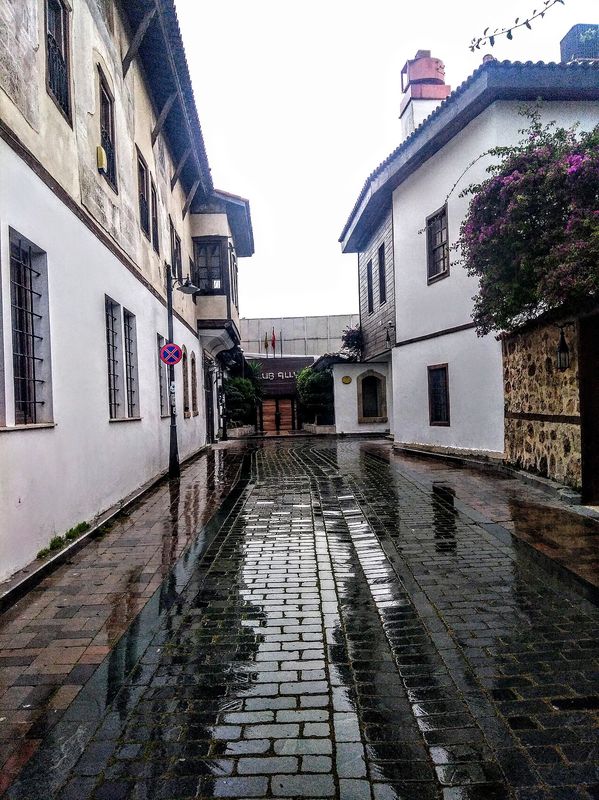
COP31 runs November 9–20, 2026, at the Antalya Expo Center, with the World Leaders’ Summit on November 11–12; access to the conference zones is by UN accreditation, and the city around it operates as normal. November is, not coincidentally, one of the best times to visit Antalya outside the summit: the summer crowds and the 35°C heat have gone, daytime temperatures sit in the comfortable low 20s Celsius, the sea is still swimmable early in the month, and hotel rates fall sharply from their August peak. Pack layers and a waterproof — the old town’s cobbles, as our lead photograph shows, see their share of autumn rain.
Getting there and getting around
Antalya Airport (AYT) is the gateway, about 13 kilometres east of the old town, with dense connections across Europe and the Middle East and frequent domestic flights from Istanbul. From the airport, the AntRay tram’s airport branch runs toward the city and the Expo Center district; taxis and airport buses cover the same ground in 25–40 minutes depending on traffic. In town, Kaleiçi is best walked; the tram and city buses handle the run east to Lara and the Düden falls, and dolmuş minibuses fill the gaps. During the summit fortnight, expect road closures and heavy traffic around the Expo Center and the airport corridor, and build in extra time.
What to see
- Kaleiçi, the old town. A walled tangle of Ottoman timber houses, Roman masonry and narrow lanes above the old Roman harbour. Enter through Hadrian’s Gate, get pleasantly lost, and finish at the harbour cliffs or the Hıdırlık Tower at sunset. Allow half a day; it rewards wandering rather than a checklist.
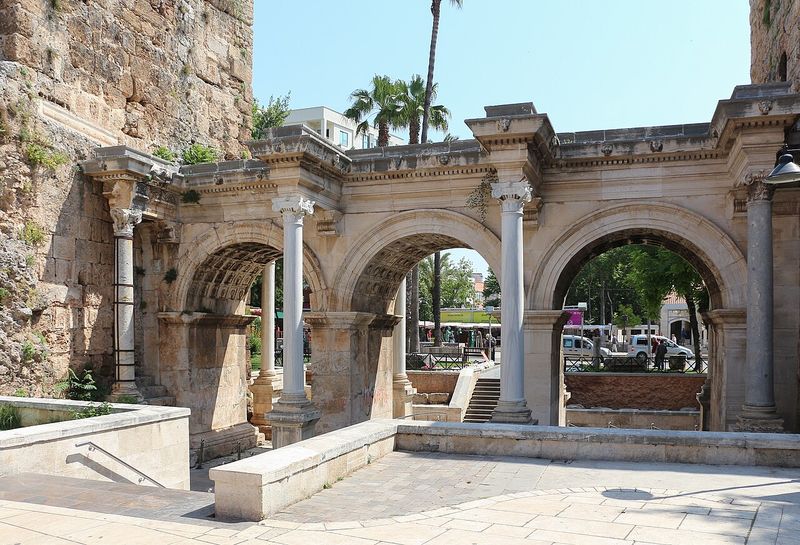
- Hadrian’s Gate. The triple-arched marble gate built for the Emperor Hadrian’s visit around 130 CE — the best-preserved piece of Roman Antalya, still the old town’s ceremonial entrance, and free to walk through at any hour.
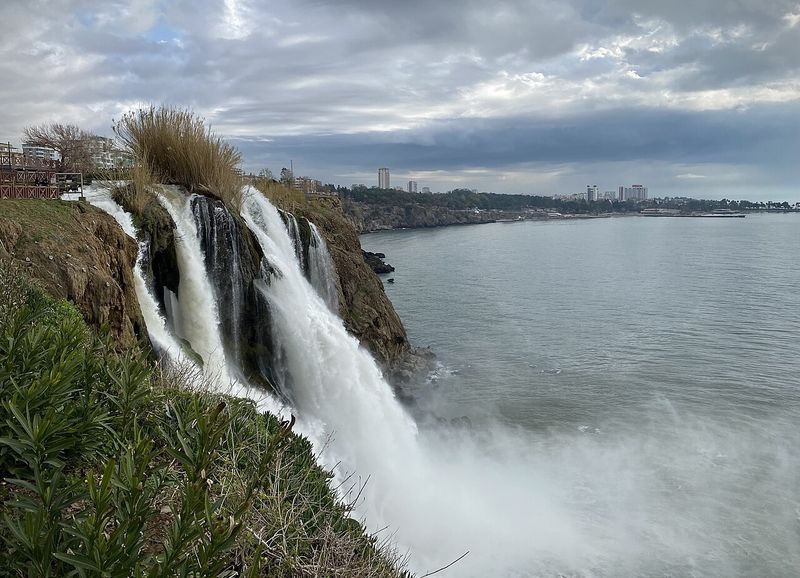
- Düden Falls. Two falls for one river: the Upper Falls, in a green park grotto north of the centre, and the Lower Falls, which pour 40 metres off the cliffs into the Mediterranean east of Lara — best seen from the clifftop park or a harbour boat. Together they make an easy half-day by bus or taxi.
- Antalya Museum. One of Türkiye’s great regional museums, on the Konyaaltı side of town: sarcophagi and statuary from Perge, Aspendos and Side that explain the entire ancient coast. Give it two to three hours; it is the single best rainy-day plan in the city.
- Beyond the centre. With a full spare day, the theatre at Aspendos — among the best-preserved Roman theatres anywhere — and the streets of Perge are the classic pairing, both under an hour away.
Tickets, hours and practicalities
In general terms: the old town, Hadrian’s Gate and the Düden parks are open public spaces; the Antalya Museum and the excavated sites charge modest entry fees, typically run daytime hours with last entry in the late afternoon, and are covered by Türkiye’s Museum Pass where it applies — check current hours before a special trip, as winter schedules are shorter. Antalya is a well-practised resort city and visitors will find the usual etiquette sufficient: modest dress inside mosques, shoes off where asked, and haggling expected in bazaars but not in shops with marked prices. Tap water is treated but most visitors drink bottled; cards are accepted almost everywhere, with cash useful for dolmuş fares and small cafés. The city is generally safe for visitors, with the standard big-resort cautions about unlicensed taxis and beach-club pricing. For COP31 delegates, the practical essentials are accreditation, a layer for over-air-conditioned halls, walking shoes for Kaleiçi’s cobbles, and a half-day kept clear — Antalya in November is worth it.
How long to spend
Two days cover the old town, the museum and the falls at a humane pace; three to four add Aspendos and Perge and a boat along the cliffs. Summit visitors with a single free day should choose Kaleiçi in the morning, the museum after lunch, and the Lower Düden Falls for the late light.
What happens next
The summit’s first week belongs to the technicians: adaptation indicators, finance work programmes, the stocktake’s opening and the argument over how the Brazilian roadmap is received. The World Leaders’ Summit on November 11–12 resets the politics mid-summit, after which Bowen’s negotiating machine must produce cover-decision language that Kurum’s presidency can gavel through by November 20 — COPs routinely overrun, and Antalya’s shared presidency will be judged partly on whether it can land a text on time. The tests to watch: an electrification goal with a date and a number, adaptation finance that moves toward the need rather than the talking point, and transition language that survives contact with the producer economies. Signal Post News will follow the Antalya texts as they land.
What do you think — can an “implementation COP” close a gap this wide, or does the 6-against-60 arithmetic need a different kind of summit altogether? Follow Signal Post News for updates from Antalya, and share your thoughts below.
Sources
Sources: UN News reporting on COP31 and the 2026 synthesis of national climate plans (updated November 8, 2026); UNFCCC and UNEP Emissions and Adaptation Gap reporting as summarised in “COP31 Antalya: what is at stake at the climate talks” and Nation Press, “COP31 kicks off in Antalya” (November 8, 2026); 350.org campaign materials on the fossil-fuel transition roadmap. Photos: Wikimedia Commons, as credited in the captions.