Sport · Rugby League
The Australia Rugby League World Cup final was effectively decided in its first 84 seconds and confirmed over the following 80 minutes: a record-breaking opening try, a 24-6 halftime lead, and a defensive clamp on the world’s best player that delivered a 13th title in front of 52,461 people at Suncorp Stadium.
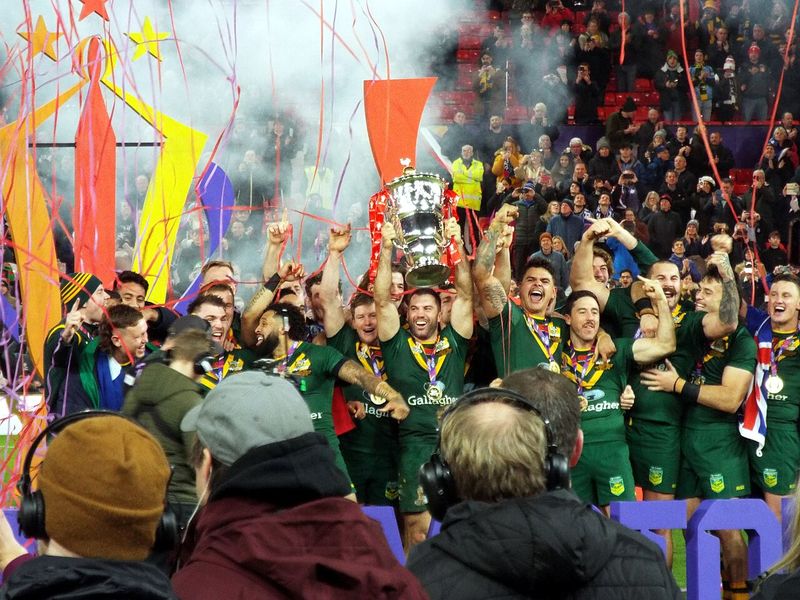
BRISBANE, November 15, 2026 — The Australia Rugby League World Cup final ended as the tournament’s form said it should: Australia outplayed New Zealand 32-12 at Brisbane’s Suncorp Stadium — Lang Park — on Sunday to win the World Cup for the 13th time, Reuters reported, before a crowd of 52,461. Second-rower Liam Martin crossed twice as the Kangaroos built a 24-6 halftime lead, and two more tries after the break secured a fourth successive title, extending a reign that has now run unbroken since New Zealand’s sole triumph in 2008. Winger Jack Bostock, who scored two tries either side of halftime, was named player of the final.
“We had such confidence in what we could achieve, and I was just happy we could have our best performance tonight,” captain Isaah Yeo said, in remarks reported by Reuters. “World champs for the next four years.” For New Zealand, whose fullback Kalyn Ponga had won the Golden Boot as the world’s best player on Thursday, the verdict was plainer: “Just a disappointing performance… we just made too many errors to defend,” Ponga said. The errors began with the first kick of the match — and the final’s defining record fell inside its first two minutes.
84 seconds: how the final was won before it had settled
The fastest try in a Rugby League World Cup final arrived by invitation. New Zealand’s Jamayne Isaako sent the opening kick-off out on the full; from the resulting penalty, Harry Grant sent Martin over with 84 seconds on the clock — breaking, according to the NRL’s match reporting, a record that had stood for only a few hours, the 125 seconds Jaime Chapman had needed to open the scoring in the women’s final earlier the same day. A final that was supposed to test Australia’s tournament-long habit of starting slowly instead handed them the one thing New Zealand could not afford to give: a lead to defend and a rhythm to defend it in.
From there the Kangaroos were clinical in the way their stuttering early-tournament form had only promised. Martin’s second try and Bostock’s first built the 24-6 halftime margin, centre Casey McLean’s try keeping New Zealand nominally attached; Tom Trbojevic and Bradman Best also crossed for Australia, and five-eighth Cameron Munster kicked three conversions and a penalty. New Zealand’s second-half try, from edge forward Isaiah Papali’i in the 65th minute, narrowed nothing that mattered, and Bostock’s second — in the 77th minute, his ninth try of the tournament, per AP reporting — closed the scoring and his player-of-the-final case in the same movement. On the field for that last try, in a farewell cameo in his final Test, was James Tedesco, captain of the 2022 triumph, per the NRL’s reporting — the dynasty handing its own closing image to the man who had captained its previous edition.
The defensive half of the performance was aimed at one player. Ponga, who had returned to the tournament after breaking his arm in its opening match and still won its Golden Boot, found few opportunities against a Kangaroos line that treated his touches as the emergency they were. Australia’s fitness in draining, muggy conditions — noted in AFP’s reporting as decisive — did the rest: a side that had opened its tournament with a 24-22 comeback win over this same New Zealand team finished it by beating them by 20.

The women’s final: Jillaroos complete the double
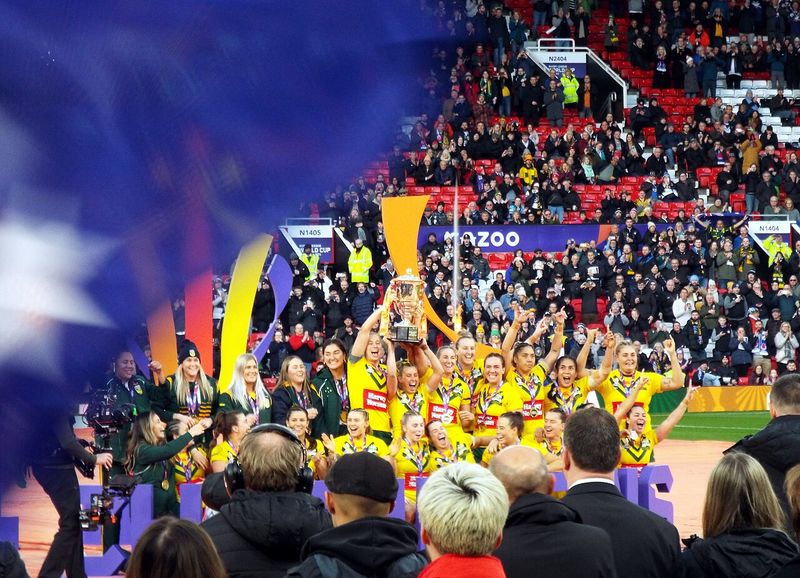
Hours before the men’s final, at the same stadium, Australia’s Jillaroos beat New Zealand’s Kiwi Ferns 34-10 to win the women’s World Cup for a fourth straight time, Reuters and AFP reported. Six first-half tries settled the match as a contest; winger Jaime Chapman scored a hat-trick, and her opening try — at 125 seconds — briefly held the record for the fastest try in a World Cup final before Martin took it from her in the evening session, a footnote that captures the day Brisbane had: both Australian teams, both trophies, both records. New Zealand won the first three women’s tournaments, from 2000 to 2008; the Jillaroos’ reign since has now matched the Kangaroos’ in length, and Sunday’s margin, while narrower than the 54-4 of the 2022 final, was assembled in a single half. In the wheelchair tournament, England beat France 50-38 in Wollongong on Friday, Reuters reported.
Why this matters
Analysis. The dynasty ledger is stark enough to state plainly: 13 World Cup titles, four in a row, and — since New Zealand’s 2008 upset, which also happened in Brisbane — 23 consecutive World Cup wins. No other team in the sport’s international history has held a tournament this completely for this long, and Sunday’s final showed why the streak persists: Australia’s worst moments in this tournament — a stuttering start, a semifinal they nearly lost — were absorbed by depth, and their best performance was saved, as Yeo noted, for the night it was required. Dynasties usually end with a generation ageing out together. Australia keep replacing the generation.
And yet the more consequential story of this World Cup may be the one told by the teams Australia beat to get here. Yeo called it, in Reuters’ reporting, “to date the most competitive and the best World Cup there’s been” — a judgement carried by Samoa and Tonga, the losing semifinalists (Australia beat Samoa 44-12; New Zealand beat Tonga 34-10), whose runs and whose fans revived a tournament concept that had spent years looking like an Australian coronation with guests. A final that ends 32-12 can still close a tournament that widened the sport: the Pacific nations supplied the crowds, the colour and the jeopardy of the middle weekends, and the final supplied the reminder of where the ceiling still sits.
What happens next
The next World Cup, in 2030, will be played as “Magic Rounds” in five cities across the Pacific and the United States, organised by the Australian Rugby League Commission, Reuters reported — a format that reads as a direct answer to this tournament’s lesson, taking the event to the Pacific fan bases that animated it and to the American market the sport keeps courting. Australia’s immediate future is the defence of a standard: Tedesco’s farewell closes one captaincy era even as Yeo’s team looks young enough to open another. New Zealand’s is a rebuild with a specific problem — they lost to Australia twice in one tournament, narrowly when it began and heavily when it ended — and a specific asset: the world’s best player, by the Golden Boot’s verdict, is theirs, and he spent Sunday evening being a plan other teams build around rather than a problem they solve. The gap between those two facts is the next four years of trans-Tasman rugby league.
Related coverage: Fiji Nearly Pulled Off the Greatest Upset in World Cup History — Then Tedesco and Trbojevic Saved Australia 36-22
Sources
Reuters — reporting of November 15, 2026: Australia beat New Zealand 32-12 at Suncorp Stadium (Lang Park), Brisbane, before 52,461 people, to win the Rugby League World Cup for the 13th time and a fourth successive title; Liam Martin scored two tries in a 24-6 halftime lead; Jack Bostock named player of the final; Cameron Munster kicked three conversions and a penalty; New Zealand tries by Casey McLean and Isaiah Papali’i (65th minute); quotes from captain Isaah Yeo and Kalyn Ponga; the Jillaroos’ 34-10 win over the Kiwi Ferns in the women’s final; England’s 50-38 wheelchair final win over France in Wollongong; the 2030 tournament to be played as Magic Rounds in five cities across the Pacific and the United States. AFP — reporting of November 15, 2026: Martin and Bostock two tries each, Bradman Best and Tom Trbojevic also crossing; Australia’s fitness in draining conditions decisive; 23 consecutive World Cup wins since New Zealand’s 2008 title. Associated Press — reporting of November 15, 2026: Bostock’s 77th-minute try was his ninth of the tournament; Australia opened the tournament beating New Zealand 24-22; semifinals Australia 44-12 Samoa and New Zealand 34-10 Tonga. NRL and Love Rugby League match reporting — the 84-second opening try by Martin, the fastest in a World Cup final, breaking Jaime Chapman’s 125-second mark from the women’s final; James Tedesco’s farewell cameo in his final Test. Photographs: Fleets (CC BY-SA 4.0) and Kgbo (CC BY-SA 4.0), via Wikimedia Commons — file photos.