A national-holiday message delivered from a Donetsk command post made the front line both setting and argument: Ukraine's survival, its negotiating position and the price of war were presented as inseparable.
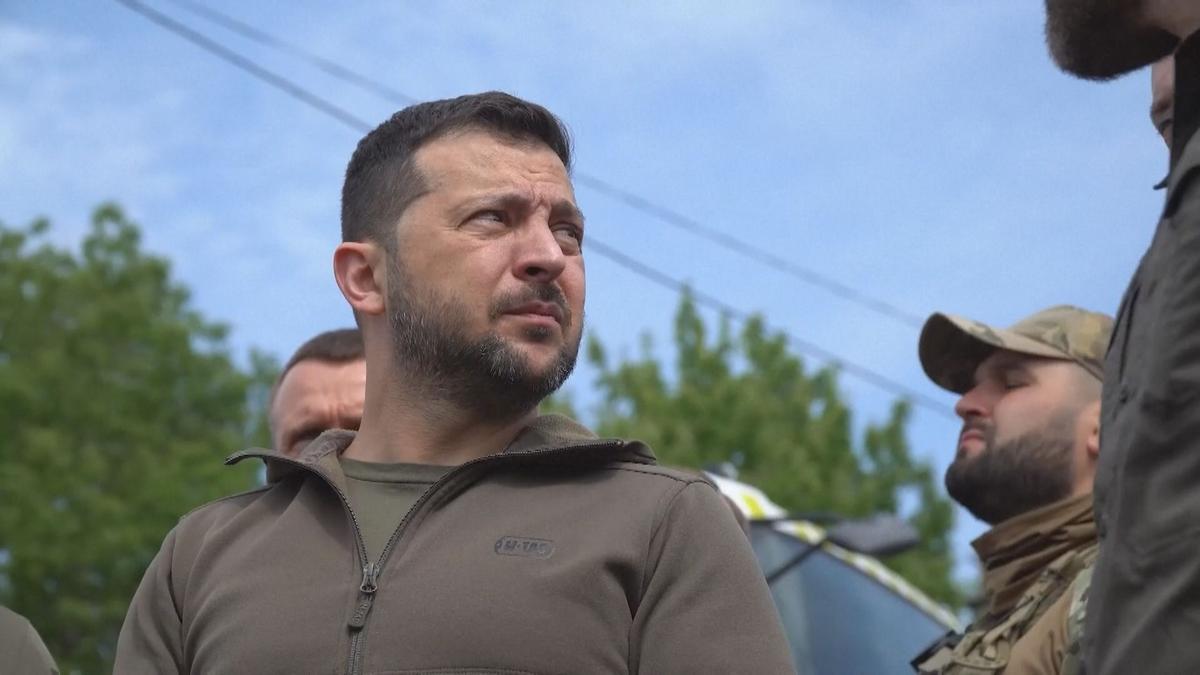
Zelenskyy Defenders Day frontline address: President Volodymyr Zelenskyy marked Ukraine's Day of Defenders and Defendresses on Thursday, October 1, 2026, from a command post in the Donetsk region rather than from the capital. With the defense minister and commander-in-chief beside him, he used the location to bind commemoration to the battlefield on the 1,681st day of Russia's full-scale invasion and in the 12th year of the war that began in 2014.
“This resilience begins precisely at the front, at such command posts and at each of our positions,” Zelenskyy said. He argued that “the fate of Ukraine, Europe and the free world is being decided” there, then reduced the message to a physical image: “Front. Independence is gained here. And the path to peace lies through these labyrinths.” The formulation was political as well as ceremonial. It made military endurance the foundation of both sovereignty and diplomacy.
The address came as Russia continued overnight strikes on Ukraine, with infrastructure damage reported in Kyiv and Odesa. That juxtaposition mattered: a holiday built around gratitude and remembrance unfolded while the air war continued, leaving little separation between national ritual and active defense.
Why this matters: the front line as political stage
Presidents normally use national holidays to speak from places designed to communicate continuity: a palace, a memorial, a parliament or a capital square. A Ukraine frontline Donetsk address reverses that convention. The command post says that the state is not being defended in the abstract; it is being defended in rooms where maps are updated, losses are counted and orders are issued.
For Ukrainian troops, the signal is proximity. Zelenskyy's presence cannot change ammunition stocks or casualty rates, but it tells soldiers that the political leadership is willing to share at least some of the physical risk and to place the front at the center of the national story. For civilians, the message is unity across distance: the country behind the lines is asked to understand that everyday life depends on positions held far to the east.
For Western capitals, the staging carries a different message. By saying Europe's fate is being decided in Donetsk, Zelenskyy reframed military support as collective security rather than charity to one country. For Moscow, the intended signal was resistance: despite sustained pressure and the approach of winter, Kyiv's leadership was not presenting the front as a prelude to capitulation. None of those messages proves battlefield momentum. Their purpose is to shape morale and political calculations around a battlefield whose daily changes can be modest but whose strategic consequences remain large.
Ukraine Defenders Day October 1 2026: remembrance before strategy
Zelenskyy honors fallen defenders in the address by naming Vitalii Skakun, Dmytro “Da Vinci” Kotsiubailo, Nazarii Hryntsevych, Andrii Verkhohliad, Iryna Tsybukh and Oleksandr Matsievskyi. He then quoted the late warrior-poet Maksym Kryvtsov: “When they ask me what war is, I will answer without hesitation: names.”
The Maksym Kryvtsov war names quote changes the scale of the speech. Numbers can describe duration, territory and force size; names restore individual lives to a war that otherwise risks becoming a series of maps and daily totals. That makes remembrance more than a ceremonial pause. It is a claim about what the state owes those who served and what political leaders must not erase when they discuss compromise.
Zelenskyy also thanked infantry, paratroopers, intelligence officers, air-defense crews, combat aviation, the Naval Forces, artillery, communications specialists and engineers. Associated Press Television reported his description of “hundreds of thousands” of troops standing as a shield. The phrase is not a precise force-strength disclosure; it is a scale marker intended to widen the holiday beyond famous units and senior leaders.
Naming the fallen and naming commanders serve different politics
The president named commanders Yevhenii Khmara, Mykhailo Drapatyi, Pavlo Palisa, Denys Prokopenko, Andrii Biletskyi, Emil Ishkulov, Oleh Apostol, Valerii Skred and Ihor Obolenskyi. Naming the dead personalizes sacrifice. Naming serving commanders publicly assigns credit and visibility inside a military and political system where reputations can influence resources, authority and future careers.
Supporters can read that list as overdue recognition for leaders carrying operational responsibility. Critics can ask why some commanders are elevated and others are not, whether public praise anticipates political roles, or whether battlefield setbacks receive the same transparency as battlefield gains. Those questions do not invalidate the tribute, but they show why ceremonial language also has institutional consequences.
The balance is delicate. A wartime president benefits when respected officers appear aligned with the civilian chain of command. The military benefits when achievement is publicly recognized. But opponents, overlooked formations and families of the fallen can lose confidence if honor appears selective or politically curated. The address attempted to offset that risk by moving from named commanders to every branch and then to all defenders.
Ukrainian Defenders Day history and the 2023 calendar shift
The Ukrainian Defenders Day history reaches beyond the current invasion. The holiday is traditionally tied to the Feast of the Intercession, or Protection, of the Mother of God, revered as a patroness of warriors since Cossack times. It was observed on October 14 until 2023, when Ukraine's Orthodox and Greek Catholic churches moved to a revised calendar and the state shifted the holiday to October 1.
The calendar change made religious practice, historical memory and national policy move together. It also placed the holiday inside Ukraine's broader effort to separate public institutions from Russian ecclesiastical and imperial reference points. That interpretation is politically important, but it should not obscure the holiday's immediate function in 2026: honoring service members, veterans and the dead during an ongoing war.
The “Ukraine 12th year of war” frame also resists treating February 2022 as the beginning of the entire conflict. Russia's full-scale invasion began on February 24, 2022, but fighting, occupation and annexation date to 2014. Calling October 1 the 1,681st day of the full-scale war and placing it in the 12th year distinguishes the intensified invasion from the longer struggle.
Zelenskyy address 1681st day of war follows Lyman visit
A day earlier, on September 30, Zelenskyy visited the 66th Separate Mechanized Brigade in the Lyman sector, presented awards and reviewed operations. Reuters reported that he praised Operation Vivaldi, which he said had prevented Russian forces from reaching the rear of Ukrainian lines around Sloviansk and Kramatorsk and had recaptured 176 square kilometers — about 68 square miles — since the operation began earlier in 2026.
The Operation Vivaldi Ukraine gains figure is a Ukrainian claim and was not independently verified in the cited reporting. Even taken at face value, 176 square kilometers is not a strategic reversal of the war. Its importance lies in geography: Sloviansk and Kramatorsk are central to Ukraine's defended belt in Donetsk, so stopping a penetration behind those lines can matter more than the raw area suggests.
Our earlier reporting examined Zelenskyy's Lyman command-post visit and the 176-square-kilometer claim, the third stage of Operation Vivaldi, and Ukraine's use of ground robots in the operation.
The numbers in context: 1,681 days, 176 square kilometers, hundreds of thousands
The three headline numbers describe different dimensions of endurance. The 1,681 days measure the uninterrupted burden of the full-scale invasion. The 176 square kilometers measure a claimed local battlefield recovery. “Hundreds of thousands” describes the human shield Zelenskyy credited with keeping the state functioning. They are not interchangeable indicators: time does not equal momentum, area does not equal victory, and personnel scale does not reveal combat effectiveness.
That distinction matters because political speeches compress complexity. A gain near Lyman can improve a local defensive position without changing the overall balance. A large military can still face shortages in trained infantry, air defense or ammunition. A country can remain institutionally resilient while suffering severe fatigue. The address uses all three numbers to support one conclusion — “Despite the attacks, the strikes and the pain, Ukraine stands firm” — but the evidence for future outcomes remains contingent.
Who benefits, who loses and what skeptics will test
Ukraine's government benefits if the speech strengthens trust between the presidency, commanders and society. Frontline units benefit if attention translates into equipment, rotations and recognition rather than only symbolism. Western governments that favor continued support gain a concise argument: holding Donetsk positions protects a wider European security order.
Russia loses if that message hardens Ukrainian morale or reduces pressure abroad for a quick settlement on Moscow's terms. Conversely, Moscow benefits if audiences view the visit as staged reassurance masking exhaustion. Ukrainian critics may argue that command-post imagery cannot substitute for transparent mobilization policy, procurement reform, casualty accounting or realistic war aims. Foreign skeptics may ask whether linking peace to frontline strength narrows diplomatic room.
Those critiques should be judged separately from the ceremony. A leader can honor sacrifice sincerely while also using the moment strategically. The factual tests come afterward: whether promised support reaches units, whether claimed gains hold, whether civilian institutions weather another winter, and whether diplomacy can move without treating the dead as an abstraction.
Ukraine path to peace frontline: three winter scenarios
The phrase “Ukraine path to peace frontline” captures the speech's central proposition: negotiations reflect power and endurance as much as language. In the first scenario, Ukrainian lines hold through winter and localized gains around Lyman endure. Kyiv then enters talks arguing that continued resistance raises the cost of Russian maximalism. Western aid remains the critical variable.
In a second scenario, intensified Russian strikes on electricity and urban infrastructure strain air defense and public confidence while the ground front remains largely static. The contest shifts toward endurance: repair capacity, interceptor supply, recruitment and allied budgets. The October 1 address is tailored to that kind of winter because it defines persistence itself as strategic achievement.
In the third and most dangerous scenario, a significant breach in Donetsk or a severe infrastructure crisis changes political expectations faster than formal diplomacy can adapt. Pressure for a ceasefire would rise, but so would arguments that concessions reward escalation. The same symbolism that builds resolve can make compromise harder if any territorial adjustment is presented as a betrayal of named sacrifices.
The address does not resolve that tension. It makes it visible. By speaking from a frontline command post on a day of remembrance, Zelenskyy argued that peace cannot be separated from the people and positions that preserve Ukraine's bargaining power. Whether that claim produces a stronger settlement, a longer war or both will depend less on the speech than on the military, economic and diplomatic facts of the winter ahead.
Sources
- Reuters — “Zelenskiy says he visits military command post near Ukraine's eastern frontline” (September 30, 2026)
- The Guardian Europe live — “Russia continues strikes on Ukraine as Zelenskyy visits frontline” (October 1, 2026)
- Associated Press Television — “Zelensky Thanks Ukrainian Soldiers as He Marks Defenders' Day Amid War With Russia” (October 1, 2026)
- The Gaze — “Zelenskyy Addresses Nation From the Front Line on Defenders Day” (October 1, 2026)
- UATV English — “The destiny of Europe is decided here” (October 1, 2026)